Yield Farming Explained: Meaning, How It Works, Examples, Benefits and Risks
1. Quick Answer: What Is Yield Farming?
Yield farming is a way to earn potential rewards by putting cryptocurrency to work in decentralized finance, usually by supplying assets to a liquidity pool, lending protocol, staking contract, or automated market maker. In return, users may earn trading fees, lending interest, protocol incentives, or governance tokens.
The simple idea is this: instead of keeping crypto idle in a wallet, a user deposits it into a DeFi protocol that other people can use. The protocol rewards the user for providing liquidity or helping the system operate. However, yield farming is not the same as a bank savings account. The returns are variable, the assets can lose value, smart contracts can fail, and users can lose money.
| Term | Simple meaning |
|---|---|
| Yield farming | Using crypto assets in DeFi protocols to seek rewards such as fees, interest, or tokens. |
| Liquidity pool | A pool of tokens locked in smart contracts so users can trade, lend, or borrow. |
| LP token | A token that represents your share of a liquidity pool. |
| APY/APR | Estimated return measures. They are not guarantees and can change quickly. |
| Impermanent loss | A possible loss from providing liquidity compared with simply holding the tokens. |
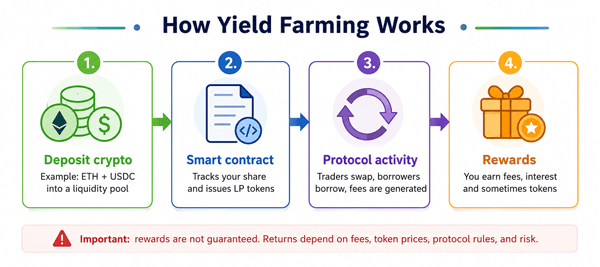
Diagram: A simplified yield farming flow from deposit to rewards.
2. Why Yield Farming Exists in DeFi
Decentralized finance, or DeFi, tries to recreate financial services such as trading, borrowing, lending, and asset management using blockchain-based software instead of traditional intermediaries. For these systems to work, they need liquidity. Traders need tokens available for swaps, borrowers need assets available to borrow, and protocols need users willing to lock funds into smart contracts.
Yield farming grew because protocols needed a practical way to attract liquidity. Rather than relying only on professional market makers or centralized institutions, DeFi protocols can reward ordinary users who supply assets. The reward is the “yield.” The activity of moving assets between opportunities to earn that yield became known as yield farming.
At its best, yield farming helps DeFi markets function more smoothly. At its worst, it can encourage users to chase extremely high returns without understanding where those returns come from or what could go wrong. A healthy approach is to treat yield farming as a high-risk DeFi strategy, not as guaranteed passive income.
3. How Yield Farming Works Step by Step
Yield farming can look complicated because different protocols use different names and reward structures. Still, most strategies follow the same basic process.
- Choose a DeFi protocol, such as a decentralized exchange, lending market, or staking platform.
- Connect a compatible crypto wallet, such as a self-custody wallet that supports the blockchain being used.
- Deposit tokens into a pool or contract. A DEX pool may require two tokens, while a lending protocol may require only one asset.
- Receive proof of your position. In many liquidity pools, this is an LP token or a position NFT.
- Earn rewards according to protocol rules. Rewards may come from trading fees, borrower interest, emissions, or bonus incentives.
- Withdraw when you choose, if the protocol allows it and if liquidity is available. You may need to claim rewards separately and pay blockchain transaction fees.
A beginner should understand that the smart contract does not “promise” a fixed outcome. It follows code. Your final result depends on token prices, pool activity, fees earned, reward token value, gas fees, and whether the protocol remains secure and liquid.
4. Common Types of Yield Farming
| Type | How it works | Typical reward | Main risk |
|---|---|---|---|
| Liquidity provision on a DEX | You deposit token pairs into a trading pool, such as ETH/USDC. | Trading fees and sometimes incentive tokens. | Impermanent loss, token price movement, smart contract risk. |
| Lending | You supply an asset that borrowers can borrow against collateral. | Variable interest paid by borrowers, sometimes protocol rewards. | Borrower/liquidation system risk, oracle risk, protocol risk. |
| Staking or single-asset vaults | You lock one token in a contract or vault strategy. | Token rewards, fees, or strategy yield. | Token price decline, lockups, validator or vault risk. |
| Liquidity mining | A protocol gives extra tokens to users who provide liquidity. | Newly issued governance or reward tokens. | Reward token inflation and price collapse. |
| Auto-compounding vaults | A vault automatically reinvests rewards for users. | Compounded returns after fees. | Strategy risk, contract risk, manager or governance risk. |
4.1 Example 1: Providing Liquidity to a DEX Pool
Imagine a decentralized exchange has an ETH/USDC pool. Traders use this pool to swap ETH for USDC and USDC for ETH. To help the pool work, you deposit both assets into it. For example, you might deposit $500 worth of ETH and $500 worth of USDC.
In return, you receive a token or position that represents your share of the pool. When traders use the pool, they pay trading fees. A portion of those fees goes to liquidity providers. If your position represents 1% of the pool, you generally receive about 1% of the fees allocated to liquidity providers, before considering protocol-specific rules.
The important catch is that your final withdrawal may not contain the same amount of ETH and USDC you deposited. Automated market makers rebalance pool assets as traders buy and sell. If ETH rises sharply or falls sharply compared with USDC, your position may underperform simply holding the original tokens. That difference is often called impermanent loss, although it can become very real when you withdraw.
4.2 Example 2: Lending Stablecoins in a DeFi Market
A second example is lending stablecoins such as USDC or DAI in a DeFi lending protocol. You deposit one asset into a lending pool. Borrowers can borrow from that pool by providing collateral, and they pay interest. You earn a variable supply rate based on demand to borrow that asset.
This may feel simpler than a two-token liquidity pool because there is no token pair to manage. However, it still has risks. The stablecoin could lose its peg, the protocol could suffer a smart contract exploit, the oracle price feed could fail, or liquidity could become tight during market stress.
4.3 Example 3: Farming a New Protocol Token
Some protocols attract users by distributing a new reward token. For example, a new DEX might offer high token incentives to people who deposit liquidity during the launch period. This can create eye-catching APRs.
The problem is that these rewards are often paid in a token with uncertain value. If many farmers earn the token and immediately sell it, the price can fall quickly. A pool that looks profitable on Monday may be far less attractive by Friday. High headline yields can be a warning sign, especially when the source of the return is token inflation rather than real fee revenue.
5. Where Do Yield Farming Rewards Come From?
A key question every beginner should ask is: who is paying the yield? The answer matters because not all yield is equally sustainable.
| Source of yield | What it means | More sustainable? | What to check |
|---|---|---|---|
| Trading fees | Users pay fees to swap assets in a liquidity pool. | Often more sustainable if real volume exists. | Daily volume, fee tier, liquidity depth, competition. |
| Borrower interest | Borrowers pay to borrow assets from a lending market. | Can be sustainable when borrowing demand is real. | Utilization rate, collateral quality, liquidation history. |
| Protocol incentives | The protocol distributes tokens to attract users. | Less sustainable if rewards depend mainly on new token emissions. | Token inflation, unlock schedule, sell pressure, treasury. |
| External strategy returns | A vault uses strategies such as lending, LPing, or arbitrage. | Depends on the strategy. | Strategy transparency, audits, track record, fees. |
| Unsustainable promises | Returns depend on new deposits or unclear sources. | Usually dangerous. | Avoid if yield source is vague or impossible to verify. |
6. Yield Farming vs Staking vs Lending vs Liquidity Mining
These terms often overlap, but they are not identical. Understanding the difference helps beginners avoid confusion.
| Activity | Main action | Common reward | Beginner note |
|---|---|---|---|
| Yield farming | Move crypto into DeFi opportunities to earn yield. | Fees, interest, incentives, tokens. | Broad umbrella term covering many strategies. |
| Staking | Lock tokens to support a blockchain or protocol. | Staking rewards or protocol fees. | Can be simpler, but still has lockup and slashing risks depending on the network. |
| Lending | Supply assets borrowers can use. | Variable interest. | Usually single-asset, but not risk-free. |
| Liquidity mining | Provide liquidity to earn extra protocol tokens. | Reward tokens in addition to possible fees. | Often used by newer protocols to attract users. |
7. Benefits of Yield Farming
Yield farming can be useful when it is understood properly and used cautiously. The main benefits are not magic returns; they come from putting assets to work in open financial markets.
- Potential income from idle assets: Users may earn fees, interest, or rewards instead of simply holding tokens in a wallet.
- Open access: Many DeFi protocols are available to anyone with a compatible wallet and internet access.
- Transparency: Pool balances, smart contracts, and many protocol metrics are visible on-chain, although beginners still need help interpreting them.
- Portfolio flexibility: Users can choose conservative-looking stablecoin pools, higher-risk volatile pools, lending markets, or automated vaults.
- Participation in new protocols: Some farms distribute governance tokens that may allow users to participate in protocol decisions.
8. Major Risks of Yield Farming
The risks are serious. A beginner should read this section carefully before depositing funds into any DeFi protocol.
| Risk | What can happen | Practical example | How to reduce it |
|---|---|---|---|
| Smart contract risk | A bug or exploit can drain funds. | A pool contract is hacked. | Use audited, battle-tested protocols; avoid unaudited farms. |
| Impermanent loss | LP position underperforms holding tokens. | ETH rises sharply while you are in ETH/USDC. | Prefer lower-volatility pairs; understand the math before LPing. |
| Token price risk | Reward or deposit tokens fall in value. | High APR is paid in a token that crashes. | Check reward token liquidity, emissions, and real demand. |
| Stablecoin depeg risk | A stablecoin falls below its intended value. | A “stable” pool contains a weak stablecoin. | Use reputable assets; diversify; monitor peg stability. |
| Rug pull or governance attack | Developers or governance exploit control. | Admin keys change pool rules or drain funds. | Check ownership, timelocks, multisig, community reputation. |
| Oracle risk | Bad price data causes wrong liquidations or losses. | Lending market uses manipulated prices. | Prefer protocols with robust oracle systems. |
| Gas and transaction costs | Fees reduce or erase returns. | Small deposits on Ethereum pay high gas. | Calculate net yield after transaction costs. |
| Liquidity risk | You cannot exit at a good price or on time. | Pool liquidity dries up during panic. | Check TVL, withdrawal rules, and pool depth. |
9. Understanding Impermanent Loss in Plain English
Impermanent loss happens when the price relationship between two tokens in a liquidity pool changes after you deposit them. The pool automatically adjusts the mix of tokens as traders swap. If one token rises a lot compared with the other, you may end up with less value than if you had simply held both tokens outside the pool.
The word “impermanent” can be misleading. The loss may shrink if prices return to the original ratio, but it becomes realized when you withdraw while the price ratio has changed. Fees can offset some or all of this loss, but they do not always do so. This is why a high-fee pool can still lose money if token prices move strongly against the LP position.
Stablecoin-stablecoin pools usually have lower impermanent loss risk because the assets are designed to stay close in price. Volatile pairs, such as ETH paired with a small-cap token, usually carry much higher impermanent loss risk.
10. What Do APR and APY Mean in Yield Farming?
APR means annual percentage rate. It estimates annual return without assuming rewards are reinvested. APY means annual percentage yield. It estimates annual return with compounding included. In DeFi, both numbers are estimates, not guarantees.
A displayed APY can change because trading volume changes, borrowing demand changes, reward token prices change, emissions change, or more users enter the pool and dilute rewards. A pool showing 80% APY today may show 15% next week. Before depositing, always ask how the number is calculated and whether it uses real historical data or promotional rewards.
11. How to Evaluate a Yield Farm Before Depositing
A practical checklist is better than chasing the highest number on a dashboard. Beginners should focus first on risk, then on reward.
- Identify the protocol. Is it well-known, open-source, and active? How long has it operated without major incidents?
- Understand the assets. Are you depositing blue-chip assets, stablecoins, governance tokens, or highly speculative tokens?
- Find the source of yield. Is the return from real fees, borrower interest, token incentives, or unclear sources?
- Check audits and security history. Audits do not guarantee safety, but no audit is a warning sign for larger deposits.
- Review admin controls. Can developers pause withdrawals, upgrade contracts, or change fees? Are there timelocks and multisig controls?
- Look at TVL and liquidity depth. Thin pools can be difficult to exit and easier to manipulate.
- Calculate net return. Include gas fees, bridge fees, deposit fees, withdrawal fees, performance fees, and taxes where applicable.
- Start small. Test deposits and withdrawals before committing more funds.
- Have an exit plan. Decide in advance when you will withdraw, claim rewards, or reduce exposure.
12. Best Practices for Beginners
Yield farming is not something beginners should rush into. The safest approach is to learn with small amounts, use reputable protocols, and avoid strategies you cannot explain in simple words.
- Do not use money you cannot afford to lose.
- Avoid farms that advertise unrealistic returns without explaining where yield comes from.
- Prefer established protocols and pools with transparent data.
- Keep wallet security tight: use hardware wallets for larger amounts, verify URLs, and beware of phishing.
- Revoke unused token approvals periodically using reputable approval management tools.
- Avoid bridging assets to unknown chains just for higher APY.
- Track deposits, rewards, fees, and transaction history for tax and accounting purposes.
- Diversify carefully, but do not confuse many risky farms with true diversification.
- Read protocol documentation before depositing, especially withdrawal rules and reward schedules.
- Remember that stablecoin pools are lower volatility, not risk-free.
13. Common Beginner Mistakes
Many losses in yield farming come from preventable mistakes rather than complicated market events. Here are the most common ones.
| Mistake | Why it is dangerous | Better approach |
|---|---|---|
| Chasing the highest APY | Very high yields often come from risky or inflationary tokens. | Ask where the yield comes from and whether it can last. |
| Ignoring impermanent loss | Fees may not cover losses from price movement. | Model possible outcomes before entering volatile pairs. |
| Depositing into unknown protocols | New farms can be unaudited or malicious. | Use small tests and research security controls. |
| Forgetting gas fees | Small positions can become unprofitable after fees. | Calculate net return before depositing. |
| Not checking token approvals | Unlimited approvals can create future wallet risk. | Use limited approvals and revoke old ones. |
| Assuming stablecoins are risk-free | Stablecoins can depeg or face issuer risk. | Use reputable assets and avoid overexposure. |
14. Is Yield Farming Safe?
Yield farming is not automatically safe. Some established DeFi protocols have operated for years and manage billions in assets, but even respected protocols can face bugs, oracle issues, governance failures, liquidity stress, and market shocks. New farms are especially risky because they may lack audits, user history, deep liquidity, or reliable governance.
A more realistic question is: how much risk am I taking for this expected return? If the farm pays a modest yield from trading fees on major assets, the risk profile may be very different from a new farm paying thousands of percent APY in a token with little liquidity.
15. Who Should Consider Yield Farming?
Yield farming may suit users who already understand wallets, blockchain transactions, DeFi protocols, and basic crypto risk management. It is usually not suitable for someone who is still learning how to safely send crypto, protect seed phrases, or identify phishing websites.
A beginner can still study yield farming and experiment with very small amounts, but they should not treat it as a replacement for savings, salary, or emergency funds. The learning curve is real, and mistakes can be expensive.
16. Yield Farming Example Calculation
Suppose you deposit $1,000 into a stablecoin liquidity pool showing an estimated 8% APR from trading fees and incentives. If the rate stayed the same for a year and there were no losses or costs, the rough annual reward would be $80. But real DeFi returns are rarely that simple.
You may pay $10 in transaction fees to enter and exit. The APR may fall to 4% after more users join. A reward token may drop in value before you sell it. A stablecoin in the pool may briefly depeg. After all costs and changes, the actual return could be far lower than the displayed estimate. This is why net return matters more than headline APR.
17. Simple Risk Scale for Yield Farming Strategies
The following scale is not a guarantee, but it helps beginners compare common strategies.
| Relative risk | Example strategy | Why |
|---|---|---|
| Lower, but not risk-free | Supplying a major stablecoin to an established lending protocol. | Single-asset exposure, but still protocol, stablecoin, and smart contract risk. |
| Moderate | Providing liquidity to a major pair such as ETH/USDC on a reputable DEX. | Can earn fees, but faces impermanent loss and market volatility. |
| High | Farming a new governance token with a volatile asset pair. | Reward token may crash; pool may be thin; contract may be new. |
| Very high | Unknown farm with extremely high APY and anonymous team. | High risk of exploit, rug pull, or unsustainable rewards. |
18. Practical Due Diligence Questions
Before using any yield farm, answer these questions in writing. If you cannot answer them, you probably do not understand the position well enough yet.
- What exact assets am I depositing?
- Can either asset lose value or depeg?
- What is the source of yield: fees, interest, incentives, or something else?
- What smart contracts will hold my funds?
- Has the protocol been audited, and by whom?
- Can the team upgrade contracts or pause withdrawals?
- What are the deposit, withdrawal, performance, gas, and bridge costs?
- How liquid are the reward tokens?
- What happens if the APY falls by 80%?
- What is my exit plan if the market moves sharply?
19. FAQs About Yield Farming
19.1 Is yield farming the same as staking?
No. Staking usually means locking tokens to help secure a blockchain or participate in a protocol. Yield farming is broader and can include liquidity provision, lending, staking, vault strategies, and liquidity mining.
19.2 Can you lose money yield farming?
Yes. Losses can come from token price drops, impermanent loss, smart contract exploits, stablecoin depegs, high gas fees, rug pulls, and reward token crashes.
19.3 Why are some yield farming APYs so high?
Very high APYs often come from temporary token incentives, low initial liquidity, high risk, or reward tokens with uncertain value. They can fall quickly as more users join or as reward token prices decline.
19.4 What is the safest type of yield farming?
There is no completely safe type. Relatively lower-risk strategies may include supplying major assets to established lending protocols or using reputable stablecoin pools, but these still carry smart contract, stablecoin, and liquidity risks.
19.5 Do I need a crypto wallet for yield farming?
Yes. Most DeFi yield farming requires a self-custody wallet connected to a blockchain network. You must protect your seed phrase and verify every transaction carefully.
19.6 What is TVL in yield farming?
TVL means total value locked. It estimates how much value is deposited in a protocol or pool. Higher TVL can suggest deeper liquidity, but it does not guarantee safety.
19.7 Should beginners use leverage in yield farming?
Generally, beginners should avoid leverage. Leveraged yield farming increases the risk of liquidation and can turn a small market move into a large loss.
19.8 How often should I claim rewards?
It depends on gas fees, reward size, and strategy. Claiming too often can waste money on transaction fees. Many users wait until rewards are large enough to justify the cost.
20. Final Thoughts: Yield Farming Can Be Useful, But It Is Not Free Money
Yield farming is one of the most important ideas in decentralized finance because it gives users a way to provide liquidity and earn potential rewards. It helps power decentralized exchanges, lending markets, and other on-chain financial tools. But it also introduces risks that beginners often underestimate.
The best way to approach yield farming is slowly and skeptically. Understand the protocol, the assets, the reward source, and the risks before depositing. Focus on net return after fees and losses, not just the biggest APY. If a farm sounds too good to be true, it often deserves extra caution.
For beginners, the goal should not be to chase every new opportunity. The goal should be to learn how DeFi works, protect capital, and only take risks that are understood clearly.
Sources Consulted and Checked
These sources were consulted and checked while preparing this article to support its accuracy and reliability.
- Aave Documentation - Protocol overview
- Uniswap Developers - Understanding returns for liquidity providers
- Chainalysis - Introduction to DeFi yield farming
- Chainalysis - What is DeFi?
- SEC Investor.gov - Crypto Asset Securities Investor Alert
- FINRA - Crypto Assets Risks
- Chainlink - Understanding Impermanent Loss in DeFi Liquidity Pools
- Aigner and Dhaliwal - Uniswap: Impermanent Loss and Risk Profile of a Liquidity Provider
Reader Advice
This article is provided for educational and informational purposes only. It is not personalized financial, investment, tax, legal, or other professional advice, and it should not be treated as a recommendation to use any cryptocurrency, DeFi protocol, or yield-farming strategy. Crypto assets and decentralized-finance activities can involve substantial risks, including volatility, loss of principal, smart-contract failures, fraud, liquidity problems, changing reward rates, and limited regulatory protections. Rules, policies, laws, tax treatment, market data, and statistics may change over time and vary by country or region. Before making a decision, verify current information through relevant official sources, conduct independent research, assess whether the risks are suitable for your circumstances, and seek qualified professional advice where appropriate. Never commit funds you cannot afford to lose.