Liquidity Pools Explained: Meaning, How It Works, Examples, Benefits and Risks
1. Quick answer: what is a liquidity pool?
A liquidity pool is a collection of crypto assets locked in a smart contract so people can trade, borrow, lend, or use decentralized finance services without relying on a traditional middleman. In a decentralized exchange, the pool usually holds two tokens, such as ETH and USDC. Traders swap against the pool, and liquidity providers deposit assets into the pool to help make those trades possible.
In simple words: a liquidity pool is like a shared digital reserve of tokens. Users provide the inventory, traders use the inventory, and smart contracts manage the rules.
2. Why liquidity pools matter in DeFi
Before liquidity pools became popular, many exchanges used order books. An order book matches buyers and sellers. That model works well on large centralized exchanges, but it can be difficult on blockchains because every order update may cost gas, take time, and require enough active traders on both sides.
Liquidity pools solve this by letting traders interact directly with reserves held by smart contracts. Instead of waiting for another person to accept a trade, a trader swaps with the pool. This is why liquidity pools are a core building block of decentralized exchanges, lending markets, yield strategies, stablecoin systems, derivatives platforms, and other DeFi applications.
3. Liquidity pool vs traditional order book
| Feature | Liquidity pool / AMM | Traditional order book |
|---|---|---|
| How trades happen | Trader swaps against a smart-contract pool of assets. | Buyer and seller orders are matched by price. |
| Who provides liquidity | Users called liquidity providers deposit assets. | Market makers, traders, and exchange participants post bids and asks. |
| Price setting | A formula or algorithm adjusts price based on pool reserves. | Market prices come from open buy and sell orders. |
| Common use case | Decentralized exchanges such as Uniswap-style AMMs. | Centralized exchanges and some advanced decentralized exchanges. |
| Main LP risk | Impermanent loss, smart contract risk, token risk, and low fee income. | Inventory risk, execution risk, and market-maker competition. |
4. How liquidity pools work step by step
The basic process is easier to understand if you separate traders from liquidity providers.
- A DeFi protocol creates a pool for a token pair, such as ETH/USDC.
- Liquidity providers deposit assets into the pool. In many classic pools, they deposit equal value of both tokens, such as $500 of ETH and $500 of USDC.
- The smart contract records each provider's share of the pool, often by giving them LP tokens or a position NFT.
- Traders use the pool to swap one token for another.
- The pool charges trading fees. These fees are usually added to the pool or distributed according to protocol rules.
- When liquidity providers withdraw, they receive their share of the pool, plus any earned fees, minus losses and costs.
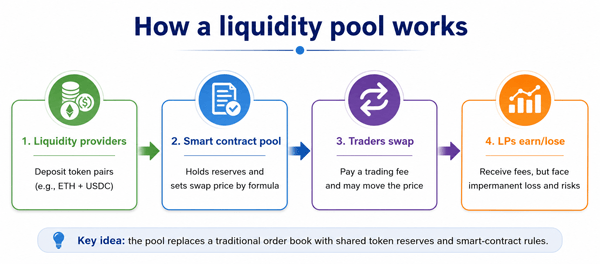
Diagram: Basic liquidity pool workflow from provider deposits to trader swaps and LP outcomes.
5. A simple liquidity pool example
Imagine a pool contains ETH and USDC. To keep the example simple, suppose ETH trades around $2,000 and a new pool starts with:
- 10 ETH
- 20,000 USDC
The pool has about $40,000 in total value: $20,000 worth of ETH and $20,000 worth of USDC. A liquidity provider who adds 1 ETH and 2,000 USDC contributes about $4,000, or roughly 10% of the pool after deposit, ignoring fees and slippage.
If traders later use the pool heavily, trading fees may increase the value of the pool. If ETH price changes sharply, the provider may suffer impermanent loss compared with simply holding 1 ETH and 2,000 USDC outside the pool. This is the trade-off: LPs can earn fees, but they also take market and protocol risk.
6. What is an automated market maker (AMM)?
An automated market maker, or AMM, is the system that allows a liquidity pool to quote prices automatically. Instead of a human market maker setting prices, the smart contract uses a rule. A common early model is the constant product formula:
x * y = k
Here, x and y represent the reserves of two tokens in the pool, and k is the constant product the pool tries to preserve before fees. When a trader removes one token from the pool, they must add enough of the other token to satisfy the formula. This is what makes price move as trades get larger.
Important beginner note: You do not need to memorize the formula to use DeFi, but you should understand the effect. Large trades move the pool price more than small trades, especially when the pool has low liquidity.
7. Key terms beginners should know
| Term | Simple meaning |
|---|---|
| Liquidity provider (LP) | A user who deposits assets into a liquidity pool. |
| LP token | A token that represents a user's share of a pool in many DeFi systems. |
| AMM | Automated market maker; the smart-contract pricing system used by many DEX pools. |
| Slippage | The difference between expected trade price and final execution price. |
| Impermanent loss | The loss compared with simply holding the deposited tokens when token prices move. |
| Trading fee | A fee paid by traders that may be earned by liquidity providers. |
| TVL | Total value locked; the value of assets deposited in a protocol or pool. |
| Pool depth | How much liquidity a pool has. Deeper pools usually support larger trades with less slippage. |
8. Types of liquidity pools
Not all liquidity pools work the same way. The design depends on the purpose of the protocol.
| Pool type | Common purpose | Beginner risk level |
|---|---|---|
| Token-pair AMM pools | Swapping assets such as ETH/USDC or WBTC/ETH. | Medium to high, depending on volatility. |
| Stablecoin pools | Swapping similar assets such as USDC/USDT or stablecoin pairs. | Lower price-volatility risk, but still has smart contract and depeg risk. |
| Concentrated liquidity pools | LPs choose a price range where their funds are active. | Higher complexity; can earn more fees but can also go out of range. |
| Lending pools | Users deposit assets that borrowers can borrow against collateral. | Different risk profile: liquidation, oracle, protocol, and borrower-market risk. |
| Yield or vault pools | Strategies move liquidity across pools or protocols. | Depends heavily on strategy quality and smart-contract risk. |
9. How liquidity providers earn money
Liquidity providers may earn returns in several ways, but none are guaranteed.
- Trading fees: Traders pay a fee on swaps. LPs may receive a share based on their pool ownership or active liquidity range.
- Token incentives: Some protocols offer extra reward tokens to attract liquidity. These rewards can be valuable, but they may also fall in price quickly.
- Lending interest: In lending pools, depositors may earn interest paid by borrowers.
- Vault strategy returns: Some DeFi vaults use liquidity pools as part of automated yield strategies.
A high advertised yield does not automatically mean a good opportunity. High yield often appears because the pool is risky, the token is volatile, rewards are temporary, or the market expects losses.
10. Benefits of liquidity pools
| Benefit | Why it matters |
|---|---|
| 24/7 decentralized trading | Users can swap tokens onchain without relying on a centralized exchange account. |
| Open access | In many protocols, anyone with a compatible wallet can provide liquidity. |
| Better token availability | New or smaller tokens can create markets without waiting for a centralized exchange listing. |
| Potential fee income | LPs can earn a share of trading activity. |
| Useful DeFi building block | Pools support swaps, lending, yield strategies, derivatives, stablecoin systems, and more. |
| Transparent reserves | Many pools are visible onchain, allowing users to inspect balances and activity. |
11. Risks of liquidity pools
Liquidity pools can be useful, but beginners should treat them as risky financial tools, not savings accounts.
11.1 Impermanent loss
Impermanent loss happens when the price ratio of the deposited tokens changes after you provide liquidity. The larger the price movement, the larger the potential loss compared with simply holding the tokens. It is called impermanent because the loss can shrink if prices return to the original ratio, but it becomes real when you withdraw while the loss exists.
11.2 Smart contract risk
Liquidity pools are controlled by code. If the smart contract has a bug, exploit, or poor design, funds can be stolen or locked. Audits reduce risk but do not remove it.
11.3 Token risk
A pool is only as safe as the tokens inside it. If one token collapses, depegs, is hacked, or becomes illiquid, LPs can be left holding more of the weaker asset.
11.4 Rug pulls and malicious pools
Scammers can create fake tokens, misleading pools, or websites that imitate real DeFi apps. A pool with a high yield and unknown token can be extremely dangerous.
11.5 Slippage and low liquidity
Low-liquidity pools can create poor trade execution. For LPs, low activity can also mean low fee income.
11.6 Gas fees and network costs
Depositing, withdrawing, claiming rewards, and adjusting positions may require blockchain transaction fees. On some networks, these costs can reduce or erase small profits.
11.7 Regulatory and tax uncertainty
DeFi activity may have tax and legal consequences. Rules vary by country and can change. Beginners should keep records and seek professional advice when needed.
12. Impermanent loss example in plain English
Suppose you deposit equal value of ETH and USDC into a pool. If ETH rises a lot, traders and arbitrage bots interact with the pool until its price catches up with the wider market. As this happens, the pool may end up holding less ETH and more USDC than before. Your share of the pool is still your share, but compared with simply holding your original ETH and USDC, you may have less total value.
Fees can offset impermanent loss, but they do not always offset it. A pool with high volume and steady fees may perform better than a pool with low volume and large price movement. This is why LP returns depend on both fee income and token-price behavior.
13. Practical examples of liquidity pools
| Example | What the pool helps users do | Main risks to consider |
|---|---|---|
| ETH/USDC pool | Swap between ETH and a dollar-pegged stablecoin. | ETH volatility, impermanent loss, smart contract risk. |
| USDC/USDT pool | Swap between two stablecoins. | Stablecoin depeg risk, protocol risk, lower fee potential. |
| WBTC/ETH pool | Trade between Bitcoin-like exposure and ETH exposure. | Both assets can move differently; impermanent loss possible. |
| New token/ETH pool | Create early market liquidity for a new project token. | Very high token risk, rug-pull risk, low liquidity, extreme volatility. |
| Lending pool for USDC | Deposit USDC so borrowers can borrow against collateral. | Borrowing-market risk, oracle risk, smart contract risk, depeg risk. |
14. How to evaluate a liquidity pool before using it
A beginner should not choose a pool only because the APY looks high. Use a basic checklist first.
- Understand both tokens. Avoid pools where you would not be comfortable holding either token by itself.
- Check pool size and trading volume. A larger, active pool usually has more meaningful fee potential and less slippage, though it is not automatically safe.
- Look at the fee tier and reward structure. Know whether returns come from real trading fees or temporary token incentives.
- Consider impermanent loss. Volatile token pairs usually have higher impermanent-loss risk than closely correlated assets.
- Research the protocol. Look for documentation, audits, history, team credibility, bug bounty programs, and community warnings.
- Check whether rewards are sustainable. A reward token with heavy emissions can lose value quickly.
- Start small. Test the deposit and withdrawal process before committing meaningful funds.
- Track results against simply holding the assets. LP profit should be compared with the hold-only alternative, not just the number shown as rewards.
15. Common beginner mistakes
- Chasing the highest APY without understanding why it is high.
- Providing liquidity to unknown tokens just because rewards look attractive.
- Ignoring impermanent loss and assuming all LP rewards are profit.
- Forgetting gas fees, bridge fees, and withdrawal costs.
- Using fake websites or signing wallet approvals without checking the URL and contract.
- Failing to record deposits, withdrawals, rewards, and token prices for tax tracking.
- Assuming stablecoin pools are risk-free. Stablecoins can depeg, freeze, fail, or face regulatory issues.
16. Best practices for safer participation
No checklist can remove all risk, but these practices can reduce avoidable mistakes.
- Use well-known protocols first while learning.
- Avoid pools with tokens you do not understand.
- Use a separate wallet for DeFi experiments and keep your main holdings elsewhere.
- Revoke unnecessary token approvals using reputable wallet-security tools.
- Compare LP returns with a hold-only benchmark.
- Do not borrow heavily against LP positions unless you understand liquidation risk.
- Read protocol documentation before depositing.
- Be extra careful with bridges, wrapped assets, and new chains.
17. Liquidity pools vs staking vs yield farming
| Activity | What you do | Potential reward | Main risk |
|---|---|---|---|
| Liquidity providing | Deposit assets into a pool used by traders or protocols. | Trading fees, incentives, or interest. | Impermanent loss, token risk, smart contract risk. |
| Staking | Lock or delegate tokens to help secure a proof-of-stake network or protocol. | Staking rewards. | Token price risk, lockups, validator/slashing risk. |
| Yield farming | Move funds across DeFi opportunities to earn rewards. | Fees, incentives, and strategy returns. | Higher complexity, smart contract stacking, reward-token risk. |
18. Are liquidity pools good for beginners?
Liquidity pools are worth learning about, but beginners should be careful before depositing funds. The concept is simple, but real returns can be complicated. You need to understand both assets, the pool design, fee income, impermanent loss, smart-contract risk, and your own risk tolerance.
A beginner-friendly approach is to learn with small amounts, use established protocols, avoid unknown tokens, and compare your result with what would have happened if you had simply held the same assets.
19. Summary: key takeaways
- A liquidity pool is a smart-contract reserve of crypto assets used for swaps, lending, and other DeFi services.
- Liquidity providers deposit assets and may earn fees or rewards.
- AMMs use formulas to price trades automatically instead of relying on a traditional order book.
- The biggest beginner risk is assuming LP rewards are guaranteed profit. Impermanent loss, token risk, and smart contract risk can outweigh rewards.
- A pool is usually safer to evaluate when you understand the tokens, protocol, fees, volume, liquidity depth, and withdrawal process.
20. FAQs about liquidity pools
20.1 What is a liquidity pool in simple terms?
It is a shared reserve of crypto tokens locked in a smart contract. Traders use the reserve to swap assets, and liquidity providers supply the reserve to potentially earn fees.
20.2 How do liquidity pools make money?
They may collect trading fees, lending interest, or protocol incentives. Liquidity providers can receive a share, but earnings are not guaranteed.
20.3 Can you lose money in a liquidity pool?
Yes. Losses can come from impermanent loss, falling token prices, smart contract exploits, scams, stablecoin depegs, and transaction costs.
20.4 What is impermanent loss?
Impermanent loss is the difference between the value of your pool position and the value you would have had by simply holding the same tokens outside the pool.
20.5 Are stablecoin liquidity pools safe?
They are often less exposed to normal price volatility, but they are not risk-free. Stablecoins can depeg, protocols can fail, and smart contracts can be exploited.
20.6 Do I need two tokens to provide liquidity?
In many classic AMM pools, yes, you deposit equal value of two tokens. Some platforms offer single-sided deposits, but the protocol may still convert or manage exposure behind the scenes.
20.7 What are LP tokens?
LP tokens represent your share of a liquidity pool in many protocols. They may be needed to withdraw your assets, so losing them can mean losing access to your position.
20.8 Is providing liquidity the same as staking?
No. Staking usually supports network or protocol security. Liquidity providing supplies assets to a market or DeFi service. The risks and rewards are different.
20.9 Why do high APYs appear in liquidity pools?
High APYs may reflect high trading activity, temporary incentives, low pool size, risky tokens, or reward emissions. A high APY can disappear quickly.
20.10 What should beginners do first?
Learn the pool mechanics, start with small amounts, use reputable protocols, avoid unknown tokens, and track performance against simply holding the assets.
Sources Consulted and Checked
These sources were consulted and checked while preparing this article to support accuracy and clarity.
- Uniswap Developers - How Uniswap Works
- Uniswap Developers - Understanding Returns
- Chainlink - What Is a Liquidity Pool?
- Chainlink - Understanding Impermanent Loss in DeFi Liquidity Pools
- Coinbase Learn - What Is Liquidity Mining?
- Kraken Learn - The Role of Liquidity Pools in Cryptocurrency Markets
Reader Advice
This article is provided for educational and informational purposes only. It is not personalized financial, legal, tax, or investment advice, and it does not recommend any specific liquidity pool, token, protocol, or transaction. Crypto and DeFi activities can involve substantial risk, including loss of funds, smart-contract failures, token volatility, impermanent loss, scams, regulatory uncertainty, and tax consequences. Rules, policies, laws, market conditions, and statistics can change over time and may vary by region, so readers should verify current information through official sources, conduct independent research, assess their own circumstances and risk tolerance, and seek qualified professional advice before making a decision.