Crypto Staking vs Yield Farming: Key Differences, Pros, Cons, Risks and Best Use Cases
Crypto staking and yield farming are two popular ways to earn rewards from crypto holdings. At first, they can sound similar because both may generate income without actively trading. But they are not the same. Staking usually supports the security of a proof-of-stake blockchain, while yield farming usually involves supplying crypto assets to decentralized finance (DeFi) protocols to earn fees, interest or token incentives.
For beginners, the most important point is this: staking is generally simpler and easier to understand, while yield farming is usually more flexible but more complex and riskier. Neither is guaranteed income. Returns can change, token prices can fall, platforms can fail, and scams are common in the crypto market.
This guide explains crypto staking vs yield farming in plain English, including how each works, practical examples, key differences, benefits, risks, mistakes to avoid and best use cases.
1. Quick Answer: Staking vs Yield Farming
Crypto staking means locking or delegating coins in a proof-of-stake network to help validate transactions and earn network rewards. Yield farming means using crypto in DeFi protocols, such as lending platforms or liquidity pools, to earn returns from fees, interest or incentive tokens.
| Feature | Crypto Staking | Yield Farming |
|---|---|---|
| Main purpose | Help secure a proof-of-stake blockchain | Provide liquidity or capital to DeFi protocols |
| Typical reward source | Network emissions, transaction fees or validator rewards | Trading fees, lending interest, incentive tokens or multiple reward streams |
| Complexity | Lower to moderate | Moderate to high |
| Risk level | Usually lower than yield farming, but still risky | Usually higher due to DeFi, smart contracts and strategy risk |
| Common beginner fit | Better for long-term holders of major proof-of-stake assets | Better for users who understand DeFi wallets, liquidity pools and risk management |
| Main risks | Price volatility, slashing, lockups, validator/custody risk | Smart contract bugs, impermanent loss, scams, rug pulls, volatile rewards |
2. What Is Crypto Staking?
Crypto staking is the process of committing coins or tokens to support a proof-of-stake blockchain. Instead of miners using computing power, proof-of-stake networks use validators who stake assets as collateral. Validators help confirm transactions, create or attest to blocks, and keep the network honest.
In return, stakers may receive rewards. These rewards are often paid in the same token being staked, although details vary by blockchain and platform.
2.1 How staking works in simple steps
- You hold a proof-of-stake cryptocurrency, such as ETH, SOL, ADA, DOT or another staking-enabled asset.
- You either run your own validator, delegate to a validator, use liquid staking, or stake through a crypto exchange.
- The validator participates in network consensus and helps process blockchain activity.
- If the validator performs correctly, rewards are distributed according to the network rules and platform fees.
- If the validator misbehaves or has serious technical failures, rewards may be reduced and, on some networks, part of the stake may be penalized or slashed.
2.2 Simple staking example
Suppose Maria owns a proof-of-stake coin and plans to hold it for several years. Instead of leaving it idle, she delegates it to a reputable validator. She still faces the risk that the coin price may fall, but she may earn staking rewards while holding. This is staking at its simplest: earning network rewards for helping secure the blockchain indirectly through a validator.
3. What Is Yield Farming?
Yield farming is a DeFi strategy where users put crypto assets into protocols to earn returns. The most common forms include providing liquidity to decentralized exchanges, lending assets to borrowing markets, or depositing tokens into vaults that automate strategies.
Yield farming became popular because some DeFi protocols offer higher potential returns than simple staking. But higher returns usually come with higher risk. A high annual percentage yield (APY) can disappear quickly if rewards are reduced, token prices drop, or a protocol fails.
3.1 How yield farming works in simple steps
- You connect a crypto wallet to a DeFi protocol.
- You deposit assets into a lending market, liquidity pool, staking pool, vault or other DeFi product.
- The protocol uses those assets for trading liquidity, borrowing, automated strategies or incentives.
- You may receive fees, interest, reward tokens or liquidity provider tokens.
- You withdraw when you choose, unless the protocol or strategy has restrictions, but your final result depends on fees, token prices, rewards, gas costs and risks.
3.2 Simple yield farming example
Suppose Ahmed deposits equal values of ETH and USDC into a decentralized exchange liquidity pool. Traders use that pool to swap between ETH and USDC, and Ahmed earns a share of trading fees. However, if ETH rises or falls sharply compared with USDC, Ahmed may experience impermanent loss. He also carries smart contract risk because the pool is controlled by code.
4. Visual Diagram: How Staking and Yield Farming Differ
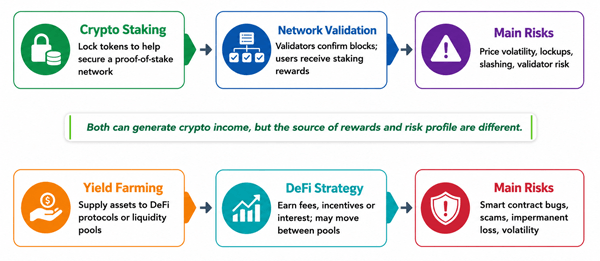
Figure: Staking earns from blockchain validation, while yield farming earns from DeFi activity such as liquidity, lending or incentives.
5. Crypto Staking vs Yield Farming: Key Differences
| Difference | Staking | Yield Farming | Why it matters |
|---|---|---|---|
| Where rewards come from | Blockchain consensus and validator rewards | DeFi fees, lending interest and incentive tokens | The source of yield affects reliability and risk. |
| Technical difficulty | Can be simple through delegation or exchanges | Often requires wallets, pools, bridges and protocol research | Beginners may make costly mistakes in DeFi. |
| Return stability | Often more predictable, but not fixed | Often changes quickly based on incentives and market demand | A high APY today may be much lower tomorrow. |
| Asset exposure | Usually one staked asset | Often two or more assets, especially in liquidity pools | More assets can mean more price and impermanent loss risk. |
| Liquidity | May involve lockup/unbonding periods; liquid staking can help | Often flexible, but some pools/vaults have conditions | You may not be able to exit instantly at the price you expect. |
| Main security risk | Validator failure, slashing, custody/platform risk | Smart contract exploits, protocol failure, rug pulls and scams | Yield farming adds protocol and strategy risk on top of crypto price risk. |
6. Pros and Cons of Crypto Staking
6.1 Benefits of staking
- Usually easier for beginners than yield farming.
- May provide regular rewards while holding a long-term crypto asset.
- Supports blockchain security and decentralization when done through reliable validators.
- Can be less time-consuming than managing multiple DeFi positions.
- Available through different methods, including self-custody delegation, validators, liquid staking and some exchanges.
6.2 Drawbacks of staking
- Rewards are not guaranteed and may change with network conditions.
- Token price losses can be much larger than staking rewards.
- Some networks have lockup or unbonding periods before funds can be moved.
- Validators can charge fees, go offline or, in some networks, cause slashing penalties.
- Exchange staking introduces custody risk because the platform controls the assets.
7. Pros and Cons of Yield Farming
7.1 Benefits of yield farming
- Can offer higher potential returns than basic staking in some market conditions.
- Provides more strategy choices, such as lending, liquidity pools, stablecoin pools and automated vaults.
- Helps DeFi protocols function by supplying liquidity and capital.
- May allow users to earn several reward types, such as fees plus token incentives.
- Can be flexible for experienced users who actively monitor markets and protocols.
7.2 Drawbacks of yield farming
- Usually more complex and easier to misunderstand.
- Smart contract bugs, hacks or oracle failures can cause severe losses.
- Impermanent loss can reduce returns in liquidity pools.
- High APY numbers can be temporary, misleading or paid in risky reward tokens.
- Gas fees, bridge fees and withdrawal costs can reduce or eliminate profits.
- Fake liquidity mining and yield farming platforms are common scam themes.
8. Risk Comparison: Which Is Safer?
Staking is usually considered simpler and often lower risk than yield farming, but it is not risk-free. Yield farming is generally riskier because it combines crypto price volatility with DeFi protocol risk, smart contract risk and strategy risk.
| Risk Type | Staking | Yield Farming | Beginner takeaway |
|---|---|---|---|
| Market volatility | High | High | Both can lose money if token prices fall. |
| Smart contract risk | Low to moderate; higher with liquid staking or platforms | High | DeFi code can fail or be exploited. |
| Slashing risk | Possible on some proof-of-stake networks | Usually not the main risk | Choose reliable validators and understand penalties. |
| Impermanent loss | Not typical | Common in liquidity pools | Understand pool math before providing two-sided liquidity. |
| Scam risk | Moderate, especially fake staking platforms | High, especially fake liquidity mining apps | Never trust guaranteed returns or strangers promising profits. |
| Complexity risk | Moderate | High | Complex strategies create more room for mistakes. |
9. Best Use Cases: When Staking Makes More Sense
- You already plan to hold a proof-of-stake asset for the long term.
- You want a simpler way to earn rewards without managing DeFi pools.
- You prefer a strategy tied to blockchain security rather than DeFi incentives.
- You are comfortable with the asset’s price risk and any lockup or unbonding rules.
- You can choose a reputable validator or platform and understand the fees.
10. Best Use Cases: When Yield Farming May Make Sense
- You understand DeFi wallets, liquidity pools, smart contract risk and transaction fees.
- You are using well-established protocols and can evaluate audits, TVL, history and risk controls.
- You want to earn trading fees or lending interest rather than only network staking rewards.
- You can monitor APYs, reward token prices and changes in pool conditions.
- You can afford to lose the amount used and are not relying on the income for essential expenses.
11. Practical Examples
11.1 Example 1: Long-term holder choosing staking
Nadia holds a proof-of-stake asset and does not plan to sell for two years. She researches validators, checks commission rates and chooses one with a good uptime record. Staking may fit her because she wants a relatively simple reward method while holding. Her biggest risk is still that the token price may fall.
11.2 Example 2: DeFi user choosing a stablecoin lending market
Omar has experience using self-custody wallets and wants to lend stablecoins through a large DeFi money market. This may be less volatile than farming two small tokens, but it still has smart contract, stablecoin, liquidation and platform risks. He checks audits, protocol history, liquidity, withdrawal conditions and whether the stablecoin has strong reserves.
11.3 Example 3: Liquidity pool farmer facing impermanent loss
Sara provides liquidity to a token pair that pays a high APY. The reward looks attractive, but one token falls sharply while the other remains stable. Trading fees and rewards do not fully cover the loss. This is a common yield farming lesson: a high APY does not automatically mean a profitable result.
12. How to Evaluate a Staking Opportunity
- Understand the asset first. Do not stake a token only because the reward rate is high.
- Check whether your funds are locked and how long withdrawal or unbonding takes.
- Review validator performance, commission rate, uptime and slashing history where available.
- Decide whether you want self-custody, exchange staking, liquid staking or running your own validator.
- Consider taxes, recordkeeping and local rules for staking rewards.
- Avoid platforms promising fixed, risk-free or unusually high returns.
13. How to Evaluate a Yield Farming Opportunity
- Identify exactly where the yield comes from: fees, lending demand, token incentives or leverage.
- Check the protocol’s age, reputation, audits, total value locked and incident history.
- Understand each asset in the pool, including stablecoin risks and token liquidity.
- Calculate realistic net returns after gas fees, slippage, reward token price changes and withdrawal costs.
- Learn whether impermanent loss applies and model different price scenarios.
- Avoid anonymous websites, wallet-draining approvals, guaranteed returns and requests to deposit more money to unlock rewards.
- Start small before committing meaningful funds.
14. Common Beginner Mistakes to Avoid
- Chasing the highest APY without understanding the risk.
- Assuming staking and yield farming are the same thing.
- Forgetting that token price losses can exceed rewards.
- Ignoring lockup periods, validator fees or withdrawal rules.
- Providing liquidity without understanding impermanent loss.
- Approving suspicious smart contracts or connecting a wallet to unknown websites.
- Using borrowed money or money needed for bills, rent or emergency savings.
- Believing anyone who promises guaranteed crypto income.
15. Staking vs Yield Farming: Which Is Better for Beginners?
For most beginners, staking a well-known proof-of-stake asset through a reputable method is easier to understand than yield farming. It has fewer moving parts and is usually better suited for someone who already wants long-term exposure to that asset.
Yield farming can be useful, but it is better for users who already understand DeFi basics. A beginner can learn about yield farming, but should not rush into complex pools, unknown protocols or extremely high APY offers. In crypto, unusually high yield often means unusually high risk.
16. Final Verdict
Crypto staking and yield farming both offer ways to earn rewards, but they serve different purposes. Staking is mainly about supporting a proof-of-stake blockchain and earning network rewards. Yield farming is mainly about supplying assets to DeFi protocols to earn fees, interest or incentives.
Choose staking if you want a simpler, more passive option tied to a blockchain you already believe in. Consider yield farming only if you understand DeFi mechanics, can evaluate protocol risks and are prepared for changing returns. The safest approach is not to chase the highest yield, but to understand exactly how the return is generated and what could go wrong.
17. FAQs About Crypto Staking vs Yield Farming
17.1 Is staking safer than yield farming?
Usually, yes. Staking is generally simpler and often carries fewer DeFi-specific risks. However, staking still has price volatility, lockup, validator, slashing and platform risks.
17.2 Can I lose money from staking?
Yes. Even if you earn staking rewards, the market value of the token can fall. You may also face penalties, fees, lockups or platform risk depending on how you stake.
17.3 Can I lose money from yield farming?
Yes. Yield farming can lose money through price drops, impermanent loss, smart contract hacks, protocol failure, scams, bad incentives or high transaction costs.
17.4 What is impermanent loss?
Impermanent loss is a potential loss that happens when the prices of tokens in a liquidity pool change compared with simply holding the tokens. It becomes permanent if you withdraw when the loss exists.
17.5 Why are yield farming APYs sometimes so high?
High APYs may come from temporary token incentives, low liquidity, high demand, high risk or unsustainable reward emissions. A high APY should be treated as a warning to investigate, not as a guarantee.
17.6 Do I need a wallet for staking or yield farming?
For self-custody staking and DeFi yield farming, yes, you usually need a crypto wallet. Some centralized exchanges offer staking without a separate wallet, but that adds custody and platform risk.
17.7 Is liquid staking the same as yield farming?
No. Liquid staking gives you a token that represents staked assets, while yield farming uses assets in DeFi strategies. However, some people use liquid staking tokens inside yield farming strategies, which adds extra layers of risk.
17.8 Which is better for passive income?
Staking is usually more passive. Yield farming can generate income too, but it often requires more monitoring, research and risk management.
17.9 Should beginners start with yield farming?
Most beginners should first learn wallet safety, blockchain fees, stablecoins, DeFi basics and risk management. If they try yield farming, they should start small and use established protocols only.
17.10 Are staking and yield farming guaranteed income?
No. Crypto rewards are never guaranteed. Returns can change, token prices can fall, protocols can fail, and scams can steal funds.
Sources Consulted and Checked
These sources were consulted and checked while preparing this article to support accuracy and clarity.
- Ethereum.org: Proof-of-stake documentation and staking rewards/penalties documentation.
- Coinbase Learn: Yield farming overview and risks including impermanent loss and smart contract flaws.
- Kraken Learn: Beginner explanation of yield farming and liquidity provision.
- FBI and IC3 public warnings: Cryptocurrency investment fraud and liquidity mining scam warnings.
- California DFPI Crypto Scam Tracker: Examples of liquidity mining/yield farming scam patterns.
Reader Advice
This article is provided for educational and informational purposes only. It is not personalized financial, legal, tax, or investment advice, and it should not be treated as a recommendation to stake, lend, farm, buy, sell, or hold any crypto asset. Crypto products can involve substantial risks, including price volatility, loss of funds, smart contract failures, platform or validator problems, scams, changing rewards, taxes, and regulatory restrictions. Rules, policies, laws, and statistics can change over time and may vary by country or region, so please verify important details through current official sources and consider qualified professional advice before making a decision. Never use money you cannot afford to lose.