DeFi Risk Management: Complete Guide, Examples, Risks and Best Practices
1. Introduction: Why DeFi Risk Management Matters
Decentralized finance, usually called DeFi, gives people access to financial services such as trading, lending, borrowing, staking, liquidity pools, derivatives, and stablecoin payments without relying on a traditional bank or broker. Instead of a company manually processing transactions, DeFi protocols use blockchain networks and smart contracts.
That openness is powerful, but it also creates a different kind of risk. In DeFi, you often control your own wallet, approve transactions yourself, interact with code directly, and depend on protocols that may be new, unaudited, or vulnerable. There is usually no customer support team that can reverse a bad transaction, recover a stolen wallet, or refund a failed investment.
DeFi risk management is the process of identifying, reducing, monitoring, and responding to the risks that come with using DeFi platforms. It does not remove risk completely. Its purpose is to help you avoid obvious mistakes, limit losses, choose better protocols, and make decisions based on evidence instead of hype.
This guide explains DeFi risk management from the ground up. It is written for beginners, but it also includes practical frameworks that more experienced users can apply before depositing funds into any DeFi protocol.
2. Quick Definition: What Is DeFi Risk Management?
DeFi risk management means using a structured process to protect your crypto assets when using decentralized finance applications. It includes checking the protocol, smart contracts, liquidity, token design, team, governance, wallet permissions, market conditions, and your own position size before and after you invest or interact with a protocol.
A simple definition: DeFi risk management is the habit of asking, “What could go wrong, how likely is it, how bad would it be, and what can I do before it happens?”
3. How DeFi Works in Simple Terms
To understand DeFi risk, you first need to understand the basic parts of the DeFi stack.
| DeFi component | Simple meaning | Why it matters for risk |
|---|---|---|
| Blockchain network | The base layer where transactions are recorded, such as Ethereum or another smart contract chain. | Network congestion, outages, bridge reliance, gas fees, and validator behavior can affect your transaction and funds. |
| Smart contract | Code that automatically performs actions such as swaps, loans, liquidations, or reward distribution. | Bugs, design flaws, and upgrade permissions can lead to losses. |
| Wallet | Your tool for holding assets and signing transactions. | If your seed phrase, private key, or device is compromised, your funds can be stolen. |
| Protocol | The DeFi application, such as a lending market, DEX, liquid staking platform, or yield vault. | Each protocol has its own rules, incentives, contracts, and failure points. |
| Oracle | A data source that brings external information, such as asset prices, into smart contracts. | Bad or manipulated price data can trigger wrong liquidations or exploit opportunities. |
| Token | The asset used in the protocol, including governance tokens, stablecoins, LP tokens, and reward tokens. | Token supply, liquidity, volatility, and incentives affect real returns and exit risk. |
4. Why DeFi Is Risky Even When a Protocol Looks Professional
A professional website, large social media following, high yield, or famous backers do not prove that a DeFi protocol is safe. DeFi risk often hides beneath the surface. The user interface may look simple, but the actual system may include complex smart contracts, admin keys, bridges, oracles, liquidators, governance votes, and third-party dependencies.
Several public reports and regulatory discussions have highlighted that DeFi creates risks for users because it relies on self-executing code, complex incentives, and often limited accountability. The Financial Stability Board has described DeFi as a multi-layered ecosystem built on blockchains, smart contracts, stablecoins, and related services. The Bank for International Settlements has also warned about the “decentralisation illusion,” where governance and control may still be concentrated even when a protocol appears decentralized.
Crypto crime and hack reporting also shows why risk controls matter. TRM Labs reported that crypto-related hacks and exploits caused about $2.2 billion in stolen funds in 2024, while Chainalysis has continued to identify crypto theft, social engineering, and infrastructure compromise as major threats. These figures are not meant to scare beginners away from learning DeFi; they show why careful risk management is necessary.
5. Main Types of DeFi Risk
5.1 Smart Contract Risk
Smart contract risk is the risk that the protocol code contains a bug, unsafe design, or hidden permission that can cause loss of funds. Smart contracts can be audited, but an audit is not a guarantee. Audits reduce risk; they do not eliminate it.
- Example: A lending protocol has a bug in its collateral calculation. An attacker uses the bug to borrow more than they should, leaving lenders with bad debt.
- Risk controls: Read audit reports, check whether critical findings were fixed, look at protocol age, review bug bounty programs, and avoid putting all funds into one contract.
5.2 Oracle Risk
Many DeFi protocols need price data. If a protocol uses weak price feeds, an attacker may manipulate a price long enough to borrow too much, drain a pool, or trigger unfair liquidations.
- Example: A low-liquidity token trades at $1 normally. An attacker temporarily pushes the price to $5 on a small exchange. A lending protocol accepts the false price and allows the attacker to borrow more valuable assets.
- Risk controls: Prefer protocols that use robust oracle systems, time-weighted prices, multiple data sources, and safeguards against low-liquidity assets.
5.3 Liquidity Risk
Liquidity risk means you may not be able to enter or exit a position at a fair price. A token can look valuable on paper but have thin trading volume. Large withdrawals can also stress a lending pool or liquidity pool.
- Example: You earn rewards in a small token, but when you try to sell, there are few buyers. Selling even a modest amount causes heavy slippage.
- Risk controls: Check total liquidity, daily volume, withdrawal queues, redemption rules, and slippage before entering.
5.4 Market Risk
Market risk is the risk that asset prices move against you. DeFi does not remove normal investment risk. In fact, leverage, volatile tokens, and automated liquidations can make losses faster.
- Example: You deposit ETH as collateral and borrow a stablecoin. ETH drops sharply, your collateral ratio falls, and your position is liquidated.
- Risk controls: Use conservative loan-to-value ratios, avoid excessive leverage, set alerts, and keep extra collateral available.
5.5 Impermanent Loss
Impermanent loss affects liquidity providers in automated market maker pools. It happens when the prices of the assets in a pool change compared with simply holding them separately. The loss becomes real when you withdraw while the price ratio has moved. Fees and rewards may offset it, but not always.
- Example: You provide ETH and USDC to a pool. ETH rises strongly. The pool automatically sells some ETH for USDC as traders rebalance the pool, so you end up with less ETH than if you had simply held it.
- Risk controls: Understand pool design, compare expected fees with possible impermanent loss, and be extra cautious with volatile token pairs.
5.6 Stablecoin Depeg Risk
Stablecoins are often treated as safe cash equivalents, but they can lose their peg. Depegging can happen because of weak reserves, liquidity stress, smart contract issues, governance problems, or market panic.
- Example: A stablecoin expected to trade near $1 falls to $0.85. If you used it as collateral or liquidity, your position may become much riskier than expected.
- Risk controls: Diversify stablecoin exposure, review reserves and redemption mechanisms, and avoid assuming every stablecoin has the same risk profile.
5.7 Bridge and Cross-Chain Risk
Bridges move assets between blockchains. They are useful, but they can also be high-risk because they often hold large pools of locked assets and rely on complex validation systems.
- Example: You bridge tokens to another chain to chase a yield opportunity. The bridge is exploited, and the wrapped version of your token loses backing.
- Risk controls: Use well-established bridges, avoid unnecessary bridging, and treat wrapped assets as different from native assets.
5.8 Governance and Admin Key Risk
Some protocols can be upgraded or controlled by a small team, multisig wallet, DAO vote, or emergency admin function. These controls may be useful for fixing bugs, but they can also create centralization, censorship, or misuse risk.
- Example: A protocol’s admin key can pause withdrawals or change risk parameters. If the key is compromised, users may be affected.
- Risk controls: Check timelocks, multisig signers, governance distribution, upgrade permissions, and emergency powers.
5.9 Wallet, Approval, and User Error Risk
Many DeFi losses happen because users sign malicious transactions, approve unlimited token spending, visit fake websites, or expose seed phrases. Even a safe protocol cannot protect you if your wallet is compromised.
- Example: You approve a fake website to spend your tokens. The attacker drains your wallet without needing your seed phrase.
- Risk controls: Use hardware wallets for larger funds, bookmark official websites, review token approvals, separate hot and cold wallets, and never share your seed phrase.
5.10 Regulatory and Legal Risk
DeFi regulation continues to evolve. Protocols, front ends, tokens, and service providers may face legal restrictions, sanctions rules, disclosure requirements, or enforcement actions. Users may also face tax and reporting obligations depending on their jurisdiction.
- Example: A front-end website becomes unavailable in your country, even though the smart contracts still exist on-chain.
- Risk controls: Understand local rules, keep transaction records, avoid sanctioned addresses or services, and do not assume “decentralized” means “outside the law.”
6. DeFi Risk Matrix: Which Risks Are Most Important?
Risk depends on the protocol, asset, chain, and strategy. Still, beginners can use the following matrix as a practical starting point.
| Risk type | Typical likelihood | Potential impact | Beginner priority |
|---|---|---|---|
| Wallet compromise | Medium to high | Very high | Critical |
| Smart contract exploit | Medium | Very high | Critical |
| Market volatility | High | Medium to high | Critical |
| Stablecoin depeg | Medium | High | High |
| Impermanent loss | Medium | Medium to high | High for liquidity providers |
| Oracle manipulation | Low to medium | High | High for lending and derivatives |
| Liquidity shortage | Medium | Medium to high | High |
| Regulatory change | Medium | Medium | Medium to high |
| Governance attack or admin misuse | Low to medium | High | High for large deposits |
| User misunderstanding | High | Medium to high | Critical for beginners |
7. DeFi Risk Management Framework: A Practical 5-Step Process
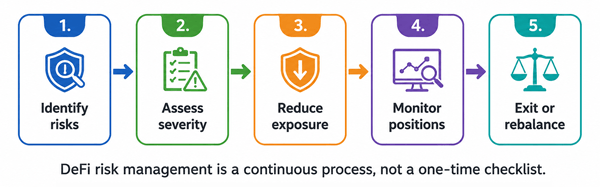
Figure: A simple DeFi risk management loop for beginners.
7.1 Identify What You Are Actually Doing
Before depositing funds, describe the strategy in plain English. If you cannot explain where the yield comes from, who pays it, what asset you will receive, and how you exit, you are not ready to use the protocol.
- Are you lending, borrowing, staking, restaking, providing liquidity, farming rewards, or using leverage?
- What assets are you depositing and what assets will you receive?
- Is the return paid from real usage fees, token emissions, leverage demand, or another source?
7.2 Assess the Main Failure Points
List the most likely ways you could lose money. Do not only look at the advertised APY. Look at contract risk, token risk, liquidity risk, oracle risk, stablecoin risk, and wallet risk.
- What happens if the token drops 50%?
- What happens if the stablecoin depegs?
- What happens if withdrawals are paused?
- What happens if rewards fall or token emissions end?
7.3 Limit Position Size
Position sizing is one of the most powerful risk controls. Beginners should avoid treating DeFi like a bank account. A common conservative approach is to risk only a small percentage of your crypto portfolio in any single protocol, especially if the protocol is new or unaudited.
| Risk level | Example protocol/strategy | Possible position-size approach |
|---|---|---|
| Lower risk, still not risk-free | Established lending market using major assets, conservative borrowing, strong history | Small to moderate allocation, with regular monitoring |
| Medium risk | Liquidity pool with volatile assets or newer yield vault | Small allocation only, test withdrawal first |
| High risk | New farm with very high APY, anonymous team, unaudited contracts | Avoid or use only funds you can afford to lose completely |
| Extreme risk | Unknown bridge, copied protocol, suspicious token, unrealistic yields | Do not use |
7.4 Use Safer Wallet and Transaction Habits
Operational security is part of DeFi risk management. Many users focus on protocol research but lose funds through phishing, fake airdrops, malicious approvals, or poor wallet hygiene.
- Use a hardware wallet for meaningful amounts.
- Keep a separate hot wallet for testing new protocols.
- Bookmark official protocol websites and avoid clicking sponsored search links.
- Read transaction prompts carefully before signing.
- Revoke old token approvals you no longer need.
- Never type your seed phrase into a website, form, support chat, or cloud document.
7.5 Monitor and Exit When the Risk Changes
A DeFi position is not “set and forget.” Risk changes when token prices move, collateral ratios fall, governance votes pass, audits reveal issues, TVL drops quickly, liquidity dries up, or social channels report exploits.
- Set price and health-factor alerts for leveraged positions.
- Check protocol announcements and governance proposals.
- Watch for sudden TVL drops, paused withdrawals, or abnormal APY spikes.
- Have an exit plan before you enter, including the chain, DEX, bridge, and expected slippage.
8. Practical Due Diligence Checklist Before Using a DeFi Protocol
| Question | What to look for | Warning signs |
|---|---|---|
| How long has the protocol been live? | Longer operating history, battle-tested contracts, transparent incident history. | Launched recently with huge incentives and little documentation. |
| Has it been audited? | Recent audits by reputable firms, public reports, fixed findings. | No audit, hidden report, unresolved critical issues. |
| Is there a bug bounty? | Meaningful bounty size and clear disclosure process. | No bug bounty or tiny bounty despite large TVL. |
| Who controls upgrades? | Timelocks, multisig, distributed governance, public proposal process. | Single admin key, unclear signers, instant upgrades. |
| Where does yield come from? | Trading fees, borrowing demand, staking rewards, clearly explained revenue. | Unclear source, only token emissions, “guaranteed” returns. |
| Can you exit? | Adequate liquidity, clear withdrawal process, tested small withdrawal. | Withdrawal queues, high slippage, low volume. |
| What assets are involved? | Major liquid assets, transparent stablecoins, reliable collateral. | Thinly traded tokens, wrapped assets with unclear backing. |
| Is the website authentic? | Official links from verified sources, consistent domain, community confirmation. | Lookalike domain, urgent pop-ups, wallet-draining approvals. |
9. Examples of DeFi Risk Management in Real Scenarios
9.1 Lending ETH and Borrowing Stablecoins
A beginner deposits ETH into a lending protocol and borrows a stablecoin. The main risk is liquidation if ETH falls in price. A risky user may borrow close to the maximum limit. A safer user borrows much less, monitors the health factor, keeps extra collateral ready, and avoids borrowing against highly volatile assets during unstable market conditions.
Best practice: Use a conservative collateral ratio. Do not borrow the maximum amount just because the platform allows it.
9.2 Providing Liquidity to an ETH/USDC Pool
A user deposits equal values of ETH and USDC into an automated market maker pool. They earn trading fees, but they face impermanent loss if ETH changes significantly against USDC. If ETH rises a lot, the pool may leave them with less ETH than they would have had by simply holding.
Best practice: Compare expected trading fees against possible impermanent loss. Avoid assuming a high fee APR automatically means a profitable strategy.
9.3 Chasing a 500% APY Farm
A new DeFi farm offers extremely high APY in its own reward token. The website looks professional, but the token has low liquidity, the contracts are unaudited, and the team is anonymous. The APY may fall quickly as more users enter, and the reward token may drop faster than rewards accumulate.
Best practice: Treat very high APY as a risk signal, not a free opportunity. Ask who is paying the yield and whether there is enough exit liquidity.
9.4 Using a Bridge to Reach a New Chain
A user bridges assets to a new blockchain to use a promising DeFi app. This adds bridge risk, chain risk, protocol risk, and liquidity risk. If the bridge fails or the wrapped asset loses backing, the user may face losses even if the DeFi app itself works as designed.
Best practice: Avoid unnecessary bridge exposure. If you must bridge, use established routes and test with a small amount first.
10. Benefits of Good DeFi Risk Management
- You make decisions based on process instead of hype.
- You reduce the chance of avoidable mistakes, such as signing fake approvals or over-borrowing.
- You can compare protocols more objectively.
- You are less likely to over-allocate to one strategy, chain, token, or stablecoin.
- You build habits that help protect you as DeFi products become more complex.
11. Limitations: What Risk Management Cannot Do
Risk management is not a guarantee. A well-researched protocol can still be exploited. A stablecoin can still depeg. A market can still crash. A bridge can still fail. The goal is not to predict every event. The goal is to avoid weak setups, reduce exposure to single points of failure, and survive mistakes or unexpected events.
- It cannot make unaudited contracts safe.
- It cannot guarantee that audits found every bug.
- It cannot remove market volatility.
- It cannot recover funds after you sign a malicious transaction.
- It cannot replace legal, tax, or financial advice.
12. Common DeFi Risk Management Mistakes Beginners Make
| Mistake | Why it is dangerous | Better approach |
|---|---|---|
| Only looking at APY | High yield often means high risk, token inflation, leverage, or unsustainable incentives. | Study where the yield comes from and whether it can last. |
| Depositing everything at once | A single exploit, depeg, or user error can cause major loss. | Start small, test deposits and withdrawals, diversify. |
| Ignoring wallet approvals | Unlimited approvals can let malicious contracts drain tokens. | Review and revoke approvals regularly. |
| Assuming “audited” means safe | Audits reduce risk but cannot prove code is bug-free. | Read audit findings and combine audits with other checks. |
| Using leverage without alerts | Fast price moves can trigger liquidation before you react. | Use conservative leverage and set health-factor alerts. |
| Trusting influencers blindly | Paid promotions may not disclose risk properly. | Verify claims from documentation, data, audits, and independent sources. |
| Ignoring taxes and records | DeFi transactions can create complex tax events. | Keep transaction records and seek professional guidance if needed. |
13. Best Practices for Safer DeFi Use
13.1 Use a Personal Risk Budget
Decide in advance how much of your portfolio can be exposed to DeFi, to one protocol, to one chain, to one stablecoin, and to one high-risk strategy. This prevents emotional decision-making during hype cycles.
13.2 Prefer Simpler Strategies First
Beginners should usually start with simple, transparent strategies before using leverage, complex vaults, derivatives, restaking layers, or cross-chain strategies. Complexity increases the number of ways something can go wrong.
13.3 Check TVL, Volume, and Liquidity Together
Total value locked, or TVL, can be useful, but it should not be used alone. High TVL may still depend on risky incentives, whales, or a single asset. Also check trading volume, withdrawal liquidity, and whether the protocol has survived stress events.
13.4 Read the Documentation
Good DeFi documentation should explain how the protocol works, where yield comes from, what the risks are, what fees apply, how liquidations work, and who controls upgrades. Weak documentation is a warning sign.
13.5 Test With a Small Amount
Before committing meaningful funds, make a small deposit and a small withdrawal. This helps you understand gas fees, withdrawal steps, lockups, slippage, wallet approvals, and the user interface.
13.6 Separate Wallets by Risk
Use one wallet for long-term holdings, another for active DeFi, and a small test wallet for new or unfamiliar apps. This limits damage if one wallet interacts with a malicious contract.
13.7 Use Alerts and Monitoring Tools
Set alerts for liquidation levels, token prices, governance proposals, stablecoin pegs, protocol announcements, and unusual on-chain activity. DeFi moves quickly, and early information can help you exit or reduce risk.
13.8 Keep Records
Save transaction hashes, deposit dates, withdrawal dates, cost basis, protocol names, and wallet addresses. Good records help with taxes, troubleshooting, and reviewing whether a strategy actually made money after fees, losses, and slippage.
14. DeFi Risk Management Tools Beginners Can Use
| Tool category | What it helps with | Examples of use |
|---|---|---|
| Block explorers | Verify transactions, contracts, token holders, and wallet activity. | Check whether you used the correct contract or whether a transaction succeeded. |
| Portfolio trackers | Monitor positions across wallets and protocols. | See lending positions, LP tokens, and yield positions in one place. |
| Approval checkers | Review and revoke token spending permissions. | Remove old unlimited approvals after using a dApp. |
| Protocol dashboards | Track TVL, volume, rates, pools, and incentives. | Compare whether yield is rising because of real demand or temporary rewards. |
| Risk dashboards | Review protocol risk scores, exposure, and market data. | Identify concentration risk or dangerous collateral levels. |
| Price and liquidation alerts | Get notified when collateral or asset prices move. | Avoid liquidation by adding collateral or repaying debt early. |
| Hardware wallets | Protect private keys from online compromise. | Require physical confirmation for important transactions. |
15. How to Evaluate a DeFi Yield Opportunity
When you see a yield opportunity, ask these questions before depositing:
- What is the real source of the yield?
- Is the yield paid in a volatile reward token?
- Is the protocol audited, and were critical issues fixed?
- How much liquidity exists if I want to exit?
- What happens if the main asset drops sharply?
- Is there lockup risk, withdrawal delay, or penalty?
- Does the strategy depend on a bridge, oracle, or another protocol?
- Can admin keys change the rules quickly?
- What percentage of my portfolio am I willing to lose if this fails?
16. Beginner-Friendly DeFi Risk Scorecard
Use this scorecard before entering a position. A low score does not prove safety, but it helps you compare opportunities more clearly.
| Category | 0 points | 1 point | 2 points |
|---|---|---|---|
| Protocol age | Less than 3 months | 3-12 months | More than 12 months with no major unresolved incident |
| Audits | No public audit | Audit exists but limited or old | Recent reputable audits and fixed findings |
| Yield source | Unclear or mostly hype | Partly explained | Clear, sustainable source such as fees or real borrowing demand |
| Liquidity | Very low or hard to exit | Moderate liquidity | Deep liquidity and tested withdrawal route |
| Admin control | Unknown or single key | Some controls but limited transparency | Timelocks, multisig, clear governance |
| Asset quality | Unknown or illiquid token | Mixed assets | Major liquid assets or transparent collateral |
| User understanding | Cannot explain strategy | Partly understand | Can explain risks, yield, and exit process |
A simple interpretation: 0-5 points is very high risk, 6-9 is high risk, 10-12 is moderate risk, and 13-14 is relatively stronger but still not risk-free.
17. DeFi Risk Management for Different User Types
| User type | Main goal | Recommended approach |
|---|---|---|
| Complete beginner | Learn safely | Use tiny test amounts, avoid leverage, avoid new farms, focus on wallet security. |
| Long-term holder | Earn moderate yield without excessive complexity | Prefer established protocols, major assets, conservative allocation, and regular monitoring. |
| Liquidity provider | Earn fees from pools | Study impermanent loss, pool volume, token volatility, fee tier, and exit liquidity. |
| Borrower | Access liquidity without selling assets | Maintain low loan-to-value, set alerts, and keep extra collateral ready. |
| Advanced yield user | Optimize returns across protocols | Use formal position limits, scenario analysis, contract reviews, and continuous monitoring. |
18. Red Flags That Should Make You Stop
- The protocol promises guaranteed high returns.
- The team pressures users with urgent deadlines or “limited time” claims.
- The contract is unaudited and controls large amounts of money.
- The website asks for your seed phrase or private key.
- The token has very low liquidity but aggressive marketing.
- The documentation does not explain how yield is generated.
- The project hides admin controls, upgrade permissions, or token allocation.
- Community questions about risk are deleted or mocked.
19. DeFi Risk Management Checklist
Before depositing:
- I understand what the protocol does and where yield comes from.
- I checked audits, documentation, TVL, liquidity, and governance controls.
- I know the main risks: smart contract, market, liquidity, oracle, stablecoin, wallet, and regulatory risk.
- I tested the protocol with a small amount first.
- I know how to exit and what slippage or withdrawal delay may apply.
- I am not investing money I cannot afford to lose.
While funds are deposited:
- I monitor prices, health factor, peg stability, governance updates, and protocol announcements.
- I keep wallet approvals under control.
- I review whether the strategy is still worth the risk after fees and market changes.
Before exiting:
- I check liquidity and slippage.
- I confirm I am using the official website and correct network.
- I save records for tracking and tax purposes.
20. Frequently Asked Questions
20.1 Is DeFi safe?
DeFi can be useful, but it is not automatically safe. It carries smart contract, market, liquidity, oracle, wallet, stablecoin, governance, and regulatory risks. Some protocols are more mature than others, but no DeFi platform is risk-free.
20.2 Can I lose all my money in DeFi?
Yes. Users can lose funds through hacks, scams, liquidation, depegged stablecoins, failed bridges, malicious approvals, or severe market moves. This is why position sizing and wallet security are essential.
20.3 Does an audit mean a DeFi protocol is safe?
No. An audit is a positive sign, but it is not a guarantee. Audits may miss bugs, and new code changes after the audit may introduce new risks. Look at audit quality, unresolved findings, bug bounties, and protocol history.
20.4 What is the safest DeFi strategy for beginners?
There is no universally safest strategy, but beginners are usually better served by simple, low-leverage strategies using established protocols and liquid assets. Avoid complex vaults, very high APY farms, and leverage until you understand the risks.
20.5 How much should I put into one DeFi protocol?
There is no fixed number that fits everyone. A conservative approach is to limit exposure to any single protocol, chain, or strategy and only allocate an amount you can afford to lose. Newer and riskier protocols deserve much smaller allocations or no allocation at all.
20.6 What is the biggest DeFi risk for beginners?
The biggest beginner risks are often user error, wallet compromise, overconfidence, and chasing high yield without understanding the strategy. Smart contract risk is important, but many losses start with a bad signature, fake website, or poor position sizing.
20.7 What does “not your keys, not your coins” mean in DeFi?
It means that whoever controls the private keys controls the assets. In DeFi, you often self-custody your funds, which gives you more control but also more responsibility. If you lose your seed phrase or sign a malicious transaction, recovery may be impossible.
20.8 How do I know if a DeFi yield is sustainable?
Look for the source of yield. Fees from real trading activity or borrowing demand may be more sustainable than temporary reward-token emissions. If yield depends mainly on new users buying or locking a token, be cautious.
20.9 Should I use DeFi bridges?
Only when necessary and with caution. Bridges add another layer of technical and liquidity risk. Use established bridges, verify the destination asset, and test with a small amount first.
20.10 Is DeFi risk management only for investors?
No. It is useful for anyone who interacts with DeFi, including traders, borrowers, liquidity providers, DAO participants, developers, and long-term holders using wallets and dApps.
21. Conclusion: Treat DeFi Like a Risk System, Not a Shortcut to Easy Money
DeFi gives users access to powerful financial tools, but power and responsibility come together. The same features that make DeFi open and flexible also make it unforgiving. Transactions are usually irreversible, smart contracts can fail, markets can move quickly, and scams can look convincing.
Good DeFi risk management starts with simple habits: understand the strategy, verify the protocol, limit position size, protect your wallet, monitor changes, and have an exit plan. The goal is not to avoid every risk. The goal is to take only the risks you understand, reduce the ones you can control, and avoid situations where one mistake can damage your entire portfolio.
For beginners, the best rule is simple: if you cannot explain how a DeFi position makes money and how it can lose money, do not deposit funds yet. Learn first, test small, and increase exposure only when your understanding and risk controls improve.
Sources Consulted and Checked
The following sources were consulted and checked while preparing this article and reviewing its accuracy:
- Financial Stability Board, The Financial Stability Risks of Decentralised Finance, 16 February 2023.
- Bank for International Settlements, DeFi risks and the decentralisation illusion, BIS Quarterly Review, December 2021.
- U.S. Treasury, Illicit Finance Risk Assessment of Decentralized Finance, 2023.
- CFTC, Statement on Decentralized Finance report and risk recommendations, 8 January 2024.
- TRM Labs, 2025 Crypto Crime Report, 10 February 2025.
- Chainalysis, crypto crime and crypto theft reporting, 2025-2026.
- Chainlink, Understanding Impermanent Loss in DeFi Liquidity Pools, updated 6 April 2026.
Reader Advice
This article is provided for educational and informational purposes only. It is not personalized financial, investment, legal, tax, or regulatory advice, and it does not recommend any particular DeFi protocol, token, platform, or strategy. DeFi involves significant risks, including smart-contract failures, scams, wallet compromise, market losses, liquidation, liquidity shortages, stablecoin depegging, bridge failures, and the possible permanent loss of funds. Rules, policies, laws, tax requirements, market data, and statistics can change over time and may vary by country or region. Before making a decision, verify current information through official and reliable sources, consider your circumstances and risk tolerance, and seek qualified professional advice where appropriate. Never use funds you cannot afford to lose.