What Is DeFi? Meaning, How It Works, Examples, Benefits and Risks
1. What Is DeFi?
DeFi, short for decentralized finance, is a group of financial services built on public blockchains. Instead of using a bank, broker, payment company, or centralized crypto exchange to manage every step, DeFi uses software programs called smart contracts to run financial activities such as trading, lending, borrowing, earning yield, and transferring value.
In simple terms, DeFi tries to make parts of finance work like open internet software. A person connects a crypto wallet to a DeFi app, approves a transaction, and the smart contract follows its programmed rules. This can make financial tools more open and transparent, but it also makes users responsible for wallet security, transaction choices, and risk management.
1.1 DeFi Meaning in One Sentence
DeFi means financial applications that run on blockchains through smart contracts, allowing people to trade, lend, borrow, save, or invest crypto assets without relying fully on traditional intermediaries.
| Term | Beginner-friendly meaning |
|---|---|
| DeFi | Decentralized finance: financial apps built on blockchain networks. |
| Smart contract | Code on a blockchain that automatically follows preset rules. |
| Wallet | Software or hardware used to store keys and sign blockchain transactions. |
| DEX | Decentralized exchange where users trade tokens through smart contracts. |
| Liquidity pool | A pool of tokens supplied by users so others can trade or borrow. |
| TVL | Total value locked: an estimate of assets deposited in a DeFi protocol. |
2. Why DeFi Exists
Traditional finance depends on trusted institutions. Banks hold deposits, brokers route trades, payment networks settle transfers, and lenders decide who can borrow. This system is familiar and regulated, but it can also be slow, expensive, limited by geography, and dependent on approvals.
DeFi was created to experiment with a different model: financial services that are open, programmable, and accessible through blockchain networks. The idea is not that every bank function disappears. The idea is that some financial activities can be handled by transparent protocols where the rules are visible and transactions can be verified on-chain.
3. How DeFi Works: Step-by-Step
Most DeFi activity follows a simple pattern. The details vary by app, but the basic flow is similar.
- A user sets up a crypto wallet. The wallet holds private keys and lets the user sign blockchain transactions.
- The user gets crypto assets. These may include ETH, stablecoins such as USDC or USDT, or other tokens supported by the app.
- The user connects the wallet to a DeFi app. The app is usually a website that provides a user interface for smart contracts.
- The user reviews and approves a transaction. The wallet shows the network, estimated fee, asset, and permission request.
- A smart contract executes the action. It may swap tokens, deposit funds, issue a loan, supply liquidity, or claim rewards.
- The blockchain records the transaction. The result is visible on the public ledger, although wallet owners are usually pseudonymous rather than personally identified by default.
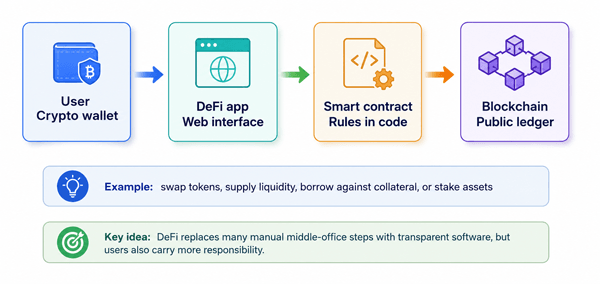
Diagram: Basic DeFi transaction flow from wallet to smart contract to blockchain record.
4. The Main Building Blocks of DeFi
4.1 Blockchains
A blockchain is the base network where transactions are recorded. Ethereum is the most widely associated DeFi network, but DeFi also exists on other blockchains and layer 2 networks. The blockchain provides settlement, transaction history, and shared rules.
4.2 Smart Contracts
Smart contracts are programs deployed on a blockchain. They can hold assets and execute rules automatically. For example, a lending smart contract can accept a deposit, calculate interest, track collateral, and allow liquidation if a borrower becomes undercollateralized.
Important beginner point: A smart contract is not automatically safe just because it is public. Code can contain bugs, economic design flaws, oracle problems, or hidden admin controls.
4.3 Crypto Wallets
A crypto wallet is your gateway to DeFi. It does not usually store coins like a physical wallet stores cash. Instead, it stores or manages private keys that prove you can control assets on a blockchain. Common wallet types include browser wallets, mobile wallets, and hardware wallets.
4.4 Tokens and Stablecoins
DeFi apps use tokens. Some represent network assets, such as ETH. Some are stablecoins designed to track a currency like the US dollar. Others are governance tokens, liquidity provider tokens, or wrapped versions of assets from another chain.
4.5 Oracles
An oracle brings outside information onto a blockchain. For example, a lending protocol may need a price feed to know whether a borrower's collateral is still enough. If an oracle fails or is manipulated, the DeFi app can suffer losses even if its smart contract code works as written.
4.6 Governance
Many DeFi protocols use governance tokens or voting systems to decide changes. Governance may control fees, upgrades, risk parameters, treasury spending, or supported assets. However, governance can be concentrated if a small group controls many tokens or if users do not participate.
5. Common Types of DeFi Apps
| DeFi category | What it does | Simple example |
|---|---|---|
| Decentralized exchanges (DEXs) | Let users swap tokens from their wallets. | Swap ETH for a stablecoin through a liquidity pool. |
| Lending and borrowing | Let users supply assets to earn interest or borrow against collateral. | Deposit USDC and borrow ETH, or deposit ETH and borrow stablecoins. |
| Stablecoin protocols | Create or manage crypto assets designed to hold a stable value. | Mint a crypto-backed stablecoin using collateral. |
| Yield aggregators | Move funds across strategies to seek better returns. | Deposit tokens into a vault that uses automated strategies. |
| Liquid staking | Let users stake assets while receiving a token that can be used elsewhere. | Stake ETH and receive a liquid staking token. |
| Derivatives and perpetuals | Offer synthetic exposure, futures-like trading, or leveraged positions. | Trade a perpetual contract linked to a crypto price. |
| Insurance and risk markets | Help users buy or provide coverage for certain protocol risks. | Buy cover against a smart contract exploit, subject to terms. |
6. Real-World DeFi Examples
The following examples are common categories, not investment recommendations.
| Example | Category | What beginners should understand |
|---|---|---|
| Uniswap | Decentralized exchange | Users trade through liquidity pools rather than a traditional order book. Liquidity providers can earn fees but may face impermanent loss. |
| Aave | Lending and borrowing | Users can supply assets, borrow against collateral, and face liquidation if collateral value falls too far. |
| MakerDAO / Sky ecosystem | Stablecoin and collateralized borrowing | Users can lock collateral to generate a dollar-linked stablecoin, with liquidation and governance risks. |
| Curve Finance | Stablecoin and similar-asset exchange | Designed for efficient swaps between assets that should trade at similar values, but pool composition and depeg risk matter. |
| Lido | Liquid staking | Users can stake assets and receive a liquid token, but they take smart contract, validator, and market risks. |
7. DeFi vs Traditional Finance vs Centralized Crypto Finance
| Feature | Traditional finance | Centralized crypto finance | DeFi |
|---|---|---|---|
| Control of assets | Usually held by a bank, broker, or custodian. | Usually held by a centralized exchange or platform. | Usually controlled by the user wallet unless funds are deposited into a contract. |
| Access | Depends on location, identity checks, banking access, and institution rules. | Depends on exchange access, identity checks, and account status. | Often open to anyone with a wallet and network access, though front ends and laws may restrict use. |
| Execution | Handled by institutions and internal systems. | Handled by company-controlled systems. | Handled by smart contracts on blockchains. |
| Transparency | Limited public visibility. | Limited public visibility. | On-chain transactions and contract code can often be inspected. |
| User protection | May include regulation, dispute processes, chargebacks, or insurance depending on jurisdiction. | Depends on platform policies and regulation. | Usually limited. Transactions are often irreversible and support may be minimal. |
| Main risk | Institution failure, fees, delays, restrictions, and counterparty risk. | Exchange failure, account freezes, custody risk, and hacks. | Smart contract bugs, wallet mistakes, scams, liquidity risk, oracle failures, and governance risk. |
8. Benefits of DeFi
DeFi is useful because it changes how people can access and combine financial tools. The benefits are real, but they should be understood together with the risks.
8.1 Open Access
Many DeFi protocols can be used by anyone with a compatible wallet and internet connection. This can be helpful for people who cannot easily access certain financial services, although users still need crypto assets, technical knowledge, and awareness of local laws.
8.2 Self-Custody
Users can keep control of their assets through their own wallets rather than leaving everything with a centralized company. This reduces some custody risk but increases personal responsibility. Losing a seed phrase or signing a malicious transaction can be final.
8.3 Transparency
Many DeFi transactions, balances, and smart contracts are visible on public blockchains. This makes it possible to verify activity, monitor protocol reserves, and analyze risk in ways that are not always possible in traditional finance.
8.4 Programmability and Composability
DeFi protocols can connect with each other like building blocks. For example, a token from one protocol may be used as collateral in another. This composability creates innovation, but it can also spread risk across interconnected systems.
8.5 Potentially Faster Settlement
Blockchain transactions can settle without traditional banking hours. This can make transfers and financial actions faster, especially across borders. However, speed depends on the network, congestion, fees, and bridge or exchange requirements.
9. Risks and Limitations of DeFi
DeFi is high risk. Beginners should not treat it like a bank account, a guaranteed investment, or a simple savings product. Here are the main risks to understand before using any DeFi app.
| Risk | What can happen | How to reduce the risk |
|---|---|---|
| Smart contract bugs | A coding error or exploit can drain funds or freeze assets. | Use audited, battle-tested protocols; avoid unaudited new projects; limit position size. |
| Wallet mistakes | Sending to the wrong address, losing keys, or approving a bad transaction can cause permanent loss. | Use a hardware wallet for larger amounts; test with small transactions; review approvals. |
| Scams and fake websites | A fake app can trick users into signing malicious permissions. | Bookmark official sites; verify URLs; avoid links from DMs, ads, or unknown groups. |
| Impermanent loss | Liquidity providers may earn fees but end up with less value than simply holding tokens. | Understand pool mechanics; be cautious with volatile token pairs. |
| Liquidation risk | Borrowers can lose collateral if prices move against them. | Borrow conservatively; monitor collateral ratios; avoid high leverage. |
| Oracle risk | Wrong or manipulated price feeds can trigger bad trades or liquidations. | Prefer protocols with robust oracle design and risk controls. |
| Stablecoin depeg risk | A stablecoin may fall below its target value. | Diversify stablecoin exposure; understand backing, redemption, and issuer risk. |
| Bridge risk | Cross-chain bridges can be exploited or halted. | Avoid unnecessary bridging; use reputable bridges; keep bridge exposure limited. |
| Governance risk | Protocol rules may change, or a small group may control decisions. | Review governance structure, admin keys, timelocks, and upgrade controls. |
| Regulatory risk | Access, taxation, reporting, or legality may change by country. | Follow local rules and keep records for taxes and compliance. |
10. Practical DeFi Use Cases for Beginners
10.1 Swapping Tokens
A user wants to exchange one token for another without creating an account on a centralized exchange. They connect a wallet to a DEX, choose the trading pair, review price impact and fees, and sign the transaction.
Beginner tip: Always check slippage, token contract address, and the final amount received. Fake tokens can have similar names and logos.
10.2 Lending Crypto Assets
A user supplies stablecoins to a lending protocol and earns a variable rate paid by borrowers. The rate is not guaranteed; it changes with market demand and protocol rules.
Beginner tip: A high yield may signal high risk, temporary incentives, low liquidity, or weak demand quality. Do not judge safety by the yield number alone.
10.3 Borrowing Against Collateral
A user deposits ETH as collateral and borrows a stablecoin. This may let them access liquidity without selling ETH. But if ETH falls sharply, the protocol may liquidate some or all collateral.
Beginner tip: Keep a large safety buffer. Borrowing close to the maximum limit is risky because crypto prices can move quickly.
10.4 Providing Liquidity
A user deposits two assets into a liquidity pool so traders can swap between them. In return, the user may earn trading fees and sometimes token rewards.
Beginner tip: Liquidity providing is not the same as earning simple interest. You can lose money from price movements, bad pools, exploits, or reward token declines.
10.5 Using Stablecoins for Payments or Transfers
Stablecoins can be used in DeFi for transfers, trading, lending, and settlement. They can be useful when users want crypto-based dollar exposure, but stablecoins carry issuer, reserve, regulatory, and depeg risks.
11. How People Earn Yield in DeFi
DeFi yield can come from several sources. Understanding the source matters because different yields have different risks.
| Yield source | Where it comes from | Key risk |
|---|---|---|
| Borrower interest | Borrowers pay interest to use supplied assets. | Borrow demand can fall; protocol risk remains. |
| Trading fees | DEX users pay fees when swapping tokens. | Impermanent loss and low trading volume. |
| Staking rewards | Network or protocol rewards paid for staking or securing systems. | Validator, slashing, smart contract, or token price risk. |
| Incentive tokens | Protocols distribute tokens to attract users. | Rewards can drop quickly; token price may collapse. |
| Complex strategies | Vaults combine lending, liquidity provision, leverage, or hedging. | Strategy, leverage, smart contract, and composability risk. |
A practical rule: The more complicated the yield source, the more carefully you should study what could go wrong. Very high annual percentage yield is usually compensation for very high risk, temporary incentives, low liquidity, or unsustainable token emissions.
12. What Is TVL in DeFi?
TVL stands for total value locked. It estimates how much value is deposited in a DeFi protocol's smart contracts. A high TVL can suggest that many users have deposited assets, but it does not prove that a protocol is safe, profitable, or decentralized.
TVL can be useful for comparing protocols, but beginners should avoid relying on TVL alone. A protocol can have high TVL and still suffer from bugs, governance problems, poor token economics, or risky collateral.
13. How to Evaluate a DeFi Protocol Before Using It
Use this checklist before connecting a wallet or depositing funds.
- Identify the official website and documentation. Avoid sponsored links and random social media links.
- Check the protocol age and track record. New protocols can be innovative but are usually riskier.
- Look for independent security audits, bug bounty programs, and public incident history.
- Understand exactly where yield comes from. If the source is unclear, do not deposit.
- Review liquidity, withdrawal limits, lockups, and exit conditions.
- Check whether admin keys, upgrade permissions, or governance votes can change the rules.
- Study token risks, including emissions, insider allocations, and unlock schedules.
- Test with a small amount first. Never make your first transaction a large one.
- Keep records for taxes and personal tracking.
- Only use money you can afford to lose. DeFi losses can be sudden and irreversible.
14. Beginner Safety Checklist
- Use a separate wallet for DeFi instead of keeping all assets in one main wallet.
- Consider a hardware wallet for larger holdings.
- Bookmark official DeFi websites and avoid clicking wallet connection links from messages or ads.
- Read every wallet pop-up before signing. Be especially careful with unlimited token approvals.
- Revoke unused approvals periodically using reputable approval-checking tools.
- Start on well-known networks and protocols before trying complex chains, bridges, or new apps.
- Avoid pressure tactics such as “guaranteed yield,” “limited private sale,” or “send now to qualify.”
- Do not share your seed phrase, private key, or screen with anyone claiming to provide support.
- Keep some native network token for transaction fees so you can exit positions if needed.
- Write down the risks of a position before entering it. If you cannot explain the risk, skip it.
15. Common DeFi Mistakes to Avoid
| Mistake | Why it is dangerous | Better approach |
|---|---|---|
| Chasing the highest yield | High yield often hides high risk or temporary incentives. | Focus on risk-adjusted yield and clear revenue sources. |
| Ignoring gas fees | Small trades can become expensive on busy networks. | Check fees before signing and use suitable networks for small amounts. |
| Using fake tokens | Scammers create tokens with familiar names. | Verify token contract addresses through official sources. |
| Over-borrowing | A sudden price move can trigger liquidation. | Borrow far below the maximum and monitor collateral. |
| Trusting social media hype | Influencers may be paid or wrong. | Read documentation, audits, and independent risk discussions. |
| Signing blind approvals | A malicious approval can let attackers drain tokens. | Check what permission is being requested before approving. |
16. Misconceptions About DeFi
16.1 DeFi is completely anonymous
Most public blockchain activity is pseudonymous, not fully anonymous. Wallet addresses may not show a real name by default, but transaction history is public and can sometimes be linked to individuals through exchanges, analytics, mistakes, or reused addresses.
16.2 Smart contracts remove all trust
DeFi reduces reliance on some intermediaries, but it does not remove trust entirely. Users may still rely on developers, auditors, governance voters, oracle providers, front-end operators, bridges, and wallet software.
16.3 High TVL means safe
TVL is only one signal. It does not guarantee code quality, economic safety, legal clarity, or sustainable yield.
16.4 DeFi yield is like bank interest
Bank deposits and DeFi deposits are very different. DeFi yield usually involves smart contract, market, liquidity, counterparty, and regulatory risks. It may not include deposit insurance or a customer support process.
17. Is DeFi Legal?
DeFi rules vary by country and can change. Some activities may trigger tax reporting, securities rules, commodities rules, money transmission rules, sanctions restrictions, or consumer protection issues. Even if a smart contract is technically accessible, that does not always mean using it is legally permitted in your location.
Beginners should keep records of transactions, understand local tax obligations, and avoid using DeFi to bypass laws or compliance requirements. For legal or tax questions, speak with a qualified professional in your jurisdiction.
18. Is DeFi Safe?
DeFi can be useful, but it is not automatically safe. The safest mindset is to treat DeFi as experimental financial technology. Some protocols have operated for years and manage significant assets, while others are new, unaudited, poorly designed, or outright scams.
Safety depends on the protocol, the asset, the network, the wallet, the user's behavior, market conditions, and legal environment. A cautious beginner should start small, avoid leverage, use reputable protocols, and learn how wallet permissions work before depositing meaningful funds.
19. Who Might Use DeFi?
| User type | Possible reason for using DeFi | Main caution |
|---|---|---|
| Crypto trader | Swap tokens directly from a wallet. | Slippage, fake tokens, MEV, and transaction fees. |
| Long-term holder | Borrow against crypto or stake assets. | Liquidation, smart contract, and market risk. |
| Stablecoin user | Transfer, lend, or hold dollar-linked tokens. | Depeg, issuer, reserve, and regulatory risk. |
| Developer or startup | Build financial apps using open protocols. | Security, compliance, and user protection responsibilities. |
| Researcher or analyst | Study transparent on-chain markets. | Data interpretation can be complex and incomplete. |
20. DeFi Best Practices for Beginners
- Learn with small amounts first. Treat early transactions as education, not income.
- Separate experimentation funds from long-term holdings.
- Prefer simple actions before complex strategies. A basic token swap is easier to understand than leveraged yield farming.
- Read protocol documentation and risk pages before depositing.
- Check multiple independent sources, not only the protocol website.
- Avoid leverage until you fully understand liquidation mechanics.
- Track every position, wallet, network, approval, and tax-relevant transaction.
- Have an exit plan before entering a position.
21. The Future of DeFi
DeFi is likely to continue evolving through better wallets, improved security tools, layer 2 networks, real-world asset experiments, institutional participation, and clearer regulation. At the same time, the sector will continue facing challenges such as hacks, scams, governance concentration, fragmented liquidity, and legal uncertainty.
The most realistic view is balanced: DeFi is not a guaranteed replacement for traditional finance, but it is an important experiment in open, programmable financial infrastructure. Its long-term value will depend on whether it can become safer, easier to use, legally clearer, and genuinely useful beyond speculation.
22. Quick Summary
- DeFi means decentralized finance: financial apps built on blockchains using smart contracts.
- Common DeFi uses include token swaps, lending, borrowing, liquidity provision, stablecoins, staking, and derivatives.
- DeFi can offer open access, transparency, self-custody, and programmability.
- Major risks include smart contract bugs, scams, wallet mistakes, liquidations, impermanent loss, oracle failures, and regulatory uncertainty.
- Beginners should start small, verify official sources, avoid leverage, protect wallet keys, and understand every transaction before signing.
23. FAQs About DeFi
23.1 What does DeFi stand for?
DeFi stands for decentralized finance. It refers to blockchain-based financial applications that use smart contracts instead of relying entirely on traditional intermediaries.
23.2 Is DeFi the same as crypto?
No. Crypto is the broader category of digital assets and blockchain networks. DeFi is a specific use of crypto technology for financial services such as trading, lending, borrowing, and yield generation.
23.3 Do I need a bank account to use DeFi?
Many DeFi apps only require a compatible crypto wallet and crypto assets. However, getting crypto in the first place often involves an exchange, payment method, or bank transfer, depending on your country.
23.4 Can beginners use DeFi?
Yes, but beginners should move slowly. Start with education, small transactions, reputable protocols, and simple actions. DeFi mistakes can be irreversible.
23.5 Can I lose money in DeFi?
Yes. Users can lose money through hacks, scams, market volatility, liquidations, impermanent loss, depegged stablecoins, bad approvals, or sending funds to the wrong address.
23.6 Is DeFi better than banks?
DeFi and banks solve different problems. DeFi can be more open and programmable, while banks may offer legal protections, customer support, compliance, and deposit insurance depending on the country. Neither is automatically better for every use case.
23.7 What is a DeFi wallet?
A DeFi wallet is a crypto wallet used to connect to decentralized applications and sign blockchain transactions. Examples include browser wallets, mobile wallets, and hardware wallets.
23.8 What is yield farming?
Yield farming means moving crypto assets into DeFi strategies to earn rewards, fees, or interest. It can be profitable but often involves high complexity and high risk.
23.9 What is impermanent loss?
Impermanent loss is a risk faced by liquidity providers when the prices of tokens in a pool change compared with simply holding those tokens. Fees may offset it, but not always.
23.10 What is the safest way to start with DeFi?
The safest approach is to learn first, use small amounts, avoid leverage, use established protocols, verify official links, protect your seed phrase, and never sign transactions you do not understand.
Sources Consulted and Checked
These sources were consulted and checked while preparing this document to support clarity and accuracy.
- Ethereum.org - What is DeFi?
- Ethereum.org - Introduction to smart contracts
- Chainalysis - DeFi glossary and risk education
- Financial Stability Board - The Financial Stability Risks of Decentralised Finance, 2023
- Bank for International Settlements - DeFi risks and the decentralisation illusion, 2021
- ESMA - Decentralised Finance: A Categorisation of Smart Contracts, 2023
- DefiLlama - DeFi analytics and TVL dashboard
Reader Advice
This article is provided for educational and informational purposes only and is not personalized financial, legal, tax, investment, or other professional advice or a recommendation to use any DeFi protocol or crypto asset. DeFi involves substantial risks, including loss of funds, smart-contract failures, scams, market volatility, liquidation, wallet errors, stablecoin depegging, and limited recovery options. Rules, policies, laws, tax requirements, protocol terms, and statistics can change over time and vary by country or region. Before making any decision, verify current information through official sources, consider your circumstances and risk tolerance, and seek advice from a qualified professional where appropriate. Never use money you cannot afford to lose.