Liquid Staking and Restaking: Complete Guide, Examples, Risks and Best Practices
Quick answer: Liquid staking lets you stake crypto and receive a tradable token that represents your staked position. Restaking lets already-staked ETH or liquid staking tokens help secure additional services for potential extra rewards. Both can improve capital efficiency, but they add smart contract, market, liquidity, operator, slashing, and DeFi risks.
1. What Is Liquid Staking?
Liquid staking is a way to stake a proof-of-stake cryptocurrency while still receiving a token you can hold, transfer, trade, or use in some DeFi applications. Instead of locking your coins directly and waiting with no usable asset, a liquid staking protocol gives you a liquid staking token, often called an LST.
For example, when someone stakes ETH through a liquid staking protocol, they may receive a token such as stETH, rETH, cbETH, or another protocol-specific receipt token. That token represents a claim on the staked ETH plus rewards, minus any fees or penalties according to the protocol rules.
| Term | Simple meaning |
|---|---|
| Staking | Locking crypto to help secure a proof-of-stake blockchain and earn rewards. |
| Liquid staking | Staking through a protocol that issues a tradable receipt token. |
| LST | Liquid staking token, such as stETH or rETH. |
| Validator | Software/node that participates in block validation and consensus. |
| Slashing | A penalty where staked assets can be reduced if validators break rules. |
1.1 Why Liquid Staking Exists
Traditional staking can be inconvenient for beginners. On Ethereum, solo validation requires 32 ETH and technical setup. Staking also normally limits what you can do with the asset while it is staked. Liquid staking solves part of this problem by pooling deposits, delegating validator operations, and issuing a token that can move through DeFi.
The trade-off is important: liquid staking improves flexibility, but it does not remove risk. It changes the risk profile from pure staking risk to staking plus protocol, market, liquidity, and DeFi composability risk.
2. How Liquid Staking Works Step by Step
- You deposit ETH or another supported proof-of-stake asset into a liquid staking protocol.
- The protocol stakes the asset through validators or node operators.
- You receive an LST that represents your staked position.
- The validators earn staking rewards for helping secure the network.
- Your LST may increase in value, rebase, or become redeemable for more underlying tokens, depending on the token design.
- You can usually exit by using the protocol withdrawal process or by swapping the LST on a secondary market, if liquidity is available.
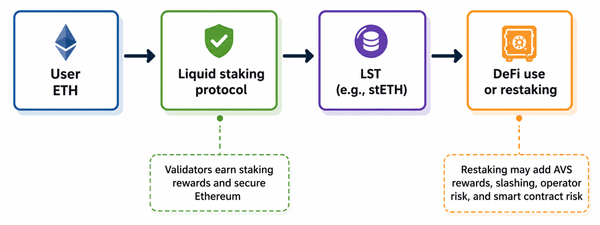
Diagram: Basic flow of liquid staking and restaking.
2.1 Common Types of Liquid Staking Tokens
| Token model | How it usually behaves | Beginner note |
|---|---|---|
| Rebasing token | Token balance can increase as rewards accrue. | Your wallet balance may change over time. |
| Reward-bearing token | Token price or exchange rate rises versus the underlying asset. | Your balance may stay the same, but each token may redeem for more. |
| Wrapped LST | A wrapped version designed for DeFi compatibility. | Useful in DeFi, but adds another layer to understand. |
| Liquid restaking token (LRT) | Represents a restaked position rather than just a staked position. | Higher complexity and usually more layered risk. |
3. What Is Restaking?
Restaking means using already-staked ETH, or supported liquid staking tokens, to help secure additional decentralized services beyond Ethereum itself. These services are often called Actively Validated Services, or AVSs. In return, restakers may earn extra rewards on top of normal staking rewards.
The simple idea is: one base staking position can be reused as economic security for more than one system. This can be powerful, but it also means one asset may now be exposed to multiple sets of rules and failure points.
3.1 How Restaking Works in Practice
- A user already has staked ETH or an LST.
- The user deposits or opts that asset into a restaking protocol.
- The user delegates to an operator, or in advanced cases runs required software themselves.
- The operator helps secure one or more AVSs, such as data availability systems, bridges, or oracle-like services.
- If the operator performs correctly, the restaker may receive additional rewards.
- If the operator or AVS breaks rules, the restaked assets may face additional penalties, depending on the protocol design.
4. Liquid Restaking Tokens: What Are LRTs?
A liquid restaking token, or LRT, is a tokenized representation of a restaked position. It is similar in spirit to an LST, but it represents assets that have been restaked into additional services. Examples in the broader market may include tokens issued by restaking-focused protocols, though exact names, support, and risk rules can change.
Beginners should treat LRTs as advanced DeFi instruments. They combine staking exposure, restaking exposure, token price risk, smart contract risk, operator risk, and sometimes points or incentive programs that may not produce guaranteed future value.
| Feature | Liquid staking | Restaking | Liquid restaking |
|---|---|---|---|
| Main purpose | Stake and keep a liquid token | Reuse staked security for extra services | Tokenize a restaked position |
| Common token | LST | May use ETH or LST | LRT |
| Reward source | Base staking rewards | Staking rewards + AVS rewards | Restaking rewards reflected in token design |
| Complexity | Moderate | High | Very high |
| Main risk added | Protocol and market risk | AVS/operator/slashing risk | Layered liquidity and smart contract risk |
| Best suited for | Users who understand staking basics | Advanced users comfortable with extra risk | Advanced DeFi users only |
5. Liquid Staking and Restaking Examples
5.1 Example 1: Beginner ETH Holder Using Liquid Staking
A user has 1 ETH and wants staking rewards but does not have 32 ETH or the technical skills to run a validator. They deposit 1 ETH into a liquid staking protocol and receive an LST. They can hold the LST, use it in compatible DeFi protocols, or later redeem/swap it back to ETH. This is simpler than solo staking, but the user now depends on the liquid staking protocol and its validator set.
5.2 Example 2: DeFi User Using an LST as Collateral
A user stakes ETH and receives an LST. They then deposit the LST into a lending protocol as collateral. This can increase capital efficiency, but it also creates liquidation risk. If the LST price temporarily trades below ETH, or if the user borrows too much, they may be liquidated even if the long-term staking position is sound.
5.3 Example 3: Restaker Delegating to an Operator
A user holds an LST and restakes it through a restaking protocol. They delegate to an operator who secures several AVSs. The user may earn extra rewards, but their funds depend on operator performance, AVS rules, smart contracts, and withdrawal/unbonding conditions. This is not just “free extra yield.” It is compensation for taking more risk.
6. Benefits of Liquid Staking
- Lower entry barrier: users can often stake smaller amounts instead of needing a full validator deposit.
- Liquidity: users receive a token that may be tradable or usable in DeFi.
- Convenience: the protocol or node operators handle validator operations.
- Composability: LSTs can be integrated into lending, trading, liquidity pools, and other DeFi products.
- Potential diversification: some protocols spread stake across multiple validators or operators.
7. Benefits of Restaking
- Additional reward potential: restakers may earn AVS rewards on top of staking rewards.
- Shared security: new services may benefit from Ethereum-aligned economic security.
- Capital efficiency: already-staked assets may do more than one job.
- New DeFi opportunities: restaking can support new products, networks, and middleware services.
8. Risks and Limitations You Must Understand
| Risk | What it means | Practical protection |
|---|---|---|
| Smart contract risk | Bugs or exploits in staking, restaking, bridge, or DeFi contracts. | Use audited, battle-tested protocols; avoid depositing more than you can afford to lose. |
| Slashing risk | Validators or operators may lose funds for rule violations. | Check validator/operator history, slashing policy, and diversification. |
| Liquidity risk | You may not be able to swap an LST/LRT at fair value during stress. | Check market depth, withdrawal queues, and redemption rules. |
| Depeg/discount risk | LST or LRT market price may trade below the underlying asset. | Do not assume 1 token always equals 1 ETH in live markets. |
| Operator risk | Restaking operators may fail, misconfigure software, or be penalized. | Delegate carefully; diversify where practical. |
| Protocol governance risk | Rules, fees, whitelists, or supported assets may change. | Read governance docs and monitor upgrades. |
| Composability risk | Using tokens across multiple DeFi platforms multiplies failure points. | Avoid excessive leverage and complex loops. |
| Regulatory/tax risk | Staking and reward treatment may differ by country. | Keep records and consult a qualified adviser where needed. |
9. The Biggest Misconceptions
| Misconception | Reality |
|---|---|
| Liquid staking is risk-free passive income. | It carries staking, smart contract, validator, liquidity, and market risks. |
| An LST is always worth exactly 1 ETH. | Protocol redemption may target underlying value, but market prices can deviate. |
| Restaking is just extra yield. | Extra yield usually comes with extra slashing, operator, AVS, and contract risk. |
| Higher APY always means better choice. | Higher rewards can reflect higher uncertainty, lower liquidity, or incentive campaigns. |
| Audits guarantee safety. | Audits reduce risk but cannot eliminate bugs, economic attacks, or governance problems. |
10. How to Evaluate a Liquid Staking or Restaking Protocol
Before using any protocol, review it like a risk analyst, not just a yield hunter. A simple checklist can prevent many beginner mistakes.
- Protocol age and track record: How long has it operated with real funds?
- Audits and bug bounties: Who audited it, and are reports public?
- Validator/operator set: Is it diversified or dependent on a small group?
- Fees: What percentage of rewards goes to the protocol or operators?
- Withdrawal process: Can you redeem directly, or must you rely on market liquidity?
- Token design: Does the token rebase, appreciate through exchange rate, or use wrapping?
- Slashing coverage: Is there insurance, reserve coverage, or a clear loss-sharing policy?
- DeFi integrations: Are you using the token in reputable markets with enough liquidity?
- Restaking scope: Which AVSs are involved, and what extra slashing rules apply?
- Incentives: Are rewards sustainable, or mostly points and temporary token emissions?
11. Best Practices for Beginners
- Start with the basic staking concept before using liquid staking or restaking.
- Use small amounts while learning the deposit, token, withdrawal, and tax-record process.
- Prefer transparent protocols with clear documentation and a long operating history.
- Do not chase the highest APY without understanding the source of rewards.
- Avoid leverage loops such as staking, borrowing, buying more LSTs, and repeating unless you fully understand liquidation risk.
- Keep emergency liquidity in unstaked assets so you are not forced to sell an LST or LRT during a discount.
- Diversify protocol and operator exposure if your position is large enough to justify it.
- Track wallet approvals and revoke unused approvals when appropriate.
- Monitor protocol announcements, governance votes, audits, and withdrawal queue conditions.
- Keep records of deposits, withdrawals, swaps, rewards, and fees for tax and accounting purposes.
12. When Liquid Staking May Make Sense
- You want staking exposure but do not have enough crypto or technical knowledge to run your own validator.
- You understand that the LST can trade at a discount or premium.
- You are comfortable with smart contract and validator risks.
- You want flexibility to use your staked position in DeFi, while accepting additional risk.
13. When Restaking May Not Be Suitable
- You are new to crypto wallets, DeFi, or staking basics.
- You cannot explain what an AVS, operator, slashing, and unbonding period mean.
- You are using borrowed money or cannot afford a sudden loss.
- You are relying mainly on “points” without knowing whether they will have value.
- You need guaranteed liquidity at a fixed price.
14. Practical Comparison: Staking, Liquid Staking, and Restaking
| Method | Main advantage | Main drawback | Beginner difficulty |
|---|---|---|---|
| Solo staking | Maximum control and supports decentralization | Requires technical skill and 32 ETH on Ethereum | High |
| Staking-as-a-service | Keeps validator keys with user in some setups; less technical work | Requires trusting operator performance | Medium |
| Centralized exchange staking | Easy interface | Custody and platform risk | Low |
| Liquid staking | Staking plus tradable receipt token | Smart contract, LST price, and liquidity risk | Medium |
| Restaking | Potential extra rewards and supports AVSs | Extra operator, AVS, slashing, and complexity risk | High |
| Liquid restaking | Restaked exposure with a liquid token | Most layered and difficult to evaluate | Very high |
15. A Simple Beginner Decision Framework
Use this simple framework before depositing funds:
- Goal: Are you trying to earn base staking rewards, use DeFi liquidity, or pursue higher-risk extra rewards?
- Knowledge: Can you explain how the token earns rewards and how you exit?
- Risk budget: How much could you lose without damaging your finances?
- Protocol risk: What smart contracts, validators, operators, and AVSs are involved?
- Liquidity: Can you redeem through the protocol, swap in a deep market, or both?
- Worst case: What happens if the token depegs, withdrawals slow, an operator is slashed, or a DeFi protocol is hacked?
16. FAQs About Liquid Staking and Restaking
16.1 Is liquid staking the same as normal staking?
No. Normal staking locks assets directly to secure a network. Liquid staking adds a tokenized receipt that can often be traded or used in DeFi.
16.2 Can I lose money with liquid staking?
Yes. You can lose money from token price movement, smart contract exploits, validator penalties, liquidity problems, or risky DeFi strategies.
16.3 What is the difference between an LST and an LRT?
An LST represents a staked asset. An LRT usually represents a restaked position, which may include exposure to additional AVSs and risk layers.
16.4 Is restaking safe?
Restaking is not risk-free. It may add extra rewards, but it also adds extra slashing, operator, AVS, protocol, and liquidity risks.
16.5 Why does an LST sometimes trade below the asset it represents?
Market price depends on supply, demand, liquidity, confidence, and redemption timing. During stress, traders may demand a discount for waiting or taking risk.
16.6 Do I need 32 ETH for liquid staking?
Usually no. Many liquid staking platforms allow smaller amounts, although rules vary by protocol and network.
16.7 Are staking rewards guaranteed?
No. Rewards depend on network rules, validator performance, fees, participation rates, and protocol conditions.
16.8 What is an AVS in restaking?
An AVS is an Actively Validated Service - a service that uses restaked security and operators to perform validation or security-related tasks.
16.9 Should beginners use restaking?
Most beginners should first understand wallets, staking, liquid staking, withdrawals, and DeFi risk before considering restaking.
16.10 What is the safest way to start?
There is no perfectly safe method. A cautious approach is to learn first, use small amounts, avoid leverage, choose transparent protocols, and understand how to exit.
17. Final Thoughts
Liquid staking and restaking are important DeFi innovations because they make staked assets more flexible and productive. Liquid staking turns a locked staking position into a usable token. Restaking takes the idea further by allowing staked assets or LSTs to secure additional services for potential extra rewards.
The key lesson for beginners is simple: flexibility is not the same as safety. Every added layer can add new failure points. The best users understand the source of yield, the exit path, the protocol design, the operator structure, and the worst-case scenarios before they deposit funds.
Sources Consulted and Checked
The following sources were consulted and checked while preparing this article and reviewing its accuracy.
- Ethereum.org - Proof-of-Stake Documentation
- Ethereum.org - How to Stake Your ETH
- Ethereum.org - Restaking Guide
- EigenLayer / EigenCloud Documentation - EigenLayer Overview
- Lido - Public Information and Risk Disclosures
- Lido Documentation - Liquidity, Market, and Token Risks
- Gogol, Velner, Kraner, and Tessone - SoK: Liquid Staking Tokens (LSTs) and Emerging Trends in Restaking, arXiv, 2024
Reader Advice
This article is provided for educational and informational purposes only. It is not personalized financial, investment, tax, legal, or regulatory advice, and it does not recommend any particular token, protocol, operator, or strategy. Liquid staking, restaking, LSTs, LRTs, and related DeFi activities can involve smart-contract exploits, slashing, depegging, liquidity constraints, withdrawal delays, operator failures, market volatility, loss of principal, and changing tax or regulatory treatment. Rules, protocol policies, fees, rewards, laws, and statistics can change over time and vary by country or region. Before acting, verify current information through official sources, assess whether you can afford the risks, and seek advice from an appropriately qualified professional where necessary.