Flash Loans Explained: Meaning, How It Works, Examples, Benefits and Risks
1. Quick answer: What is a flash loan?
A flash loan is a type of DeFi loan that lets someone borrow crypto without providing collateral, as long as the borrowed assets are returned within the same blockchain transaction. If the borrower cannot repay the loan plus any required fee before the transaction ends, the transaction is reversed automatically.
This is very different from a normal loan. A bank loan may last months or years and depends on identity checks, collateral, credit history, or legal enforcement. A flash loan lasts only for the life of one blockchain transaction, often seconds, and repayment is enforced by smart contract code.
Beginner takeaway: a flash loan is not free money. It is a temporary source of liquidity for users or smart contracts that can complete a profitable or useful action immediately and repay the loan in the same transaction.
2. Flash loans in simple words
Imagine a vending machine that lets you borrow $10,000, but only inside a sealed room. You can use the money to complete a trade inside that room. Before the door opens, the machine checks whether you returned the $10,000 plus a small fee. If you did, the trade is accepted. If you did not, everything that happened inside the room is cancelled.
That sealed room is similar to a blockchain transaction. Either all steps succeed together, or none of them count. This property is called atomicity. Flash loans use atomicity to make uncollateralized borrowing possible in DeFi.
3. How flash loans work step by step
A flash loan usually happens through a smart contract. The borrower does not manually receive funds and decide what to do later. Instead, the borrower writes or uses a contract that tells the blockchain exactly what should happen in one sequence.
- The borrower requests funds from a DeFi lending pool or liquidity protocol.
- The protocol sends the assets to the borrower contract inside the same transaction.
- The borrower contract uses the funds for a planned action, such as arbitrage, collateral swapping, liquidation, or refinancing.
- The borrower contract returns the borrowed amount plus the flash loan fee before the transaction ends.
- If repayment succeeds, the transaction is confirmed. If repayment fails, the whole transaction reverts.
3.1 Flash loan flow diagram
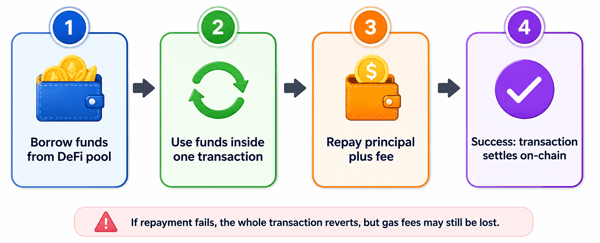
Figure 1: A flash loan must borrow, use, and repay funds within one atomic blockchain transaction.
4. Why flash loans do not need collateral
Traditional lenders need collateral because borrowers can disappear, default, or fail to repay later. Flash loans work differently because there is no later. The smart contract only allows the transaction to complete if the funds are returned before the transaction finishes.
If the repayment condition is not met, the blockchain discards the transaction as if the loan never happened. The lender is protected by code-level transaction logic, although the borrower may still lose network gas fees for attempting a failed transaction.
5. Flash loans vs traditional loans
| Feature | Flash loan | Traditional loan |
|---|---|---|
| Collateral | Usually no upfront collateral | Often requires collateral, income proof, or credit assessment |
| Loan duration | One blockchain transaction | Days, months, or years |
| Repayment enforcement | Smart contract reverts the transaction if unpaid | Legal agreements, collection processes, collateral seizure |
| Typical users | Developers, arbitrage bots, DeFi power users, protocols | Individuals, businesses, institutions |
| Main cost | Protocol fee plus gas fees | Interest, fees, and sometimes penalties |
| Main limitation | All steps must succeed immediately | Approval process, credit checks, collateral requirements |
6. Common uses of flash loans
Flash loans are mostly used by technically skilled DeFi users and automated trading systems. They are not usually beginner tools, but understanding their use cases helps explain why they matter.
6.1 Arbitrage between exchanges
Arbitrage means buying an asset where it is cheaper and selling it where it is more expensive. In DeFi, the same token may have slightly different prices across decentralized exchanges because each exchange has its own liquidity pools.
Example: ETH trades for 3,000 USDC on Exchange A and 3,020 USDC on Exchange B. A trader could use a flash loan to borrow USDC, buy ETH on Exchange A, sell ETH on Exchange B, repay the loan and fee, and keep the remaining profit. This only works if the price difference is larger than gas fees, trading fees, slippage, and the flash loan fee.
6.2 Collateral swapping
Some DeFi users borrow against collateral. A flash loan can help replace one type of collateral with another in a single transaction. For example, a user might switch from volatile collateral to a more stable asset without manually repaying and reopening the whole position.
6.3 Debt refinancing
A user may use a flash loan to close a loan on one protocol and reopen a cheaper loan on another protocol. This can make sense if interest rates, collateral rules, or liquidation thresholds are better elsewhere.
6.4 Liquidations
In lending protocols, undercollateralized positions can be liquidated. Liquidators may use flash loans to access the capital needed to repay part of a borrower’s debt and receive collateral at a discount. The liquidator repays the flash loan and keeps any remaining profit.
6.5 Protocol-level liquidity operations
Some applications use flash liquidity to rebalance positions, execute complex swaps, or improve capital efficiency. In these cases, flash loans are infrastructure rather than a product aimed at everyday users.
7. Simple flash loan example with numbers
Here is a simplified arbitrage example. Real transactions are more complex, but this shows the basic idea.
| Step | Action | Amount |
|---|---|---|
| 1 | Borrow USDC through a flash loan | 100,000 USDC |
| 2 | Buy Token X on Exchange A | 100,000 USDC worth |
| 3 | Sell Token X on Exchange B at a higher price | 100,450 USDC |
| 4 | Repay flash loan principal | 100,000 USDC |
| 5 | Pay flash loan fee, trading fees, and gas | Example total: 180 USDC |
| 6 | Estimated profit | 270 USDC |
In this example, the opportunity is profitable only because the final amount after selling is higher than all costs. If slippage, gas, or fees increase, the trade may fail or become unprofitable.
8. Benefits of flash loans
- Capital efficiency: Users can access large temporary liquidity without locking collateral first.
- Fast execution: Borrowing, trading, repayment, and settlement happen in one transaction.
- Open access: Anyone who can interact with the protocol and pay gas fees can attempt a flash loan.
- Useful for arbitrage and market efficiency: Price differences across decentralized exchanges can be corrected more quickly.
- Helpful for advanced DeFi management: Users can refinance, swap collateral, or restructure positions in fewer steps.
9. Risks and limitations of flash loans
Flash loans are powerful, but they are risky and often misunderstood. The biggest risks are not only for borrowers. Poorly designed DeFi protocols can also be harmed by flash loan-powered attacks.
9.1 Smart contract risk
A flash loan strategy depends on smart contract code. A small error can cause the transaction to fail, lose gas fees, or interact with the wrong contract. Bugs can also expose funds if the strategy contract holds tokens.
9.2 Gas fees and failed transactions
If a flash loan transaction fails, the loan itself is reverted, but the user can still lose gas fees. On busy networks, failed attempts can be expensive.
9.3 Slippage and price movement
DeFi prices can change quickly. A trade that looks profitable before submission may become unprofitable by the time it is executed. Slippage settings and miner/maximal extractable value, often called MEV, can affect results.
9.4 Complexity
Most flash loan strategies require coding skill, smart contract knowledge, protocol knowledge, and careful testing. Beginners should not assume they can safely use flash loans through copied code or online tutorials.
9.5 Security abuse and flash loan attacks
Flash loans are often mentioned in connection with DeFi exploits. The loan itself is not usually the vulnerability. Instead, attackers use temporary large capital to exploit weak price oracles, low-liquidity pools, flawed liquidation logic, or poorly tested smart contracts.
10. What is a flash loan attack?
A flash loan attack is when someone uses flash-borrowed funds to exploit a weakness in a DeFi protocol. The attacker may manipulate an asset price, trigger a faulty calculation, drain liquidity, or abuse a governance or liquidation mechanism.
A common pattern is oracle manipulation. If a protocol relies on the spot price from a low-liquidity decentralized exchange as its only price source, an attacker can use a flash loan to make a large trade, distort the price temporarily, exploit the protocol while the price is wrong, then reverse or complete the transaction before the block ends.
10.1 Simplified attack pattern
- Borrow a large amount of tokens using a flash loan.
- Use the borrowed tokens to move the price in a low-liquidity pool.
- Make a vulnerable protocol read the manipulated price.
- Borrow, withdraw, or liquidate assets based on the false price.
- Repay the flash loan and keep the extracted value.
Important distinction: Flash loans can make attacks larger and faster, but the root problem is usually weak protocol design, poor oracle choices, or missing risk controls.
11. How DeFi protocols reduce flash loan risk
- Use reliable oracle design, such as time-weighted average prices or decentralized price feeds, instead of relying only on one low-liquidity spot market.
- Add liquidity and volatility checks before accepting asset prices.
- Limit how much can be borrowed, withdrawn, or liquidated in one transaction when needed.
- Run professional smart contract audits and formal reviews before deployment.
- Use circuit breakers, pause mechanisms, rate limits, and monitoring for unusual activity.
- Test protocol behavior against adversarial scenarios, not only normal user behavior.
12. Are flash loans legal?
Flash loans are a technical feature in DeFi protocols, not automatically illegal. Legitimate users may use them for arbitrage, refinancing, collateral management, or liquidation. However, using a flash loan to exploit a vulnerability, manipulate markets, steal assets, or bypass rules can create legal, financial, and ethical consequences. Regulations vary by country and continue to evolve, so users should treat risky DeFi activity with caution and seek professional advice for legal or tax questions.
13. Can beginners use flash loans?
Most beginners should learn the concept before trying to use flash loans with real funds. A flash loan usually requires more than clicking a button. You may need to understand smart contracts, gas, slippage, decentralized exchanges, lending protocols, and transaction simulation.
A safer learning path is:
- Understand basic DeFi concepts such as wallets, gas fees, liquidity pools, lending protocols, and smart contracts.
- Study simple flash loan examples from reputable documentation.
- Use a testnet or local blockchain fork before risking real money.
- Simulate every transaction and include conservative assumptions for fees and slippage.
- Never copy and run unknown code that asks for wallet approvals or private keys.
14. Flash loan costs: what fees should you consider?
A flash loan may have a protocol fee, but that is not the only cost. You should also consider network gas fees, decentralized exchange trading fees, slippage, bridge fees if any, and the cost of failed attempts. Fee rates vary by protocol and can change through governance, so users should always check the current protocol documentation before building a strategy.
| Cost type | What it means | Why it matters |
|---|---|---|
| Flash loan fee | The protocol fee charged for borrowing | Reduces or eliminates profit if the opportunity is small |
| Gas fee | Blockchain transaction cost | Paid even when a transaction fails on many networks |
| DEX trading fee | Fee charged by decentralized exchanges | Applies to swaps inside the strategy |
| Slippage | Price difference caused by trade size or market movement | Can turn a profitable trade into a loss |
| MEV impact | Competition and transaction ordering effects | Bots may copy, front-run, or sandwich profitable transactions |
15. Flash loans vs margin trading vs regular DeFi loans
| Feature | Flash loan | Regular DeFi loan | Margin trading |
|---|---|---|---|
| Collateral needed? | No upfront collateral for the borrowed amount, but repayment is immediate | Usually overcollateralized | Usually requires margin collateral |
| How long can it last? | One transaction | Until repaid or liquidated | As long as margin rules are met |
| Best for | Arbitrage, liquidation, refinancing, collateral swaps | Longer-term borrowing and leverage | Leveraged trading |
| Main risk | Failed execution, gas loss, smart contract bugs | Liquidation and interest costs | Liquidation and market volatility |
| Beginner-friendly? | Usually no | Moderate, depending on platform | Risky for beginners |
16. Common misconceptions about flash loans
16.1 Flash loans are free money
They are not. You need a profitable strategy that works after all fees, slippage, and gas costs. Many opportunities are highly competitive and disappear quickly.
16.2 Flash loans are always used for hacking
Flash loans are neutral tools. They can be used for legitimate arbitrage, liquidation, and position management. They can also be used by attackers when a protocol has weaknesses.
16.3 Anyone can profit from flash loans easily
In practice, profitable flash loan strategies often require strong technical skill, fast execution, risk controls, and competition with sophisticated bots.
16.4 Lenders take no risk at all
Atomic repayment reduces default risk, but DeFi protocols still face smart contract, oracle, governance, liquidity, and systemic risks.
17. Best practices for users
- Do not risk real funds until you understand the full transaction path.
- Use official protocol documentation and verified contract addresses.
- Simulate transactions before sending them on mainnet.
- Include all costs in profit calculations, especially gas and slippage.
- Set conservative slippage limits and avoid low-liquidity markets unless you know the risks.
- Treat online “guaranteed profit” flash loan scripts as suspicious.
- Never share seed phrases, private keys, or unlimited token approvals with unknown contracts.
18. Best practices for DeFi builders
- Assume attackers can access very large temporary liquidity.
- Do not rely on a single spot price from one AMM pool as a critical oracle.
- Use robust oracle mechanisms and sanity checks.
- Design liquidation, collateral, and accounting logic to resist transaction-level manipulation.
- Add tests that simulate flash loan-assisted attacks.
- Get independent security reviews before launch and after major upgrades.
- Monitor abnormal transaction patterns and prepare incident response procedures.
19. Pros and cons of flash loans
| Pros | Cons |
|---|---|
| No upfront collateral required for the borrowed amount | Usually too technical for beginners |
| Can improve market efficiency through arbitrage | Failed transactions can still cost gas |
| Useful for refinancing and collateral management | Profits are uncertain and highly competitive |
| Enables advanced DeFi automation | Can amplify protocol vulnerabilities |
| Repayment is enforced automatically by smart contracts | Depends on smart contract security and reliable price data |
20. Who should consider flash loans?
Flash loans may be suitable for developers, DeFi researchers, trading bot operators, liquidators, and advanced users who understand smart contracts and transaction simulation. They are generally not suitable for casual investors looking for passive income or beginners hoping for easy profit.
21. Key takeaways
- A flash loan is an uncollateralized DeFi loan that must be borrowed and repaid in the same blockchain transaction.
- If repayment fails, the transaction reverts, which protects the lender from normal borrower default.
- Common uses include arbitrage, liquidations, collateral swaps, and refinancing.
- Flash loans can also be used in attacks when protocols rely on weak or manipulable assumptions.
- The main risks include smart contract bugs, gas costs, slippage, MEV, complexity, and protocol-level vulnerabilities.
- Beginners should treat flash loans as an advanced DeFi concept, not a quick-profit tool.
22. FAQs about flash loans
22.1 What is a flash loan in crypto?
A flash loan is a DeFi loan that lets a user borrow crypto without upfront collateral as long as the borrowed amount plus any fee is repaid within the same blockchain transaction.
22.2 What happens if a flash loan is not repaid?
The transaction reverts automatically. The lender keeps its funds, and the borrower may still lose gas fees for the failed transaction.
22.3 Do flash loans require collateral?
The borrowed amount usually does not require upfront collateral because repayment is enforced inside the same transaction. However, the borrower may need funds for gas fees and sometimes for protocol fees or setup costs.
22.4 Are flash loans safe?
They can be safe for lenders when correctly implemented, but they are risky for users who do not understand smart contracts, fees, and execution risk. They can also expose weak DeFi protocols to attacks.
22.5 Can I make money with flash loans?
It is possible, but not easy. Profitable flash loan opportunities are competitive, technical, and often captured by bots. Costs and failed transactions can erase profits.
22.6 What are flash loan attacks?
Flash loan attacks happen when an attacker uses temporary large liquidity to exploit a protocol weakness, often involving price oracle manipulation, flawed accounting, or low-liquidity markets.
22.7 Which platforms offer flash loans?
Several DeFi protocols and liquidity systems offer flash loan or flash liquidity features. Availability, supported assets, fees, and rules vary, so users should check current official documentation.
22.8 Are flash loans only on Ethereum?
They are common on Ethereum and EVM-compatible networks, but similar atomic borrowing concepts can exist wherever smart contracts and suitable liquidity protocols support them.
22.9 Why do flash loans matter?
They show how DeFi can create new forms of programmable finance. They also force protocols to design security systems that assume anyone can temporarily access large amounts of capital.
Sources Consulted and Checked
These sources were consulted and checked while preparing this article to support accuracy and clarity:
- Aave Protocol Documentation - Flash Loans
- Chainlink Education Hub - What Are Flash Loans?
- Cyfrin - Flash Loans: Everything You Need To Know
- Cyfrin - Price Oracle Manipulation Attacks
- Aave V3 core interfaces on GitHub
Reader Advice
This article is provided for educational and informational purposes only. It does not constitute personalized legal, financial, tax, investment, or security advice, and it should not be treated as a recommendation to use flash loans or any DeFi protocol. Flash loans, smart contracts, digital assets, and related strategies involve significant technical, market, execution, cybersecurity, regulatory, and loss risks, including failed transactions and gas costs. Rules, policies, laws, protocol terms, fees, and statistics may change over time and may vary by country, region, network, and platform. Before making any decision, verify current information through official sources, assess the risks carefully, and obtain advice from an appropriately qualified professional where needed.