How Warren Buffett Analyzes Stocks: Key Metrics and Principles
1. What Buffett-style stock analysis really means
Warren Buffett does not analyze a stock as a ticker symbol that moves up and down every minute. He analyzes it as a real business. The share price matters, but it comes after a much bigger question: “Would I want to own this entire business if the stock market closed for several years?”

That simple question changes everything. Instead of asking, “Will this stock go up next week?”, Buffett-style investors ask: What does this company sell? Why do customers keep buying? Can competitors copy it easily? Does it earn good cash profits? Does management treat shareholders fairly? Is the price low enough compared with the company’s conservative value?
This is why Buffett’s method is often called value investing, but it is not just “buying cheap stocks.” A stock can look cheap and still be a bad investment if the business is weak, debt is dangerous, profits are temporary, or management destroys capital. Buffett’s modern approach is closer to buying a wonderful business at a fair or attractive price, then allowing time and compounding to do the hard work.
2. The Buffett framework in one picture
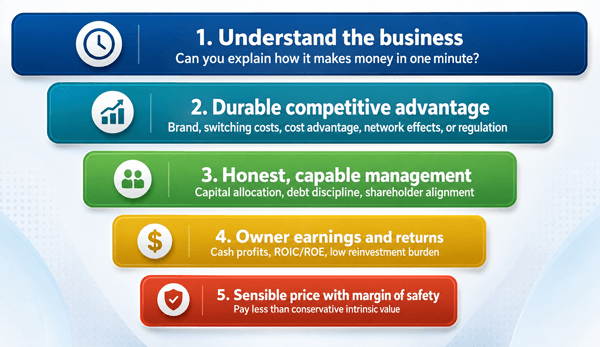
Figure 1: A practical Buffett-style stock analysis funnel. This is an original editorial diagram for this article.
3. The beginner mindset: think like a business owner
A beginner should start with the owner mindset. If you bought a small bakery in your town, you would not buy it because a chart looked exciting. You would ask how much cash it earns, whether customers are loyal, whether rent and wages are manageable, whether competitors can take business away, and whether the purchase price makes sense. Public stocks are no different. A stock is a fractional ownership interest in a business.
This mindset also makes investing calmer. Market prices can be emotional. Business value usually changes more slowly. Buffett-style analysis tries to take advantage of the gap between price and value. Price is what the market offers today. Value is what the business is worth based on its future cash generation, quality, and risk.
4. Key principles behind Warren Buffett’s stock analysis
| Principle | What it means in plain English |
|---|---|
| Circle of competence | Stay with businesses you can understand. A simple company you understand is usually safer than a complex company you cannot evaluate. |
| Economic moat | Look for a durable competitive advantage that protects profits from competitors. Examples include strong brands, low costs, network effects, switching costs, patents, scale, or regulation. |
| Owner earnings | Focus on cash that could realistically belong to owners after the company spends enough to maintain its competitive position. |
| Quality of management | Prefer managers who allocate capital rationally, communicate honestly, avoid reckless debt, and think like owners. |
| Margin of safety | Buy only when the price is comfortably below conservative value. This protects you from mistakes, bad luck, and over-optimistic forecasts. |
| Long-term holding period | Buffett-style investing works best when the business can compound value over many years, not when the investor needs quick excitement. |
5. Key metrics Buffett-style investors study
Metrics do not replace judgment. They are warning lights and evidence. The goal is not to find one magic ratio, but to build a clear picture of business quality, financial strength, valuation, and risk.
| Metric | Question it answers | Buffett-style use | Beginner warning |
|---|---|---|---|
| Revenue growth | Is demand growing? | Stable or steady growth is better than one-time spikes. | Compare 5-10 year trend, not one quarter. |
| Gross margin / operating margin | Does the business have pricing power or cost advantage? | High and stable margins often suggest a moat. | Falling margins may show competition or weak pricing power. |
| Return on equity (ROE) | How efficiently does the company use shareholder capital? | High ROE can be excellent if not caused mainly by heavy debt. | Compare with debt levels and industry norms. |
| Return on invested capital (ROIC) | Does the business earn strong returns on all operating capital? | Often more useful than ROE for comparing business quality. | Look for consistency above the cost of capital. |
| Free cash flow | How much cash remains after capital spending? | Cash funds dividends, buybacks, debt reduction, and growth. | Watch for companies with profits but weak cash flow. |
| Owner earnings | What cash could owners take out without hurting the business? | A Buffett-style estimate of true economic earnings. | Requires estimating maintenance capex, not just reported capex. |
| Debt-to-equity / net debt to earnings | Can the company survive bad years? | Lower debt gives management flexibility. | Avoid businesses that need perfect conditions to survive. |
| P/E ratio | How much investors pay for each dollar of earnings. | Useful for stable companies. | A low P/E can be a value trap if earnings are declining. |
| Price to free cash flow | How much investors pay for each dollar of cash flow. | Often better than P/E when accounting earnings are noisy. | Compare with growth, stability, and capital needs. |
| Dividend payout ratio | How much profit is paid as dividends. | A sustainable payout can be attractive for income investors. | Very high payout may leave little room for reinvestment or downturns. |
6. Owner earnings: the Buffett metric beginners should understand
In his 1986 Berkshire Hathaway shareholder letter, Buffett explained “owner earnings” as a better way to think about the cash a business produces for owners. In plain English, owner earnings asks: after the company pays the costs needed to keep the business strong, how much cash is left for shareholders?
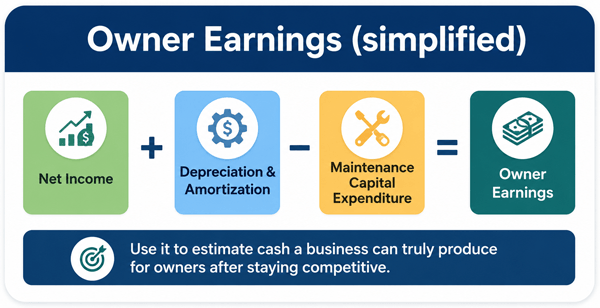
Figure 2: A simplified owner earnings formula. In real analysis, maintenance capital expenditure is an estimate and should be conservative.
Example: A company reports $100 million in net income and $20 million in depreciation. It spends $35 million on capital expenditures, but you estimate $25 million is needed just to maintain the business and $10 million is for expansion. A rough owner earnings estimate is $100 million + $20 million - $25 million = $95 million. That $95 million is closer to the cash power of the business than net income alone.
7. How to analyze a stock step by step
- Step 1: Explain the business in one paragraph - Write what the company sells, who buys it, why customers buy it, and what could go wrong. If you cannot explain it simply, put it on a watchlist instead of buying it.
- Step 2: Identify the moat - Ask why a competitor cannot easily take customers away. Look for evidence in margins, market share, customer retention, brand strength, cost advantage, or network effects.
- Step 3: Study the financial statements - Read the annual report, especially the business description, risk factors, management discussion, financial statements, and notes. The SEC’s 10-K format is designed to help investors find these sections.
- Step 4: Check earnings quality - Compare net income with operating cash flow and free cash flow. If accounting profit rises but cash flow does not, investigate before trusting the earnings.
- Step 5: Measure profitability and capital efficiency - Look at ROIC, ROE, margins, and how much reinvestment is needed. Buffett prefers businesses that can earn high returns without constantly needing huge new capital.
- Step 6: Evaluate debt and resilience - A strong company can survive recessions, lawsuits, supply shocks, and management mistakes. Check debt maturity, interest expense, cash balance, and cyclicality.
- Step 7: Judge management - Read several years of shareholder letters and conference call transcripts. Look for plain language, honest discussion of mistakes, sensible buybacks, disciplined acquisitions, and executive pay that aligns with owners.
- Step 8: Estimate intrinsic value conservatively - Use a simple valuation method: normalized owner earnings multiplied by a sensible range, or a discounted cash flow with conservative growth assumptions. Do not use heroic forecasts.
- Step 9: Demand a margin of safety - If your conservative value is $100 per share, Buffett-style discipline may require buying only at a meaningful discount, such as $70 or $75, depending on quality and risk.
- Step 10: Decide what would make you sell - Before buying, write the sell rules: thesis broken, moat weakening, debt risk rising, management losing discipline, or price far above reasonable value.
8. Practical example: comparing two simple companies
Imagine two businesses in the same industry. Both earn $100 million in reported profit. At first glance, they look equal. A Buffett-style investor looks deeper.
| Item | Company A | Company B | Interpretation |
|---|---|---|---|
| Net income | $100m | $100m | Same on the surface |
| Free cash flow | $90m | $35m | Company A converts profit into cash; Company B needs heavy spending |
| ROIC | 22% | 7% | Company A uses capital better |
| Debt | Low | High | Company B has less room for mistakes |
| Moat evidence | Stable margins, loyal customers | Margins falling, price competition | Company A appears more durable |
| Management | Regularly buys back stock only when cheap | Issues shares and makes expensive acquisitions | Company A acts more owner-friendly |
| Valuation | 18x owner earnings | 10x earnings | Company B looks cheaper, but may be a value trap |
A beginner may choose Company B because the P/E ratio looks lower. Buffett-style analysis may prefer Company A because it has higher quality, stronger cash conversion, better capital efficiency, lower financial risk, and more trustworthy management. Cheap is not enough. Quality and durability matter.
9. What beginners should know before using Buffett’s method
- Buffett’s method is simple to describe but difficult to practice. The hard part is patience, emotional discipline, and saying “no” often.
- You do not need to analyze every stock. A small circle of competence is normal. Many successful investors wait for only a few obvious opportunities.
- A stock can be a great company and still be a bad investment if the price is too high.
- A low valuation ratio can be dangerous when the business is shrinking, debt is heavy, or earnings are temporary.
- Diversification still matters. Beginners should avoid putting too much of their portfolio into one company, especially before they have years of experience.
- Index funds can be a sensible choice for many people who do not have the time, interest, or skill to analyze individual stocks.
10. Common mistakes beginners make
| Mistake | Better practice |
|---|---|
| Copying Buffett’s holdings blindly | Berkshire may buy for reasons that do not fit your account size, taxes, time horizon, or risk tolerance. |
| Using only the P/E ratio | P/E ignores balance sheet strength, cash flow quality, cyclicality, and reinvestment needs. |
| Confusing a famous brand with a moat | A brand is valuable only if it protects pricing power, customer loyalty, or market share. |
| Ignoring dilution | If a company constantly issues shares, your ownership percentage shrinks. |
| Overestimating growth | Small changes in growth assumptions can make intrinsic value look much higher than it really is. |
| Selling because of market noise | If the business thesis is intact, price volatility alone is not a reason to sell. |
| Falling in love with a stock | Good analysis includes disconfirming evidence. Look for reasons you might be wrong. |
11. Buffett-style checklist before buying a stock
- □ Can I explain the business model clearly?
- □ Is the company inside my circle of competence?
- □ Does it have a durable competitive advantage?
- □ Are revenue, margins, and cash flow reasonably consistent?
- □ Does it earn attractive ROIC or ROE without excessive debt?
- □ Does free cash flow support the reported earnings?
- □ Can the company survive a recession or industry downturn?
- □ Does management allocate capital wisely?
- □ Is the stock price below conservative intrinsic value?
- □ Do I have a written reason to buy and a written reason to sell?
- □ Would I be comfortable owning this business for five to ten years?
12. Simple valuation example for beginners
Suppose a stable company produces $5 per share in owner earnings. It has a strong moat, low debt, and modest growth. You believe a fair valuation may be 18 to 22 times owner earnings. That gives a value range of $90 to $110 per share. Because estimates are never perfect, you might require a margin of safety and only consider buying below $75 to $80. This is not a prediction. It is a disciplined way to avoid overpaying.
| Input | Example |
|---|---|
| Owner earnings per share | $5.00 |
| Conservative fair multiple | 18x |
| Estimated conservative value | $90 |
| Desired margin of safety | 20% |
| Possible buy zone | $72 or lower |
13. How to make this practical in your own research routine
A beginner can turn Buffett-style analysis into a repeatable weekly routine. Pick one company, read the latest annual report, build a one-page summary, and decide whether the company is worth deeper research. The goal is not to buy every week. The goal is to improve judgment.
| Day | Task |
|---|---|
| Monday | Read business description and risk factors. |
| Tuesday | Review income statement, balance sheet, and cash flow statement. |
| Wednesday | Calculate margins, ROE/ROIC, free cash flow, debt, and share count trend. |
| Thursday | Study competitors and moat evidence. |
| Friday | Estimate value range and write the bear case. |
| Weekend | Decide: reject, watchlist, or research deeper. |
14. FAQ
14.1 Is Buffett-style investing only for experts?
No. The core ideas are beginner-friendly: understand the business, avoid excessive debt, focus on cash, buy with a margin of safety, and think long term. The challenge is practicing them consistently.
14.2 What is the most important Buffett metric?
There is no single magic metric. Owner earnings, ROIC, free cash flow, debt, and valuation all matter. The best investors combine numbers with business judgment.
14.3 Does Buffett use technical analysis?
Buffett is known for fundamental analysis, not short-term chart trading. His focus is business value, management quality, competitive advantage, and price versus intrinsic value.
14.4 Can beginners use discounted cash flow models?
Yes, but keep them simple and conservative. A complicated spreadsheet can create false confidence. Use ranges, stress tests, and lower growth assumptions.
14.5 Should I buy a stock just because Buffett bought it?
No. Buffett’s portfolio decisions may not match your goals, taxes, account size, or time horizon. Use his principles, not blind copying.
14.6 How long should a Buffett-style investor hold a stock?
The ideal holding period is long when the business remains excellent and the price is not irrationally high. But long-term investing does not mean ignoring broken fundamentals.
15. Conclusion
Warren Buffett’s stock analysis is powerful because it is grounded in common sense. He looks for understandable businesses with durable advantages, honest and capable management, strong cash generation, high returns on capital, manageable debt, and a price below conservative value. Beginners can use the same framework by slowing down, reading annual reports, focusing on owner earnings, and refusing to buy without a margin of safety.
The best Buffett-style investors are not trying to look busy. They are trying to be right when it matters. They study patiently, avoid what they do not understand, and let compounding work over time.
Sources Consulted and Checked
The following sources were consulted and checked while preparing this article to support accuracy and reliability.
- Berkshire Hathaway Shareholder Letters archive
- Berkshire Hathaway 1986 Chairman’s Letter - owner earnings discussion
- Berkshire Hathaway annual and interim reports
- Berkshire Hathaway 2024 Annual Report
- SEC Investor Bulletin: How to Read a 10-K
- Investor.gov: Introduction to Investing
- FINRA: Using Financial Statements to Evaluate Investment Opportunities
Reader Advice
This article is provided solely for educational and informational purposes. It does not constitute personalized investment, financial, legal, tax, or professional advice, and it should not be treated as a recommendation to buy, sell, or hold any security. Investing involves risk, including the possible loss of principal. Before making any financial decision, readers should conduct independent research, consider their objectives, financial circumstances, time horizon, and risk tolerance, and consult appropriately qualified professionals where necessary.
Financial data, market conditions, company circumstances, laws, regulations, tax rules, reporting standards, and official guidance may change over time and may differ by country or individual situation. Readers should verify current facts, figures, filings, and applicable rules directly from official and primary sources before acting. Past performance does not guarantee future results, and valuation examples in this article are illustrative rather than predictions or promises of returns.