Warren Buffett's Investment Strategy: Principles Behind His Success
1. Quick Answer
Warren Buffett's investment strategy is a simple idea practiced with unusual discipline: buy understandable, financially strong businesses at sensible prices, hold them for a long time, and let business growth compound. Buffett does not try to predict next week's stock price. He tries to judge whether a company can keep earning money for many years, whether its management treats shareholders honestly, and whether the current price offers enough room for mistakes.
For a beginner, the practical lesson is not to copy every Berkshire Hathaway stock purchase. The better lesson is to think like a business owner: know what you own, avoid debt-fueled speculation, keep cash for emergencies, prefer quality over excitement, and be patient enough for compounding to work.
2. What Makes Buffett Different?
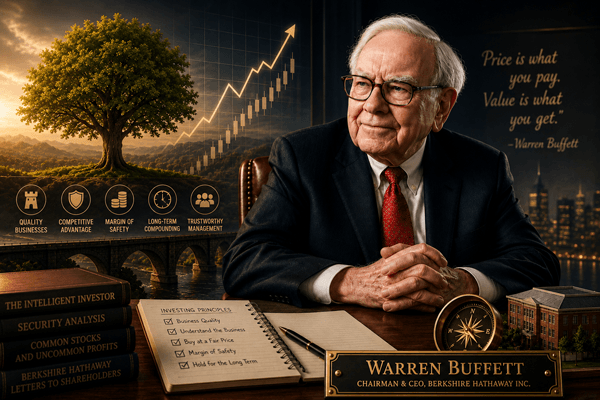
Most people enter the stock market asking, 'What stock will go up soon?' Buffett asks a different question: 'Would I be happy owning this business if the stock market closed for several years?' That shift changes everything. It moves the investor away from hype, tips, price charts, and emotional trading. It moves the investor toward business quality, cash generation, competitive advantage, and price discipline.
Berkshire Hathaway's own long-term record shows why this patient approach became famous. In its 2025 annual report, Berkshire reported a compounded annual gain of 19.7% from 1965 through 2025 versus 10.5% for the S&P 500 with dividends included. The overall gain shown for Berkshire over that period was 6,099,294%, compared with 46,061% for the S&P 500. These figures are historical, not a future promise, but they show the power of disciplined compounding over decades.
The method is easy to describe but hard to practice. It requires saying no often, ignoring market noise, and accepting that excellent investing can look boring for long periods.
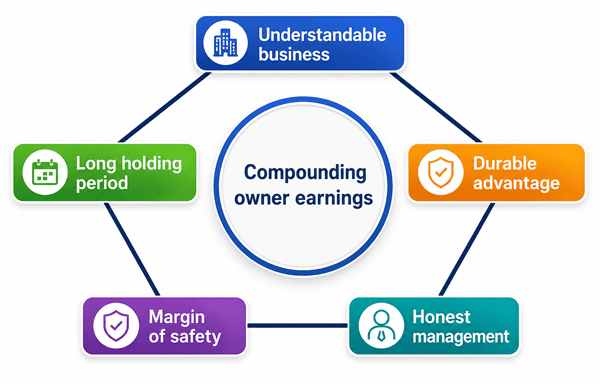
Figure 1: The Buffett Investing Flywheel
3. Buffett Strategy in One Table
| Principle | Plain-English meaning | Beginner action |
|---|---|---|
| Circle of competence | Invest only in businesses you can explain clearly. | Write a five-sentence explanation before buying any stock. |
| Economic moat | Look for durable advantages that protect profits. | Check brand strength, switching costs, scale, network effects, or low-cost leadership. |
| Margin of safety | Buy with a cushion between price and estimated value. | Avoid paying perfection prices. Use conservative assumptions. |
| Owner earnings | Focus on cash a business can generate for owners. | Look beyond headline profit; review free cash flow and debt. |
| Long-term holding | Let a strong business compound over years. | Avoid trading because of headlines, fear, or short-term price moves. |
| Management quality | Prefer honest managers who allocate capital wisely. | Read annual letters, buyback policy, debt use, and acquisition history. |
| Emotional discipline | Use temperament as an advantage. | Make decisions from a checklist, not from panic or FOMO. |
4. Think Like a Business Owner, Not a Stock Picker
Buffett's first mental model is ownership. A share is not a lottery ticket. It is a small ownership claim on a real business. If the business grows its earnings over time and uses capital wisely, the owner's value can grow. If the business destroys capital, the stock may disappoint even if the story sounds exciting.
A beginner can practice this by asking simple questions before looking at the stock chart: What does the company sell? Who are its customers? Why do customers choose it? What could damage the business? How does it make cash? Could it still be relevant in ten years?
This is why Buffett often prefers simple businesses. Simple does not mean small or weak. It means understandable. Insurance, railroads, energy, consumer brands, payment networks, and industrial businesses can be complex in operation, but their economic logic can be understood: customers need the product, the company has advantages, and the business can earn attractive returns over time.
4.1 Practical Example: A Coffee Shop Versus a Software Platform
Imagine two businesses. A local coffee shop earns steady profits but faces dozens of competitors, rising rent, and limited pricing power. A software platform with high customer switching costs may keep customers for years and earn high margins once built. Buffett-style thinking does not automatically choose one industry over another. It asks: which business has more durable economics, clearer future demand, stronger pricing power, and a better price compared with value?
5. Stay Inside Your Circle of Competence
Your circle of competence is the area where you can judge a business with reasonable confidence. Buffett does not need to understand every company. He only needs a few understandable opportunities where the odds are favorable. This protects investors from buying complex products, fashionable sectors, or speculative assets they cannot evaluate.
For beginners, the circle of competence is usually smaller than they think. That is not a weakness. It is a safety feature. A nurse may understand healthcare demand better than a semiconductor supply chain. A small-business owner may understand pricing power, inventory, and customer retention better than a trend-following trader. A software engineer may understand cloud infrastructure better than a bank balance sheet. The goal is not to know everything; it is to avoid pretending.
5.1 Circle of Competence Checklist
- Can I explain how the business makes money without using buzzwords?
- Can I name the main competitors and why customers stay or leave?
- Do I understand the biggest risks, including regulation, debt, technology change, and customer concentration?
- Can I estimate what normal earnings might look like in a recession?
- Would I still understand this business if the stock price fell 30%?
6. Look for a Durable Competitive Advantage
Buffett popularized the idea of an economic moat: something that protects a company's profits from competitors. Without a moat, high profits attract competitors, competitors cut prices, and returns fall. With a moat, a company may protect profits for many years.
| Type of moat | What it looks like | Example-style clue |
|---|---|---|
| Brand power | Customers trust the name and pay a fair price repeatedly. | A consumer product people buy without checking every alternative. |
| Switching costs | Changing providers is painful, risky, or expensive. | Business software deeply embedded in daily operations. |
| Network effects | The service becomes more useful as more people use it. | A payment network accepted by millions of merchants. |
| Cost advantage | The company can produce or deliver at lower cost. | A large retailer or insurer with scale and data advantages. |
| Regulatory or asset advantage | Hard-to-replicate licenses, routes, infrastructure, or assets. | A railroad network or regulated utility system. |
A moat should be tested, not assumed. Many companies claim to have a strong brand, but if customers quickly switch when prices rise, the brand may be weaker than management says. Many technology companies grow quickly, but if users can leave easily, the moat may be thin. The best investors look for evidence in profit margins, customer retention, return on capital, and behavior during hard times.
7. Buy at a Sensible Price: Intrinsic Value and Margin of Safety
Intrinsic value means what a business is worth based on the cash it can produce in the future. It is not an exact number. It is an estimate. Because estimates can be wrong, Buffett-style investors want a margin of safety: a discount between the price paid and conservative value.
A simple beginner version works like this: estimate normal earnings, judge whether those earnings can grow, compare the price with similar quality businesses, and ask whether the current valuation already assumes perfect results. If a stock only looks attractive under heroic assumptions, it does not offer much safety.
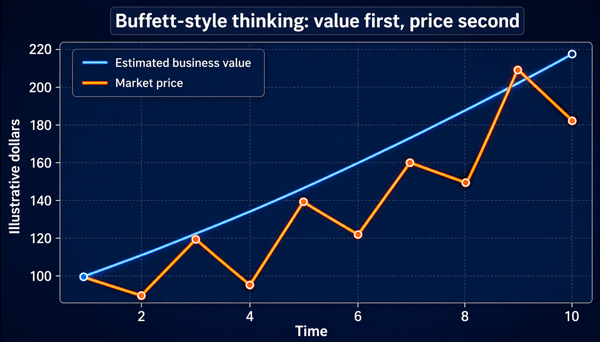
Figure 2: Price vs. Value
7.1 Simple Valuation Example
Suppose Company A earns $5 per share in normal annual profit and can grow slowly for a long time. If investors pay $100 per share, they are paying 20 times earnings. That may be reasonable for a stable, high-quality business. But if the company is cyclical, heavily indebted, or losing its advantage, 20 times earnings may be too expensive. Buffett's discipline is not merely buying cheap stocks. It is buying quality at a price that still leaves room for error.
| Business | Quality | Price/Earnings | Beginner interpretation |
|---|---|---|---|
| Company A | Stable, strong moat, low debt | 20x | May be fair if growth and durability are real. |
| Company B | Cyclical, weak moat, high debt | 8x | May be a value trap, not a bargain. |
| Company C | Excellent business, priced for perfection | 45x | Could disappoint if growth slows even slightly. |
8. Prefer Quality Over Cheapness
Early value investing often focused on statistically cheap stocks. Buffett evolved toward buying better businesses, influenced strongly by Charlie Munger. The key lesson is that a low price alone is not enough. A declining business can be cheap for a reason. A high-quality company can be worth paying a fair price for if it can reinvest profits at attractive rates for many years.
A common beginner mistake is buying stocks that have fallen heavily and calling them bargains. Price decline is not the same as value. A stock can fall 70% and still be expensive if the business model is broken. Buffett-style analysis starts with business quality, then asks whether the price is sensible.
8.1 Quality Signals to Check
- Consistent revenue and earnings through different economic cycles.
- High return on equity or return on invested capital without excessive debt.
- Free cash flow that roughly supports reported earnings.
- Clear reinvestment opportunities or disciplined cash returns to owners.
- A balance sheet strong enough to survive recessions without desperate financing.
9. Management Matters Because Capital Allocation Matters
A great business can be damaged by poor management. Buffett pays close attention to honesty, rationality, and capital allocation. Capital allocation means what leaders do with the cash the business produces: reinvest, acquire other companies, repay debt, buy back shares, or pay dividends.
Berkshire's 2025 annual report describes capital allocation principles that include investing in understandable businesses with durable advantages, partnering with high-integrity leaders, acting quickly on high-conviction ideas, and letting compounding unfold. It also says Berkshire buys back shares when they trade below conservatively determined intrinsic value. That is a practical example of value discipline applied not only to other companies, but also to Berkshire's own stock.
| Management behavior | Good sign | Warning sign |
|---|---|---|
| Communication | Clear, candid letters that discuss mistakes. | Promotional language with little detail. |
| Debt | Prudent debt matched to business stability. | Borrowing heavily to chase growth. |
| Buybacks | Repurchases when stock is below intrinsic value. | Buybacks at any price to boost per-share metrics. |
| Acquisitions | Deals that improve long-term per-share value. | Overpaying for growth or prestige. |
| Incentives | Leaders own meaningful stock and think long term. | Pay packages reward short-term stock movement only. |
10. Cash Is Not Laziness; It Is Optionality
Beginners often feel pressure to be fully invested at all times. Buffett's record shows another approach: cash can be a strategic asset. Cash protects you from forced selling, helps you handle emergencies, and gives you the ability to act when others are fearful.
In the 2025 Berkshire report, the company described maintaining a fortress-like balance sheet and noted that cash and U.S. Treasury holdings exceeded $370 billion, while also stating that Berkshire aims for ownership of productive businesses over Treasuries. The lesson is balanced: cash is useful, but it should not become a permanent excuse to avoid investing in productive assets when attractive opportunities exist.
10.1 Personal Finance Application
For an individual investor, the Buffett-style use of cash usually means building an emergency fund before aggressive stock investing, avoiding margin debt, and not investing money needed soon for rent, tuition, taxes, or a house deposit. Long-term investing works best when short-term needs are already protected.
11. Be Patient, but Do Not Be Blind
Buffett is famous for patience, but patience does not mean ignoring new facts. A long holding period makes sense when the business remains strong and the purchase thesis remains valid. If the moat erodes, debt becomes dangerous, management loses credibility, or valuation becomes extreme compared with future prospects, an investor should re-evaluate.
The beginner's challenge is separating temporary price volatility from permanent business damage. A 25% stock decline caused by broad market panic may be an opportunity if the business is intact. A 25% decline caused by fraud, permanent demand loss, or a broken balance sheet may be a warning.
12. Index Funds and Buffett: What Should Beginners Actually Do?
Many readers admire Buffett but do not have the time, interest, or accounting skill to analyze individual companies. For them, the most practical Buffett-inspired approach may be low-cost diversified index funds, steady contributions, and a long-term plan. This is not a failure. It is often more honest than pretending to be a professional stock picker.
A beginner can combine Buffett principles with simple portfolio management: keep a diversified core, avoid high-fee products that are hard to understand, use tax-efficient investing accounts when appropriate, and only buy individual stocks with money they can responsibly allocate to research-driven decisions.
| Investor type | Practical Buffett-style route | Why it fits |
|---|---|---|
| Busy beginner | Low-cost broad index fund plus emergency fund | Captures market growth without stock-picking pressure. |
| Curious learner | Index core plus small watchlist of understandable companies | Allows learning while limiting mistakes. |
| Experienced analyst | Concentrated positions in researched high-quality businesses | Requires skill, temperament, and risk control. |
| Income-focused investor | Quality dividend stocks plus diversified funds | Focuses on durability, payout safety, and valuation. |
13. Beginner Action Plan: How to Use Buffett Principles Step by Step
- Build a cash reserve first. Do not invest emergency money in stocks.
- Pay down high-interest debt before chasing investment returns.
- Choose a simple investment policy: goals, time horizon, risk tolerance, target allocation, and rebalancing rule.
- Use diversified low-cost funds as the core unless you genuinely want to analyze businesses.
- Create a watchlist of companies you understand and follow them for months before buying.
- Read annual reports, not just social media posts or price targets.
- Estimate value conservatively and demand a margin of safety.
- Write down the reason for every investment before buying.
- Review the business, not the stock price, on a regular schedule.
- Keep a mistake journal so experience becomes useful instead of expensive.
14. A Practical Stock Research Template
| Question | What to write before buying |
|---|---|
| Business model | How does the company make money in one paragraph? |
| Customer value | Why do customers buy from this company instead of competitors? |
| Moat | What protects profits five to ten years from now? |
| Financial strength | How much debt exists, and can the company handle a recession? |
| Owner earnings | Does free cash flow support reported profit? |
| Management | Has management allocated capital well and communicated honestly? |
| Valuation | What conservative value range do I estimate? |
| Margin of safety | What price would make the odds attractive? |
| Risks | What would prove my thesis wrong? |
| Exit rule | What business change, not price movement alone, would make me sell? |
15. Common Mistakes Beginners Make When Copying Buffett
- Copying Berkshire holdings without understanding position size, tax context, timing, or opportunity cost.
- Buying a stock only because Buffett once bought a similar business decades ago.
- Confusing low P/E ratios with true value.
- Ignoring debt, cyclicality, and share dilution.
- Selling quality businesses because of normal market volatility.
- Holding broken businesses forever because Buffett talks about long-term investing.
- Overconcentrating before developing research skill and emotional discipline.
- Using borrowed money or options to imitate a strategy built on patience and survival.
16. Buffett Strategy vs. Other Investing Styles
| Style | Main focus | Best for | Main risk |
|---|---|---|---|
| Buffett-style value investing | Business quality, intrinsic value, margin of safety | Patient investors who like analysis | Can underperform for years and requires judgment. |
| Index investing | Own the broad market at low cost | Most beginners and busy professionals | Market declines still hurt; returns are average before behavior. |
| Dividend investing | Cash distributions and payout durability | Income-focused investors | High yield can signal business trouble. |
| Growth investing | Fast revenue and earnings growth | Investors skilled at assessing future markets | Overpaying for optimism. |
| Trading | Short-term price movement | Experienced traders with risk systems | High costs, taxes, stress, and behavioral errors. |
17. Understanding the Limits of Buffett-Style Investing
A responsible article about Warren Buffett's investment strategy should not promise easy wealth. It should explain both the strengths and limits of the approach. Buffett's success came from skill, temperament, reputation, access to deals, insurance float, tax efficiency, and decades of compounding. A beginner cannot replicate all of that. But a beginner can copy the habits that matter most: patience, clarity, conservative valuation, low debt, honest self-assessment, and respect for risk.
Clear, people-first investment education should inform readers without hype. No strategy guarantees success, and no company should be presented as 'the next Berkshire.' Markets are uncertain. Even excellent businesses can be poor investments if bought at excessive prices, and even careful investors make mistakes.
18. Frequently Asked Questions
18.1 What Is Warren Buffett's Investment Strategy in Simple Words?
It is buying good businesses at sensible prices and holding them long enough for the business value to compound. The focus is business quality, not short-term price prediction.
18.2 Is Warren Buffett a Value Investor or a Growth Investor?
He is usually called a value investor, but his mature strategy blends value and quality. He wants to pay less than a business is worth, but he prefers businesses that can grow owner earnings over time.
18.3 Can Beginners Use Buffett's Strategy?
Yes, but beginners should start with the principles rather than copying individual holdings. The safest starting point for many readers is a diversified low-cost portfolio, then gradually learning business analysis.
18.4 Does Buffett Only Buy Cheap Stocks?
No. Cheapness alone is not enough. Buffett looks for understandable companies, durable advantages, capable management, strong finances, and a price that makes sense.
18.5 What Is Margin of Safety?
It is the cushion between what you pay and what you conservatively estimate the business is worth. It protects you when your assumptions are wrong or the future is harder than expected.
18.6 Should I Sell When the Stock Price Falls?
Not automatically. First ask whether the business value has changed. A falling price can be an opportunity if the business remains strong, but it can be a warning if the fundamentals are deteriorating.
19. Final Takeaway
Warren Buffett's investment strategy is powerful because it is built on common sense repeated with discipline: understand the business, demand quality, pay a sensible price, avoid unnecessary risk, and give compounding time to work. The hard part is not learning the words. The hard part is behaving this way when markets are emotional.
For a beginner, the best first step is not to search for a secret stock tip. It is to build a strong financial base, learn how businesses create value, invest with a written plan, and avoid decisions that can permanently damage capital. Buffett's strategy is not about getting rich quickly. It is about making fewer foolish decisions for a very long time.
Sources Consulted and Checked
The following sources were consulted and checked while preparing this document to support accuracy, context, and responsible presentation.
- Berkshire Hathaway Inc., 2025 Annual Report, CEO letter and performance table. Used for Berkshire's historical performance, capital discipline, cash/Treasury holdings, and stated capital allocation principles.
- Berkshire Hathaway official website, shareholder letters archive and annual/interim reports page. Used as the primary source hub for Buffett and Berkshire materials.
- Berkshire Hathaway Inc., 2024 Annual Report. Used as background for Buffett's most recent pre-transition shareholder commentary.
- Robert G. Hagstrom, The Warren Buffett Way. Used as a secondary framework for common Buffett tenets such as business, management, financial, and value analysis.
- General investor education concepts: intrinsic value, margin of safety, diversification, index funds, risk tolerance, and tax-efficient investing are presented for education only, not as personalized financial advice.
Reader Advice
This article is provided solely for educational and informational purposes. It does not constitute personal financial, investment, legal, tax, or professional advice; it is not a recommendation to buy, sell, or hold any security; and it does not promise any particular result or return. Investment rules, market conditions, tax treatment, regulations, company information, and reported figures may change over time and may differ by country, account type, and personal circumstances.
Before making any financial decision, readers should independently verify material facts and figures through current official sources, consider their objectives, time horizon, financial position, and risk tolerance, and seek advice from a suitably qualified and regulated professional when appropriate. All investing involves risk, including the possible loss of principal, and past performance does not guarantee future results.