Peter Lynch's Investment Strategy: How to Find Winning Stocks
1. Introduction: Why Peter Lynch Still Matters
Peter Lynch became famous because he made stock investing sound less mysterious without making it careless. His core message was simple: ordinary people can find interesting investment ideas in everyday life, but they must still research the business before buying the stock.
That last part is the key. Lynch is often reduced to the slogan “buy what you know,” but a more accurate version is: start with what you know, then prove it with numbers. A busy restaurant, a popular software product, or a store your family loves can be a clue. It is not a complete investment case.

Peter Lynch managed Fidelity’s Magellan Fund from 1977 to 1990 and became widely known for combining common-sense observation with deep fundamental analysis. His approach is often linked with growth at a reasonable price, or GARP: finding businesses that can grow, but not paying any price for that growth.
2. What Is Peter Lynch’s Investment Strategy?
Peter Lynch’s investment strategy is a practical stock-picking approach based on five ideas:
- Look for investment clues in real life, such as products people love, stores with repeat customers, or companies solving obvious problems.
- Understand the business before you look at the stock price. If you cannot explain how the company makes money, you are guessing.
- Study the financials: earnings, sales, debt, profit margins, cash flow, and valuation.
- Match the stock to the right category. A fast-growing company, a cyclical company, and a turnaround need different analysis.
- Hold winners patiently while the original business story remains intact, but sell when the facts change.
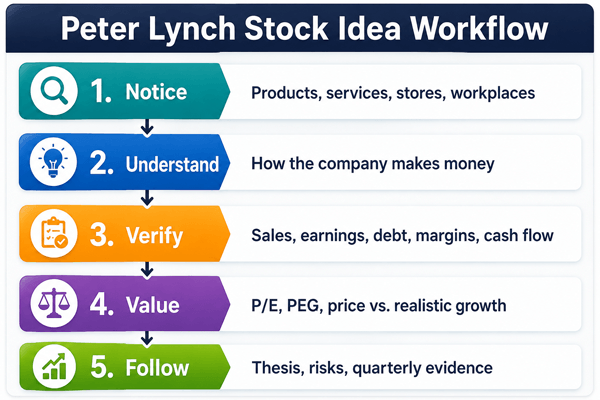
Figure 1. Peter Lynch stock idea workflow: notice, understand, verify, value, and follow.
2.1 The Strategy in One Sentence
Find understandable companies with real growth, durable advantages, reasonable debt, and a stock price that does not already assume perfection.
2.2 The Beginner Mistake: “I Know the Product” Is Not the Same as “I Know the Stock”
Many beginners hear “invest in what you know” and buy shares of a company because they like the brand. That is not Lynch’s full method. A great product can still be a bad investment if the company has weak margins, too much debt, slowing growth, bad management, or an expensive stock price.
| Beginner assumption | Lynch-style question | Why it matters |
|---|---|---|
| “The store is always crowded.” | Are same-store sales and profits rising? | Crowds do not matter if discounts destroy margins. |
| “Everyone uses the app.” | Is the company monetizing users profitably? | Popular products can still lose money. |
| “The stock is down, so it is cheap.” | Is earnings power falling faster than price? | A falling stock can be a value trap. |
| “The company is growing fast.” | Is the valuation reasonable compared with growth? | Overpaying can ruin a good business investment. |
3. How Peter Lynch Found Stock Ideas
Lynch liked the idea that individual investors may notice change before Wall Street fully reacts. A teacher may notice a new education platform spreading through schools. A nurse may see which medical devices hospitals prefer. A parent may see which low-cost retailer is gaining loyalty. A small business owner may notice which payment software saves time.
The advantage is not secret information. The advantage is attention. You are not looking for rumors. You are looking for visible business momentum that anyone could legally observe.
3.1 Places to Look for Stock Ideas
- Your workplace and industry
- Products your family repeatedly buys
- Retail stores with real customer traffic
- Software tools people do not want to stop using
- Suppliers or vendors gaining share in your field
- Public companies behind boring but essential services
3.2 Red Flags While Looking for Ideas
- Hype without profits
- Products popular only because of heavy discounts
- Companies you cannot understand after one hour of reading
- Management constantly issuing new shares
- High debt in a weak or cyclical business
- A stock story based only on “someone on social media said so”
4. Lynch’s Six Stock Categories Explained Simply
One useful part of Lynch’s method is that he did not analyze every company the same way. He grouped stocks into categories. This helps beginners ask the right questions instead of using one checklist for every stock.
| Category | Simple meaning | What can go right | Main risk | Useful metrics |
|---|---|---|---|---|
| Slow grower | Mature company with limited growth | Stable dividends | Low growth traps investors | Dividend payout, debt, cash flow |
| Stalwart | Large company with steady earnings | Moderate gains with lower drama | Overpaying for safety | P/E, earnings consistency, margins |
| Fast grower | Smaller company growing quickly | Potential multi-bagger returns | Growth slows or valuation collapses | Revenue growth, earnings growth, PEG, debt |
| Cyclical | Business rises and falls with cycles | Big gains near cycle recovery | Buying at peak earnings | Inventory, industry capacity, commodity prices |
| Turnaround | Troubled business trying to recover | Large rebound if fixed | Bankruptcy or dilution | Cash runway, debt maturities, restructuring progress |
| Asset play | Hidden assets worth more than market sees | Market revalues assets | Assets are overstated or inaccessible | Book value, asset sales, real estate, cash |
5. The “Company Story”: Lynch’s Most Practical Tool
Before buying any stock, write a short story that explains why the company should be worth more in the future. This is not a marketing story. It is a testable investment thesis.
A good company story answers these questions:
- What does the company sell?
- Who buys it and why?
- How does the company make money?
- What is causing growth?
- How long can that growth continue?
- What could break the story?
- What evidence would make you sell?
Example thesis: “Company A sells affordable home repair tools through big retailers and online. Sales are growing because more homeowners are doing small repairs themselves. The company has low debt, rising margins, and a valuation that is not extreme compared with earnings growth. I would change my mind if sales growth slows for two quarters while inventory rises.”
6. The Numbers Beginners Should Check
Lynch was not anti-numbers. He wanted investors to connect the story with the financial statements. Here is a beginner-friendly checklist.
| Item | What to check | Good sign | Warning sign |
|---|---|---|---|
| Revenue growth | Are sales rising over several years? | Growth is steady and not only from one temporary event. | Sales jump once, then flatten. |
| Earnings growth | Are profits rising with sales? | Profit growth follows revenue growth. | Sales grow but losses widen. |
| Debt | Can the company handle its obligations? | Debt is manageable relative to cash flow. | Debt is high and interest costs are rising. |
| Margins | Does the company keep more profit per sale? | Margins stable or improving. | Margins shrinking despite growth. |
| Cash flow | Does profit turn into cash? | Operating cash flow supports earnings. | Accounting profits without cash. |
| Valuation | Is the price reasonable? | P/E and PEG make sense for growth rate. | Price assumes perfect future growth. |
7. How to Use the PEG Ratio Without Fooling Yourself
The PEG ratio compares a stock’s price-to-earnings ratio with its earnings growth rate. A simple version is:
PEG = P/E ratio ÷ expected earnings growth rate
Example: if a company has a P/E ratio of 20 and expected earnings growth of 20 percent, the PEG is 1.0. If the P/E is 30 and growth is 15 percent, the PEG is 2.0. Lynch often looked for growth that was not overpriced, but beginners should treat PEG as a rough tool, not a magic formula.
| Company | P/E | Expected earnings growth | PEG |
|---|---|---|---|
| A | 15 | 20% | 0.75 |
| B | 25 | 25% | 1.00 |
| C | 40 | 20% | 2.00 |
| D | 8 | -5% | Not useful |
Practical warning: PEG becomes unreliable when earnings are temporarily depressed, growth estimates are unrealistic, the company is cyclical, or profits are negative. Always ask where the growth estimate comes from and whether it is sustainable.
8. A Practical Peter Lynch Stock Research Process
8.1 Step 1: Start with an Understandable Idea
Write down why the company caught your attention. Keep it simple and observable.
8.2 Step 2: Read the Latest Annual Report and Investor Presentation
Look for how the company describes revenue, risks, segments, debt, and strategy.
8.3 Step 3: Check Five-Year Financial Trends
Look at sales, earnings, margins, debt, shares outstanding, and cash flow.
8.4 Step 4: Compare with Competitors
A company may look strong until you see that competitors are growing faster with better margins.
8.5 Step 5: Estimate Reasonable Growth
Avoid fantasy projections. Ask what needs to happen for the company to double profits.
8.6 Step 6: Decide What Would Make You Sell
A sell rule protects you from falling in love with your own idea.
9. Worked Example: Applying Lynch’s Strategy to a Fictional Company
Imagine you notice a fictional public company called CleanSip, which sells reusable water bottles through supermarkets, gyms, and online marketplaces. You see the product everywhere. That is only the starting clue.
| Research question | CleanSip example | Decision impact |
|---|---|---|
| Is demand real? | Revenue grew 18%, 21%, and 19% in the last three years. | Supports growth story. |
| Are profits improving? | Operating margin rose from 8% to 12%. | Shows scale advantage. |
| Is debt risky? | Debt is low and interest expense is small. | Reduces bankruptcy risk. |
| Is valuation fair? | P/E is 24 and realistic growth is around 18%. PEG is 1.3. | Not cheap, but not absurd. |
| What could go wrong? | Competitors can copy designs; retailers may demand discounts. | Requires margin monitoring. |
A Lynch-style beginner conclusion might be: “CleanSip is worth watching or buying only if I can accept the valuation and monitor margins. I should not buy simply because I like the bottle.”
10. Peter Lynch Strategy vs. Other Investing Styles
| Style | Main focus | Best for | Main risk |
|---|---|---|---|
| Peter Lynch / GARP | Understandable growth at a reasonable price | Investors willing to research businesses | Overconfidence in familiar brands |
| Deep value investing | Buying assets or earnings very cheaply | Patient investors comfortable with unpopular stocks | Value traps and weak businesses |
| Pure growth investing | Fast revenue and earnings growth | Investors who can handle volatility | Overpaying for future growth |
| Index investing | Broad market ownership | Most beginners and passive investors | No chance to outperform the market before fees |
| Dividend investing | Cash income and stability | Income-focused investors | Chasing high yields from weak companies |
11. How Beginners Can Use Lynch’s Strategy Safely
A practical way for beginners to use Lynch’s strategy is not to put all savings into individual stocks. A more responsible approach is to keep a diversified core portfolio and use a smaller “learning portfolio” for researched stock ideas. Diversification cannot remove all risk, but it can reduce the damage from being wrong about one company.
- Start with education before stock picking.
- Use position sizing so one mistake does not damage your financial life.
- Avoid margin debt and short-term trading if you are a beginner.
- Write down your thesis before buying.
- Review the thesis after earnings reports, not every hour.
- Never buy because of fear of missing out.
- Do not confuse a falling stock with a bargain.
12. Common Mistakes People Make with the Peter Lynch Method
| Mistake | Why it hurts | Better practice |
|---|---|---|
| Buying only because you like the product | The stock may already be overpriced. | Check valuation and financials. |
| Ignoring debt | Debt can destroy shareholders during downturns. | Read the balance sheet and debt maturity notes. |
| Using PEG blindly | Growth estimates can be wrong. | Use conservative assumptions. |
| Selling winners too early | Big winners need time to compound. | Hold while the thesis remains true. |
| Holding losers without evidence | Hope is not analysis. | Define sell triggers in advance. |
| Copying famous investors late | Their price, goal, and risk may differ from yours. | Build your own thesis. |
13. A Simple Lynch-Style Checklist Before Buying a Stock
- Can I explain the business in two sentences?
- What category is this stock: stalwart, fast grower, cyclical, turnaround, asset play, or slow grower?
- What is the company’s growth driver?
- Are revenue, earnings, and cash flow improving?
- Is debt manageable?
- Is the stock price reasonable compared with growth?
- What does management say in the annual report?
- What are the top three risks?
- What evidence would prove my thesis wrong?
- How much can I lose if I am wrong?
14. Frequently Asked Questions
14.1 Is Peter Lynch’s Strategy Good for Beginners?
Yes, as an educational framework, because it teaches beginners to understand businesses instead of chasing stock tips. However, beginners should still diversify, manage risk, and avoid putting money into companies they have not researched.
14.2 Did Peter Lynch Mean “Buy Any Company You Know”?
No. Familiarity is only the starting point. Lynch-style investing requires checking earnings, debt, valuation, growth, competition, and the company’s story.
14.3 What Is a Tenbagger?
A tenbagger is a stock that rises to ten times the original purchase price. Lynch popularized the term, but tenbaggers are rare and usually require patience, business growth, and the discipline not to sell too early.
14.4 What Is a Good PEG Ratio?
Many investors view a PEG around 1 or lower as attractive, but the number depends on the quality and reliability of growth. PEG is less useful for cyclical companies, negative earnings, and unstable businesses.
14.5 Can This Strategy Work Today?
The principles still make sense: understand what you own, research the business, avoid overpaying, and think long term. The challenge today is that information moves faster, hype spreads quickly, and many popular companies are expensive before beginners notice them.
14.6 Should I Use This Instead of Index Funds?
Not necessarily. Many investors use diversified index funds as a core portfolio and individual stocks only as a smaller researched portion. This can reduce the risk of one bad stock decision damaging the whole plan.
15. Final Takeaway
Peter Lynch’s investment strategy is powerful because it is both simple and demanding. Simple: start with businesses you can understand. Demanding: prove the idea with research, numbers, valuation, and patience. The best beginner lesson is not “buy what you know.” It is “notice what you know, then investigate like an owner.”
For a reader with no background in investing, this is the safest way to understand Lynch’s message: your everyday experience can help you find ideas, but only disciplined research can turn an idea into a responsible investment decision.
Sources Consulted and Checked
These sources were consulted and checked while preparing this article to support its accuracy and educational value.
- Fidelity / Peter Lynch investing philosophy and interviews: https://www.fidelity.com/
- SEC Investor.gov - Introduction to Investing: https://www.investor.gov/introduction-investing
- SEC - Beginner’s Guide to Asset Allocation, Diversification, and Rebalancing: https://www.sec.gov/about/reports-publications/investorpubsassetallocationhtm
- FINRA - Investing Basics: Risk: https://www.finra.org/investors/investing/investing-basics/risk
- Peter Lynch and John Rothchild, One Up on Wall Street, Simon & Schuster: https://www.simonandschuster.com/books/One-Up-On-Wall-Street/Peter-Lynch/9780743200400
- Peter Lynch and John Rothchild, Beating the Street, Simon & Schuster: https://www.simonandschuster.com/books/Beating-the-Street/Peter-Lynch/9780671891633
- Investopedia - Peter Lynch and GARP/PEG educational references: https://www.investopedia.com/terms/p/peterlynch.asp
Reader Advice
This article is provided solely for educational and general informational purposes. It does not constitute personal financial, investment, legal, tax, or accounting advice, and it does not recommend any particular stock, fund, broker, adviser, platform, strategy, account, or portfolio allocation. Investing in individual securities involves risk, including the possible permanent loss of capital. Before making any financial decision, readers should assess their own objectives, time horizon, financial circumstances, and tolerance for risk, and should consider consulting an appropriately qualified and regulated professional.
Financial rules, tax treatment, market conditions, company information, valuations, and regulatory requirements can change over time and may differ by country or personal circumstances. Readers should therefore verify material facts, figures, filings, and current requirements through official company disclosures, securities regulators, tax authorities, and other authoritative sources before acting.