Benjamin Graham's Investing Principles: Lessons for Value Investors
1. Introduction: Why Benjamin Graham Still Matters
Benjamin Graham is widely known as the father of value investing because he turned investing from a guessing game into a disciplined process. His core message is simple: a stock is not just a ticker symbol moving up and down on a screen. It represents partial ownership in a real business. If you can estimate what that business is worth and buy it at a meaningfully lower price, you give yourself a better chance of earning a sensible return while reducing the chance of permanent loss.

This article explains Graham's ideas in plain English. It is written for a person who has no background in investing, accounting, or stock market analysis. You will learn what value investing is, how the margin of safety works, how to think about Mr. Market, what beginners should check before buying a stock, and how to use Graham's principles in today's market without blindly copying old formulas.
Key takeaway: Graham investing is not about finding a cheap-looking stock. It is about buying a sound business or security at a price that gives you protection against mistakes, bad news, and market mood swings.
2. What Is Value Investing?
Value investing is an investment strategy where the investor looks for securities selling below a reasonable estimate of their true economic value. In everyday language, it is like buying a good product during a sale, but with one big difference: in the stock market, the 'sale price' may exist because investors are scared, distracted, impatient, or overly focused on short-term news.
A value investor does not ask, 'Which stock is popular this week?' The better question is: 'What is this business worth, what are the risks, and is the current price low enough to justify buying it?' That mindset separates investing from speculation.
| Speculation mindset | Graham-style investing mindset |
|---|---|
| I hope the price goes up quickly. | I want to understand what the asset is worth. |
| Everyone is buying it, so I should too. | Popularity is not proof of value. |
| A falling price means I must be wrong. | A falling price may create opportunity if the business value remains intact. |
| I only need a chart or social media tip. | I need financial statements, valuation, risk review, and patience. |
| I focus on excitement. | I focus on downside protection and long-term results. |
3. The Four Big Benjamin Graham Principles
3.1 Think Like a Business Owner, Not a Ticker Watcher
Graham taught that a stock should be analyzed as a claim on a business. When you buy shares, you are not buying a lottery ticket. You are buying a small ownership stake in a company with assets, liabilities, revenue, profits, competitors, managers, and future risks. This shift in thinking is powerful because it slows you down. You stop reacting to every market movement and start asking business questions.
- How does the company make money?
- Is revenue stable, growing, or declining?
- Does the company earn real profits and cash flow?
- How much debt does it carry?
- Is management honest with shareholders?
- Would I be comfortable owning this business if the stock market closed for a year?
3.2 Estimate Intrinsic Value
Intrinsic value means a reasonable estimate of what a business is worth based on facts such as assets, earnings, dividends, cash flow, financial strength, and future prospects. It is not a precise number. It is usually a range. A beginner should not pretend to value a company to the last decimal point. Graham's approach is more humble: estimate value conservatively, admit uncertainty, and demand a discount.
| Valuation input | Beginner-friendly meaning | Why it matters |
|---|---|---|
| Earnings | How much profit the company keeps after expenses | Consistent profits support business value. |
| Cash flow | Actual cash generated by operations | Cash pays debt, dividends, and reinvestment costs. |
| Assets | Things the company owns: cash, inventory, property, investments | Assets can provide downside support, especially for conservative investors. |
| Debt | Money the company owes | High debt can turn a cheap stock into a value trap. |
| Growth prospects | Likely future improvement in sales and profits | Growth is useful only if you do not overpay for it. |
| Management quality | Capital allocation, honesty, shareholder treatment | Poor management can destroy value even in a good business. |
3.3 Demand a Margin of Safety
Margin of safety is Graham's most practical idea. It means buying only when the market price is meaningfully lower than your conservative estimate of value. The gap protects you because your estimate may be wrong, the business may face unexpected trouble, or the market may stay negative for longer than expected.
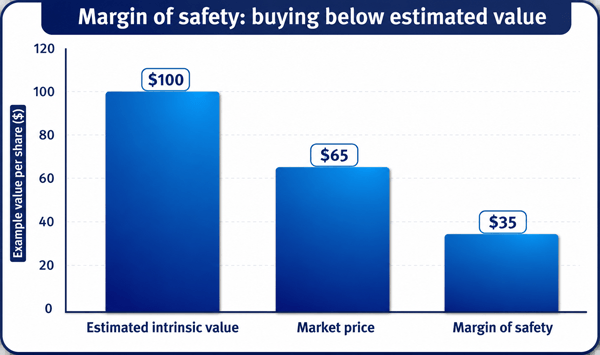
Figure 1: A simple margin of safety example. If estimated value is $100 and the stock trades at $65, the $35 gap is the investor's cushion.
Key takeaway: The purpose of margin of safety is not to guarantee profit. It is to reduce the damage caused by overconfidence, bad assumptions, and market uncertainty.
3.4 Use Mr. Market Instead of Being Used by Him
Graham described the market as an emotional business partner named Mr. Market. Every day, he offers to buy your share of a business or sell you his share. Some days he is optimistic and quotes a high price. Other days he is fearful and quotes a low price. You are not required to agree with him. You can ignore him until the price is attractive.
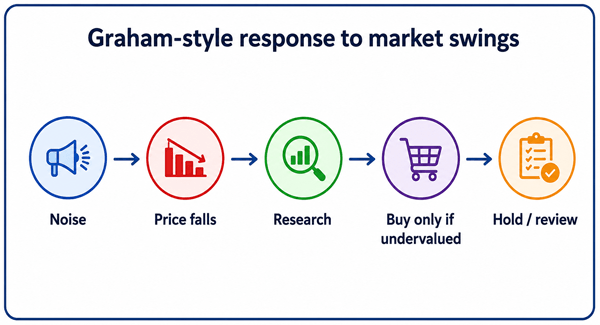
Figure 2: A Graham-style investor treats market volatility as information, not instruction.
4. How Benjamin Graham Investing Works Step by Step
4.1 Build financial safety first
Before buying individual stocks, beginners should have emergency savings, manageable debt, and a clear time horizon. Investing money you may need soon forces emotional decisions.
4.2 Define your circle of competence
Start with businesses you can understand. If you cannot explain how the company makes money in two sentences, it may be outside your current circle.
4.3 Screen for financial strength
Look for manageable debt, positive earnings, positive cash flow, and a record of surviving difficult periods. Graham preferred strength before excitement.
4.4 Estimate value conservatively
Use simple valuation tools such as price-to-earnings, price-to-book, dividend yield, free cash flow yield, or asset value. Treat the result as a range, not a perfect answer.
4.5 Require a discount
A stock that is worth about $100 may not be attractive at $98. A value investor waits for a discount large enough to compensate for uncertainty.
4.6 Write down the reason before buying
A one-page investment note can prevent emotional mistakes. Include the business summary, valuation, risks, expected holding period, and reason the market may be mispricing the stock.
4.7 Review the thesis, not the daily price
After buying, track whether the business facts are improving or weakening. Daily price changes matter less than revenue, cash flow, debt, competitive position, and management behavior.
5. Practical Example: A Simple Graham-Style Stock Review
Imagine a company called Stable Tools Ltd. It sells industrial tools, has been profitable for 10 years, pays a modest dividend, and carries little debt. The stock price recently fell because investors are worried about a slow economy. A beginner using Graham's framework might create the following simple review.
| Question | Example answer | Graham-style interpretation |
|---|---|---|
| Is the business understandable? | It sells tools to factories and repair businesses. | Simple enough to analyze. |
| Is it profitable? | Earnings have been positive in 9 of the last 10 years. | Good sign, but check why one year was weak. |
| Is debt dangerous? | Debt is 25% of total capital. Interest is covered 8 times by operating profit. | Debt appears manageable. |
| Estimated value range | Using conservative earnings and book value, estimated value is $45-$55 per share. | Use the lower end for caution. |
| Current price | Stock trades at $32. | Possible margin of safety if analysis is correct. |
| Main risk | A recession could reduce orders for 1-2 years. | Risk is real; position size should be moderate. |
| Decision | Watchlist or small purchase after deeper research. | Not a blind buy; verify statements and compare competitors. |
In this example, the beginner does not buy only because the stock price fell. The decision depends on business quality, balance sheet strength, conservative valuation, and risk control. That is the difference between value investing and bargain hunting.
6. Defensive Investor vs Enterprising Investor
Graham separated investors into two broad groups. This distinction is very useful for beginners because it prevents people from pretending they have more time, skill, or emotional discipline than they really do.
| Investor type | Best for | Typical approach | Main risk |
|---|---|---|---|
| Defensive investor | Busy people, beginners, retirement savers, people who do not want to analyze many companies | Diversified portfolio, funds or high-quality stocks, strict risk control, less trading | Getting bored and chasing hot stocks. |
| Enterprising investor | People willing to study financial statements, valuation, industries, and management behavior | Active stock selection, deeper research, special situations, contrarian opportunities | Overconfidence, too much concentration, and confusing cheap with valuable. |
Key takeaway: Most beginners should start as defensive investors. You can become more enterprising only after you prove that you can analyze businesses calmly and manage risk honestly.
7. Beginner Checklist Before Buying a Value Stock
| Checklist item | Yes/No |
|---|---|
| I understand how the company makes money. | |
| The company has a history of profits or a clear path to profits. | |
| Debt looks manageable under conservative assumptions. | |
| Free cash flow is positive or the reason for weakness is temporary and understandable. | |
| The current price is below a conservative estimate of intrinsic value. | |
| I have identified the main risks and what would prove my thesis wrong. | |
| The position size is small enough that I can think clearly. | |
| I am not buying only because of social media, news hype, or fear of missing out. | |
| I have compared this company with at least two competitors or alternatives. | |
| I know when I would sell: overvaluation, thesis failure, better opportunity, or risk change. |
8. Common Value Investing Metrics Explained Simply
| Metric | Plain-English meaning | Useful when | Warning |
|---|---|---|---|
| P/E ratio | Price compared with annual earnings | Comparing profitable companies in the same industry | Low P/E may signal declining profits. |
| P/B ratio | Price compared with accounting book value | Banks, insurers, asset-heavy businesses | Book value may be overstated for weak assets. |
| Dividend yield | Annual dividend compared with stock price | Income-oriented analysis | Very high yield may be a dividend cut warning. |
| Free cash flow yield | Cash flow after capital spending compared with market value | Quality businesses with steady operations | Cash flow can be temporarily high or low. |
| Debt-to-equity | Borrowing compared with shareholder capital | Financial strength check | Some industries naturally use more debt. |
| Interest coverage | Operating profit compared with interest expense | Debt safety review | Coverage can collapse during recessions. |
9. Value Investing vs Growth Investing
Value and growth investing are often presented as opposites, but the best investors understand that value and growth are connected. A growing business can be a value investment if the price is reasonable. A low-priced business can be expensive if its future is deteriorating.
| Factor | Value investing | Growth investing | Balanced view |
|---|---|---|---|
| Main focus | Price below value | Future expansion | Growth matters, but price still matters. |
| Typical opportunity | Unpopular, overlooked, temporarily troubled stocks | Fast-growing companies with strong future prospects | Both require careful valuation. |
| Main danger | Value traps | Overpaying for optimism | Avoid weak businesses and unrealistic expectations. |
| Best investor behavior | Patience and discipline | Vision and tolerance for volatility | Use facts, not labels. |
10. The Biggest Beginner Mistakes Graham Would Warn Against
10.1 Buying because a stock is down
A 60% price drop does not automatically mean value. The business may be permanently impaired. Always ask whether intrinsic value is stable, rising, or falling.
10.2 Ignoring debt
Debt can destroy a value thesis. A cheap stock with a weak balance sheet may become cheaper for a good reason.
10.3 Overconfidence in valuation
Intrinsic value is an estimate. Use conservative assumptions and require a wide margin of safety.
10.4 No written thesis
If you do not write down why you bought, you may not know whether later news supports or breaks your investment case.
10.5 Confusing patience with stubbornness
Value investors are patient, but they change their mind when facts change. Holding a broken thesis is not discipline.
10.6 Concentrating too early
Beginners often underestimate emotional pressure. Diversification helps you survive mistakes while learning.
11. How to Use Graham Principles in Today's Market
Modern markets move faster than Graham's era. Information is widely available, index funds are common, technology companies can be asset-light, and accounting can be complex. Still, Graham's principles remain useful because human behavior has not changed. Investors still become greedy, fearful, impatient, and overconfident.
- Use index funds as a baseline. Before picking individual stocks, ask whether your analysis is likely to beat a low-cost diversified fund after time, taxes, and mistakes.
- Be careful with old formulas. Graham's exact numerical screens were built for a different market. Use the principles, not just mechanical rules.
- Include qualitative analysis. Brand strength, network effects, switching costs, and management skill may not appear fully in book value.
- Avoid leverage as a beginner. Borrowed money can turn temporary volatility into permanent loss.
- Keep position sizes modest. A good idea can still lose money if it is too large for your temperament.
- Review opportunity cost. A stock is not attractive only because it is cheap; it must be better than available alternatives.
12. A Practical Graham-Style Research Template
| Section | What to write |
|---|---|
| Business summary | What the company does, how it earns money, and why customers buy from it. |
| Financial strength | Debt, cash, interest coverage, profitability, and cash flow record. |
| Valuation range | Conservative estimate using 2-3 methods, with assumptions listed clearly. |
| Margin of safety | Current price compared with low-end intrinsic value estimate. |
| Risks | Business, industry, debt, management, regulation, technology, and valuation risks. |
| Catalysts | What could help the market recognize value: earnings recovery, asset sale, dividend growth, buybacks, improved margins. |
| Sell rules | Sell when price exceeds value, thesis breaks, debt risk rises, or a better risk-adjusted opportunity appears. |
13. Helpful Facts for Readers
- Graham's ideas influenced many long-term investors, including Warren Buffett, who studied under him at Columbia Business School.
- The phrase margin of safety is central because it accepts that investors cannot predict the future perfectly.
- Diversification and asset allocation remain essential risk-management tools, especially for beginners.
- A low valuation ratio should start research, not end it. The real question is whether the market is wrong or the business is weak.
- The best value investing process is boring in a good way: research, wait, buy carefully, monitor facts, and avoid emotional trading.
14. FAQ: Benjamin Graham Investing Principles
14.1 Is Benjamin Graham investing good for beginners?
Yes, because it teaches caution, business analysis, and risk control. However, beginners should usually start defensively and avoid concentrated stock picking until they understand financial statements and valuation.
14.2 What is the most important Graham principle?
Margin of safety. It forces you to buy only when the price gives room for error.
14.3 Does value investing still work?
The principle of paying less than something is worth remains logical. What changes is how investors estimate value in different industries and market environments.
14.4 How much margin of safety is enough?
There is no universal number. A stable, high-quality business may require a smaller discount than a risky cyclical company. Beginners should be conservative.
14.5 Can a cheap stock be dangerous?
Yes. Cheap stocks can be value traps if earnings are falling, debt is high, management is poor, or the business model is deteriorating.
14.6 Should beginners buy individual value stocks?
Only with money they can afford to put at risk and after doing serious research. Many beginners may be better served by diversified funds while learning stock analysis.
14.7 When should a value investor sell?
Common reasons include price reaching or exceeding fair value, a broken investment thesis, rising debt risk, better opportunities, or a mistake in the original analysis.
15. Conclusion: The Simple but Difficult Lesson
Benjamin Graham's investing principles are simple to understand but difficult to practice. Buy securities like a business owner. Estimate value conservatively. Demand a margin of safety. Treat market volatility as opportunity, not command. Stay diversified. Avoid debt-driven speculation. Write down your reasons. Be patient, but not stubborn.
For beginners, the best way to use Graham's wisdom is not to hunt for the cheapest stock immediately. Start by learning how businesses make money, how financial statements work, how valuation can be wrong, and how emotions damage returns. The goal is not to look clever today. The goal is to make sound decisions repeatedly over many years.
Key takeaway: Value investing is not a shortcut to quick profits. It is a disciplined way to think clearly when the market is emotional.
Sources Consulted and Checked
The following sources were consulted in preparing this article and checking its accuracy and context.
- Benjamin Graham, The Intelligent Investor, especially the concepts of Mr. Market and margin of safety.
- Benjamin Graham and David Dodd, Security Analysis, for the deeper analytical foundation of value investing.
- U.S. Securities and Exchange Commission investor education materials on saving, investing, diversification, and margin account risk.
- FINRA investor education materials on investment risk and investing basics.
- Columbia Business School, Heilbrunn Center for Graham & Dodd Investing, summary of value investing history and core concepts.
- Warren Buffett shareholder letters and public commentary for modern applications of Graham's business-owner mindset.
Reader Advice
This article is provided solely for educational and informational purposes. It is not personal financial, investment, legal, accounting, or tax advice; it is not a recommendation to buy, sell, or hold any security; and it does not promise or guarantee any return. Investing involves risk, including the possible loss of principal.
Before making any financial or investment decision, consider your objectives, time horizon, risk tolerance, emergency savings, debt, tax circumstances, and personal situation. Rules, regulations, market conditions, product features, fees, facts, and figures may change over time or differ by country, institution, and individual circumstances. Verify material information with current official sources, review relevant disclosures, and seek advice from a suitably qualified professional when appropriate.