Ray Dalio’s Investment Strategy: Principles for Building Wealth
Ray Dalio’s investment strategy can sound complicated because people often connect it with hedge funds, macroeconomics, risk parity, and the famous All Weather portfolio. But the basic idea is simple: do not build your financial life around one prediction. Build a portfolio that can survive different economic seasons.
For a beginner, that is the most useful lesson. Dalio is not saying you can avoid every loss or copy a billionaire’s portfolio and become rich quickly. He is saying that most investors are bad at predicting the future, so they should focus on balance, diversification, risk control, and disciplined decision-making.
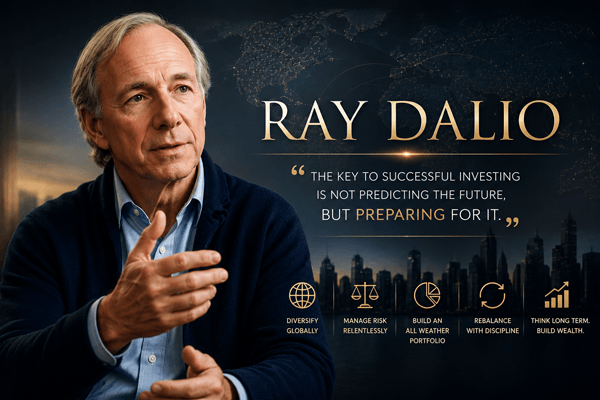
This guide explains Ray Dalio’s investment principles in plain English. You will learn what the strategy is, how it works, what beginners should know, practical ways to apply it with ETFs or mutual funds, where it can fail, and how to use it honestly without treating it as a guaranteed wealth-building formula.
Quick answer: Ray Dalio’s strategy is built around diversification, risk balancing, macro awareness, and humility. Instead of betting everything on stocks, bonds, gold, cash, or one economic forecast, the Dalio-inspired approach spreads risk across assets that may perform differently during growth, recession, inflation, and deflation.
1. Who Is Ray Dalio and Why Do Investors Study His Strategy?
Ray Dalio is the founder of Bridgewater Associates, one of the best-known global macro investment firms. Bridgewater’s All Weather strategy is widely discussed because it popularized a form of investing known as risk parity, where the focus is not only on how much money goes into each asset, but how much risk each asset contributes to the whole portfolio.
Beginners study Dalio because his ideas are practical even if they never invest like an institution. His message is not “buy this exact fund.” It is: understand that economies move in cycles, diversify across different return drivers, avoid overconfidence, and make decisions from written principles rather than emotions.
This matters because many new investors start with a one-asset mindset. They buy only growth stocks, only crypto, only real estate, or only whatever is trending online. That can work for a while, but it leaves them exposed when the economic environment changes. Dalio’s framework pushes the investor to ask: what happens if I am wrong?
2. The Big Idea: Do Not Bet Your Future on One Scenario
The heart of the Ray Dalio investment strategy is uncertainty management. Nobody knows with certainty whether the next decade will bring strong growth, recession, inflation, deflation, falling rates, rising rates, political stress, or a technology boom. A concentrated portfolio may do very well in one environment and badly in another.
Dalio’s answer is to build a portfolio that has more than one way to survive. Stocks may do well when growth is strong. Bonds may help when growth weakens and interest rates fall. Inflation-linked bonds, commodities, and gold may help when inflation is unexpectedly high. Cash may help with stability and opportunity, although it can lose purchasing power over time when inflation is high.
A beginner can think of this as financial weatherproofing. You do not wear the same clothes for every season. Likewise, a portfolio designed for only sunny markets can feel painful when the weather changes.
2.1 How Different Assets May Behave in Different Economic Conditions
| Economic environment | Possible winners | Possible pressure points | Beginner takeaway |
|---|---|---|---|
| Strong growth, normal inflation | Stocks, corporate credit | Long bonds may lag if rates rise | Growth assets can help, but do not rely only on them. |
| Weak growth or recession | High-quality government bonds, cash | Stocks and risky credit may fall | Defensive assets can reduce panic selling. |
| Rising inflation | Commodities, gold, TIPS, real assets | Nominal bonds can struggle | Inflation protection matters for purchasing power. |
| Falling inflation or deflation | High-quality bonds, cash-like stability | Commodities may weaken | Safety assets can matter even when returns look boring. |
3. The All Weather Portfolio Explained in Simple Words
The All Weather portfolio is the most famous public-facing example of Dalio’s thinking. Bridgewater describes All Weather as a strategy created to perform across a wide range of economic environments, and Ray Dalio’s recent explanation describes it as a passively held mix of investments intended to earn more than cash with less risk than portfolios dominated by stocks or bonds.
The name matters. It does not mean the portfolio never loses money. It means the portfolio is designed so that no single economic environment completely controls the outcome. Instead of asking, “What asset will win next year?” the All Weather idea asks, “What mix can give me a reasonable chance of staying invested through many environments?”
A simplified version often discussed online includes stocks, long-term bonds, intermediate bonds, commodities, and gold. However, beginners should be careful: popular internet versions are not the same as Bridgewater’s institutional strategy. They are rough educational models, not a secret formula.
4. Risk Parity: The Engine Behind the Strategy
Risk parity is the technical idea behind much of the All Weather approach. A normal portfolio may look diversified by dollars but not by risk. For example, a 60% stock and 40% bond portfolio may still get most of its short-term volatility from stocks, because stocks are usually much more volatile than high-quality bonds.
Risk parity tries to balance the risk contribution from different asset classes. In plain English, it asks: which assets can hurt the portfolio the most, and are we relying too much on one of them?
Institutional risk parity strategies can use leverage, derivatives, and advanced volatility estimates. Beginners usually should not copy that complexity. The useful takeaway is simpler: do not confuse owning many holdings with being truly diversified. Ten different stock funds may still behave like one big stock bet during a market crash.
5. Ray Dalio’s Core Investment Principles
5.1 Diversification is the “holy grail” of investing
Dalio often emphasizes that the right kind of diversification can reduce risk without necessarily reducing expected return as much as people assume. For beginners, the practical point is not to chase a magical number of holdings. It is to combine assets that do not all depend on the same thing going right.
5.2 Know what economic environment each asset likes
A stock is not just a ticker symbol. A bond is not just a safe thing. Each asset responds to growth, inflation, interest rates, liquidity, and investor confidence. Dalio-style thinking connects investments to the economic machine behind them.
5.3 Balance risk, not just dollars
A 50/50 portfolio is not automatically balanced. If one side is far more volatile, it may dominate the result. Beginners can apply this by checking how much of their portfolio is exposed to stock-market risk, interest-rate risk, inflation risk, currency risk, or single-country risk.
5.4 Rebalance with discipline
Rebalancing means bringing the portfolio back to its target mix after markets move. It forces a simple behavior: trim what has grown too large and add to what has become underweight. This is emotionally hard but helps stop the portfolio from drifting into a hidden bet.
5.5 Be humble about forecasts
Dalio studies history and cycles, but the strategy is not built on pretending to know exactly what happens next. Beginners should avoid all-or-nothing predictions and instead ask how their portfolio would behave if the opposite of their view happens.
5.6 Protect against ruin before chasing maximum return
A portfolio that loses too much can force bad decisions. Dalio’s framework values staying power. For ordinary investors, that means emergency savings, reasonable debt levels, suitable asset allocation, and avoiding leverage they do not understand.
6. A Practical Beginner Example
Imagine Aisha, age 30, wants to invest for long-term wealth building and retirement planning. She has an emergency fund, no high-interest debt, and can invest monthly. She likes Dalio’s logic but does not want complex hedge fund techniques.
A sensible Dalio-inspired approach for her is not to copy an internet All Weather portfolio blindly. Instead, she can use the principles: diversify globally, include high-quality bonds, add a modest inflation hedge, keep a cash buffer, and rebalance once or twice a year.
Here is a simple educational example. It is not a recommendation, but it shows how the thinking can be translated into beginner-friendly portfolio management.
6.1 Illustrative Asset Allocation
| Asset bucket | Example exposure | Purpose | Beginner notes |
|---|---|---|---|
| Global stock ETFs | 30-45% | Long-term growth | Higher volatility; diversify across countries and sectors. |
| High-quality bond ETFs | 25-40% | Stability and recession defense | Interest-rate risk still exists; match duration to comfort level. |
| Inflation-linked bonds | 5-15% | Inflation protection | May lag when inflation expectations fall. |
| Commodities or gold ETF | 5-15% | Unexpected inflation and crisis hedge | Can be volatile and may produce no income. |
| Cash or money market fund | 5-15% | Emergency liquidity and dry powder | Too much cash can reduce long-term growth. |
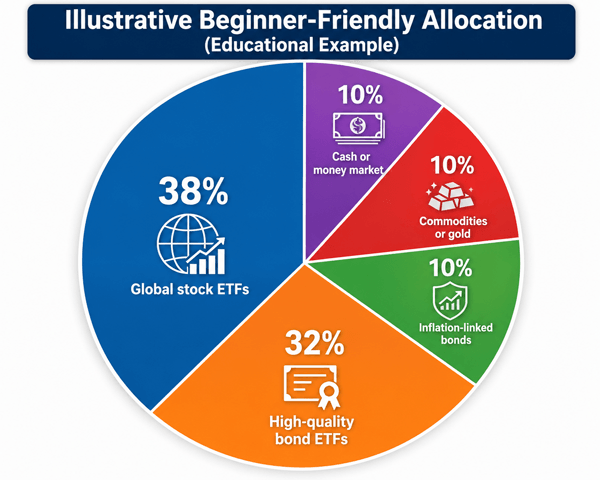
Figure 1. Illustrative midpoint allocation based on the educational ranges above; this is not a recommendation.
7. How to Use the Strategy Step by Step
7.1 Build the foundation before investing
Pay off high-interest debt, create an emergency fund, understand your monthly cash flow, and choose tax-efficient accounts where available. A beautiful portfolio cannot fix weak financial planning basics.
7.2 Define your goal and time horizon
A retirement portfolio for 25 years is different from money needed for a house in 18 months. Dalio-style risk management still has to fit your personal timeline.
7.3 Choose simple building blocks
Most beginners can use broad, low-cost ETFs or mutual funds rather than individual stocks. Common buckets include global equities, high-quality bonds, inflation-linked bonds, commodities or gold, and cash.
7.4 Pick target percentages you can hold during stress
The best allocation is not the one that looks perfect in a spreadsheet. It is the one you can stick with when stocks fall, bonds disappoint, or inflation surprises investors.
7.5 Rebalance on a schedule
A practical rule is to review once or twice per year, or when an asset class drifts meaningfully from target. Avoid checking daily unless you are trying to train anxiety.
7.6 Keep costs and taxes low
Expense ratios, spreads, advisory fees, and taxes matter. A portfolio management strategy should be efficient, transparent, and easy to maintain.
7.7 Review the plan, not the headlines
Dalio watches macro cycles, but beginners should not trade every news story. Use macro awareness to build resilience, not to become a short-term market timer.
8. Dalio Strategy vs. 60/40 Portfolio vs. Stock-Only Investing
| Approach | Main idea | Strengths | Weaknesses | Best suited for |
|---|---|---|---|---|
| Dalio-inspired All Weather | Balance exposure across growth, recession, inflation, and deflation | Broader risk management; less dependent on one forecast | Can underperform stock-heavy portfolios in long bull markets; commodities/gold can be frustrating | Investors who value resilience and smoother behavior |
| Traditional 60/40 | 60% stocks, 40% bonds | Simple, widely used, easy to implement | Still may be equity-risk dominated; bonds can suffer when rates rise | Long-term investors wanting simplicity |
| Stock-only portfolio | Own broad equity market funds | Highest long-term growth potential for many investors | Large drawdowns; emotionally difficult; sequence risk near retirement | Young investors with high risk tolerance and long horizons |
9. Common Mistakes Beginners Make
- Copying a model portfolio without understanding it: A portfolio that looks smart online may be wrong for your country, taxes, currency, income stability, goals, or risk tolerance.
- Thinking All Weather means no losses: All diversified portfolios can lose money. The goal is resilience, not immunity.
- Owning too many funds that do the same thing: Five U.S. stock ETFs may not diversify you much if they all own similar mega-cap companies.
- Ignoring bond duration: Long-term bonds can be volatile when interest rates rise. Beginners should learn the difference between short, intermediate, and long-duration bond funds.
- Overusing gold or commodities: Inflation hedges can help in certain environments, but they can also sit flat or fall for long periods.
- Rebalancing too often or never: Too often can create costs and taxes; never rebalancing allows the portfolio to drift into a different risk profile.
- Using leverage without expertise: Institutional risk parity may use leverage. Most beginners should avoid borrowed money or leveraged ETFs unless they fully understand the risks.
10. Who This Strategy May Fit - and Who It May Not Fit
| May fit investors who... | May not fit investors who... |
|---|---|
| Want a diversified portfolio rather than a single big bet | Want maximum stock-market upside and can handle deep drawdowns |
| Prefer disciplined rebalancing and long-term investing | Enjoy frequent trading, predictions, and market timing |
| Care about risk management, retirement planning, and staying invested | Need money very soon and cannot tolerate losses |
| Understand that lower volatility may mean lower returns in strong bull markets | Believe any strategy should win every year |
11. What Real Investors Often Experience With This Approach
The biggest advantage many ordinary investors report from diversified strategies is emotional. When one part of the portfolio is falling, another part may be holding up better. That can make it easier to continue monthly investing instead of selling at the worst moment.
The biggest frustration is underperformance during hot stock markets. When technology stocks or crypto assets surge, an All Weather-style portfolio can look boring. This is where the investor’s purpose matters. If the goal is wealth building with lower regret and better staying power, boring may be a feature. If the goal is maximum upside, this strategy may feel too conservative.
Another common experience is that diversification feels unnecessary until it becomes necessary. Investors often appreciate bonds, cash, or inflation hedges only after a market shock. The discipline is to build the protection before the shock, not after prices have already moved.
12. Beginner Checklist Before Using a Dalio-Inspired Portfolio
☐ I have an emergency fund separate from my investments.
☐ I know my time horizon and risk tolerance.
☐ I understand that diversification reduces certain risks but does not eliminate losses.
☐ I can explain why each asset bucket is in my portfolio.
☐ I know the costs, tax treatment, and currency exposure of my funds.
☐ I have a written rebalancing rule.
☐ I will not use leverage unless I fully understand it and can afford the risk.
☐ I understand this is not a guaranteed passive income or get-rich-quick strategy.
13. FAQs About Ray Dalio’s Investment Strategy
13.1 What is Ray Dalio’s investment strategy in simple terms?
It is a risk-balanced way of investing that spreads money across assets designed to perform differently in different economic environments. The goal is not to predict the future perfectly, but to avoid being destroyed by one wrong prediction.
13.2 Is the All Weather portfolio good for beginners?
The principles can be useful for beginners, but the exact portfolio should not be copied blindly. A beginner-friendly version should use simple, low-cost funds and fit the investor’s goals, country, taxes, and risk tolerance.
13.3 Does Ray Dalio recommend gold?
Dalio has often discussed gold as a diversifier and store-of-value asset in certain macro environments. That does not mean a beginner should put too much money in gold. Gold can be volatile and does not produce income.
13.4 Is risk parity the same as diversification?
No. Diversification means spreading investments. Risk parity goes further by trying to balance the amount of risk each asset contributes. A portfolio can be diversified by number of holdings but still dominated by one risk source.
13.5 Can I build this strategy with ETFs?
Many ordinary investors can build a simplified version using broad stock ETFs, bond ETFs, inflation-linked bond ETFs, and a modest commodity or gold ETF. The exact mix should be personal and cost-conscious.
13.6 What is the biggest risk of the Dalio strategy?
The biggest practical risks are misunderstanding the strategy, overcomplicating it, holding assets that behave differently than expected, and abandoning it when it underperforms a stock-heavy portfolio.
13.7 How often should I rebalance?
Many long-term investors use annual or semiannual rebalancing, or rebalance when allocations drift outside preset bands. Taxable accounts require extra care because selling can create taxes.
13.8 Is this better than the 60/40 portfolio?
Not always. It is different. A Dalio-inspired strategy adds more focus on inflation environments and risk contribution. A 60/40 portfolio is simpler and may be easier for many investors to maintain.
Sources Consulted and Checked
The following sources were consulted and checked while preparing this article and reviewing its accuracy. Readers should consult the latest official versions because information, market conditions, regulations, and published guidance may change over time.
- Bridgewater Associates, “The All Weather Story”: https://www.bridgewater.com/research-and-insights/the-all-weather-story
- Bridgewater Associates, “The All Weather Strategy”: https://www.bridgewater.com/research-and-insights/the-all-weather-strategy
- Ray Dalio, “The Concept and Mechanics of an All Weather Portfolio”: https://raydalio.substack.com/p/the-concept-and-mechanics-of-an-all
- SEC Investor.gov, “Beginners’ Guide to Asset Allocation, Diversification, and Rebalancing”: https://www.investor.gov/additional-resources/general-resources/publications-research/info-sheets/beginners-guide-asset
- Investor.gov, “Asset Allocation and Diversification”: https://www.investor.gov/introduction-investing/getting-started/asset-allocation
- FINRA, “Asset Allocation and Diversification”: https://www.finra.org/investors/investing/investing-basics/asset-allocation-diversification
- Ray Dalio, “Principles for Navigating Big Debt Crises”: https://www.principles.com/big-debt-crises
Reader Advice
This article is provided only for educational and informational purposes. It does not constitute personal financial, investment, tax, legal, or professional advice, and it should not be treated as a recommendation to buy, sell, or hold any investment. Investing involves risk, including the possible loss of principal, and no strategy can guarantee profits or prevent losses. Before making any decision, readers should independently assess their goals, time horizon, financial circumstances, tax position, currency exposure, and risk tolerance, and should consider consulting an appropriately qualified financial, investment, tax, or legal professional.
Rules, regulations, product terms, tax treatment, market data, facts, figures, and investment conditions can change because of jurisdiction, time, policy, market developments, and individual circumstances. Readers should therefore verify material information through current official and authoritative sources before acting.