Charlie Munger's Investing Philosophy: Timeless Lessons for Investors
- Charlie Munger’s investing philosophy is not about finding hot stock tips. It is about avoiding obvious mistakes, buying understandable high-quality businesses, and letting time do the heavy lifting.
- His approach combines value investing, business quality, psychology, patience, and a strong margin of safety.
- Beginners can use the philosophy by building a written checklist, staying inside their circle of competence, avoiding hype, and comparing every stock idea with simple alternatives like index funds.
- The goal is not to be active every day. The goal is to make a few sensible decisions and avoid the errors that permanently damage wealth.
2. What Is Charlie Munger’s Investing Philosophy?
Charlie Munger’s investing philosophy is a disciplined way of making investment decisions. It asks a simple question: can you find a business that is understandable, durable, well-managed, and available at a price that still makes sense? If the answer is no, you do not need to invest. You can wait.
Munger helped push Warren Buffett and Berkshire Hathaway away from buying only statistically cheap companies and toward buying excellent companies at reasonable prices. That shift matters because a cheap stock can stay cheap or become cheaper if the business itself is weak. A great business, on the other hand, can compound value for many years when bought sensibly.

For a beginner, the philosophy can be summarized in plain English: know what you own, know why you own it, do not overpay, avoid emotional decisions, and give good businesses enough time to work. This is why Munger’s ideas are still relevant for people building a retirement portfolio, managing a brokerage account, or learning basic financial planning.
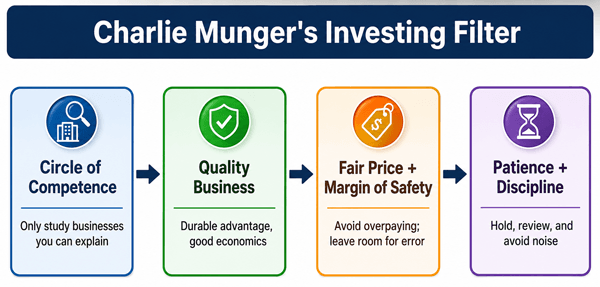
3. The Core Idea: Buy Great Businesses, Not Just Cheap Stocks
Traditional value investing often starts with price: Is the stock cheap compared with earnings, book value, or assets? Munger did not reject price. He simply believed price alone was not enough. A bad business at a low price can be a value trap. A good business at a fair price can become a powerful wealth-building asset.
A quality business usually has some combination of pricing power, repeat customers, strong brands, low production costs, network effects, high switching costs, or a culture that allocates capital wisely. These advantages help the business protect profits over time. In investing language, people often call this an economic moat.
This does not mean beginners should chase famous companies at any price. Munger’s philosophy still requires valuation discipline. The practical lesson is balance: business quality first, price discipline second, patience always.
| Approach | What It Focuses On | Main Risk |
|---|---|---|
| Buying cheap stocks only | Low price-to-earnings, low price-to-book, discounts to assets | Can buy weak businesses that never improve |
| Buying popular growth stocks | Fast revenue growth, exciting stories, market attention | Can overpay for optimism |
| Munger-style quality investing | Understandable business, durable advantage, fair price, long runway | Requires patience and honest judgment |
4. The Beginner’s Version of Munger’s Investing System
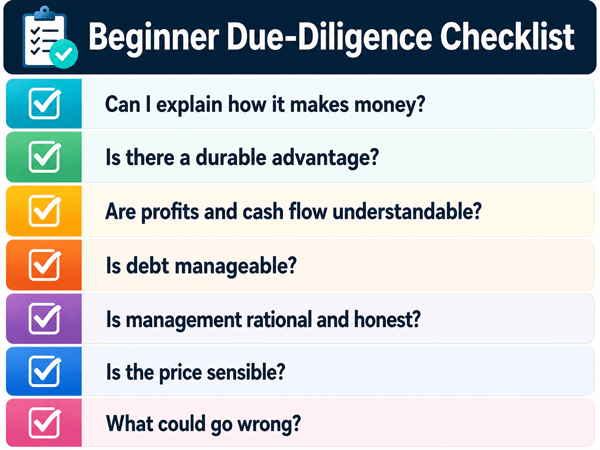
Munger’s system can feel intellectual because he talked about psychology, incentives, probability, and mental models. But a beginner can use it in a very practical way. Before buying any individual stock, slow down and answer a few basic questions in writing.
Can you explain how the company makes money in two sentences? Who are its customers? Why do they keep buying? What would make the business weaker? Is the balance sheet safe enough? What price would make the investment attractive? What evidence would prove your idea wrong?
This written approach matters because investing mistakes often happen when people rely on a feeling. Writing forces clarity. It also creates a record you can review later, which improves judgment over time.
4.1 Circle of Competence: Invest Only Where You Can Think Clearly
The circle of competence means the area where you can make reasonable judgments. A software engineer may understand cloud infrastructure better than bank balance sheets. A restaurant operator may understand food chains better than biotechnology. A teacher may understand education platforms better than oil exploration.
The important point is not to make your circle look impressive. The important point is to know its boundary. Many beginner investors lose money because they buy companies they cannot explain. They mistake familiarity with a product for understanding the business model.
Action step: create three lists: businesses I understand, businesses I partly understand, and businesses I should avoid for now. Your investable universe becomes smaller, but your decisions become cleaner.
4.2 Mental Models: Better Thinking Before Better Returns
Munger believed investors should build a latticework of mental models from many disciplines. In simple terms, a mental model is a thinking tool. From psychology, you learn how incentives and social proof influence decisions. From economics, you learn supply, demand, competition, and opportunity cost. From mathematics, you learn probability and compounding. From accounting, you learn how numbers can clarify or mislead.
A practical investor does not need to become a scientist. But you should understand enough basic models to avoid one-dimensional thinking. For example, a company may look cheap on earnings, but psychology may explain why customers are leaving, economics may show that competition is rising, and accounting may reveal that cash flow is weaker than reported profit.
Action step: when analyzing a stock, ask: what would a customer say, what would a competitor say, what would an accountant say, and what would a skeptic say? This simple exercise improves decision quality.
4.3 Inversion: Solve Problems Backward
Inversion means thinking backward. Instead of asking only, ‘How can I make money?’ ask, ‘How could I lose money here?’ This is one of Munger’s most useful ideas for beginners because it turns risk management into a practical checklist.
For example, an investor considering a fast-growing company might list failure paths: the product becomes a fad, competition cuts prices, debt becomes expensive, management issues too many shares, or the valuation already assumes perfect growth. If these risks are serious and hard to measure, passing on the investment may be the intelligent choice.
Action step: before every purchase, write a short pre-mortem titled ‘Why this investment failed.’ If you cannot handle those risks, do not buy.
4.4 Margin of Safety: Leave Room for Being Wrong
A margin of safety means you do not require a perfect forecast to avoid a bad result. If you estimate a business is worth $100 per share, you may only want to buy it at a meaningful discount. The discount protects you from errors in your assumptions, bad news, and market volatility.
Beginners often think risk means price movement. Munger-style investors think deeper: risk is the chance of permanent loss of capital. A stock falling temporarily is uncomfortable. A business losing its advantage, drowning in debt, or being bought at a foolish price can permanently damage returns.
Action step: use conservative assumptions. If the investment only looks attractive under optimistic growth, perfect margins, and a high valuation multiple, the margin of safety is probably weak.
4.5 Patience: The Money Is Often Made in the Waiting
Munger’s philosophy rewards patience in two ways. First, you may wait months or years before finding a truly attractive opportunity. Second, after buying a high-quality business, you may need to hold through boring periods while compounding works.
This is difficult because modern brokerage apps, financial news, and social media encourage constant action. But activity is not the same as progress. Trading too often can increase taxes, fees, mistakes, and emotional stress.
Action step: set a review schedule. For long-term holdings, review the business quarterly or semiannually instead of reacting to every daily price move.
4.6 Concentration vs. Diversification: Know the Difference Between Confidence and Overconfidence
Munger favored concentrated investing when an investor truly understands a business. But beginners should be careful. Concentration can build wealth when judgment is excellent, and it can destroy wealth when judgment is poor.
For most people, broad index funds can be a sensible foundation because they provide diversification at low cost. Individual stock investing can then be treated as a learning project or a smaller satellite portion of the portfolio. This is not less intelligent. It is honest risk control.
Action step: if you are new, consider separating your core portfolio from your active stock-picking portfolio. The core may support retirement planning and long-term financial goals, while the smaller active portion lets you practice business analysis without risking your entire plan.
5. Practical Example: Applying Munger’s Filter to Two Businesses
The following simplified example shows how the Munger-style thinking process works.
| Question | Business A: Durable Consumer Brand | Business B: Trend-Driven Startup | Munger-Style Takeaway |
|---|---|---|---|
| Can you explain how it makes money? | Yes. Sells repeat-purchase products through established channels. | Partly. Revenue model changes often. | Prefer clarity over excitement. |
| Does it have an advantage? | Brand loyalty, distribution scale, pricing power. | Maybe, but competitors are copying quickly. | A moat should be visible in behavior and numbers. |
| Is debt manageable? | Moderate debt and stable cash flow. | Heavy cash burn and future financing needs. | Weak balance sheets reduce patience. |
| Is price sensible? | Fair, not obviously cheap. | Expensive based on optimistic future growth. | Quality still needs valuation discipline. |
| What could go wrong? | Brand weakens, costs rise, poor capital allocation. | Funding dries up, growth slows, dilution rises. | Inversion exposes hidden risk. |
6. How Beginners Can Use Munger’s Philosophy Step by Step
Step 1: Start with education, not prediction: Read annual reports, learn basic accounting, and study how businesses actually earn cash. Do not start by guessing next month’s stock price.
Step 2: Build a watchlist of understandable businesses: Choose industries where you can explain the customer, product, competition, and economics. A focused watchlist is better than chasing every market story.
Step 3: Write a one-page investment memo: Include the business model, moat, risks, valuation, reasons you might be wrong, and what would make you sell. This creates discipline.
Step 4: Compare every stock with a simple alternative: Ask whether this idea is clearly better than a low-cost index fund after risk, taxes, and effort. This one question prevents many unnecessary trades.
Step 5: Use position sizing as risk management: Do not let one idea decide your financial future. Increase size only when knowledge, evidence, and risk control justify it.
Step 6: Review decisions, not just returns: A good decision can have a bad short-term result, and a bad decision can get lucky. Track process quality over time.
7. Common Mistakes Munger Would Warn Beginners About
| Mistake | Why It Hurts Investors | Better Practice |
|---|---|---|
| Buying because a stock is popular | Social proof can replace independent thinking. | Write your own reason before reading price targets or online opinions. |
| Confusing a great product with a great investment | The company may be excellent but the stock may be overpriced. | Separate business quality from valuation. |
| Using too much leverage | Debt can force selling at the worst time. | Keep personal finances and portfolio risk conservative. |
| Ignoring incentives | Management, analysts, promoters, and influencers may benefit from your excitement. | Ask who gains if you buy. |
| Selling because of normal volatility | Temporary price drops can trigger emotional decisions. | Focus on business facts, not daily noise. |
| Over-diversifying without understanding | Owning many random stocks can create hidden ignorance. | Use index funds for broad exposure; use individual stocks only where you have a reasoned view. |
8. Charlie Munger Philosophy vs. Warren Buffett Value Investing
Buffett and Munger are often discussed together, but Munger’s special contribution was pushing the partnership toward quality. Buffett’s early Graham-style approach looked for bargains, including statistically cheap companies. Munger emphasized that a wonderful business can be worth a fair price because its economics may compound for decades.
In practical terms, Buffett supplied extraordinary discipline and capital allocation skill, while Munger sharpened the focus on business quality, psychology, and multidisciplinary thinking. Modern investors can learn from both: demand value, but define value as more than cheapness.
9. Is Charlie Munger’s Strategy Still Useful in Today’s Market?
Yes, but it must be applied honestly. Today’s market includes index funds, algorithmic trading, commission-free brokerage accounts, social media hype, and faster information flow. These tools have changed investor behavior, but they have not changed human psychology. Fear, greed, envy, overconfidence, and impatience still move markets.
Munger’s philosophy remains useful because it is behaviorally strong. It does not require you to predict interest rates, elections, or short-term market direction. It asks you to understand businesses, control risk, avoid stupidity, and let compounding work. Those principles are timeless.
10. How This Fits Into Financial Planning and Wealth Management
Munger-style investing should not be isolated from your real financial life. Before picking stocks, beginners should usually build an emergency fund, avoid high-interest debt, understand taxes, and define goals. Investing for a house deposit in two years is very different from building a retirement portfolio over 30 years.
For many people, the best investment strategy may combine low-cost diversified funds with a smaller allocation to carefully chosen individual companies. A qualified investment advisor or financial planner can help with tax-efficient investing, asset allocation, estate planning, and risk management, especially when the stakes are high.
11. A Simple Charlie Munger Investing Checklist
- Can I explain the business model without jargon?
- Do customers have a strong reason to keep buying?
- Does the company have evidence of a durable competitive advantage?
- Are profits supported by real cash flow?
- Is debt low enough that the business can survive bad periods?
- Does management allocate capital rationally and communicate honestly?
- What are the incentives of management, analysts, sellers, and promoters?
- What would make this investment fail?
- Is the price reasonable under conservative assumptions?
- Is this better than simply adding to a diversified index fund?
- Am I buying because of analysis, or because I fear missing out?
12. Frequently Asked Questions
12.1 Is Charlie Munger’s investing philosophy good for beginners?
Yes, because it teaches beginners to avoid hype, understand what they own, and think long term. The hard part is patience and honest self-assessment.
12.2 Do I need to pick individual stocks to use Munger’s ideas?
No. You can apply the same ideas to fund selection, asset allocation, personal finance, and business decisions. Avoiding bad decisions is useful everywhere.
12.3 What is the most important Munger lesson?
For most beginners, the most important lesson is to avoid big mistakes. A single reckless investment, too much leverage, or panic selling can undo years of savings.
12.4 How many stocks should a beginner own?
There is no universal number. Beginners who lack time or expertise may be better served by diversified funds. If buying individual stocks, position size should reflect knowledge and risk.
12.5 Does Munger-style investing mean never selling?
No. Long-term investing does not mean blind loyalty. Reasons to sell can include a broken thesis, poor management behavior, excessive valuation, better opportunities, or a change in personal financial needs.
12.6 Can this philosophy work with small amounts of money?
Yes. The principles are about decision quality, not account size. Small investors can practice with modest sums, learn accounting, use low-cost funds, and avoid expensive mistakes.
13. Final Thoughts: The Quiet Power of Not Being Foolish
Charlie Munger’s investing philosophy is powerful because it is simple but not shallow. It tells investors to be rational, patient, ethical, and realistic. It does not promise quick profits. It offers something better: a way to think clearly when markets are noisy.
For a beginner, the best starting point is not to find the next great stock. The best starting point is to build habits: read, think, write, compare, wait, and avoid obvious errors. Over a lifetime, those habits can matter more than any single investment idea.
The Munger approach is ultimately a philosophy of judgment. It rewards people who are willing to learn slowly, act carefully, and let compounding do its quiet work.
Sources Consulted and Checked
The following sources were consulted and checked while preparing this article and supporting its accuracy.
- Berkshire Hathaway annual reports and shareholder letters: https://www.berkshirehathaway.com/reports.html
- CNBC Warren Buffett Archive: Berkshire annual meeting transcripts: https://buffett.cnbc.com/annual-meetings/
- Farnam Street: Charlie Munger, Elementary Worldly Wisdom transcript: https://fs.blog/great-talks/a-lesson-on-worldly-wisdom/
- Investopedia: Charlie Munger and Berkshire Hathaway overview: https://www.investopedia.com/warren-buffett-s-right-hand-man-charlie-munger-8786141
- Poor Charlie’s Almanack investing checklist discussion: https://www.sloww.co/investing-principles-checklist-charlie-munger/
Reader Advice
This article is provided solely for educational and general informational purposes. It does not constitute personalized investment, financial planning, tax, accounting, or legal advice, and it should not be treated as a recommendation to buy, sell, or hold any security or financial product. Investment decisions should be based on each reader’s objectives, financial circumstances, time horizon, and tolerance for risk. Rules, regulations, tax treatment, market conditions, product features, fees, and factual data may change over time and may also differ by country or individual circumstances. Before making a decision, readers should verify relevant facts and figures through current official or primary sources and, where appropriate, consult a suitably qualified financial, tax, accounting, or legal professional. All investing involves risk, including the possible loss of principal.