USDT vs USDC: Key Differences, Pros, Cons, Risks and Best Use Cases
1. Quick Answer: USDT vs USDC in Simple Terms
USDT and USDC are both dollar-pegged stablecoins. They are designed to trade close to one U.S. dollar, but they are not identical. USDT, issued by Tether, is usually the most widely traded stablecoin and is deeply used across global crypto exchanges. USDC, issued by Circle, is often preferred by users who value clearer reserve reporting, stronger regulatory positioning, and integrations with more compliance-focused platforms.
For many beginners, the practical choice is simple: use USDT when liquidity and exchange availability matter most, and use USDC when transparency, regulated business use, and dollar settlement quality matter more. For large balances, neither should be treated as risk-free cash in a bank account.
| Best For | USDT | USDC |
|---|---|---|
| Active crypto trading | Usually stronger liquidity and more trading pairs | Available on many platforms, but often lower volume than USDT |
| Longer short-term parking of funds | Useful, but reserve transparency is a common concern | Often preferred because of reserve structure and reporting |
| Institutions and regulated businesses | Used widely, but may face compliance restrictions in some regions | Often better fit for compliance-heavy workflows |
| Global availability | Very strong, especially outside the U.S. | Strong, but availability can vary by country and exchange |
| Beginner simplicity | Easy to find but requires network caution | Easy to understand and often favored for transparent reserves |
2. Simple Decision Diagram
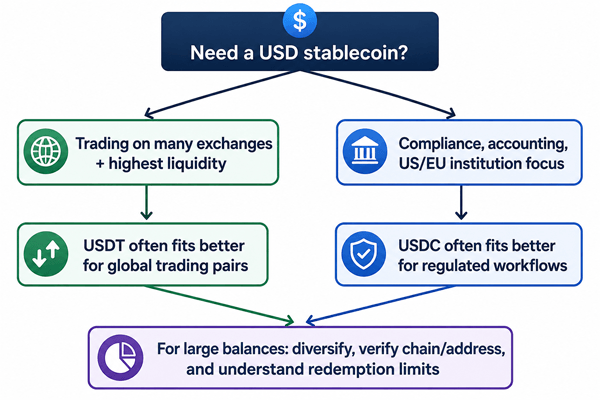
Figure: A practical beginner decision path for choosing between USDT and USDC.
3. What Are Stablecoins?
Stablecoins are crypto assets designed to keep a relatively stable value. The most common type is a fiat-backed stablecoin, which aims to stay close to the value of a national currency such as the U.S. dollar. USDT and USDC are both U.S. dollar stablecoins, so each token is intended to be worth about $1.
People use stablecoins because normal cryptocurrencies such as Bitcoin and Ethereum can move sharply in price. A trader who sells Bitcoin may not want to convert back to a bank account every time. Instead, they may hold a dollar stablecoin and stay inside the crypto ecosystem. Stablecoins are also used for transfers, payments, DeFi, remittances, exchange settlement, and temporary cash-like balances.
4. What Is USDT?
USDT, also known as Tether, is a dollar-pegged stablecoin issued by Tether. It is one of the oldest and most widely used stablecoins in the crypto market. Its biggest advantage is liquidity. In simple terms, liquidity means it is usually easy to buy, sell, transfer, and trade in large amounts without major price movement.
USDT is especially common on centralized exchanges, global trading platforms, and networks used for low-cost transfers. Many crypto traders use USDT as a base currency, meaning they trade coins against USDT pairs such as BTC/USDT or ETH/USDT.
5. What Is USDC?
USDC, or USD Coin, is a dollar-pegged stablecoin issued by Circle. It is designed to be redeemable 1:1 for U.S. dollars by eligible customers through Circle. USDC is widely used by exchanges, wallets, payment companies, fintech apps, and DeFi protocols.
USDC is commonly viewed as the more compliance-focused stablecoin because Circle publishes reserve information, works with regulated financial institutions, and has positioned USDC for institutional and business use. This does not make USDC risk-free, but it does make its risk profile different from USDT.
6. How USDT and USDC Work
Both USDT and USDC work through a similar basic process. A user or institution sends dollars to the issuer or an approved partner. The issuer creates, or mints, stablecoin tokens. Those tokens can then move on supported blockchains. When eligible users redeem tokens, the issuer destroys, or burns, the tokens and sends dollars back.
The peg depends on trust, reserves, redemption access, market demand, and exchange liquidity. If people believe a stablecoin is safely backed and redeemable, it usually trades near $1. If confidence falls, the token can trade below $1. This is called depegging.
7. USDT vs USDC: Key Differences
The biggest differences between USDT and USDC are liquidity, reserve transparency, issuer structure, regulatory positioning, and user preference. USDT usually wins on trading depth and global exchange usage. USDC usually wins on reserve clarity and compliance perception.
A beginner should not choose only by name recognition. The better stablecoin depends on what you plan to do: trade, transfer, hold temporarily, use DeFi, receive payments, or manage business funds.
| Feature | USDT (Tether) | USDC (Circle) |
|---|---|---|
| Issuer | Tether | Circle |
| Primary design | USD-pegged stablecoin for broad crypto liquidity | USD-pegged stablecoin with compliance and transparency focus |
| Market position | Largest stablecoin by market cap and trading volume in recent market data | Second-largest dollar stablecoin in recent market data |
| Reserve style | Tether states tokens are backed by reserves; reserve reports include U.S. Treasuries and other assets | Circle states reserves are held in cash and the Circle Reserve Fund, which can contain short-dated U.S. Treasuries and overnight Treasury repos |
| Transparency approach | Publishes transparency data and reserve reports/attestations | Publishes transparency information, reserve reports, and portfolio reporting through its reserve structure |
| Main strength | Liquidity and exchange availability | Transparency, compliance positioning, and institutional fit |
| Main concern | Questions around reserve composition, disclosure depth, and regulatory treatment | Banking exposure, platform restrictions, and lower liquidity than USDT in some markets |
| Typical users | Traders, global exchange users, cross-border crypto users | Businesses, DeFi users, institutions, compliance-focused users |
7.1 Liquidity and Trading Pairs
USDT usually has the advantage in liquidity. On many crypto exchanges, the most active markets are quoted against USDT. For example, a trader may see BTC/USDT, ETH/USDT, SOL/USDT, and hundreds of altcoin pairs. This matters because better liquidity can mean tighter spreads, easier entry and exit, and less slippage.
USDC is also liquid, especially on major exchanges and DeFi platforms, but it may not always have the same number of trading pairs or the same depth as USDT. If you are actively trading smaller altcoins, USDT may be easier to use. If you are holding stable value or using business payments, USDC may be more comfortable.
7.2 Reserve Transparency
Reserve transparency is one of the most important differences. A stablecoin is only as reliable as the assets and redemption process behind it. Circle describes the USDC reserve as cash and the Circle Reserve Fund, which can contain cash, short-dated U.S. Treasuries, and overnight U.S. Treasury repurchase agreements. Tether states that Tether tokens are backed by its reserves and publishes transparency information and reserve reports.
The practical takeaway is not that one coin is guaranteed safe and the other is unsafe. The better takeaway is that USDC is generally viewed as having a cleaner and easier-to-understand reserve model, while USDT is generally viewed as having broader market adoption but more debate around disclosure and reserve composition.
7.3 Regulation and Compliance
USDC is often favored by companies that care about compliance, financial reporting, and regulated counterparties. Circle has made regulation and transparency a core part of its public positioning. This can matter for businesses, fintech apps, institutions, and users who want clearer documentation.
USDT is widely accepted in the crypto market, but some regulated platforms or jurisdictions may treat it differently. Stablecoin regulation is still developing in many regions, so users should check local rules and exchange policies before relying on either coin.
7.4 Networks and Transfer Costs
USDT and USDC both exist on multiple blockchains. The cost and speed of using either stablecoin depends heavily on the network, not just the coin. Sending USDT on Ethereum may cost much more than sending USDT on Tron, Solana, or another low-fee network. The same idea applies to USDC across Ethereum, Solana, Base, Arbitrum, Avalanche, and other supported networks.
The most common beginner mistake is choosing the wrong network. For example, if an exchange gives you a USDT deposit address on Tron, sending USDT from Ethereum to that address can lead to lost funds. Always match the coin, network, and address format before sending.
7.5 Redemption Access
Most everyday users do not redeem USDT or USDC directly with the issuer. Instead, they sell stablecoins on an exchange or swap them through a wallet or DeFi protocol. Direct redemption may require an account, identity verification, location eligibility, minimum amounts, and compliance checks.
This matters because the market price of a stablecoin is supported partly by arbitrage. If USDC trades at $0.995, eligible traders may buy it cheaply and redeem it near $1. That activity helps restore the peg. If redemption becomes difficult, delayed, or uncertain, confidence can weaken.
7.6 Depegging Risk
A stablecoin can temporarily move away from $1. This may happen because of bank failures, reserve concerns, legal action, exchange problems, blockchain congestion, panic selling, or liquidity shortages. USDC had a notable depeg during the Silicon Valley Bank crisis in March 2023 because part of its cash reserves were exposed to the bank. It later recovered. USDT has also traded above or below $1 during market stress.
The lesson is simple: a stablecoin is not the same as insured bank cash. It is a crypto token backed by a promise, reserves, market confidence, and redemption systems.
8. USDT Pros and Cons
| USDT Pros | USDT Cons |
|---|---|
| Very high liquidity across global exchanges | Reserve transparency and asset composition are frequent concerns |
| Many trading pairs, especially for altcoins | May face restrictions or caution from some regulated platforms |
| Often useful for fast global crypto transfers | Direct redemption may not be practical for small everyday users |
| Strong network availability and exchange support | Still exposed to issuer, regulatory, blockchain, and depeg risk |
9. USDC Pros and Cons
| USDC Pros | USDC Cons |
|---|---|
| Clearer reserve structure and transparency positioning | Usually lower trading volume than USDT in many global markets |
| Often preferred by institutions and compliance-focused users | Can still depeg during banking or market stress |
| Strong use in DeFi, payments, and fintech apps | Availability and supported networks vary by exchange and country |
| Issued by a company with a more public regulatory profile | Issuer can freeze tokens under legal/compliance requirements |
10. Best Use Cases: When to Use USDT vs USDC
| Use Case | Better Fit | Why |
|---|---|---|
| Trading major crypto pairs | USDT or USDC | Both are widely available, but USDT often has deeper order books |
| Trading smaller altcoins | USDT | More exchanges list altcoin pairs against USDT |
| Holding stable value for a few days or weeks | USDC or diversified stablecoin mix | USDC has a simpler reserve story; diversification reduces single-issuer risk |
| Business payments or invoices | USDC | Often easier to explain for accounting and compliance |
| Cross-border crypto transfer | Depends on network support | The cheapest option depends on the blockchain and recipient exchange |
| DeFi lending or liquidity pools | Depends on protocol liquidity | Check pool depth, smart contract risk, and accepted collateral |
| Large balances | Diversify and use regulated custody when possible | Issuer, bank, chain, and exchange risks become more important |
11. Practical Examples
11.1 Example: A beginner wants to buy Bitcoin and trade occasionally
A beginner deposits money on an exchange and wants to trade BTC, ETH, and a few altcoins. USDT may be convenient because the exchange likely offers many USDT pairs. However, if the exchange offers strong USDC markets and the user values transparency more than pair availability, USDC is also reasonable.
11.2 Example: A freelancer receives crypto payments
A freelancer who wants dollar-like payments may prefer USDC because it is often easier to explain as a transparent, compliance-focused stablecoin. But the freelancer must confirm that their wallet and exchange support the same USDC network as the client.
11.3 Example: A user wants to send $500 internationally
The best choice may depend less on USDT vs USDC and more on network fees and exchange support. If the recipient can receive USDT on Tron cheaply, USDT may be practical. If the recipient uses a wallet or app built around USDC on Solana or Base, USDC may be better. The key is to match the network exactly.
11.4 Example: A business holds $100,000 temporarily
For larger balances, the business should avoid treating any stablecoin as risk-free cash. It may use USDC for compliance reasons, split exposure across stablecoins and bank deposits, use reputable custody, and maintain written policies for approvals, wallets, and counterparties.
12. Key Risks Beginners Should Understand
- Peg risk: The market price can temporarily move below or above $1.
- Reserve risk: The assets behind the stablecoin may lose value, become unavailable, or be less transparent than expected.
- Issuer risk: You depend on the company issuing and redeeming the token.
- Regulatory risk: Stablecoins can be restricted, delisted, frozen, or treated differently under new laws.
- Blockchain risk: Congestion, hacks, smart contract bugs, bridge failures, or wrong-network transfers can cause losses.
- Exchange risk: Holding stablecoins on an exchange exposes you to exchange insolvency, freezes, hacks, and withdrawal delays.
- Address risk: Crypto transfers are usually irreversible. A wrong address or wrong network can permanently lose funds.
13. Best Practices Before Using USDT or USDC
- Use the stablecoin that fits your purpose. Do not choose only because a coin is popular.
- Check the network before every transfer. USDT on Tron is not the same transfer route as USDT on Ethereum. USDC on Solana is not the same as USDC on Base.
- Send a small test transaction first when using a new wallet, exchange, or network.
- Do not keep large balances on exchanges longer than necessary unless you understand the custody risk.
- For large balances, consider diversifying between bank cash, USDC, USDT, and other low-risk options rather than relying on one issuer.
- Check current reserve reports, exchange support, fees, and local regulations before making a major decision.
- Keep records for taxes and accounting. Stablecoin trades and transfers may still create reporting obligations.
14. Common Misconceptions
| Misconception | Reality |
|---|---|
| Stablecoins are risk-free. | They are designed to be stable, but they still carry issuer, reserve, regulatory, chain, and exchange risk. |
| USDT and USDC are exactly the same. | They both aim to track $1, but their issuers, reserve models, transparency, liquidity, and best use cases differ. |
| A $1 peg means the price can never move. | Stablecoins can trade above or below $1 during stress. |
| Network fees are the same for every stablecoin transfer. | Fees depend mostly on the blockchain network and exchange withdrawal fee. |
| Holding USDC or USDT is the same as holding dollars in a bank. | Stablecoins are tokens, not bank deposits, and are generally not protected like insured bank accounts. |
15. Current Market Snapshot to Mention With Caution
As of the latest checked data on June 24, 2026, CoinGecko showed USDT with a market cap of about $186 billion and USDC with a market cap of about $74 billion. These figures move constantly, so they should be treated as a market snapshot, not a permanent fact.
16. So, Which Is Safer: USDT or USDC?
There is no perfect answer because safety depends on the exact risk you care about. If you care about market liquidity and the ability to trade quickly across many exchanges, USDT often has the advantage. If you care about reserve transparency, regulatory positioning, and institutional comfort, USDC often looks stronger.
A sensible beginner answer is: use USDT for active trading where liquidity matters, use USDC for transparency-focused holding and business workflows, and avoid keeping life savings in either stablecoin. For meaningful amounts, diversify and use proper custody and risk controls.
17. FAQs About USDT vs USDC
17.1 Is USDT better than USDC?
USDT is often better for trading liquidity and exchange availability. USDC is often better for transparency, compliance-focused use, and business payments. The better choice depends on your use case.
17.2 Is USDC safer than USDT?
Many users view USDC as safer from a transparency and regulatory standpoint, but it is not risk-free. USDC can still face bank, issuer, regulatory, blockchain, and depeg risks.
17.3 Can USDT or USDC lose its peg?
Yes. Both can temporarily trade below or above $1. Depegging can happen during market panic, reserve concerns, banking problems, regulatory events, or liquidity shortages.
17.4 Which stablecoin has lower fees?
The fee depends mostly on the blockchain network and the exchange withdrawal fee, not only on whether you use USDT or USDC. Always compare the exact network you plan to use.
17.5 Can I send USDT to a USDC address?
No. USDT and USDC are different tokens. Even when they use the same blockchain, you must choose the correct token and network. Sending the wrong token or wrong network can cause permanent loss.
17.6 Should I hold my savings in USDT or USDC?
Stablecoins may be useful for short-term crypto balances, but they are not the same as insured bank deposits. For savings or large balances, consider regulated bank accounts, diversification, and professional financial advice.
17.7 Why is USDT more popular than USDC?
USDT has been around longer and is deeply integrated into global crypto trading pairs. Its liquidity and exchange support make it very convenient for traders.
17.8 Why do institutions often prefer USDC?
Institutions often care about transparency, reporting, compliance, and regulated counterparties. USDC is commonly positioned for those needs.
17.9 Are USDT and USDC taxable?
Tax treatment depends on your country. Even stablecoin trades, swaps, and transfers may create tax records or taxable events. Keep transaction history and consult a qualified tax professional.
17.10 What is the best stablecoin for beginners?
For beginners, USDC is often easier to understand because of its transparency positioning, while USDT may be easier to trade because of liquidity. The safest approach is to start small and learn how networks, wallets, and exchanges work before moving large amounts.
18. Final Verdict
USDT and USDC are both important stablecoins, but they solve slightly different problems. USDT is the liquidity leader and is often the easiest stablecoin to use for active trading across global exchanges. USDC is often the cleaner choice for users who prioritize transparency, compliance, business payments, and reserve clarity.
The best approach is not to ask only, “Which one is better?” A better question is, “Which one is better for this specific transaction, platform, network, and risk level?” For small trades, convenience may matter most. For large balances, risk management matters more than convenience.
Sources Consulted and Checked
The following sources were consulted and checked while preparing this article and reviewing its accuracy:
- Tether Transparency page: Tether states its tokens are pegged 1-to-1 and backed by reserves; reviewed June 24, 2026.
- Tether Supported Protocols page: network support and legacy blockchain notes; reviewed June 24, 2026.
- Circle Transparency page: Circle describes the Circle Reserve Fund and reserve transparency process; reviewed June 24, 2026.
- Circle USDC reserve report, March 2026 examination report: reserve asset details as of March 11, 2026.
- CoinGecko Tether and USDC pages: market cap and trading volume snapshot checked June 24, 2026.
- Reuters and S&P-related reporting: stablecoin risk assessments and market concerns about reserve transparency and risk assets.
Reader Advice
This article is provided for educational and informational purposes only and is not personalized financial, investment, legal, tax, accounting, or other professional advice or a recommendation to buy, sell, hold, or transfer USDT, USDC, or any crypto asset. Stablecoins can depeg, lose value, be frozen or restricted, and may expose users to issuer, reserve, banking, exchange, custody, blockchain, smart-contract, liquidity, regulatory, tax, and irreversible-transfer risks. Rules, policies, laws, fees, supported networks, reserve information, market statistics, and platform availability can change over time and vary by country or region. Please verify current details through official issuer, regulator, exchange, wallet, and tax-authority sources, confirm the token, network, and address before every transfer, consider a small test transaction, and seek qualified professional advice before making significant decisions or moving substantial funds.