Stablecoin Risks: Risks, Red Flags, Prevention Tips and Safety Checklist
Stablecoins are often described as the “safer” part of crypto because they are designed to track the value of another asset, usually the US dollar. A stablecoin such as USDT, USDC, DAI or another dollar-linked token may aim to stay close to $1. But “stable” does not mean risk-free.
A stablecoin can lose its peg, an issuer can face a run, reserves may be unclear, a wallet can be hacked, a smart contract can fail, or a trading platform can freeze withdrawals. For beginners, the biggest mistake is treating a stablecoin like money in a bank account. It is not the same. Stablecoins are digital tokens with different legal protections, technical risks and market risks.
This guide explains the main stablecoin risks in plain English, the warning signs to watch for, how to reduce risk, and a practical checklist you can use before holding or using any stablecoin.
- Stablecoins are designed to maintain a stable price, but they can still de-peg or fail.
- The most important risks are reserve quality, redemption access, issuer transparency, platform safety, regulation, liquidity and smart contract security.
- A stablecoin is only as strong as its backing, legal structure, governance and ability to handle heavy withdrawals.
- Never judge a stablecoin only by its market cap, popularity, yield or social media reputation.
- Use stablecoins as tools, not as risk-free savings accounts. Diversify, verify reserves and avoid unusually high yields.
1. What Is a Stablecoin?
A stablecoin is a cryptocurrency designed to keep a relatively stable value compared with another asset. Most stablecoins try to track one fiat currency, especially the US dollar. In theory, one dollar-backed stablecoin should be worth about one US dollar.
Stablecoins are commonly used to move money between exchanges, trade crypto without converting back to bank currency, send payments, participate in decentralized finance and temporarily reduce exposure to volatile assets such as Bitcoin or Ethereum.
Imagine you sell Bitcoin for 1,000 USDC on a crypto exchange. Instead of withdrawing dollars to your bank, you hold USDC because it is easier to trade again later. The risk is that USDC is still a token. You depend on the issuer, the blockchain, the exchange or wallet you use, and the market’s confidence that USDC can be redeemed for dollars.
2. How Stablecoins Are Supposed to Work
The basic idea is simple: the stablecoin issuer creates tokens and claims that the tokens are backed by assets, rules or mechanisms that help keep the token close to its target price. The method depends on the type of stablecoin.
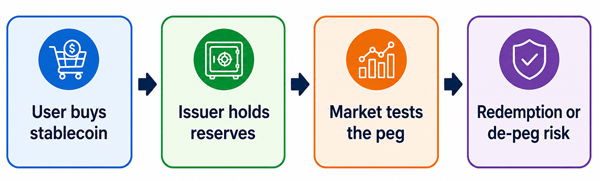
Figure: The main risk path in a stablecoin. A stablecoin appears simple to the user, but the safety depends on what happens behind the scenes when confidence is tested.
2.1 Main types of stablecoins
| Type | How it tries to stay stable | Main risk |
|---|---|---|
| Fiat-backed stablecoin | Claims to be backed by cash, bank deposits, Treasury bills or similar assets. | Reserve quality, issuer solvency, redemption limits and regulatory risk. |
| Crypto-backed stablecoin | Backed by crypto collateral, usually over-collateralized through smart contracts. | Collateral price crashes, smart contract bugs and liquidation cascades. |
| Algorithmic stablecoin | Uses incentives, mint/burn mechanisms or market arbitrage rather than full external backing. | High de-peg risk if confidence breaks or demand collapses. |
| Commodity-backed stablecoin | Claims to be backed by gold or another commodity. | Custody, audit, redemption and commodity price risks. |
3. Why Stablecoin Risks Matter
Stablecoins sit at the center of many crypto activities. They are used for trading pairs, lending, payments, collateral and cross-border transfers. If a major stablecoin loses trust, the impact can spread quickly across exchanges, DeFi protocols and crypto markets.
Regulators and central banks have repeatedly highlighted stablecoin vulnerabilities such as run risk, redemption pressure, reserve quality, liquidity mismatches and links with traditional financial markets. These risks matter because a stablecoin failure can harm individual users and may also create wider market stress when large reserves must be sold quickly.
4. The Biggest Stablecoin Risks Beginners Should Understand
4.1 De-pegging risk
De-pegging happens when a stablecoin trades meaningfully above or below its target price. A dollar stablecoin trading at $0.99 for a short time may not be a disaster, but a drop to $0.95, $0.80 or lower can create panic. The larger and longer the de-peg, the more serious the problem.
De-pegging can happen because of fear about reserves, issuer problems, market panic, blockchain congestion, large redemptions, exchange liquidity shortages or smart contract failures.
4.2 Reserve risk
For fiat-backed stablecoins, reserves are the assets meant to support the token. The key questions are: What assets are held? Where are they held? Are they liquid? Are they independently verified? Can they be sold quickly without major losses?
High-quality reserves usually mean cash, short-term government securities and other low-risk liquid assets. Riskier reserves may include commercial paper, corporate debt, loans, affiliated assets, opaque investments or assets that are hard to sell in a crisis.
4.3 Redemption risk
A stablecoin may trade near $1 on exchanges, but that does not always mean every user can redeem it directly for $1. Some issuers only allow institutional users to redeem. Some require minimum redemption amounts, identity checks or bank access. Some redemptions may pause during stress.
For ordinary users, the real exit route is often selling the token on an exchange. If exchange liquidity dries up, the market price can fall below the peg even if the issuer says the token is backed.
4.4 Liquidity risk
Liquidity means how easily you can buy or sell without moving the price too much. A stablecoin can look stable when markets are calm but become hard to sell during panic. Thin liquidity is especially dangerous for smaller stablecoins and tokens mostly traded on one platform.
4.5 Issuer and governance risk
Stablecoin users depend on the issuer’s management, legal structure, internal controls, banking partners and risk decisions. Weak governance can lead to poor reserve management, conflicts of interest, delayed disclosures or unclear responsibility when something goes wrong.
4.6 Regulatory and legal risk
Stablecoin rules differ by country and continue to change. A stablecoin may face new licensing rules, restrictions, enforcement actions, sanctions exposure or limits on who can issue, hold or redeem it. Users can also face tax, reporting or compliance obligations depending on their country.
4.7 Platform and custody risk
Many people hold stablecoins on exchanges, lending apps or wallets they do not fully control. In that case, the stablecoin risk is only one layer. You also face platform insolvency, account freezes, withdrawal pauses, hacks, phishing, poor custody controls and terms of service that may limit your rights.
4.8 Smart contract and blockchain risk
Stablecoins often run on public blockchains and interact with smart contracts. Bugs, bridge exploits, oracle failures, chain congestion, validator problems or incorrect contract permissions can affect access or value. Multi-chain stablecoins add another layer of complexity because tokens may exist on several networks with different risks.
4.9 Counterparty and banking partner risk
Stablecoin issuers typically rely on banks, custodians, payment processors and market makers. If a banking partner fails or freezes funds, users may see temporary de-pegging or redemption delays. Even a well-known stablecoin can face stress if key reserve or payment partners are disrupted.
4.10 Yield risk
High stablecoin yields can be tempting because the token appears stable. But yield usually comes from lending, leverage, liquidity incentives, risky DeFi strategies or platform subsidies. If a platform offers returns far above normal money-market rates, the extra yield is usually compensation for hidden risk.
5. Stablecoin Risk Comparison Table
| Risk | What it means | Beginner example | How to reduce it |
|---|---|---|---|
| De-pegging | The token trades below or above its target value. | A $1 stablecoin falls to $0.92 during panic. | Use liquid, transparent stablecoins and monitor peg stability. |
| Reserve risk | Backing assets may be low quality, unclear or hard to sell. | The issuer says reserves are “cash equivalents” but gives little detail. | Read reserve reports and prefer independent attestations or audits. |
| Redemption risk | You may not be able to redeem directly or quickly. | Retail users can sell on exchanges but cannot redeem with the issuer. | Know the issuer’s redemption rules before holding large amounts. |
| Platform risk | The exchange or app holding your coins may fail or freeze withdrawals. | A lending app pauses withdrawals during a market crash. | Use reputable platforms and self-custody where appropriate. |
| Smart contract risk | Code or blockchain infrastructure may fail. | A DeFi pool or bridge is hacked. | Avoid unknown protocols and limit exposure to complex DeFi. |
| Regulatory risk | Rules or enforcement may affect use, issuance or redemption. | A stablecoin is restricted in a region. | Use compliant services and stay aware of local rules. |
| Yield risk | High returns may hide lending, leverage or insolvency risk. | A platform offers 20% on stablecoins with vague strategy. | Treat high yield as high risk and avoid opaque products. |
6. Stablecoin Red Flags: Warning Signs to Watch For
Red flags do not always mean a stablecoin will fail, but they mean you should slow down and investigate before using it.
- No clear explanation of what backs the stablecoin.
- No recent independent reserve report, audit or attestation.
- Reserves include risky, illiquid or affiliated assets without clear limits.
- The issuer does not clearly explain who can redeem, how redemption works and how long it takes.
- The stablecoin trades below the peg for an extended period.
- Most liquidity is on one exchange, one chain or one DeFi protocol.
- The project advertises unusually high “safe” yield.
- The issuer, founders or reserve managers are anonymous or hard to verify.
- The legal entity, jurisdiction and user rights are unclear.
- There are frequent withdrawal pauses, bridge delays or unexplained wallet movements.
- The token relies on complex algorithms that ordinary users cannot understand.
- Social media communities attack basic questions about reserves or redemption instead of answering them.
7. Practical Prevention Tips for Safer Stablecoin Use
7.1 Start with the purpose
Before choosing a stablecoin, ask why you need it. Are you trading for a few minutes, sending a payment, holding value for weeks, using DeFi or earning yield? The longer you hold it and the more money involved, the stricter your safety standards should be.
7.2 Check reserve transparency
Look for recent reserve reports, the type of assets held, the reporting date, the accounting firm or auditor, and whether liabilities are clearly matched against assets. A report from many months ago is less useful than a recent one. A vague claim such as “fully backed” is not enough by itself.
7.3 Understand redemption rules
Find out whether retail users can redeem directly, whether there are minimums, fees, KYC requirements, supported countries and normal processing times. If your only exit is selling on an exchange, you also need to consider exchange liquidity and withdrawal reliability.
7.4 Avoid concentration
Do not keep all your funds in one stablecoin, one exchange, one wallet, one blockchain or one DeFi protocol. Concentration turns a single failure into a major loss. For larger balances, consider spreading risk across different custody methods and reputable stablecoins, while still avoiding products you do not understand.
7.5 Be careful with stablecoin yield
Stablecoin yield is not automatically safer than other crypto yield. Ask where the yield comes from. Is it from lending to traders, liquidity mining, leverage, token incentives, real-world assets or platform subsidies? If the source of yield is unclear, assume the risk is higher than advertised.
7.6 Keep custody risk separate from token risk
A good stablecoin held on a weak exchange can still be lost. A transparent token used in a risky DeFi protocol can still be hacked. Evaluate the stablecoin, the platform, the wallet, the blockchain and the strategy as separate risk layers.
7.7 Use small test transactions
When using a new wallet, exchange, bridge or network, send a small test amount first. This reduces the chance of losing funds due to wrong chain selection, unsupported tokens, fake addresses or network mistakes.
7.8 Monitor the peg during stress
Stablecoins often look safest when markets are calm. The real test comes during high volatility, banking stress, exchange failures or major crypto liquidations. Watch price spreads, redemption announcements, liquidity conditions and official issuer updates.
8. Beginner Safety Checklist Before Using a Stablecoin
| Question | Safe sign | Warning sign |
|---|---|---|
| What backs it? | Clear reserve breakdown with liquid, low-risk assets. | Vague backing, risky collateral or no details. |
| Who issues it? | Known legal entity with public leadership and controls. | Anonymous team or unclear legal structure. |
| Can users redeem? | Clear redemption process, timing and eligibility. | Retail users cannot redeem or terms are unclear. |
| Are reports recent? | Regular independent reports or audits. | Old, missing or self-published claims only. |
| Is liquidity strong? | Deep markets across reputable venues. | Liquidity concentrated in one place. |
| Has it held the peg? | Small, short-lived price deviations in stress. | Repeated or long de-pegs. |
| Where will I hold it? | Secure wallet or reputable regulated platform. | Unknown app, risky lending site or unverified wallet. |
| Am I chasing yield? | Yield source is clear and risk is understood. | High APY promoted as “guaranteed” or “risk-free”. |
9. Common Stablecoin Mistakes to Avoid
- Assuming “stable” means “guaranteed.” Stablecoins can fail, freeze or de-peg.
- Holding large balances without reading redemption terms.
- Using a stablecoin only because it is popular on social media.
- Ignoring the difference between the token issuer and the exchange that holds your tokens.
- Chasing the highest stablecoin yield without understanding where returns come from.
- Using bridges or DeFi protocols without checking security history and contract risk.
- Sending tokens on the wrong network, such as sending a stablecoin on a chain the recipient does not support.
- Treating reserve attestations as perfect guarantees. They are useful, but they are not the same as deposit insurance.
10. Are Stablecoins Safer Than Regular Crypto?
Stablecoins are usually less price-volatile than Bitcoin, Ethereum or many altcoins because they aim to track a reference asset. That can make them useful for trading, payments and short-term parking of value. But they have different risks rather than no risks.
A volatile crypto asset can fall because the market price changes. A stablecoin can fail because confidence breaks, reserves are questioned, redemptions are blocked, regulation changes, the issuer fails, or the platform holding it collapses. For many beginners, these hidden risks are harder to see than normal price volatility.
11. Stablecoins vs Bank Deposits vs Money Market Funds
| Feature | Stablecoins | Bank deposits | Money market funds |
|---|---|---|---|
| Main purpose | Digital token for crypto trading, payments and blockchain use. | Traditional money storage and payments through banks. | Investment product seeking stability and income. |
| Value target | Usually aims for $1 or another fiat value. | Denominated directly in fiat currency. | Usually aims to preserve value, but share price can vary. |
| Protection | Depends on issuer, platform, jurisdiction and legal terms. | May have deposit insurance depending on country and limits. | Regulated investment product; not the same as bank deposit insurance. |
| Main risk | De-peg, reserves, redemption, custody and smart contract risk. | Bank failure beyond insured limits, account restrictions and currency risk. | Market, liquidity and fund management risk. |
| Best use | Blockchain-based transfers, crypto trading and DeFi with caution. | Everyday savings, salaries, bills and regulated payments. | Cash management or short-term investing where suitable. |
12. What To Do If a Stablecoin Starts De-Pegging
A de-peg can be stressful. The worst response is panic-clicking without checking facts. Use a simple process:
- Confirm the price across several reputable exchanges and data sources. One platform may show a temporary liquidity issue.
- Check official issuer announcements, redemption status and known incidents.
- Review your exposure. Separate funds held directly from funds locked in DeFi, lending, bridges or exchanges.
- Decide whether the loss from exiting is acceptable compared with the risk of a deeper de-peg.
- Avoid moving through unknown bridges or fake emergency links promoted on social media.
- After the event, reduce concentration and update your checklist for future use.
13. Benefits of Stablecoins When Used Carefully
A balanced article should also acknowledge why stablecoins are widely used. Their benefits can be real when users understand the risks.
- They can reduce exposure to crypto price volatility during trading.
- They can make crypto-to-crypto trading faster and easier.
- They can support cross-border transfers where traditional payment rails are slow or expensive.
- They can be used in DeFi applications such as liquidity pools and lending, although these uses add extra risk.
- They can provide access to dollar-like digital value in markets where banking access is limited, subject to local laws and practical risks.
14. Limitations and Misconceptions
14.1 Misconception: A stablecoin is the same as a dollar in the bank
A stablecoin is not automatically a bank deposit. Your rights depend on the issuer’s terms, legal structure, platform custody and local law. Deposit insurance usually does not apply to stablecoins in the same way it may apply to regulated bank deposits.
14.2 Misconception: A big market cap means it is safe
Large stablecoins may have deeper liquidity and more public scrutiny, but size alone does not remove reserve, redemption, governance or regulatory risk.
14.3 Misconception: Algorithmic stablecoins are safe if the code is clever
Algorithms can work in normal conditions but fail when demand collapses or confidence breaks. If a stablecoin depends mainly on incentives rather than strong external backing, users should treat it as higher risk.
14.4 Misconception: Stablecoin yield is guaranteed income
Yield usually comes from risk. It may involve lending, leverage, liquidity pools, incentives or exposure to a platform’s balance sheet. Stablecoin yield should never be described as risk-free.
15. Best Practices for Different Use Cases
| Use case | Practical approach | Extra caution |
|---|---|---|
| Trading | Use liquid pairs on reputable platforms and avoid keeping idle balances for too long. | Watch exchange solvency and withdrawal reliability. |
| Payments | Confirm network, address, fees and recipient support with a small test transfer. | Stablecoin transfers are usually irreversible. |
| Short-term holding | Prefer transparent, liquid, well-established stablecoins and diversify custody. | Do not treat it like insured savings. |
| DeFi | Use only protocols you understand and limit position size. | Smart contract, oracle and liquidation risks are added on top. |
| Yield earning | Understand the source of yield and worst-case loss scenario. | Avoid unusually high APY and lockups you cannot exit. |
16. A Simple Stablecoin Risk Scorecard
You can score a stablecoin before using it. This is not a guarantee, but it helps beginners think systematically.
| Category | Score 0 | Score 1 | Score 2 |
|---|---|---|---|
| Reserve transparency | No clear reports. | Some reports but limited detail. | Recent independent reports with asset breakdown. |
| Redemption clarity | No clear redemption process. | Limited or institutional-only redemption. | Clear redemption terms and history. |
| Liquidity | Thin or concentrated liquidity. | Moderate liquidity. | Deep liquidity across reputable venues. |
| Governance | Unknown or opaque issuer. | Known issuer but limited disclosures. | Strong public controls and legal structure. |
| Technical risk | New, unaudited or complex system. | Some audits or history. | Mature contracts and strong security record. |
| Regulatory position | Unclear or high-risk jurisdiction. | Partly regulated or evolving. | Clear compliance posture in major markets. |
A total score below 6 suggests high caution. A score from 6 to 9 suggests more research is needed. A score above 9 may be stronger, but it still does not make the stablecoin risk-free.
17. FAQs About Stablecoin Risks
17.1 Can stablecoins lose value?
Yes. Stablecoins can lose value if they de-peg, if reserves are questioned, if redemptions fail, if the issuer faces legal or banking problems, or if the platform holding your tokens becomes insolvent.
17.2 What is the safest stablecoin?
There is no universally safest stablecoin for every user and country. A safer choice usually has transparent reserves, strong liquidity, clear redemption rules, reputable custody, regulatory compliance and a long record of maintaining its peg. Users should compare current information before deciding.
17.3 Are stablecoins insured?
Usually, stablecoins are not insured like bank deposits. Some regulated structures may offer stronger protections than others, but users should not assume deposit insurance applies unless it is clearly stated by a relevant regulated institution and confirmed in the legal terms.
17.4 Is USDT or USDC risk-free?
No stablecoin is risk-free. Large stablecoins may be widely used and liquid, but users still face reserve, issuer, redemption, platform, regulatory and blockchain risks.
17.5 Are algorithmic stablecoins dangerous?
They can be especially risky because they may depend on market confidence and incentives rather than fully liquid external reserves. If confidence breaks, the mechanism can fail quickly.
17.6 Should beginners use stablecoins?
Beginners can use stablecoins carefully for specific purposes, such as trading or transfers, but they should start small, avoid high-yield schemes, verify the stablecoin and platform, and avoid holding more than they can afford to lose.
17.7 What is the biggest red flag in a stablecoin?
The biggest red flag is unclear backing combined with unclear redemption. If you cannot understand what supports the token and how users can exit, the risk is too high for most beginners.
17.8 How often should I review stablecoin risk?
Review risk whenever you increase your balance, use a new platform, bridge to another chain, chase yield, or see news about reserves, regulation, de-pegging, lawsuits, banking partners or withdrawal delays.
18. Final Safety Checklist
- I understand what type of stablecoin this is.
- I know who issues it and where to find official information.
- I checked recent reserve or collateral information.
- I understand whether I can redeem directly or only sell on exchanges.
- I checked liquidity on reputable venues.
- I know the risks of the wallet, exchange or DeFi protocol I am using.
- I am not relying on unusually high yield as if it were guaranteed.
- I have tested transfers before sending a large amount.
- I have not put all funds in one stablecoin, platform or chain.
- I am prepared for temporary freezes, delays or de-pegging events.
19. Conclusion
Stablecoins can be useful tools, but they are not risk-free money. The main risks come from de-pegging, reserves, redemption limits, liquidity, regulation, platforms, custody and smart contracts. The safest approach is to understand the structure before using the token, avoid concentration, be skeptical of high yields, and keep a clear exit plan.
For beginners, the best rule is simple: do not hold a stablecoin only because it is called “stable.” Hold it only after you understand what backs it, how you can exit, where you are storing it and what could go wrong.
Sources Consulted and Checked
The following sources were consulted and checked while preparing this document to support accuracy and reliability.
- European Central Bank, Financial Stability Review focus box on stablecoins and de-pegging risk, 2025.
- U.S. Securities and Exchange Commission, Division of Corporation Finance statement on certain USD-backed stablecoins, April 2025.
- Financial Stability Board, High-level Recommendations for the Regulation, Supervision and Oversight of Global Stablecoin Arrangements, 2023, and implementation review updates, 2025.
- Bank for International Settlements, publications on stablecoin risks, reserves, payment use and financial stability implications.
- International Monetary Fund, Understanding Stablecoins, 2025.
- Financial Action Task Force, Targeted Report on Stablecoins and Unhosted Wallets, 2026.
- Reserve Bank of Australia, Stablecoins: Market Developments, Risks and Regulation, 2022.
Reader Advice
This article is provided for educational and informational purposes only and does not constitute personalized financial, investment, legal, tax, or regulatory advice or a recommendation to buy, sell, hold, or use any stablecoin, platform, wallet, or service. Stablecoins and related crypto activities involve risks, including loss of value, de-pegging, liquidity problems, issuer or platform failure, fraud, cyberattacks, smart-contract defects, account restrictions, and possible loss of access to funds. Rules, policies, laws, protections, market conditions, and statistics can change over time and vary by country or region. Readers should verify current information through official sources, review applicable terms and local requirements, assess their own circumstances and risk tolerance, and seek advice from a qualified professional before making significant financial or legal decisions. Never commit funds you cannot afford to lose.