DAI Explained: Meaning, How It Works, Examples, Benefits and Risks
DAI is one of the most important stablecoins in decentralized finance. It is designed to track the value of the U.S. dollar, but it works differently from common reserve-backed stablecoins such as USDT and USDC. Instead of relying mainly on a company that holds bank deposits and short-term securities, DAI is created through smart contracts, collateral, governance, market incentives, and risk controls.
For beginners, the easiest way to understand DAI is this: DAI is a crypto token that aims to stay close to $1. Users can hold it, send it, trade it, use it in DeFi apps, or create it by locking approved collateral in a smart contract. The system is now part of the Sky ecosystem, formerly known as MakerDAO. DAI still exists, while USDS is the newer Sky stablecoin and official documentation describes a DAI-USDS converter that lets holders convert between them at parity through supported routes.
1. Quick answer: What is DAI?
DAI is a decentralized, collateral-backed stablecoin that aims to maintain a value close to one U.S. dollar. It is issued through the Maker/Sky Protocol when users lock approved assets as collateral and generate DAI against that collateral. DAI can also be bought on exchanges or decentralized exchanges like any other token.
| Feature | Simple explanation |
|---|---|
| Token name | Dai, commonly written as DAI |
| Type | Crypto-backed stablecoin |
| Target value | About $1 |
| Main use | Trading, DeFi, payments, saving, borrowing, liquidity |
| How it is created | Users deposit collateral into protocol vaults and mint DAI as debt |
| Main risk | Peg instability, liquidation, smart contract bugs, governance decisions, collateral risk |
| Current context | MakerDAO rebranded to Sky; DAI continues to exist alongside USDS in the Sky ecosystem |
2. Why stablecoins like DAI exist
Crypto prices can move very quickly. Bitcoin, Ether, and many other tokens may rise or fall sharply in a single day. Stablecoins were created to give users a crypto asset that is easier to price, transfer, and use inside blockchain applications.
A stablecoin does not remove all risk, but it can reduce exposure to day-to-day crypto volatility. For example, a trader may sell ETH into DAI during a market downturn, a DeFi user may borrow DAI against collateral, and a person sending money on-chain may prefer a dollar-like token instead of a volatile coin.
3. How DAI works in simple terms
DAI works through an overcollateralized borrowing model. Overcollateralized means the value of the collateral must usually be higher than the amount of DAI created. This extra collateral is a safety buffer. If the collateral falls in price, the protocol can liquidate the position before the debt becomes undercollateralized.
3.1 The basic DAI creation process
- A user connects a self-custody wallet to a supported interface or directly interacts with the protocol.
- The user deposits approved collateral, such as ETH-based assets, stablecoins, or other accepted assets depending on current governance settings.
- The user generates DAI up to the allowed borrowing limit for that collateral type.
- The user can use the DAI elsewhere while the collateral remains locked.
- To unlock the collateral, the user repays the generated DAI plus the applicable stability fee.
- If the collateral value falls too far, the vault may be liquidated to repay the debt and protect the system.
3.2 Diagram: DAI creation and repayment flow
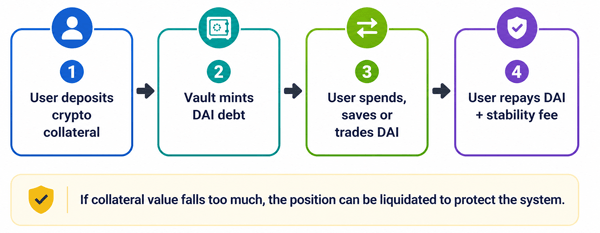
Figure: A simplified view of how DAI is created, used, repaid, and protected by liquidation rules.
4. Important terms beginners should know
| Term | Meaning |
|---|---|
| Stablecoin | A crypto token designed to keep a relatively stable value, often near $1. |
| Collateral | Assets locked to support a loan or minted stablecoin. |
| Vault | A smart contract position where a user locks collateral and generates DAI. |
| Overcollateralization | Having more collateral value than the amount borrowed or minted. |
| Stability fee | A fee charged on DAI debt. It is similar in effect to interest on a loan. |
| Liquidation | Forced sale or closing of collateral when a position becomes too risky. |
| Oracle | A data source that brings asset prices into the protocol. |
| Peg | The target price DAI tries to maintain, usually around $1. |
| Governance | The process by which protocol parameters are changed by token-holder voting and governance decisions. |
5. How DAI tries to stay close to $1
DAI does not stay near $1 by magic. The peg is supported by several mechanisms that work together. None of them guarantee perfect stability at all times, but they are designed to encourage market participants to bring DAI back toward its target value.
5.1 Collateral backing
DAI is backed by assets deposited into the protocol. Because vaults are generally required to hold more collateral value than the DAI they generate, there is a cushion against normal market movements. The exact collateral types, debt ceilings, liquidation ratios, and fees can change through governance.
5.2 Liquidations
If a user borrows too much DAI against collateral and the collateral price falls, the vault may be liquidated. Liquidation is unpleasant for the borrower, but it is important for system solvency. It helps ensure that DAI debt remains backed by enough value.
5.3 Fees and incentives
The protocol can change borrowing costs and other parameters. If demand for DAI is too high or too low, governance-controlled fees and rates can influence whether users create, repay, hold, or sell DAI.
5.4 Market arbitrage
When DAI trades above or below $1, traders may have an incentive to buy, sell, mint, repay, or convert it through available routes. These actions can help push the price back toward the target. However, in stressed markets, arbitrage can be slow, expensive, or risky.
5.5 Conversion routes in the Sky ecosystem
After MakerDAO became Sky, official developer documentation describes DAI and USDS as linked to the same issuance source, with a converter contract allowing holders to convert DAI and USDS in either direction through the supported route. This is important for readers because older articles may discuss DAI without explaining the newer USDS context.
6. DAI vs USDT vs USDC
DAI, USDT, and USDC are all commonly used dollar-linked stablecoins, but their structures are different. The main difference is how they are issued and what users must trust.
| Stablecoin | How it is generally backed | Main trust model | Common strengths | Common risks |
|---|---|---|---|---|
| DAI | On-chain collateral and protocol mechanisms; collateral mix can change over time | Smart contracts, governance, oracles, collateral quality, market incentives | Decentralized DeFi design, transparent on-chain mechanics, useful for borrowing and DeFi | Liquidation risk for minters, peg risk, smart contract risk, governance risk, exposure to collateral risks |
| USDC | Reserves managed by a centralized issuer | Issuer, banks, custodians, attestations, regulation | High liquidity, broad exchange support, strong fiat on/off-ramp use | Issuer freeze risk, banking/custody risk, regulatory risk |
| USDT | Reserves managed by a centralized issuer | Issuer and reserve management | Very high trading liquidity and exchange availability | Reserve transparency concerns, issuer risk, regulatory risk |
7. Practical examples of how DAI is used
DAI is not only a token people buy and hold. It is part of a wider DeFi toolkit. Here are realistic examples.
7.1 Example 1: Holding a dollar-like crypto asset
A beginner has ETH but does not want to stay fully exposed to ETH volatility. They swap part of their ETH into DAI. This gives them a crypto asset designed to stay near $1 while they remain on-chain. The risk is that DAI can still move away from the peg, and the user must safely manage their wallet.
7.2 Example 2: Borrowing DAI against collateral
A user owns ETH and does not want to sell it. They lock ETH in a vault and mint DAI. They can use the DAI for other purposes while keeping exposure to ETH. This is risky because if ETH falls enough, the vault can be liquidated. Borrowing against volatile collateral is not beginner-friendly unless the user understands collateral ratios and liquidation prices.
7.3 Example 3: Trading between crypto assets
A trader may sell a volatile token into DAI during uncertain market conditions, then later use DAI to buy another token. DAI can act as a temporary parking asset. This does not guarantee safety, but it can reduce exposure to volatile assets while the trader stays within crypto markets.
7.4 Example 4: Using DAI in DeFi apps
DAI can be supplied to lending markets, used in liquidity pools, bridged to other networks, or deposited in protocols that support it. These uses can create yield opportunities, but each extra protocol adds another layer of risk, such as smart contract bugs, liquidity risk, bridge risk, or impermanent loss.
8. Benefits of DAI
- Dollar-like pricing on-chain: DAI aims to track $1, making it easier to quote values and trade crypto pairs.
- Decentralized design: DAI is created through smart contracts and governance rather than only through a centralized issuer.
- Useful in DeFi: DAI is widely integrated into lending, trading, liquidity, and payment workflows.
- Self-custody compatible: Users can hold DAI in their own wallets without needing a bank account or exchange account.
- Transparent mechanics: Many parts of the system can be checked on-chain, including collateral positions and protocol activity.
- Borrowing flexibility: Users can generate DAI by locking collateral instead of selling their crypto assets.
9. Risks and limitations of DAI
DAI is often described as safer than volatile crypto assets, but it is not risk-free. A beginner should understand the following risks before using it.
9.1 Peg risk
DAI aims to stay close to $1, but it can trade above or below that level. Stressful market conditions, liquidity shortages, governance problems, or collateral concerns can all affect confidence in the peg.
9.2 Liquidation risk for borrowers
If you mint DAI by locking collateral, you are taking a loan-like position. If your collateral price drops and your position falls below the required safety level, it can be liquidated. You may lose part of your collateral and still face costs.
9.3 Smart contract risk
DAI depends on smart contracts. A bug, exploit, faulty integration, or upgrade issue could cause losses or unexpected behavior. Audits and history reduce some risk but do not remove it.
9.4 Oracle risk
The protocol relies on price data. If an oracle gives wrong, delayed, or manipulated prices, liquidations and collateral valuations could be affected.
9.5 Governance risk
Protocol settings are not fixed forever. Governance can change collateral types, fees, debt ceilings, risk parameters, and other settings. Bad decisions, slow responses, or governance concentration can create risk.
9.6 Collateral composition risk
DAI may be backed by a mix of crypto assets, stablecoins, and other collateral categories depending on current protocol rules. Some collateral may depend on centralized assets, real-world asset structures, custodians, or external legal arrangements. This means DAI is not purely isolated from traditional finance or centralized risk.
9.7 DeFi composability risk
Using DAI inside another DeFi protocol creates stack risk. Even if DAI itself works as expected, a lending app, bridge, liquidity pool, or wallet interface could fail.
9.8 Wallet and private key risk
If you self-custody DAI, you are responsible for your wallet. If you lose your seed phrase, sign a malicious transaction, or send DAI to the wrong address or network, recovery may be impossible.
10. Common mistakes beginners make with DAI
- Thinking DAI is guaranteed to equal exactly $1 at all times.
- Borrowing too much DAI against volatile collateral and leaving little safety buffer.
- Ignoring gas fees, liquidation penalties, and stability fees.
- Using unofficial websites or fake token contracts.
- Bridging DAI to other networks without understanding bridge risk.
- Assuming every yield opportunity using DAI has the same risk.
- Forgetting that DAI, USDS, sDAI, sUSDS, and bridged versions may have different properties.
11. Best practices for using DAI safely
- Start by buying a small amount from a reputable exchange or using a trusted decentralized exchange before experimenting with vaults.
- Check the token contract address and network before receiving or swapping DAI.
- Use a hardware wallet or strong wallet security for meaningful amounts.
- Do not mint DAI against collateral until you understand liquidation ratios, liquidation price, stability fees, and repayment requirements.
- Keep a large collateral buffer if you borrow DAI. Many experienced users avoid borrowing near the maximum allowed amount.
- Monitor your vault during volatile markets. Crypto can move while you are asleep.
- Understand the difference between holding DAI and depositing DAI into another protocol. Depositing creates extra risk.
- Use official documentation and reputable analytics dashboards to check current protocol settings, because fees and parameters can change.
- Do not chase high yields without asking where the yield comes from and what can go wrong.
- Keep tax records. Borrowing, swapping, yield farming, and liquidations may have tax consequences depending on your country.
12. DAI and USDS: what changed after MakerDAO became Sky?
MakerDAO rebranded to Sky and introduced USDS as a newer stablecoin in the same broader ecosystem. This does not mean every DAI holder automatically lost access to DAI. In current Sky documentation, DAI and USDS are connected through official token routes, and the DAI-USDS converter supports movement between the two tokens through the specified route.
For beginners, the practical takeaway is simple: when reading about DAI, check whether the information is from before or after the Sky transition. Older tutorials may still be useful for understanding the original MakerDAO model, but they may not mention USDS, sUSDS, updated interfaces, or current protocol routes.
13. When DAI may make sense
- You want a dollar-like crypto token for DeFi activity.
- You prefer a stablecoin with decentralized and on-chain mechanics rather than only a centralized issuer model.
- You understand the risks of self-custody and smart contracts.
- You need a stable asset for trading pairs, liquidity, or collateral management.
- You want to borrow against crypto collateral without selling the collateral, and you understand liquidation risk.
14. When DAI may not be suitable
- You need government-insured bank deposits or traditional consumer protections.
- You cannot tolerate stablecoin depeg risk.
- You are not comfortable managing private keys.
- You do not understand how DeFi protocols, gas fees, and blockchain transactions work.
- You are considering borrowing near the maximum collateral limit.
- You are only attracted by high yield and have not studied the risks behind it.
15. Mini case study: safe vs risky DAI borrowing behavior
| Scenario | Safer behavior | Riskier behavior |
|---|---|---|
| Collateral buffer | Borrowing far below the maximum limit and keeping extra collateral available | Borrowing the maximum possible amount because the interface allows it |
| Monitoring | Checking collateral ratio and market conditions regularly | Ignoring the vault after minting DAI |
| Volatile markets | Adding collateral or repaying debt before the danger zone | Waiting until liquidation is already close |
| Fee awareness | Understanding stability fees and transaction costs | Assuming borrowed DAI is free money |
| Emergency plan | Knowing how to repay, add collateral, or close the position | Not knowing which wallet, network, or interface to use under pressure |
16. Beginner checklist before using DAI
- Do I know which network I am using?
- Have I verified the DAI token contract address?
- Do I understand that DAI can move away from $1?
- If borrowing, do I know my liquidation price and collateral ratio?
- Do I understand the stability fee and possible liquidation penalty?
- Am I using official or reputable interfaces?
- Have I tested with a small amount first?
- Do I know how to recover my wallet and protect my seed phrase?
- Have I considered tax and record-keeping requirements?
17. Frequently asked questions about DAI
17.1 Is DAI always worth exactly $1?
No. DAI targets about $1, but market prices can move above or below that level. The system uses collateral, liquidations, fees, incentives, and market activity to help maintain the peg, but perfect stability is not guaranteed.
17.2 Who issues DAI?
DAI is generated through the Maker/Sky Protocol when users lock approved collateral and mint DAI. It can also be acquired from exchanges or DeFi markets after it has been created.
17.3 Is DAI decentralized?
DAI is more decentralized in design than a traditional issuer-backed stablecoin, but decentralization is not absolute. It depends on smart contracts, governance, oracles, collateral choices, interfaces, and sometimes collateral with centralized or real-world dependencies.
17.4 Can I earn yield on DAI?
DAI may be used in lending markets, savings products, liquidity pools, and other DeFi applications. Yield is not guaranteed and usually comes with extra protocol, liquidity, smart contract, or market risk.
17.5 What is the difference between DAI and USDS?
USDS is the newer Sky stablecoin introduced after MakerDAO rebranded to Sky. DAI remains part of the ecosystem, and official developer documentation describes a converter route between DAI and USDS.
17.6 Can DAI collapse like an algorithmic stablecoin?
DAI is different from purely algorithmic stablecoins because it is collateral-backed and overcollateralized in its core design. However, it can still face peg, collateral, governance, liquidity, smart contract, and market risks.
17.7 Do I need to create a vault to use DAI?
No. You can buy, receive, or swap DAI without creating a vault. Vaults are only needed if you want to mint DAI by borrowing against collateral.
17.8 What happens if my DAI vault is liquidated?
Your collateral can be sold or transferred through the protocol liquidation process to cover the DAI debt and related costs. Liquidation can result in losing a meaningful portion of your collateral.
17.9 Is DAI better than USDC or USDT?
Not universally. DAI may appeal to users who value DeFi-native collateral-backed design. USDC or USDT may be preferred for centralized exchange liquidity, fiat on/off-ramps, or simple reserve-backed stablecoin use. The best choice depends on the user’s risk tolerance and purpose.
17.10 Is DAI safe for beginners?
Holding a small amount of DAI in a secure wallet may be simpler than minting DAI. Borrowing DAI, using leverage, bridging, or depositing into DeFi protocols requires more knowledge and risk management.
18. Final thoughts
DAI is one of the best-known examples of a DeFi-native stablecoin. Its goal is simple: provide a crypto token that stays close to $1. Its design is more complex: collateralized vaults, liquidation rules, governance decisions, price oracles, market incentives, and now its relationship with the Sky ecosystem and USDS.
The practical lesson for beginners is to separate holding DAI from minting DAI. Holding DAI is similar to holding a dollar-linked crypto token, though still risky. Minting DAI is closer to taking a collateralized loan, and it requires careful risk management. DAI can be useful, but it should not be treated as risk-free cash.
Sources Consulted and Checked
These sources were consulted and checked while preparing this document and reviewing its accuracy.
- MakerDAO White Paper: https://makerdao.com/whitepaper/
- Sky Protocol developer documentation - Protocol Token Routes: https://developers.skyeco.com/quick-start/protocol-token-routes/
- Sky Legal Documents - User Risks: https://docs.sky.money/legal/skybase-international/user-risks
- Sky Protocol developer documentation - sUSDS: https://developers.sky.money/protocol/tokens/susds/
- Sky/MakerDAO official website: https://makerdao.com/
Reader Advice
This article is provided for educational and informational purposes only. It is not personalized financial, investment, legal, or tax advice, and it does not recommend buying, selling, borrowing, lending, or using DAI or any other crypto asset or DeFi service. Stablecoins, self-custody wallets, smart contracts, bridges, exchanges, and collateralized borrowing can involve loss of funds, depegging, liquidation, fraud, technical failures, and regulatory or tax consequences. Rules, policies, laws, protocol settings, fees, and statistics may change over time and vary by country or region, so please verify current information through official sources and consider qualified professional advice before making important decisions. Use only amounts you can afford to risk and carefully check networks, token contracts, interfaces, and transaction details.