How Stablecoins Work: Complete Guide, Examples, Risks and Best Practices
Stablecoins are digital tokens designed to keep a relatively stable value, usually by tracking a real-world asset such as the U.S. dollar. A common dollar stablecoin aims to stay close to $1. It does this through reserves, redemption rights, market trading, smart contracts, and user confidence. Stablecoins can be useful for crypto trading, payments, transfers, and decentralized finance, but they are not risk-free. A stablecoin can lose its peg if reserves are weak, redemption is blocked, regulation changes, a blockchain fails, or users panic at the same time.
Key Takeaways
- A stablecoin is not the same as cash in a bank account. It is usually a crypto token issued by a company or protocol.
- The most common stablecoins are fiat-backed stablecoins such as USDT and USDC, which aim to track the U.S. dollar.
- The peg is maintained through reserves, redemption, arbitrage, liquidity, and trust.
- Important risks include depegging, issuer failure, weak reserves, smart contract bugs, exchange freezes, regulatory changes, and wrong-network transfers.
- Beginners should use reputable platforms, check the blockchain network, avoid unknown high-yield schemes, and keep only the amount they need for a clear purpose.
1. What Is a Stablecoin?
A stablecoin is a type of cryptocurrency designed to reduce price volatility. While Bitcoin or Ethereum can move sharply in a single day, a stablecoin tries to follow the value of another asset. Most popular stablecoins are linked to fiat currencies, especially the U.S. dollar, but some are linked to the euro, gold, or a basket of assets.
For example, if a stablecoin is pegged to the U.S. dollar, one token is intended to be worth about $1. In practice, the price can move slightly above or below $1 because it trades on exchanges, depends on liquidity, and relies on confidence in the issuer or protocol.
Stablecoins are widely used because they combine some features of traditional money with some features of crypto. They can move on blockchains, settle quickly, and be used in crypto apps, but they are easier to price than volatile coins.
2. How Stablecoins Work
The basic idea is simple: a stablecoin tries to make a token behave like a stable asset. The exact method depends on the type of stablecoin, but most stablecoins rely on five building blocks:
- A peg: the target price, such as $1, EUR1, or one gram of gold.
- A backing mechanism: reserves, collateral, or an algorithmic system intended to support the peg.
- Minting and burning: new tokens are created when users deposit value, and tokens are destroyed when users redeem them.
- Market arbitrage: traders buy when the token is below the peg and sell or redeem when it is above the peg.
- Trust and transparency: users must believe the stablecoin can be redeemed and that the backing is real and liquid.
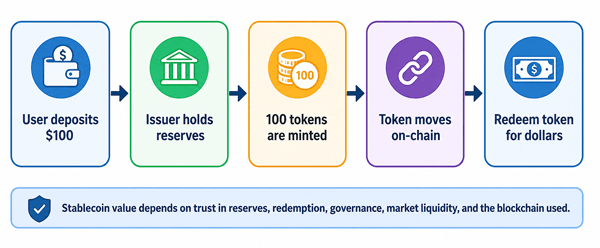
Figure: A simplified fiat-backed stablecoin lifecycle.
2.1 Example: A Simple Dollar Stablecoin
Imagine a regulated issuer creates a stablecoin called ExampleUSD. A business sends $100,000 to the issuer. The issuer keeps the money in approved reserve assets, such as bank deposits and short-term Treasury bills, and mints 100,000 ExampleUSD tokens. The business can then send those tokens over a blockchain to suppliers, exchanges, or customers. Later, an eligible customer can redeem 100,000 ExampleUSD and receive $100,000 back, minus any fees or processing limits.
This redemption promise is central. If users believe they can reliably redeem the token for dollars, market prices usually stay near $1. If users doubt the reserves or redemption process, the token can trade below $1.
3. The Main Types of Stablecoins
| Type | How it tries to stay stable | Common examples | Main risk |
|---|---|---|---|
| Fiat-backed | Backed by cash, bank deposits, Treasury bills, or similar assets held by an issuer. | USDC, USDT, EURC | Issuer, reserve, banking, and redemption risk. |
| Crypto-collateralized | Backed by crypto assets locked in smart contracts, often overcollateralized. | DAI-style models | Collateral price crashes and smart contract risk. |
| Commodity-backed | Linked to assets such as gold, with reserves held by an issuer or custodian. | Gold-backed tokens | Custody, audit, and liquidity risk. |
| Algorithmic or partially algorithmic | Uses incentives, supply changes, or another token to defend the peg. | Various experimental designs | High failure risk during stress or loss of confidence. |
3.1 Fiat-Backed Stablecoins
Fiat-backed stablecoins are the easiest for beginners to understand. The issuer promises that the token is backed by assets that can support redemption. For dollar stablecoins, those assets commonly include cash, cash equivalents, and short-term government securities. Circle states that USDC is backed by highly liquid cash and cash-equivalent assets and publishes reserve information and attestations. Tether states that its tokens are backed by its reserves and publishes transparency reports. These disclosures are useful, but users should still understand the difference between a reserve attestation and a full audit.
Fiat-backed stablecoins are popular because they are simple and liquid. They are commonly used on centralized exchanges, crypto payment rails, and trading platforms. The trade-off is that users depend on the issuer, banks, custodians, regulators, and redemption rules.
3.2 Crypto-Collateralized Stablecoins
Crypto-collateralized stablecoins are backed by crypto assets rather than bank deposits. For example, a user may lock $150 worth of crypto collateral to mint $100 worth of stablecoins. The extra collateral is intended to absorb price moves. If the collateral falls too much, the system may liquidate it to protect the stablecoin.
These systems can be more transparent on-chain, but they are complex. They depend on smart contracts, price oracles, liquidation mechanisms, and the liquidity of the collateral. During sharp market crashes, collateral can fall faster than the system can respond.
3.3 Commodity-Backed Stablecoins
Commodity-backed stablecoins track assets such as gold. A token might represent a claim on a small amount of gold held by a custodian. These tokens can be useful for people who want blockchain transferability and commodity exposure. However, the user must trust the custodian, the legal claim, storage arrangements, redemption rules, and audits.
3.4 Algorithmic Stablecoins
Algorithmic stablecoins try to keep a peg mainly through code, incentives, supply changes, or a related token rather than simple 1:1 cash backing. They can look attractive because they promise decentralization and capital efficiency, but they have historically been much riskier. If confidence disappears, the mechanism may fail quickly. Beginners should be extremely cautious with stablecoins that depend on complex incentives instead of clear, liquid backing.
4. How the Peg Is Maintained
A stablecoin peg is not magic. It is maintained through economic incentives and operational systems.
| Mechanism | What it does | Beginner example |
|---|---|---|
| Reserves | Provide assets that can support redemption. | An issuer holds cash and Treasury bills backing tokens in circulation. |
| Redemption | Lets eligible users exchange tokens for the reference asset. | A verified customer redeems 10,000 USDC for dollars. |
| Arbitrage | Encourages traders to correct price differences. | If a token trades at $0.99, traders may buy and redeem for $1. |
| Liquidity | Allows buying and selling without large price moves. | Large exchange order books help the token stay near $1. |
| Transparency | Helps users judge whether backing and liabilities match. | Reserve reports show assets compared with tokens outstanding. |
4.1 What Happens When a Stablecoin Trades Below $1?
If a dollar stablecoin trades at $0.98, professional traders may buy it cheaply and redeem it for $1, earning a small profit. This buying pressure can push the price back toward $1. But this only works well if redemption is available, reserves are trusted, fees are reasonable, and the market believes the issuer can handle withdrawals.
4.2 What Happens When a Stablecoin Trades Above $1?
If a stablecoin trades at $1.01, eligible market participants may mint new tokens for $1 and sell them for $1.01. The extra supply can push the price back down. Again, this depends on access to minting, redemption, and liquid markets.
5. Stablecoin Examples
| Stablecoin | General description | Typical use case | Important note |
|---|---|---|---|
| USDT | Large dollar stablecoin issued by Tether. | High-liquidity trading pairs, transfers, exchange liquidity. | Very widely used, but users should review reserve disclosures and transparency concerns. |
| USDC | Dollar stablecoin issued by Circle. | Payments, trading, business settlement, regulated platforms. | Known for reserve reporting and attestations, but still exposed to banking and market stress. |
| DAI-style tokens | Crypto-collateralized stablecoin models. | DeFi lending, borrowing, and on-chain use. | Depends on collateral, smart contracts, governance, and oracles. |
| EUR or gold-backed tokens | Stablecoins pegged to non-dollar assets. | Euro payments or commodity exposure. | Liquidity may be lower than major dollar stablecoins. |
6. Real-World Use Cases
6.1 Crypto Trading
Stablecoins are commonly used as a trading base currency. A trader may sell Bitcoin into USDT or USDC instead of converting back to a bank account. This can make it easier to move in and out of positions, compare prices, and manage exposure during volatile markets.
6.2 Cross-Border Transfers
A stablecoin transfer can be faster than some traditional international bank transfers, especially outside banking hours. A freelancer, merchant, or family member may receive stablecoins and later convert them to local currency. The practical benefit depends on fees, local exchange access, regulation, and the recipient’s ability to cash out safely.
6.3 Business Payments and Settlement
Some businesses use stablecoins for supplier payments, treasury movement, or settlement with partners. Stablecoins can be useful where both parties already use crypto infrastructure. However, businesses must consider accounting, tax treatment, compliance, sanctions screening, custody controls, and local law.
6.4 DeFi Lending and Borrowing
Stablecoins are heavily used in decentralized finance. Users may supply stablecoins to lending protocols, borrow against collateral, or provide liquidity. These activities can generate yield, but yield is not risk-free. It may come from borrower interest, trading fees, token incentives, leverage, or riskier strategies.
6.5 Holding Dollar-Like Value in Crypto Markets
In countries with unstable currencies or limited access to dollar banking, some people use dollar stablecoins as a digital dollar substitute. This can be useful, but it also creates risks around regulation, exchange access, self-custody mistakes, scams, and reliance on private issuers.
7. Benefits of Stablecoins
- Lower volatility than most cryptocurrencies when the peg works properly.
- Fast blockchain transfers, often available 24/7.
- Useful bridge between crypto assets and traditional currency value.
- Practical for exchanges, remittances, payments, and DeFi.
- Programmable money features, such as smart contract payments and automated settlement.
- More transparent movement on public blockchains compared with many traditional payment rails, although issuer reserves may still require trust.
8. Risks and Limitations
8.1 Depeg Risk
A stablecoin can trade below or above its target. Small deviations are normal, but large deviations can cause losses. Depegging can happen because of reserve concerns, panic withdrawals, blocked redemptions, exchange problems, weak liquidity, or smart contract failures.
8.2 Reserve Risk
A stablecoin is only as strong as its backing. Reserves should be high quality, liquid, and available when users redeem. Risk increases when reserves include risky assets, unclear counterparties, long-duration securities, loans, or assets that may fall in value during market stress.
8.3 Redemption Risk
Many users buy stablecoins on exchanges but do not have a direct redemption relationship with the issuer. If the exchange halts withdrawals, local ramps fail, or the issuer limits redemptions to verified customers, the user may not be able to get cash immediately.
8.4 Issuer and Custody Risk
Fiat-backed stablecoins depend on companies, banks, trustees, custodians, and payment partners. If one of these fails, redemption may be delayed. The 2023 USDC depeg after Silicon Valley Bank’s failure showed that even well-known stablecoins can be affected by banking stress.
8.5 Smart Contract and Blockchain Risk
Stablecoins often move on smart contract platforms. A bug, exploit, bridge hack, oracle failure, network congestion, or chain halt can affect access to funds. Tokens can also exist on multiple networks, and sending to the wrong network can lead to loss or costly recovery.
8.6 Regulatory Risk
Stablecoin rules are changing around the world. In the United States, the GENIUS Act created a federal framework for payment stablecoins, including reserve and compliance requirements. In the UK, the Bank of England has been developing rules for sterling-denominated systemic stablecoins. Regulation can improve trust, but it can also change which stablecoins are available on certain platforms.
8.7 Counterparty and Exchange Risk
If you keep stablecoins on an exchange, you also depend on that exchange. Even if the stablecoin itself works, the exchange could freeze withdrawals, be hacked, become insolvent, or impose account restrictions.
8.8 Scam and Yield Risk
High stablecoin yields can be misleading. A platform advertising very high returns may be using leverage, risky lending, token incentives, or unsustainable rewards. Stable value does not mean safe yield.
9. Stablecoins vs Bank Deposits vs CBDCs
| Feature | Stablecoin | Bank deposit | CBDC |
|---|---|---|---|
| Issuer | Private company or protocol. | Commercial bank. | Central bank. |
| Technology | Usually blockchain-based token. | Bank ledger and payment systems. | Government-issued digital money system. |
| Typical protection | Depends on issuer, reserves, law, and custody. | May have deposit insurance up to legal limits. | Direct central bank liability, depending on design. |
| Access | Crypto wallets, exchanges, apps. | Bank accounts. | Would depend on country-specific rollout. |
| Main risk | Depeg, issuer, smart contract, custody, regulation. | Bank failure above insured limits, account freezes, payment delays. | Privacy, design, policy, and access questions. |
10. How to Evaluate a Stablecoin Before Using It
Beginners should not choose a stablecoin only because it is popular or offers high yield. Use a simple checklist:
- Check the peg: Has it stayed close to the target during market stress?
- Check reserves: Are reserves mostly cash, Treasury bills, or other high-quality liquid assets?
- Check transparency: Are reserve reports frequent, clear, and prepared by reputable firms?
- Check redemption: Who can redeem directly, how fast, and under what conditions?
- Check liquidity: Is it widely traded on reputable exchanges with deep markets?
- Check networks: Which blockchains support it, and which network does your exchange or wallet require?
- Check legal availability: Is the stablecoin supported in your country or on your platform?
- Check custody: Will you hold it in your own wallet or on an exchange?
- Check use case: Are you using it for a short transfer, trading, savings-like storage, or DeFi?
- Check worst-case plan: What will you do if it depegs, withdrawals pause, or your exchange blocks transfers?
11. Best Practices for Beginners
- Use stablecoins for a clear purpose, not because they seem risk-free.
- Start with small test transfers before sending a large amount.
- Always match the blockchain network exactly, such as Ethereum, Tron, Solana, Arbitrum, or Polygon.
- Keep records of purchases, transfers, redemptions, fees, and exchange rates for tax and accounting purposes.
- Avoid unknown stablecoins with low liquidity or unclear backing.
- Do not chase very high yields without understanding where the yield comes from.
- For larger amounts, diversify counterparty risk rather than relying on one issuer, one exchange, or one wallet.
- Use hardware wallets or strong security practices for self-custody, and protect seed phrases offline.
- Stay updated on regulatory changes and exchange support notices.
- Remember that stablecoins reduce price volatility; they do not remove financial risk.
12. Common Mistakes to Avoid
- Assuming every stablecoin is backed 1:1 by cash in a bank.
- Ignoring the difference between an attestation and a full financial audit.
- Keeping large balances on an exchange without understanding exchange risk.
- Sending tokens on the wrong blockchain network.
- Using bridged stablecoins without understanding bridge risk.
- Believing “stable” means guaranteed.
- Putting emergency savings into a high-yield crypto platform.
- Not checking redemption fees, withdrawal limits, or minimum amounts.
- Failing to consider local law, taxes, and bank off-ramp restrictions.
13. Practical Scenarios
13.1 Scenario 1: A Trader Moving Out of Bitcoin Temporarily
A beginner trader sells $1,000 worth of Bitcoin into USDC during a volatile market. The benefit is that the trader avoids Bitcoin price swings while staying inside the crypto exchange. The risk is that the exchange or stablecoin could face problems. A safer approach is to use a reputable exchange, understand withdrawal options, and avoid keeping more than needed for trading.
13.2 Scenario 2: A Freelancer Receiving Payment
A freelancer receives $500 in USDT because the client cannot easily send a bank transfer. The freelancer checks the network, receives a small test payment first, then converts the stablecoin to local currency through a trusted platform. The main risks are wrong-network transfers, platform fees, local liquidity, and compliance with local rules.
13.3 Scenario 3: A DeFi User Earning Yield
A user supplies stablecoins to a lending protocol promising yield. The user should ask: Who is borrowing? Is the protocol audited? Can the smart contract be exploited? Is the yield subsidized by token rewards? What happens if the stablecoin depegs? A stablecoin yield strategy can be much riskier than it looks.
14. Mini Glossary
| Term | Meaning |
|---|---|
| Peg | The target value a stablecoin tries to maintain, such as $1. |
| Depeg | When a stablecoin moves meaningfully away from its target price. |
| Mint | Creating new stablecoin tokens, usually after value is deposited. |
| Burn | Destroying tokens, usually when they are redeemed. |
| Reserve | Assets held to back the stablecoin. |
| Attestation | A report from an accounting firm checking specified information at a point in time. |
| Redemption | Exchanging stablecoins for the underlying reference asset or fiat money. |
| On-ramp/off-ramp | Services that convert between traditional money and crypto. |
| Bridge | A tool that moves tokens or representations of tokens between blockchains. |
15. FAQs
15.1 Are stablecoins safe?
Stablecoins can be safer than volatile cryptocurrencies for short-term price stability, but they are not risk-free. Safety depends on reserves, redemption, regulation, custody, liquidity, and the blockchain used.
15.2 Can a stablecoin lose value?
Yes. A stablecoin can depeg and trade below its target. This may be temporary, or it may become permanent if the backing mechanism fails.
15.3 Is USDT or USDC better?
There is no single best choice for everyone. USDT is widely used and highly liquid on many exchanges. USDC is often preferred by users who value reserve transparency and regulated infrastructure. The better choice depends on your country, platform, liquidity needs, network fees, and risk tolerance.
15.4 Are stablecoins the same as dollars?
No. A dollar stablecoin is designed to track the dollar, but it is not the same as holding insured bank deposits or physical cash. It is a token with issuer, custody, and technology risks.
15.5 Do stablecoins pay interest?
Most major payment stablecoins do not directly pay interest to token holders. Some platforms offer yield on stablecoin deposits, but that yield introduces platform, lending, smart contract, and market risks.
15.6 Why do stablecoin prices move slightly?
Prices move because stablecoins trade on markets. Fees, liquidity, redemption access, blockchain congestion, exchange demand, and market fear can make the price slightly above or below the target.
15.7 What is the biggest stablecoin risk for beginners?
The most common beginner risks are using the wrong network, trusting high-yield schemes, holding funds on weak platforms, and assuming a stablecoin is guaranteed.
15.8 Can I send stablecoins internationally?
Yes, if both sender and receiver have compatible wallets and legal access to on-ramps and off-ramps. The sender must choose the correct blockchain network and account for fees and local rules.
15.9 What happens if I send stablecoins to the wrong network?
The funds may be lost or difficult to recover. Some exchanges can recover wrong-network deposits for a fee, but many cannot. Always send a small test transaction first.
15.10 Should beginners hold savings in stablecoins?
Stablecoins may be useful for specific crypto-related needs, but they are generally not a substitute for a regulated bank account, emergency savings account, or diversified financial plan.
16. Conclusion
Stablecoins are one of the most practical parts of the crypto market because they make it easier to move dollar-like value on blockchains. They are used for trading, payments, transfers, settlement, and DeFi. But the word “stable” can be misleading. A stablecoin depends on reserves, redemption, governance, market liquidity, technology, regulation, and trust.
For beginners, the best approach is simple: understand the type of stablecoin you are using, check how it is backed, use reputable platforms, test transfers, avoid unrealistic yields, and never assume a token is risk-free just because it is designed to stay near $1.
Sources Consulted and Checked
The following sources were consulted and checked while preparing this document and supporting its accuracy:
- Circle transparency and USDC reserve disclosures, including weekly reserve information and monthly third-party assurance reports.
- Tether transparency and reserve reporting pages, including quarterly reserve attestations.
- Federal Reserve research note on payment stablecoins and cross-border payments, March 2026.
- Bank for International Settlements papers and speeches on stablecoin risks, runs, reserves, and financial stability, 2026.
- White House fact sheet and Reuters reporting on the GENIUS Act stablecoin framework, July 2025.
- Bank of England policy materials on sterling-denominated systemic stablecoins, June 2026.
- Federal Reserve analysis of the Silicon Valley Bank failure and its impact on stablecoins, December 2025.
Reader Advice
This article is provided for educational and informational purposes only. It is not personalized financial, investment, legal, tax, accounting, or regulatory advice, and it does not recommend any stablecoin, platform, transaction, or strategy. Stablecoins and related services involve risks, including loss of value, depegging, issuer or exchange failure, blocked redemptions, fraud, smart-contract or blockchain problems, regulatory restrictions, and irreversible transfer errors. Rules, policies, laws, fees, product features, and statistics may change over time and vary by country or region. Before making a decision, verify current information through official sources and, where appropriate, seek advice from a qualified professional who understands your circumstances.