Stablecoins for Payments and Remittances
Quick answer: What are stablecoin payments?
Stablecoin payments are transfers made with digital tokens designed to keep a stable value, usually one token equals one unit of a fiat currency such as the US dollar. For example, someone can send USDC or USDT from one wallet to another instead of using a bank wire or traditional money transfer company.
For remittances, stablecoins can be useful because they move across borders on blockchain networks. The transfer itself can settle in minutes or seconds, and network fees can be low on efficient blockchains. But the full user experience is not only the blockchain transfer. The sender may need to buy stablecoins, the recipient may need to convert them into local currency, and both sides may face exchange, cash-out, compliance, wallet, and fraud risks.
Key takeaways for beginners
- Stablecoins can make cross-border payments faster and sometimes cheaper, especially when both sender and recipient already have digital wallets or exchange access.
- The cheapest-looking option is not always the safest. You must count network fees, exchange spreads, cash-out charges, local taxes, and the risk of sending to the wrong address.
- Use well-known, regulated or transparent stablecoins with clear reserve disclosures and reliable redemption routes.
- For family remittances, the best solution is often a hybrid: use stablecoins for settlement, but use a trusted local cash-out or bank/mobile-money partner for the recipient.
- Stablecoins are not bank deposits in most places. They can carry issuer, regulatory, blockchain, wallet, scam, and liquidity risks.
1. Why stablecoins matter for payments and remittances
Traditional international money movement is often slow, fragmented, and expensive. A payment may pass through multiple banks, correspondent banking networks, foreign exchange desks, local payout partners, and compliance checks. Each step can add time or cost.
The World Bank Remittance Prices Worldwide database reported a global average remittance cost of 6.36% in its September 2025 data release. Its Q3 2025 report also showed that average costs varied by funding method, with bank-account-funded transfers averaging 8.69%, cash 7.01%, mobile money 5.29%, and card funding 4.39%. These figures are not stablecoin prices, but they show why people keep looking for lower-cost alternatives.
Stablecoins offer a different model. Instead of moving money through a chain of intermediaries, the sender transfers a token on a blockchain. In theory, this can reduce settlement time, make tracking easier, and allow payments outside banking hours. In practice, the user still needs trusted entry and exit points between local currency and stablecoins.
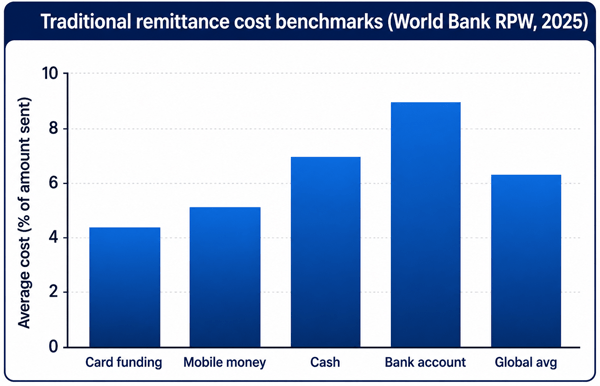
Chart: Traditional remittance cost benchmarks from World Bank Remittance Prices Worldwide data. Stablecoin costs can be lower in some corridors, but total cost depends on buying, sending, converting, and cashing out.
2. What is a stablecoin?
A stablecoin is a crypto token that aims to maintain a steady value against another asset. Most payment stablecoins are pegged to a fiat currency, especially the US dollar. A dollar stablecoin tries to stay close to $1. Popular examples include USDT, USDC, PYUSD, and DAI, although they differ in issuer structure, reserves, transparency, blockchain availability, and risk profile.
2.1 Main types of stablecoins used in payments
| Type | How it is supposed to stay stable | Payment/remittance use | Main risk |
|---|---|---|---|
| Fiat-backed stablecoins | Issuer holds cash, bank deposits, Treasury bills, or similar reserve assets. | Most common for payments because users understand the dollar value. | Issuer, reserve, redemption, banking, and regulatory risk. |
| Crypto-backed stablecoins | Backed by crypto collateral, usually overcollateralized. | Useful in decentralized finance, less common for everyday remittances. | Collateral volatility, liquidation, smart contract, and governance risk. |
| Algorithmic or undercollateralized stablecoins | Use market incentives or algorithms instead of full high-quality reserves. | Generally unsuitable for beginner payments or family remittances. | Can break the peg quickly and permanently. |
| Tokenized bank deposits or bank-issued tokens | Issued by regulated banks or financial institutions. | May become more common for institutional payments. | Availability, interoperability, bank-specific rules, and legal treatment. |
3. How stablecoin payments work step by step
A stablecoin payment usually has five practical steps. The technical transfer may be simple, but beginners should understand the full path from local money to recipient payout.
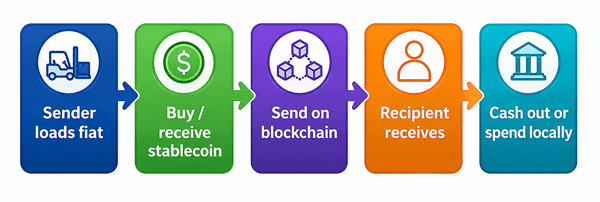
Diagram: Basic stablecoin payment and remittance flow.
- The sender funds an account or wallet. This may be through a bank transfer, debit card, cash agent, salary account, or crypto exchange.
- The sender obtains stablecoins. They may buy USDC, USDT, or another stablecoin directly, or the service provider may convert fiat into stablecoins behind the scenes.
- The stablecoin is transferred on a blockchain network. The sender must choose the correct token and network, such as Ethereum, Solana, Tron, Polygon, Base, Stellar, or another supported chain.
- The recipient receives the stablecoin in a compatible wallet or account. The transfer is usually visible on-chain once confirmed.
- The recipient holds, spends, or cashes out. This is where local adoption matters. Cash-out may happen through an exchange, mobile money partner, OTC desk, merchant, card, or bank transfer.
4. Stablecoins for remittances: a practical example
Imagine a worker in Dubai wants to send money to family in Pakistan. A traditional remittance provider may quote a visible transfer fee plus an exchange rate that includes a hidden spread. A stablecoin route might look cheaper because the blockchain transfer fee is low. But the real comparison must include every step:
| Cost item | Traditional remittance | Stablecoin remittance |
|---|---|---|
| Sending fee | Often shown upfront. | May be exchange fee, card fee, or platform fee. |
| FX spread | Often included in the quoted exchange rate. | Applies when buying stablecoin and when converting to local currency. |
| Network fee | Not visible to user; included in provider cost. | Paid on-chain; varies by blockchain congestion and network. |
| Cash-out fee | Usually included in payout method. | May be charged by exchange, agent, mobile money, or bank. |
| Speed | Minutes to days depending on corridor and provider. | On-chain may be fast, but fiat cash-out may still take minutes to days. |
| Reversal | Some providers can investigate or reverse errors. | Blockchain transfers are usually irreversible once confirmed. |
A stablecoin remittance is attractive when the sender and recipient both have reliable access to low-cost on-ramps and off-ramps. It is less attractive when the recipient has to pay a high cash-out fee, use an unsafe local trader, or accept a poor local exchange rate.
5. Common use cases for stablecoin payments
| Use case | Why stablecoins may help | What to check first |
|---|---|---|
| Family remittances | Faster settlement and potential cost savings in corridors with expensive transfers. | Recipient cash-out options, local legality, FX rate, and wallet safety. |
| Freelancer payments | Clients can pay internationally without slow bank wires. | Invoice records, tax treatment, token choice, and chain compatibility. |
| Business-to-business payments | Useful for suppliers, contractors, and cross-border settlement. | Accounting, compliance, counterparty screening, treasury policy, and custody controls. |
| Merchant payments | Can reduce card chargeback risk and reach global customers. | Payment processor, refunds, pricing in local currency, and volatility if token depegs. |
| Aid and humanitarian transfers | Can reach people where banking access is limited. | Identity checks, fraud prevention, device access, local cash-out, and sanctions compliance. |
| Treasury movement between crypto platforms | Fast movement of dollar value across exchanges and wallets. | Exchange risk, withdrawal limits, supported networks, and address whitelisting. |
6. Benefits of using stablecoins for payments and remittances
6.1 Faster settlement
Many stablecoin transfers settle much faster than international bank wires. Some networks confirm in seconds; others take minutes. This can be helpful for urgent family support, supplier payments, or weekend transactions. However, “fast on-chain settlement” does not always mean instant local cash in hand.
6.2 Potentially lower total cost
Stablecoins may reduce costs in corridors where traditional remittance fees and spreads are high. The biggest savings usually appear when users can access cheap fiat conversion and low-fee blockchains. If on-ramp or cash-out spreads are high, savings can disappear.
6.3 24/7 availability
Blockchains operate outside normal banking hours. This can be useful for people sending money at night, on weekends, or during holidays. Still, exchanges, banks, and local payout agents may have their own operating hours.
6.4 Better transparency of transfer status
Blockchain transfers can often be tracked using a transaction hash. This helps confirm whether funds moved successfully. But beginners must be careful: public transaction data can expose wallet activity, so privacy should not be ignored.
6.5 Access for people with limited banking options
Stablecoins may help people who have smartphones but limited access to international bank accounts. This is especially relevant in countries where receiving dollars is difficult or where local currency is unstable. But access still depends on internet, device security, compliant service providers, and local rules.
7. Risks and limitations of stablecoin remittances
Stablecoins can solve some payment problems, but they introduce different risks. A beginner should treat them as financial tools, not magic money rails.
| Risk | What can go wrong | How to reduce it |
|---|---|---|
| Depeg risk | A stablecoin may fall below its intended $1 value if confidence or reserves are questioned. | Use transparent, liquid stablecoins; avoid algorithmic or weakly backed tokens for payments. |
| Issuer and reserve risk | The issuer may face reserve losses, banking problems, fraud, or redemption pressure. | Check reserve disclosures, audits/attestations, regulation, and redemption history. |
| Wrong network or address | Sending USDT on one network to an unsupported address can cause loss of funds. | Send a small test transaction and confirm token, chain, and address. |
| Wallet/key loss | If private keys or seed phrases are lost or stolen, funds may be unrecoverable. | Use secure wallets, backups, hardware wallets for larger balances, and 2FA on exchanges. |
| Scams and fake tokens | Fraudsters may send fake stablecoins, fake wallet links, or phishing messages. | Verify token contract addresses and use trusted apps, exchanges, and payment links. |
| Regulatory risk | Rules can change; some transfers may be restricted or require KYC/AML checks. | Use compliant providers and understand local laws before sending. |
| Cash-out risk | Recipient may receive stablecoins but struggle to convert them at fair rates. | Confirm cash-out method before sending the full amount. |
| Privacy risk | Public blockchains can reveal wallet balances and transaction history. | Use separate wallets for different purposes and avoid posting wallet addresses publicly. |
| Tax/accounting risk | Some jurisdictions treat crypto transfers, conversions, or gains as reportable events. | Keep records and consult a qualified tax adviser for significant activity. |
7. Stablecoins vs traditional remittance providers
| Feature | Traditional remittance company | Stablecoin route |
|---|---|---|
| Beginner friendliness | Usually easier for non-crypto users. | Can be confusing unless using a simple app. |
| Speed | Often minutes, but some corridors take longer. | On-chain fast; cash-out can vary. |
| Cost visibility | Fee may be visible, FX spread may be hidden. | Network fee visible, but spreads and cash-out costs can be hidden. |
| Reversibility | Some support disputes and corrections. | Usually irreversible once sent. |
| Local payout | Cash pickup, bank, wallet, mobile money depending on provider. | Depends on local exchange, agent, bank, merchant, or card support. |
| Compliance | Provider manages most KYC/AML checks. | User/provider may still need KYC; peer-to-peer transfers can carry compliance risk. |
| Best for | Cash recipients, low-tech users, regulated corridors. | Digitally comfortable users with good on/off-ramp access. |
8. Choosing the right stablecoin for payments
For payments and remittances, the “best” stablecoin is not simply the one with the lowest fee. You need a token that is liquid, widely accepted, available on the right networks, and easy to convert back into local money.
- Reserve quality: Prefer stablecoins backed by high-quality liquid assets such as cash and short-term government securities, with clear public reporting.
- Redemption reliability: The stablecoin should have a credible path to redeem or convert into fiat currency.
- Liquidity: It should trade deeply on reputable exchanges and payment platforms.
- Network support: The recipient’s wallet or service must support the exact token and blockchain network.
- Regulatory posture: Stablecoins issued by transparent, supervised entities may be safer than opaque alternatives.
- Local acceptance: A stablecoin is useful only if the recipient can spend it, save it, or cash it out at a fair rate.
9. Choosing the right blockchain network
The same stablecoin can exist on multiple blockchains. For example, a dollar stablecoin may be available on Ethereum, Solana, Polygon, Stellar, Tron, Arbitrum, Base, or other networks. Network choice affects fee, speed, reliability, wallet support, and risk.
| Factor | Why it matters |
|---|---|
| Fees | High network fees can make small remittances uneconomical. |
| Confirmation speed | Useful for urgent payments, but speed should be balanced with reliability. |
| Wallet and exchange support | Both sender and recipient must use the same supported network. |
| Security and downtime history | Cheaper networks may still have congestion, outages, bridge risks, or ecosystem risks. |
| Token contract authenticity | Fake tokens are common. Use official token contract addresses from reputable sources. |
| Compliance support | Businesses may prefer networks supported by regulated custodians and analytics tools. |
10. Best practices: how to send a stablecoin remittance safely
- Confirm the recipient’s needs first. Do they want dollars, local currency, mobile money, cash, or the stablecoin itself?
- Check local legality and platform rules. Do not assume stablecoin transfers are allowed or unrestricted everywhere.
- Choose a reputable platform or wallet. Beginners should avoid unknown apps, random Telegram traders, and unverified links.
- Use a well-known stablecoin with strong liquidity and transparent reserves.
- Match the exact network. USDT on Tron, USDT on Ethereum, and USDT on another chain are not automatically interchangeable in every wallet.
- Send a small test amount first, especially when using a new address, new network, or new recipient wallet.
- Calculate total cost, not just the network fee. Include buying fee, spread, withdrawal fee, network fee, receiving fee, and cash-out spread.
- Keep transaction records. Save the recipient address, transaction hash, date, amount, exchange rate, and platform receipt.
- Use strong security. Enable 2FA, avoid public Wi-Fi for transfers, never share seed phrases, and watch for fake support agents.
- Avoid keeping large emergency funds in a single wallet, exchange, stablecoin, or blockchain network.
11. Stablecoin payment safety checklist
| Before sending | Yes/No |
|---|---|
| I verified the recipient wallet address directly with the recipient. | |
| I confirmed the exact token and network are supported by the recipient wallet or exchange. | |
| I checked the full cost including FX spread, platform fee, network fee, and cash-out fee. | |
| I understand that the transfer is usually irreversible. | |
| I sent a small test transaction first for a new recipient or new network. | |
| I verified that the stablecoin is genuine, not a fake token with a similar name. | |
| I saved the transaction hash and receipt. | |
| I did not share my seed phrase, private key, or one-time passcode with anyone. | |
| The recipient knows how to cash out or safely hold the stablecoin. |
12. Best practices for businesses accepting stablecoin payments
Businesses have extra responsibilities because stablecoin payments affect accounting, compliance, customer support, treasury management, and fraud controls.
- Use a payment processor or regulated custodian if your team is not experienced with blockchain operations.
- Price goods and services in fiat currency and convert the stablecoin amount at the time of payment to avoid pricing confusion.
- Create a clear refund policy. Refunds may need to be sent to a new address if the original wallet is custodial or exchange-based.
- Separate operating wallets from treasury wallets. Keep only working balances in hot wallets.
- Use address whitelisting, multi-signature approval, and role-based access for larger transfers.
- Screen payments for sanctions and illicit-finance risk where required by law.
- Record the fair value, transaction hash, fees, customer invoice, and conversion details for accounting.
- Define when to convert stablecoins into bank money. Holding large stablecoin balances introduces issuer and liquidity risk.
13. When stablecoins are a good fit - and when they are not
| Stablecoins may be a good fit when... | Stablecoins may not be a good fit when... |
|---|---|
| Both sender and recipient are comfortable using wallets or regulated crypto apps. | The recipient needs cash immediately and has no safe local cash-out route. |
| Traditional transfer fees or FX spreads are high in that corridor. | A trusted remittance provider is already cheaper and easier. |
| The recipient wants to hold dollars or dollar-like digital value. | Local law restricts crypto ownership, transfer, or conversion. |
| The payment is time-sensitive and banks are closed. | The sender cannot tolerate irreversible mistakes. |
| The amount is large enough for savings to matter but not so large that custody risk is unacceptable. | The user does not understand wallet security or may fall for scams. |
14. Common mistakes beginners make
- Looking only at the blockchain fee and ignoring exchange spreads and cash-out fees.
- Sending the right stablecoin on the wrong network.
- Trusting screenshots instead of verifying the transaction hash.
- Assuming every dollar stablecoin is equally safe.
- Using peer-to-peer traders without reputation checks or escrow.
- Keeping all funds on one exchange or in one hot wallet.
- Believing stablecoins are risk-free because their price is usually close to $1.
- Ignoring taxes, business records, or local reporting obligations.
15. Regulation and compliance: what beginners should know
Stablecoin regulation is developing quickly. The United States enacted the GENIUS Act in July 2025, creating a federal framework for payment stablecoin activities. In 2026, the US Treasury proposed rules that would treat permitted payment stablecoin issuers as financial institutions for Bank Secrecy Act purposes and require anti-money laundering and sanctions compliance programs. The European Union has already implemented stablecoin rules under MiCA, and the Bank of England has been finalizing a framework for systemic sterling stablecoins.
For users, this means two things. First, stablecoins are becoming more mainstream in regulated payments. Second, compliance checks are likely to increase. A payment app may ask for identity verification, source of funds, recipient details, transaction purpose, or additional review for large or unusual transfers.
Do not use stablecoins to bypass sanctions, capital controls, taxes, or financial crime rules. Aside from legal risk, doing so can result in frozen accounts, blocked wallets, lost funds, or criminal penalties.
16. Simple cost comparison template
Use this template before choosing between a traditional remittance provider and a stablecoin route.
| Question | Traditional provider | Stablecoin route |
|---|---|---|
| How much does the sender pay in total? | ||
| What exchange rate does the recipient effectively get? | ||
| How long until the recipient can actually use the money? | ||
| Can the recipient receive cash, bank deposit, mobile money, or stablecoin? | ||
| What happens if there is a mistake? | ||
| What ID/KYC is required? | ||
| What records will be kept for tax or business purposes? | ||
| Who provides customer support? |
17. Example scenarios
17.1 Scenario 1: Small family remittance
A sender wants to send $100 to a parent. If the traditional provider charges $6 total and the stablecoin route costs $1 on-chain but $5 to cash out, the stablecoin route is not meaningfully cheaper. The sender should choose the method the parent can receive safely and easily.
17.2 Scenario 2: Freelancer paid by an overseas client
A freelancer invoices a client for $800. A stablecoin payment may arrive faster than a bank wire and avoid intermediary bank fees. The freelancer should still record the invoice, payment date, token amount, local-currency value, conversion fees, and cash-out receipt.
17.3 Scenario 3: Business supplier payment
A company pays an overseas supplier in USDC. This may reduce settlement delays, but the company should use approved wallets, transaction limits, dual approval, counterparty screening, and accounting controls. For larger amounts, a regulated custodian or payment processor is usually safer than a personal wallet.
17.4 Scenario 4: Recipient wants to hold dollars
In some countries, people use stablecoins to hold dollar-like value because local currency is unstable. This can be useful, but it creates exposure to stablecoin issuer risk, wallet theft, exchange restrictions, and changing local regulations.
18. FAQs about stablecoins for payments and remittances
18.1 Are stablecoin remittances legal?
It depends on the country, the platform, the amount, and the purpose of the transfer. Many regulated platforms allow stablecoin payments with KYC, but some jurisdictions restrict crypto activity. Always check local rules and use compliant providers.
18.2 Are stablecoins cheaper than Western Union, banks, or money transfer apps?
Sometimes, but not always. Stablecoins may have low network fees, but the full cost includes buying, selling, exchange spreads, withdrawal fees, and cash-out fees. Compare the final amount the recipient can actually use.
18.3 Can I send stablecoins without a bank account?
In some places, yes, especially through cash agents, mobile wallets, peer-to-peer marketplaces, or crypto apps. But using informal channels can increase fraud, safety, and compliance risks.
18.4 What is the safest stablecoin for payments?
There is no universally safest stablecoin. For payments, look for strong reserves, transparent reporting, high liquidity, reliable redemption, regulatory oversight, and broad wallet/exchange support.
18.5 What happens if I send stablecoins to the wrong address?
In most cases, blockchain transfers cannot be reversed. If you send to the wrong address or wrong network, recovery may be impossible or depend on the receiving platform.
18.6 Do stablecoins avoid foreign exchange fees?
No. If the sender starts with one currency and the recipient needs another, someone still pays for currency conversion. Stablecoins may reduce some intermediary costs, but they do not remove FX costs entirely.
18.7 Can stablecoins lose their peg?
Yes. Some stablecoins have traded below or above their target value during stress. The risk depends on reserve quality, issuer credibility, liquidity, redemption rights, and market confidence.
18.8 Should beginners use self-custody wallets or exchanges?
For small learning transfers, a simple regulated app may be easier. For larger balances, self-custody can reduce exchange risk but increases responsibility for private-key security. Beginners should avoid holding large amounts until they understand both options.
18.9 Are stablecoin payments private?
Not fully. Many blockchain transactions are public. Even if names are not shown on-chain, wallet activity can often be analyzed. Regulated platforms also keep customer records.
18.10 Can merchants accept stablecoins safely?
Yes, but they should use proper payment tools, accounting records, refund policies, wallet controls, compliance screening, and clear conversion rules.
19. Final thoughts
Stablecoins can be a powerful tool for payments and remittances, especially where traditional cross-border transfers are slow, expensive, or hard to access. They can help people move dollar-like value quickly across borders, pay freelancers and suppliers, and build new digital payment experiences.
But beginners should stay realistic. The blockchain transfer is only one part of the journey. The real question is whether the sender can buy safely, send correctly, and the recipient can use or cash out at a fair rate. The safest approach is to start small, use reputable platforms, confirm every detail, keep records, and never treat stablecoins as risk-free bank money.
Sources Consulted and Checked
These sources were consulted when preparing this document and checking its accuracy.
- World Bank Remittance Prices Worldwide, September 2025 database highlight and Q3 2025 report: global average remittance cost 6.36%; funding method cost examples including card, mobile money, cash, and bank account.
- Bank for International Settlements Annual Economic Report 2025 and BIS Papers No. 170 (2026): stablecoin opportunities and risks for cross-border payments, monetary sovereignty, financial stability, and safe-asset markets.
- International Monetary Fund, “How Stablecoins Can Improve Payments and Global Finance” (2025): benefits and risks of stablecoins in global payments.
- US Federal Register and US Treasury materials on implementing the GENIUS Act for payment stablecoins (2026): regulatory framework, AML, sanctions, and compliance obligations.
- European Central Bank Financial Stability Review focus box on stablecoins (2025): market concentration, run risk, and potential impact on reserve assets.
- Bank of England 2026 stablecoin policy framework reporting: evolving regulatory treatment of systemic sterling-backed stablecoins.
Reader Advice
This article is provided for educational and informational purposes only and does not constitute personalized financial, legal, tax, investment, or regulatory advice or a recommendation to use any stablecoin, wallet, exchange, blockchain, payment service, or remittance route. Stablecoin transfers can involve depegging, issuer, custody, fraud, cybersecurity, liquidity, compliance, tax, exchange-rate, cash-out, and irreversible-transaction risks, including the possible loss or freezing of funds. Rules, policies, laws, platform requirements, fees, and statistics can change over time and vary by country or region, so readers should verify current information through official sources and, where appropriate, seek advice from a qualified professional before making a financial or business decision.