What Are Stablecoins? Meaning, How It Works, Examples, Benefits and Risks
1. What Is a Stablecoin?
A stablecoin is a type of cryptocurrency designed to keep a relatively stable value. Most stablecoins try to stay close to the value of a real-world asset, usually the U.S. dollar. For example, a dollar-pegged stablecoin aims to trade around $1.00.
Stablecoins were created because normal cryptocurrencies such as Bitcoin and Ethereum can move sharply in price. A coin that stays near $1 can be useful for trading, payments, savings inside crypto apps, transfers between exchanges, and decentralized finance. However, “stable” does not mean risk-free. A stablecoin can lose its peg, become hard to redeem, be frozen, or fail if its backing or design is weak.
2. Stablecoins Explained in One Simple Example
Imagine you want to send $100 to a crypto exchange but do not want to hold Bitcoin because its price may move before you trade. You buy 100 units of a dollar-backed stablecoin. If the stablecoin holds its peg, each unit is worth about $1. You can move it on a blockchain, trade with it, or redeem it through supported platforms.
In the simplest fiat-backed model, users deposit dollars with an issuer. The issuer keeps reserve assets, such as cash or short-term government securities, and issues stablecoin tokens. When users redeem, the issuer takes back the tokens and pays dollars, usually burning or removing the redeemed tokens from circulation.
3. How Stablecoins Work
Stablecoins use different mechanisms to maintain their value. The design matters because each type has different risks.
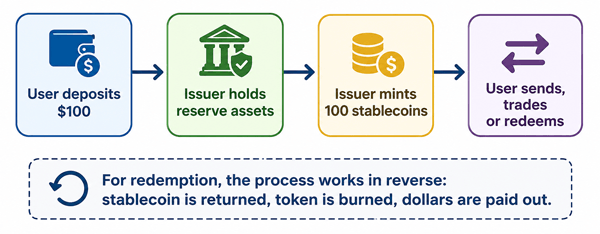
Diagram: Basic fiat-backed stablecoin flow
4. Main Types of Stablecoins
| Type | How it tries to stay stable | Common examples | Main risks |
|---|---|---|---|
| Fiat-backed | Backed by cash, bank deposits, Treasury bills, money market funds, or similar assets. The issuer promises redemption at or near the peg. | USDT, USDC, PYUSD | Issuer risk, reserve quality, redemption limits, regulation, bank/custody risk. |
| Crypto-backed | Backed by crypto collateral held in smart contracts, often overcollateralized to absorb price swings. | DAI, USDS-style systems | Collateral crash risk, liquidation risk, smart contract risk, governance risk. |
| Commodity-backed | Backed by a commodity such as gold, with tokens representing a claim or economic exposure. | PAXG, XAUT | Storage/custody risk, redemption rules, commodity price risk, issuer transparency. |
| Algorithmic or partially algorithmic | Uses software incentives, mint/burn rules, or linked tokens to defend the peg instead of full high-quality reserves. | TerraUSD was a failed example | High collapse risk during stress, confidence spirals, weak redemption backing. |
4.1. Fiat-Backed Stablecoins
Fiat-backed stablecoins are the easiest to understand. A company issues tokens and says each token is backed by reserve assets. Good designs focus on liquid, low-risk reserves, clear audits or attestations, legal segregation of assets, and reliable redemption. Circle says USDC is backed by equivalent U.S. dollar-denominated reserve assets, including cash at regulated financial institutions and the Circle Reserve Fund, which can contain short-dated U.S. Treasuries, overnight Treasury repurchase agreements, and cash. Paxos says PYUSD is redeemable 1:1 for U.S. dollars and is backed by U.S. dollar deposits, short-term U.S. Treasuries, and similar cash equivalents.
The key beginner question is not only “Is it backed?” but “Backed by what, held where, reported how often, and redeemable by whom?”
4.2. Crypto-Backed Stablecoins
Crypto-backed stablecoins use digital assets as collateral. For example, a user may lock more than $150 worth of crypto to mint $100 worth of stablecoin. This overcollateralization gives the system a buffer. If the collateral price falls too far, the position may be liquidated to protect the stablecoin. DAI is one of the best-known decentralized stablecoins historically linked to MakerDAO/Sky-style smart-contract systems.
4.3. Commodity-Backed Stablecoins
Commodity-backed stablecoins track assets such as gold. These are not “stable” against your local currency in the same way a dollar stablecoin is stable against the dollar. If gold falls 10%, a gold-backed token should also fall roughly 10% in dollar terms. They can be useful for commodity exposure, but they are not the same as cash.
4.4. Algorithmic Stablecoins
Algorithmic stablecoins try to hold a peg with code, incentives, and market arbitrage. Some are partially collateralized; others rely heavily on confidence in a related token. Beginners should be extremely careful with this category. The collapse of TerraUSD in 2022 showed that a stablecoin can break when redemptions, incentives, and confidence fail at the same time.
5. Popular Stablecoin Examples
| Stablecoin | Peg | Issuer / model | Beginner notes |
|---|---|---|---|
| USDT (Tether) | U.S. dollar | Issued by Tether; multi-chain fiat-backed model. | Largest and widely used in crypto trading, but reserve transparency and asset composition should be reviewed carefully. |
| USDC (Circle) | U.S. dollar | Issued by Circle; reserve assets include cash and short-dated U.S. government-related instruments. | Common on regulated platforms and DeFi. Check Circle’s current reserve reports and supported networks. |
| DAI | U.S. dollar target | Decentralized, crypto-backed / collateralized smart-contract model. | Useful in DeFi, but depends on collateral, governance, oracles, and smart contracts. |
| PYUSD (PayPal USD) | U.S. dollar | Issued by Paxos for PayPal; redeemable 1:1 for U.S. dollars according to PayPal/Paxos. | Designed for payments and transfers, but availability and features depend on jurisdiction and platform. |
| PAXG / XAUT | Gold | Commodity-backed gold token models. | Tracks gold rather than staying fixed at $1. Useful only if the user wants gold exposure. |
6. Why Do People Use Stablecoins?
Stablecoins are popular because they combine some features of digital money with blockchain transferability. They are often used when people want to avoid the price swings of ordinary crypto without leaving the crypto ecosystem.
- Trading: Traders move between volatile coins and stablecoins without converting back to bank money every time.
- Transfers: Users can send value across blockchain networks, sometimes faster than traditional international transfers.
- DeFi: Stablecoins are widely used in lending, borrowing, liquidity pools, and decentralized exchanges.
- Dollar access: In some countries, people use USD-pegged stablecoins as digital dollar exposure, although this may carry legal, tax, and currency-control risks.
- Payments: Some businesses and apps use stablecoins for settlement, creator payouts, payroll pilots, or cross-border B2B payments.
7. Benefits of Stablecoins
| Benefit | What it means in practice | Important limitation |
|---|---|---|
| Lower volatility than many cryptocurrencies | A dollar stablecoin aims to stay near $1. | The peg can break; stability depends on design and confidence. |
| Fast crypto settlement | Transfers can settle on-chain without waiting for banking hours. | Speed and fees depend on the blockchain network. |
| Useful trading pair | Many exchanges quote crypto prices against stablecoins. | Exchange risk and token risk still apply. |
| Programmable money | Stablecoins can interact with smart contracts and DeFi apps. | Smart contracts can be hacked or fail. |
| Cross-border usability | A user can send tokens globally where legal and technically supported. | Local laws, compliance controls, and on/off-ramp access may limit use. |
8. Risks of Stablecoins
The biggest mistake beginners make is assuming a stablecoin is the same as money in a bank account. It is not. Stablecoins can be useful, but they carry several layers of risk.
8.1. De-Peg Risk
A stablecoin de-pegs when it trades meaningfully above or below its target, such as $0.97 instead of $1.00. This can happen when users doubt the reserves, redemption is delayed, markets panic, or collateral falls in value.
8.2. Reserve and Issuer Risk
For fiat-backed coins, the issuer must hold enough high-quality assets and manage them well. Reserves made of cash and short-term government securities are generally easier to understand than reserves containing loans, corporate debt, volatile assets, or unclear counterparties.
8.3. Redemption Risk
The market price may be near $1, but that does not mean every retail user can redeem directly with the issuer. Some issuers only redeem for approved institutional customers, while ordinary users rely on exchanges or brokers.
8.4. Smart Contract and Blockchain Risk
Stablecoins can exist on different blockchains. A bug, hack, bridge failure, congested network, or wrong-chain transfer can cause losses even if the stablecoin itself is sound.
8.5. Regulatory and Freezing Risk
Centralized issuers may freeze tokens, block addresses, or comply with law-enforcement orders. Regulations can also change how a stablecoin is issued, traded, or redeemed.
8.6. Platform and Custody Risk
Holding stablecoins on an exchange means trusting the exchange. Holding them in your own wallet means you are responsible for private keys, seed phrases, and transfer accuracy.
8.7. Yield Risk
High yields paid on stablecoins are not “free interest.” They may come from lending, leverage, liquidity incentives, or risky DeFi strategies. A high advertised yield usually means added risk.
9. Stablecoins vs Bank Deposits vs CBDCs
| Feature | Stablecoin | Bank deposit | CBDC |
|---|---|---|---|
| Issuer | Usually a private company, protocol, or trust structure. | Commercial bank. | Central bank. |
| Value target | Usually pegged to fiat currency or another asset. | Denominated directly in national currency. | Direct digital central bank money, where available. |
| Insurance | Generally not the same as deposit insurance. | May be insured up to legal limits, depending on country. | Would depend on central bank design. |
| Transfer method | Blockchain wallets, exchanges, apps, smart contracts. | Bank rails and payment networks. | Official digital cash system if launched. |
| Main risk | Issuer, peg, reserve, smart contract, regulatory, and custody risks. | Bank failure beyond insured limits, account restrictions, banking delays. | Policy design, privacy, availability, and adoption questions. |
10. How to Evaluate a Stablecoin Before Using It
A beginner does not need to become a financial analyst, but should check the basics before holding meaningful money in any stablecoin.
- What is the peg? Is it meant to track $1, €1, gold, or something else?
- Who issues or governs it? Is it a company, regulated trust, DAO, or smart-contract protocol?
- What backs it? Look for cash, short-term government securities, or transparent collateral details.
- How often are reserves reported? Monthly reports and independent attestations are better than vague promises, but they are still not the same as a full real-time audit.
- Who can redeem directly? Check whether retail users can redeem or must sell through exchanges.
- Which blockchain network are you using? USDC on Ethereum is not automatically the same transfer route as USDC on Solana, Base, Polygon, or another chain.
- What are the fees and transfer times? Ethereum may be costly during congestion; other networks may be cheaper but carry different risks.
- Is the platform safe? Exchange failure, phishing, fake tokens, and wrong addresses are common beginner risks.
- What does local law say? Stablecoin usage may be restricted, taxed, or regulated differently depending on your country.
11. Best Practices for Beginners
- Start small. Test with a small transfer before sending a large amount.
- Use official contract addresses. Scammers create fake tokens with similar names.
- Match the network exactly. Sending a token on the wrong network can make recovery difficult or impossible.
- Do not chase very high stablecoin yields. Ask where the yield comes from and what can go wrong.
- Diversify if holding large balances. Do not keep all funds in one issuer, exchange, wallet, or blockchain.
- Check reserve reports and news regularly. Stablecoin safety can change over time.
- Keep long-term emergency money in regulated bank accounts, not only in stablecoins.
- Use hardware wallets or reputable custody for larger amounts, and protect seed phrases offline.
- Understand tax records. Stablecoin trades may still be reportable transactions in many jurisdictions.
12. Common Stablecoin Misconceptions
| Misconception | Reality |
|---|---|
| “Stablecoins cannot lose value.” | They can de-peg, become illiquid, or fail. Some have collapsed. |
| “1 stablecoin always equals 1 dollar in my bank.” | Market price, direct redemption, and bank withdrawal are different things. |
| “All stablecoins are backed the same way.” | Reserve quality, transparency, legal structure, and redemption rights vary widely. |
| “Stablecoin yield is the same as bank interest.” | Yield may involve lending, DeFi contracts, leverage, counterparty risk, or token incentives. |
| “A famous exchange listing means it is safe.” | Exchange listings do not remove issuer, market, smart contract, or regulatory risk. |
13. Stablecoin Regulation and Market Trends
Stablecoin regulation is changing quickly. The European Union’s MiCA framework began applying to stablecoin issuers in phases from 2024. In the United Kingdom, the Bank of England has continued developing rules for sterling-backed systemic stablecoins, including reserve and issuance limits. In the United States, policymakers have continued debating federal stablecoin frameworks. Because rules can change, users should check the latest rules in their own jurisdiction before using stablecoins for business, savings, or payments.
Central banks and international bodies have also warned that larger stablecoin markets can create financial stability issues. For example, the Federal Reserve has discussed stablecoin growth and reserve quality, while the Bank for International Settlements has warned about run risk, fire sales of safe assets, and monetary sovereignty concerns. These concerns do not mean every stablecoin is unsafe, but they explain why reserve transparency, redemption rights, and regulation matter.
14. FAQs About Stablecoins
14.1. Are stablecoins safe?
Some stablecoins are safer than others, but none are risk-free. Safety depends on the issuer, reserves, legal structure, redemption process, blockchain, wallet, and platform used.
14.2. Can a stablecoin lose its peg?
Yes. A stablecoin can trade below or above its target during stress, poor liquidity, weak collateral, operational problems, or loss of confidence.
14.3. Is USDT the same as USDC?
No. Both are major USD-pegged stablecoins, but they have different issuers, reserve structures, transparency practices, regulatory relationships, supported networks, and risk profiles.
14.4. Is a stablecoin the same as a digital dollar?
Not exactly. A USD stablecoin is a private token designed to track the dollar. It is not the same as a dollar in an insured bank account or a central bank digital currency.
14.5. Can I earn interest on stablecoins?
Some platforms offer stablecoin yield, but the yield usually involves lending, liquidity provision, leverage, or other risks. Treat high yields with caution.
14.6. What is the best stablecoin for beginners?
There is no single best stablecoin for everyone. Beginners should prefer coins with clear reserves, strong liquidity, reputable platforms, transparent reporting, and easy redemption or selling options.
14.7. What happens if I send stablecoins to the wrong address?
Blockchain transfers are usually irreversible. Always check the address, network, and token contract before sending.
14.8. Can stablecoins be frozen?
Centralized stablecoin issuers may be able to freeze tokens or block addresses under legal or compliance obligations. Decentralized designs have different risks, such as smart contract and governance risk.
14.9. Are stablecoins good for long-term savings?
They may be useful for short-term liquidity or crypto transactions, but they are not a perfect substitute for regulated bank deposits, insured savings, or diversified investments.
14.10. Do stablecoins have transaction fees?
Yes. You may pay blockchain network fees, exchange withdrawal fees, conversion fees, or spread costs. Fees depend on the network and platform.
15. Final Thoughts: Stablecoins Are Useful, But Not Risk-Free
Stablecoins are one of the most practical tools in the crypto market. They help traders move in and out of positions, support DeFi activity, make blockchain transfers easier, and offer digital exposure to assets such as the U.S. dollar or gold. But the word “stable” can be misleading. A stablecoin is only as reliable as its backing, redemption process, governance, technology, and market confidence.
For beginners, the safest mindset is simple: use stablecoins as tools, not as magic risk-free money. Check the issuer, reserves, redemption rules, network, platform, fees, and legal situation. Start small, avoid fake tokens, be cautious with high yields, and never hold more in any stablecoin than you can afford to risk.
Sources Consulted and Checked
These sources were consulted and checked while preparing this article and reviewing its accuracy.
- Federal Reserve, “Stablecoins in 2025: Developments and Financial Stability Implications,” 2026
- Bank for International Settlements, “The next-generation monetary and financial system,” Annual Economic Report 2025
- BIS Bulletin No. 108, “Stablecoin growth - policy challenges and approaches,” 2025
- Circle, USDC transparency and reserve information
- Circle, USDC product and reserve information
- Paxos, PayPal USD launch and reserve information
- Paxos, PYUSD transparency reports
- PayPal, PayPal USD information
- Tether transparency page
- Reuters, Bank of England stablecoin policy update, June 22, 2026
Reader Advice
This article is provided for educational and informational purposes only. It is not personalized financial, investment, legal, tax, or regulatory advice, and it is not a recommendation to buy, sell, hold, transfer, or use any stablecoin or crypto asset. Stablecoins can lose their peg, become illiquid, be frozen or restricted, expose users to issuer, reserve, platform, custody, blockchain, smart-contract, fraud, and cybersecurity risks, and may result in partial or total loss. Rules, policies, laws, tax treatment, product features, reserve arrangements, and market statistics can change over time and vary by country or region. Before making a decision, please verify current information through official issuer, regulator, platform, and government sources, consider your own circumstances and risk tolerance, and seek qualified professional advice where appropriate.