Stablecoin Yield: Complete Guide, Examples, Risks and Best Practices
Key takeaway: Stablecoin yield is not “free interest.” A stablecoin may track the value of a dollar, but the yield usually comes from lending, trading activity, token incentives, real-world assets, or platform promotions. Each source of return creates risk. The safest approach is to understand where the yield comes from, use only reputable and transparent platforms, diversify, and never deposit money you cannot afford to lose.
1. What Is Stablecoin Yield?
Stablecoin yield is a return earned by holding or depositing stablecoins such as USDC, USDT, DAI, or other fiat-pegged tokens. The return is usually shown as APY, which stands for annual percentage yield. For example, a platform might advertise 5% APY on USDC, meaning a $1,000 deposit could earn about $50 over a year if the rate stays the same and compounding works as expected.
The important point is that stablecoins themselves do not automatically create income. A payment stablecoin is mainly designed to maintain a stable value, usually close to $1. The yield normally comes from what someone else does with the stablecoins after you deposit them: lending them to borrowers, using them in a liquidity pool, investing reserves, sharing trading fees, or paying promotional rewards.
1.1 Stablecoin Yield in One Simple Example
Imagine Sara deposits 1,000 USDC into a crypto lending platform that advertises 6% APY. The platform lends stablecoins to traders who need liquidity and charges them interest. After taking its own fee, the platform pays part of that interest to Sara. If everything works smoothly for a full year and the rate stays at 6%, Sara may earn about 60 USDC. But if borrowers default, the platform fails, withdrawals pause, the stablecoin loses its peg, or rules change, Sara may receive less or even lose part of her deposit.
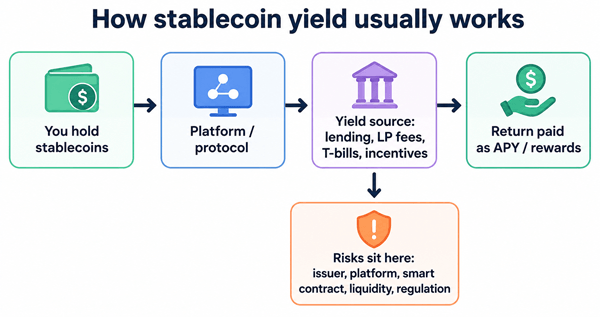
Diagram: Stablecoin yield is a chain of promises and mechanisms. The APY is only as safe as the stablecoin, platform, yield source, and withdrawal process behind it.
2. How Stablecoin Yield Works
Stablecoin yield can look similar to bank interest, but it is not the same thing. In many countries, bank deposits may be regulated and insured up to a limit. Stablecoin deposits on crypto platforms usually do not have the same protections. A higher APY is often compensation for taking extra risk.
- You buy or receive a stablecoin such as USDC or USDT.
- You deposit it into an exchange, lending platform, DeFi protocol, wallet app, or yield product.
- The platform or protocol uses the stablecoin in a strategy, such as lending, market making, liquidity provision, or holding tokenized money-market assets.
- The strategy earns income, rewards, or fees.
- A portion of that income is paid to you as APY, sometimes daily, weekly, or continuously through smart contracts.
3. Common Sources of Stablecoin Yield
| Yield source | How it may generate returns | Main risks |
|---|---|---|
| Crypto lending | Borrowers pay interest to borrow stablecoins, often for trading, market making, or leverage. | Borrower default, weak collateral, platform insolvency, withdrawal freezes. |
| DeFi lending protocols | Users deposit stablecoins into a smart contract. Borrowers pay variable rates based on supply and demand. | Smart contract bugs, oracle failures, governance attacks, bad debt, changing rates. |
| Liquidity pools | You provide stablecoins to a decentralized exchange and earn trading fees or incentives. | Impermanent loss, pool imbalance, smart contract risk, low liquidity, depeg exposure. |
| Exchange earn products | A centralized exchange pays yield through lending, staking-like promotions, or internal treasury programs. | Counterparty risk, opaque use of funds, bankruptcy risk, changing terms. |
| Token incentives | A protocol pays extra reward tokens to attract deposits. | Reward token price collapse, unsustainable emissions, farming-and-dumping. |
| Tokenized money-market or Treasury products | Stablecoin holders access products backed by short-term government debt or money-market instruments. | Regulatory limits, redemption delays, custody risk, interest-rate and operational risk. |
| Issuer or affiliate rewards | A related platform may pay rewards even when the stablecoin issuer itself does not pay interest. | Regulatory uncertainty, conflicts of interest, unclear protection if the program ends. |
4. Stablecoin Yield vs Bank Interest vs Money Market Funds
| Feature | Stablecoin yield | Bank savings account | Money market fund |
|---|---|---|---|
| Typical asset | Digital token on a blockchain. | Bank deposit in fiat currency. | Investment fund holding short-term instruments. |
| Return source | Lending, DeFi activity, trading fees, incentives, or yield products. | Bank pays interest from its lending and funding model. | Income from securities such as Treasury bills or commercial paper. |
| Insurance/protection | Usually no deposit insurance on crypto platform deposits. | Often insured up to legal limits, depending on country and bank. | Usually not bank-insured; subject to investment risk. |
| Access | Crypto wallets, exchanges, DeFi apps. | Bank account. | Brokerage or fund platform. |
| Main risk | Platform failure, smart contracts, depeg, hacks, regulation. | Bank failure beyond insurance limits, low rates, account restrictions. | Market, liquidity, credit, and fund-level risks. |
| Best for | Experienced users who understand crypto custody and counterparty risk. | Cash savings and everyday banking. | Conservative investors who understand fund risks. |
5. Types of Stablecoin Yield Strategies
5.1 Centralized Exchange “Earn” Products
These products are easy to use. You deposit stablecoins on an exchange, choose an earn product, and receive a displayed APY. The platform controls custody and decides how funds are used. This is convenient for beginners, but it introduces counterparty risk. You are trusting the exchange to manage lending, liquidity, risk controls, custody, and withdrawals.
5.2 Centralized Crypto Lending Platforms
Lending platforms may lend stablecoins to institutions, traders, market makers, or retail borrowers. The advertised APY depends on borrower demand, collateral quality, and platform policy. The main danger is that users often cannot see the full loan book, collateral terms, or concentration risk. Past crypto lending failures showed that attractive APYs can hide maturity mismatches, undercollateralized loans, and weak risk management.
5.3 DeFi Lending
In DeFi lending, stablecoins are deposited into smart contracts. Rates change automatically based on supply and demand. If many people want to borrow USDC, APY may rise. If supply is high and borrowing demand is low, APY falls. DeFi can be transparent because on-chain data is visible, but it still requires technical knowledge and exposes users to smart contract, oracle, wallet, and governance risks.
5.4 Stablecoin Liquidity Pools
A liquidity pool lets traders swap between stablecoins, such as USDC and USDT, or between a stablecoin and another asset. Liquidity providers earn part of trading fees and sometimes reward tokens. Stablecoin pools may seem safer than volatile crypto pools, but they can still lose money if one stablecoin depegs, if the pool becomes imbalanced, or if the protocol is hacked.
5.5 Tokenized Treasury and Real-World Asset Products
Some products use stablecoins to access tokenized Treasury bills, money-market-like assets, or real-world credit. These may have a clearer yield source than a vague “earn” program, but they are still not risk-free. Users should check who holds the assets, what legal claim they have, when redemptions are available, what fees apply, and whether the product is available in their jurisdiction.
6. How APY Is Calculated
APY estimates the yearly return after compounding. It is different from APR, which usually does not include compounding. In stablecoin yield products, APY is often variable. A platform may show 8% today and 3% next week.
| Deposit | Advertised APY | Approximate annual earnings if unchanged | Important caveat |
|---|---|---|---|
| $1,000 | 4% | $40 | Rate may change and fees may reduce returns. |
| $5,000 | 6% | $300 | Assumes no losses, no withdrawal limits, and stable peg. |
| $10,000 | 10% | $1,000 | Double-digit APY usually deserves extra scrutiny. |
A simple way to think about APY is this: APY tells you the possible reward, not the level of safety. A 12% APY is not automatically better than a 4% APY. It may simply mean the platform, borrower, protocol, or reward model is taking more risk.
7. Real-World Scenarios: What Can Happen?
| Scenario | What the user sees | What may be happening behind the scenes | Lesson |
|---|---|---|---|
| Normal market | APY is stable and withdrawals work. | Borrowers repay, liquidity is healthy, and the stablecoin holds its peg. | Even good periods do not prove the product is risk-free. |
| Demand falls | APY drops from 7% to 2%. | Fewer borrowers need stablecoins or more users deposited funds. | Variable APYs should be expected. |
| Depeg event | A “$1” stablecoin trades at $0.96. | Market confidence weakens or redemption pressure rises. | Stable does not mean guaranteed. |
| Platform stress | Withdrawals slow or pause. | The platform may lack liquid assets or face insolvency. | Custody and liquidity matter as much as APY. |
| Smart contract exploit | Funds disappear or protocol pauses. | A bug, exploit, or governance attack affects the protocol. | Audits reduce risk but do not eliminate it. |
| Regulatory change | Product closes to some users. | New rules restrict yield products or customer eligibility. | Legal availability can change quickly. |
8. Benefits of Stablecoin Yield
- Potentially higher returns than some traditional cash accounts, especially when crypto borrowing demand is strong.
- Fast access to global crypto markets without holding highly volatile coins.
- Flexible products that may allow daily rewards, short lockups, or on-chain transparency.
- Useful for experienced users who already hold stablecoins for trading, payments, or DeFi activity.
- Can help users compare different yield sources and learn how crypto credit markets work.
9. Major Risks of Stablecoin Yield
The biggest mistake beginners make is focusing on the APY and ignoring the risk stack. Stablecoin yield combines several risks at once.
9.1 Stablecoin Depeg Risk
A stablecoin can trade below or above its target price. This can happen because of reserve concerns, market panic, weak redemption access, issuer problems, regulatory news, or technical issues. If you earn 6% APY but the stablecoin falls 10%, the yield does not protect your capital.
9.2 Issuer and Reserve Risk
Fiat-backed stablecoins depend on reserve assets and redemption promises. Strong stablecoins usually publish reserve reports, use reputable custodians, and hold liquid assets. Weak or opaque stablecoins may hold risky assets, provide poor disclosures, or make redemption difficult. The SEC has described certain dollar stablecoins as designed for one-for-one value, backed by low-risk liquid reserves, and redeemable for dollars; those characteristics are central to understanding stability risk. [2]
9.3 Platform Counterparty Risk
If you deposit stablecoins with a centralized platform, you may become an unsecured creditor if the platform fails. You are relying on its risk controls, custody practices, accounting, security, and honesty. A platform can look professional and still be fragile if it borrows short, lends long, uses customer assets in risky strategies, or lacks transparent reserves.
9.4 Smart Contract Risk
DeFi protocols run on code. Bugs, oracle manipulation, governance attacks, bridge exploits, and admin key misuse can cause losses. A smart contract audit is useful, but it is not a guarantee. More complex strategies usually create more places for something to break.
9.5 Liquidity and Withdrawal Risk
Some products advertise flexible access but can still pause, delay, or limit withdrawals during stress. Lockups, withdrawal queues, redemption windows, and exit fees can make it hard to access funds when you need them most.
9.6 Regulatory Risk
Rules for stablecoins and yield products differ by country and continue to evolve. The BIS Financial Stability Institute notes that payment stablecoins are generally not designed to generate on-chain returns, while yield-bearing products can involve lending, margin pools, arbitrage, derivatives collateral, DeFi lending, or loyalty programs. It also notes that these products can blur the line between payment instruments and investment products. [1]
9.7 Fraud, Scam, and User-Error Risk
Stablecoin transfers can be fast and difficult to reverse. Sending funds to the wrong network, approving a malicious smart contract, falling for fake support, or using a phishing website can lead to permanent loss. The Atlantic Council has highlighted compatibility and fraud risks in stablecoin payments, including the danger of sending funds to an incompatible wallet or being targeted by scams. [5]
9.8 Yield Sustainability Risk
A high APY may come from temporary token rewards, venture-funded promotions, or aggressive borrowing demand. When incentives end, the yield can collapse. If the return is much higher than comparable low-risk cash products, ask exactly what risk is paying for that difference.
10. Stablecoin Yield Red Flags
- The platform says the yield is “guaranteed,” “risk-free,” or “insured” without clear proof.
- APY is unusually high compared with other reputable platforms and no clear yield source is explained.
- The platform does not identify borrowers, collateral policy, reserve practices, custodians, or audits.
- Withdrawals require long lockups, vague approval, or unclear liquidity terms.
- The product depends heavily on a reward token with weak demand or unlimited emissions.
- The team is anonymous, unresponsive, or uses aggressive referral marketing.
- The smart contract is unaudited, recently deployed, or controlled by admin keys without safeguards.
- The stablecoin has poor disclosures, low liquidity, thin exchange support, or a history of losing its peg.
- Terms of service allow the platform to rehypothecate, freeze, or use assets broadly without clear limits.
- Influencers promote the APY but do not explain downside scenarios.
11. How to Evaluate a Stablecoin Yield Product
- Identify the exact stablecoin. Check its issuer, reserve disclosures, redemption process, liquidity, history, and supported networks.
- Identify the yield source. Is it borrower interest, trading fees, Treasury income, token incentives, or a platform subsidy?
- Check custody. Are funds held by you in a smart contract, by an exchange, by a custodian, or by a lending company?
- Read withdrawal terms. Look for lockups, queues, minimums, exit fees, and emergency pause rights.
- Review audits and security history. For DeFi, check smart contract audits, bug bounties, TVL history, and admin controls.
- Compare APY with alternatives. If a product pays far more than others, assume there is extra risk until proven otherwise.
- Check legal availability. Do not use products that are not allowed in your country or require false information to access.
- Start small. Test deposits, withdrawals, network selection, and wallet permissions before committing meaningful funds.
- Plan exits. Decide in advance what conditions would make you withdraw, such as a depeg, withdrawal delay, audit issue, or sudden APY spike.
12. Best Practices for Beginners
- Use well-known stablecoins with strong liquidity and transparent reserve reporting.
- Prefer simple strategies over complex multi-layer yield farms.
- Do not chase the highest APY; chase the clearest risk-adjusted return.
- Diversify across stablecoins, platforms, and custody methods if the amount is meaningful.
- Keep emergency savings in traditional accounts, not in crypto yield products.
- Use hardware wallets for self-custody where appropriate and protect seed phrases offline.
- Revoke unused wallet approvals and avoid signing transactions you do not understand.
- Track tax obligations because yield, rewards, and token swaps may be taxable in many jurisdictions.
- Monitor the stablecoin peg, platform announcements, reserve reports, and security alerts.
- Withdraw periodically rather than assuming a product will stay safe forever.
13. Stablecoin Yield Safety Checklist
| Question | Good sign | Warning sign |
|---|---|---|
| Where does the yield come from? | Clear explanation with data, borrowers, fees, or asset income. | Vague “automated strategy” or “risk-free arbitrage.” |
| Can I withdraw quickly? | Transparent withdrawal rules and successful test withdrawal. | Paused withdrawals, vague lockups, or hidden fees. |
| Is the stablecoin liquid? | Large trading volume, deep markets, broad exchange support. | Thin liquidity or only available on obscure venues. |
| Are reserves transparent? | Regular attestations or reports from reputable firms. | No reserve reports or unclear asset backing. |
| Who controls the funds? | Clear custody model and legal terms. | Unclear ownership rights or broad rehypothecation. |
| Is the smart contract safe? | Audits, bug bounty, long track record, limited admin powers. | New unaudited contract or unlimited upgrade power. |
| Is APY sustainable? | Return matches visible market demand or asset income. | APY depends mainly on promotional tokens. |
| What happens in stress? | Documented risk controls and emergency process. | No stress policy or history of poor communication. |
14. Practical Allocation Example
This is only an educational example, not financial advice. Suppose a user has $10,000 in stablecoins but does not need all of it for trading. A conservative approach might look like this:
| Portion | Possible placement | Reasoning |
|---|---|---|
| 50% | No yield or very low-risk custody | Keeps liquidity available and reduces platform risk. |
| 25% | Reputable, transparent stablecoin yield product | Moderate exposure to earn return while limiting concentration. |
| 15% | DeFi lending protocol with strong track record | Higher transparency but requires technical care. |
| 10% | Experimental or higher-yield strategy | Only if the user understands the risk and can afford loss. |
A beginner could also decide to keep 100% out of yield products until they understand wallets, networks, stablecoin reserves, taxes, and platform risk. Not participating is a valid risk-management decision.
15. Stablecoin Yield Mistakes to Avoid
- Treating stablecoins like insured bank deposits.
- Assuming a well-known app is safe just because it has a polished interface.
- Ignoring the difference between holding a stablecoin and lending it to a platform.
- Depositing funds into a product without testing withdrawal first.
- Using one platform for all funds.
- Chasing double-digit APY without understanding the source of return.
- Ignoring network fees, bridge risks, tax records, and wallet approvals.
- Believing “audited” means “impossible to hack.”
- Forgetting that APY can change quickly.
- Using borrowed money to earn stablecoin yield.
16. When Stablecoin Yield May Make Sense
Stablecoin yield may make sense for users who already understand crypto custody, accept the risks, and want to earn a return on stablecoins they already hold for trading or DeFi. It may also be useful for users who can carefully compare products, read terms, monitor risks, and diversify responsibly.
17. When Stablecoin Yield May Not Make Sense
Stablecoin yield may not be suitable for emergency savings, rent money, tuition, business payroll, debt payments, or any funds you cannot afford to lose. It is also a poor fit for users who do not understand wallet security, network selection, taxes, or the difference between insured deposits and crypto platform obligations.
18. Regulation and Why It Matters
Stablecoin regulation is important because it affects reserves, redemption rights, issuer oversight, consumer protection, and whether yield can be offered directly or indirectly. The SEC has described covered dollar stablecoins as payment or store-of-value instruments that do not provide interest, profit rights, governance rights, or financial benefits tied to issuer performance. [2] The BIS has noted that regulatory approaches to stablecoin-related yields differ across jurisdictions and that third-party or affiliate yield arrangements may require rules beyond the stablecoin issuer itself. [1]
In the United States, the White House Council of Economic Advisers summarized that the GENIUS Act requires one-to-one reserve backing for payment stablecoins and prohibits stablecoin issuers from offering interest or yield to holders, while affiliate or third-party arrangements may be treated differently depending on the legal framework. [3] Because rules can change, users should check current local law before using any stablecoin yield product.
19. Frequently Asked Questions About Stablecoin Yield
19.1 Is stablecoin yield safe?
It can be lower-volatility than yield on volatile crypto assets, but it is not automatically safe. Risks include stablecoin depegging, platform failure, smart contract bugs, hacks, liquidity problems, and regulation.
19.2 Can I lose money with stablecoin yield?
Yes. You can lose money if the stablecoin loses its peg, the platform becomes insolvent, a smart contract is exploited, withdrawals are paused, or you make a wallet or network mistake.
19.3 Why do stablecoin APYs change?
Rates change because borrowing demand, liquidity supply, trading fees, incentives, and market conditions change. A high rate may fall quickly when demand drops or rewards end.
19.4 Is USDC or USDT yield the same as earning dollars in a bank?
No. Holding or lending stablecoins is different from holding insured bank deposits. A stablecoin is a token, and yield products often involve crypto platform or protocol risk.
19.5 What is a good stablecoin APY?
There is no single “good” APY. A reasonable APY depends on the yield source, risk, liquidity, platform quality, and current interest-rate environment. Extremely high APY should be treated as a warning sign until the source is clearly understood.
19.6 Are DeFi yields safer than centralized exchange yields?
Not necessarily. DeFi may offer more transparency, but it adds smart contract, oracle, wallet, and governance risks. Centralized platforms are easier to use but require trust in the company.
19.7 Should beginners use stablecoin yield?
Beginners should learn first, start small, test withdrawals, and avoid using essential funds. Stablecoin yield is best approached slowly and cautiously.
19.8 Do I owe taxes on stablecoin yield?
Possibly. Many jurisdictions treat interest, rewards, or token income as taxable. Rules vary by country, so users should keep records and consult a qualified tax professional.
19.9 What is the safest way to earn stablecoin yield?
There is no risk-free method. A safer approach is to use transparent, reputable products, avoid excessive APY, diversify, understand custody, and keep essential savings outside crypto yield products.
19.10 What should I check before depositing?
Check the stablecoin, platform, yield source, withdrawal terms, custody model, security history, audits, legal availability, fees, and worst-case loss scenario.
20. Final Thoughts
Stablecoin yield can be useful, but it should never be treated as guaranteed income. The word “stable” describes the target price of the token, not the safety of the yield strategy. A practical investor asks four questions before depositing: What stablecoin am I holding? Who controls it? Where does the yield come from? What could stop me from withdrawing?
For beginners, the best practice is simple: learn the mechanics, avoid hype, start small, prioritize transparency, and protect capital before chasing returns. A lower APY from a clear and liquid product is often better than a high APY from a strategy you cannot explain.
Sources Consulted and Checked
These sources were consulted and checked while preparing this document to support accuracy and context.
[1] Bank for International Settlements, FSI Brief: Stablecoin-related yields: some regulatory approaches.
[2] U.S. Securities and Exchange Commission, Statement on Stablecoins, April 4, 2025.
[3] The White House, Effects of Stablecoin Yield Prohibition on Bank Lending, April 8, 2026.
[4] Federal Reserve Bank of Richmond, Stablecoins and Financial Stability, 2025.
[5] Atlantic Council, Stablecoins are trending, but what frictions and risks are getting overlooked?, July 2025.
Reader Advice
This article is provided for educational and informational purposes only. It is not personalized financial, investment, legal, or tax advice, and it does not recommend any stablecoin, platform, protocol, or strategy. Stablecoin yield products can involve loss of principal, depegging, platform insolvency, smart-contract failures, scams, withdrawal restrictions, tax consequences, and regulatory changes. Laws, rules, platform policies, rates, and statistics can change over time and vary by country or region, so readers should verify current information through official sources and consider advice from appropriately qualified professionals before making decisions. Never commit funds you cannot afford to lose.