Stablecoin Depeg Risk: Complete Guide, Examples, Risks and Best Practices
1. What Is Stablecoin Depeg Risk?
Stablecoin depeg risk is the chance that a stablecoin will stop trading close to its intended value. For a U.S. dollar stablecoin, that target is usually $1. A depeg happens when the market price moves meaningfully away from that target, such as $0.98, $0.90, or much lower.
For beginners, the key point is simple: a stablecoin is designed to be stable, but it is not automatically risk-free. Stability depends on the issuer, the reserve assets, market confidence, redemption access, exchange liquidity, smart contracts, and regulation. When one or more of those fail, the price can break away from the peg.
Quick Answer: What Does It Mean When a Stablecoin Depegs?
A stablecoin depegs when it no longer trades at or near its promised reference value. If USDC, USDT, DAI, or another dollar stablecoin trades at $0.95 instead of $1, holders are effectively seeing a 5% market loss unless the coin recovers or they can redeem it directly for $1.
2. How Stablecoins Are Supposed to Work
A stablecoin is a crypto token designed to track the value of another asset, usually a fiat currency such as the U.S. dollar or euro. Stablecoins are widely used for trading, payments, cross-border transfers, decentralized finance, and holding a digital dollar-like balance without moving back into a bank account.
| Type of stablecoin | How it tries to keep the peg | Beginner risk level |
|---|---|---|
| Fiat-backed stablecoin | The issuer holds cash, Treasury bills, bank deposits, money market fund shares, or similar reserves and promises redemption at par. | Lower than most crypto assets, but not risk-free. Reserve quality and redemption rights matter. |
| Crypto-collateralized stablecoin | Crypto assets are locked in smart contracts, often overcollateralized, to support the stablecoin. | Medium to high. Collateral can fall quickly, and smart contract risks remain. |
| Algorithmic stablecoin | Software incentives, mint-and-burn mechanics, or related tokens try to maintain the peg without full external reserves. | High. History shows these designs can collapse during loss of confidence. |
| Commodity-backed stablecoin | Tokens are backed by assets such as gold or other commodities. | Varies. The peg depends on custody, audits, redemption rules, and commodity price movements. |
2.1 The Basic Peg Mechanism
- The issuer or protocol defines a target value, such as 1 token = $1.
- Users buy, sell, mint, redeem, or trade the token across exchanges and DeFi platforms.
- If the coin trades below $1, arbitrage traders may buy it cheaply and redeem it for $1, if redemption works.
- If the coin trades above $1, new supply may be created and sold until the price moves back down.
- The peg holds only if the market believes redemption, collateral, and liquidity are reliable.
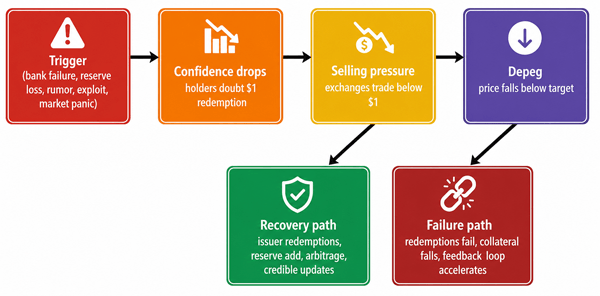
Diagram: How confidence shocks can turn into a stablecoin depeg.
3. Why Stablecoins Depeg
Stablecoins usually depeg because holders stop believing that the token can be redeemed at its promised value quickly, safely, and at scale. The trigger can be real, such as a bank failure, or psychological, such as a rumor that causes panic selling.
| Cause | What it means in practice | Example scenario |
|---|---|---|
| Reserve risk | The backing assets may be insufficient, illiquid, risky, poorly disclosed, or exposed to a failed bank or custodian. | A stablecoin issuer holds part of its cash at a bank that suddenly fails. Holders sell before they know whether the funds are recoverable. |
| Redemption risk | Users may not be able to redeem directly, quickly, or at all. Retail holders often rely on exchanges instead of issuer redemption. | The stablecoin trades at $0.97 on exchanges because direct redemption is closed on weekends or only available to large institutional customers. |
| Liquidity risk | Thin exchange order books can push the price away from $1 even if reserves are sound. | A large seller dumps tokens into a shallow pool and the price temporarily falls to $0.985. |
| Smart contract risk | Bugs, hacks, oracle failures, bridge issues, or governance attacks can damage collateral or market trust. | A DeFi pool containing a stablecoin is exploited, causing traders to flee the asset. |
| Algorithmic design risk | The mechanism depends on confidence in a related token or incentive loop rather than strong external reserves. | Holders rush to exit an algorithmic stablecoin, causing both the stablecoin and its support token to fall. |
| Regulatory or legal risk | A lawsuit, enforcement action, sanctions concern, or license problem can disrupt access or confidence. | Exchanges restrict a stablecoin after a regulatory announcement, reducing liquidity. |
4. Not All Depegs Are the Same
| Depeg type | Typical price range | What it usually means | How serious is it? |
|---|---|---|---|
| Minor fluctuation | $0.995 to $1.005 | Normal market noise, fees, spreads, and exchange differences. | Usually low concern. |
| Soft depeg | $0.98 to $0.995 | Liquidity stress, temporary confidence issue, or high selling pressure. | Monitor closely. |
| Severe depeg | $0.80 to $0.98 | A major reserve, redemption, legal, or confidence shock. | High risk. Avoid assuming recovery. |
| Collapse | Far below $0.80 | Peg mechanism may be broken or market expects large losses. | Extreme risk; recovery is uncertain. |
5. Real-World Stablecoin Depeg Examples
Real depegs are useful because they show that stablecoin risk is not theoretical. The lessons differ depending on whether the stablecoin was fiat-backed, algorithmic, or dependent on another stablecoin.
5.1 TerraUSD (UST): Algorithmic Stablecoin Collapse in May 2022
TerraUSD, commonly called UST, was designed to maintain a $1 value through an algorithmic relationship with the LUNA token rather than traditional full cash reserves. In May 2022, confidence broke, holders rushed to exit, UST fell far below $1, and LUNA collapsed as the system tried to absorb the selling pressure. The SEC later obtained a final judgment in its case involving Terraform Labs and Do Kwon, and the collapse remains one of the clearest warnings about algorithmic stablecoins.
- Lesson for beginners: a high yield is not proof of safety.
- Lesson for risk management: if the peg depends on a second volatile token, a death spiral is possible.
- Practical takeaway: be extremely cautious with stablecoins that are not backed by transparent, high-quality reserves.
5.2 USDC: Silicon Valley Bank Stress in March 2023
USDC is a fiat-backed stablecoin issued by Circle. In March 2023, USDC lost its peg after Circle disclosed that $3.3 billion of reserves were held at Silicon Valley Bank, which had failed. USDC traded sharply below $1 during the panic, then recovered after confidence improved and the banking situation stabilized. This case showed that even a major fiat-backed stablecoin can depeg if reserve access becomes uncertain.
- Lesson for beginners: reserve assets are only useful if they are accessible when users want redemption.
- Lesson for investors: bank and custodian concentration can matter as much as the total reserve amount.
- Practical takeaway: monitor reserve disclosures, banking partners, and redemption conditions.
5.3 DAI: Indirect Depeg Exposure Through Collateral
DAI is a decentralized stablecoin backed by a mix of collateral. At times, part of DAI's backing has included other stablecoins such as USDC. When USDC came under pressure in March 2023, DAI also traded below $1 because the market worried about its exposure. This shows that one stablecoin can inherit risk from another stablecoin used as collateral.
5.4 USDT: Liquidity and Transparency Concerns
USDT, issued by Tether, is the largest stablecoin by usage in many crypto markets. It has generally maintained strong market liquidity, but it has also traded below $1 during periods of market stress and has faced recurring questions about reserve transparency. The lesson is not that size alone makes a stablecoin safe; users still need to evaluate reserves, redemption access, jurisdiction, and issuer transparency.
6. Why People Use Stablecoins Despite Depeg Risk
| Benefit | Why it matters | Risk-aware note |
|---|---|---|
| Fast crypto settlement | Stablecoins can move value across blockchain networks faster than many traditional rails. | Network congestion, wrong-chain transfers, and bridge risks still apply. |
| Trading liquidity | Traders use stablecoins as a quote currency and temporary parking place. | Exchange custody risk and sudden depegs can still cause losses. |
| Dollar exposure | Users in volatile currency environments may seek digital dollar exposure. | Stablecoins are not bank deposits and may not have deposit insurance. |
| DeFi access | Stablecoins are used for lending, liquidity pools, and payments in decentralized apps. | Smart contract and protocol risks can be larger than the stablecoin risk itself. |
| Cross-border payments | Businesses and individuals may use stablecoins for international transfers. | Compliance, tax, sanctions, and local legal rules vary by country. |
7. Stablecoin Depeg Warning Signs to Watch
- The stablecoin trades below $0.995 for more than a brief moment across several major exchanges.
- Redemptions are paused, delayed, restricted, or available only to a narrow group of customers.
- The issuer gives vague updates about reserves, custodians, or banking partners.
- Reserve reports are old, unaudited, difficult to understand, or dominated by risky or illiquid assets.
- Liquidity pools become imbalanced, with many users trying to exit the stablecoin at once.
- A major exchange disables deposits, withdrawals, or trading pairs involving the stablecoin.
- The stablecoin offers unusually high yield without a clear, sustainable source of return.
- The design relies on a volatile governance token to defend the peg.
8. How to Evaluate a Stablecoin Before Using It
| Question to ask | Why it matters | Better answer |
|---|---|---|
| Who issues it? | A stablecoin is only as credible as its issuer, governance, or protocol design. | A known issuer or transparent protocol with clear accountability. |
| What backs it? | Cash, short-term Treasury bills, and equivalent liquid assets are easier to value than risky assets. | High-quality, liquid reserves with clear disclosure. |
| Can you redeem it at $1? | Market price is not the same as legal redemption right. | Clear, timely redemption terms with reasonable fees and broad access. |
| How often are reserves reported? | Old reports do not prove current backing. | Frequent public attestations or audits by reputable firms. |
| Where are reserves held? | Custodian and bank concentration can create single points of failure. | Diversified, regulated custodians and banks. |
| What chain is it on? | The same stablecoin on different chains may involve bridges or wrapped versions. | Native issuance on well-supported chains, not obscure wrapped copies. |
| How liquid is it? | A stablecoin can be solvent but temporarily hard to sell at $1. | Deep order books and multiple trading venues. |
| What legal protections exist? | Stablecoins are usually not insured bank deposits. | Clear terms, regulatory oversight, and transparent claims on reserves. |
9. Best Practices to Reduce Stablecoin Depeg Risk
- Do not treat any stablecoin as risk-free cash. Think of it as a financial product with issuer, reserve, market, and technical risks.
- Diversify across stablecoins only after understanding each one. Diversification helps less if all coins share the same collateral, exchange, bridge, or bank exposure.
- Use stablecoins mainly for short-term utility, not as your entire savings plan.
- Prefer transparent, liquid, redeemable stablecoins with clear reserve reports and strong market depth.
- Avoid chasing unusually high yields. High yield often means hidden credit, leverage, smart contract, or liquidity risk.
- Keep some funds outside crypto rails if you may need emergency liquidity.
- Check the exact token contract and network before depositing or withdrawing. Fake or wrapped tokens can create extra risk.
- Set alerts for stablecoin prices, issuer announcements, and exchange withdrawal changes.
- Understand whether you can redeem directly with the issuer or only sell on exchanges.
- For businesses, write a stablecoin treasury policy that covers limits, approved tokens, custody, redemption procedures, and emergency actions.
10. Common Mistakes and Misconceptions
| Misconception | Reality |
|---|---|
| Stable means guaranteed. | Stablecoins aim to be stable, but the peg can fail. |
| A large market cap means no depeg risk. | Large coins can be more liquid, but size does not remove reserve, legal, or redemption risk. |
| All dollar stablecoins are the same. | They differ by issuer, reserve assets, redemption terms, jurisdiction, chains, and transparency. |
| A 20% yield on a stablecoin is safe because the token is stable. | The yield source may be risky even if the token usually trades near $1. |
| If a stablecoin briefly trades below $1, it must be doomed. | Some depegs are temporary liquidity events; others are fatal. The cause matters. |
| Holding stablecoins on an exchange removes depeg risk. | It adds exchange custody risk and may limit your ability to react during stress. |
11. What Should You Do During a Stablecoin Depeg?
There is no single right answer because the best action depends on the cause of the depeg, your size, your time horizon, your jurisdiction, tax rules, and your access to redemption. Panic selling can lock in losses, but waiting can be worse if the peg mechanism is broken.
- Identify the cause. Is it a temporary exchange liquidity issue, a reserve problem, a hack, a bank failure, or an algorithmic collapse?
- Check multiple prices. Compare centralized exchanges, decentralized exchanges, and the issuer redemption price if available.
- Read official updates, but do not rely only on marketing language. Look for specifics about reserves, redemptions, timelines, and counterparties.
- Reduce single-asset exposure if the risk is unclear. Consider moving part of the balance to fiat, a different stablecoin, or another low-risk asset.
- Avoid high-slippage trades. Large panic swaps in thin pools can cause unnecessary losses.
- Document transactions for tax and accounting records.
- For large balances, consider professional legal, tax, or financial advice before taking irreversible action.
12. Pros and Cons of Using Stablecoins
| Pros | Cons |
|---|---|
| Fast blockchain-based transfers and settlement. | Not the same as insured bank deposits. |
| Useful for trading, payments, and DeFi. | Can depeg during market stress. |
| Can provide digital access to dollar-like value. | Reserve transparency and redemption access vary widely. |
| Often liquid across many crypto venues. | Smart contract, bridge, exchange, and operational risks remain. |
| Can reduce exposure to volatile crypto prices. | Regulatory rules differ by country and can change. |
13. Regulation and Consumer Protection: What Beginners Should Know
Stablecoin regulation is developing quickly. In the European Union, the Markets in Crypto-Assets Regulation, known as MiCA, created rules for crypto-assets, including asset-referenced tokens and e-money tokens. In the United States, the GENIUS Act was enacted in July 2025 to create a federal framework for payment stablecoins, with rulemaking continuing in 2026. These frameworks aim to improve reserve standards, issuer supervision, disclosures, and anti-money-laundering controls, but regulation does not eliminate depeg risk.
Important beginner point: A regulated stablecoin may be safer than an unregulated one in some respects, but it still may not be a bank deposit, may not have deposit insurance, and may be affected by market liquidity, operational failures, or legal restrictions.
14. Practical Scenarios
14.1 Scenario A: You Hold $500 for Trading
For a small short-term trading balance, the most practical risk controls are using reputable venues, avoiding obscure wrapped tokens, and setting a price alert. The cost of overcomplicating the setup may exceed the likely benefit.
14.2 Scenario B: You Hold $50,000 for a Business Payment
For a larger balance, use stricter controls: split funds, confirm direct redemption options, check reserve disclosures, avoid weekend concentration if banking access matters, and keep a fiat backup for payroll or critical invoices.
14.3 Scenario C: A DeFi Pool Offers 25% Yield on a Stablecoin
A very high yield should trigger caution. Ask where the yield comes from. Is it trading fees, token incentives, leverage, lending risk, or a subsidy? If the answer is unclear, the risk is probably higher than the word stablecoin suggests.
15. Stablecoin Depeg Risk Checklist
- I understand what backs the stablecoin.
- I know whether I can redeem directly or only sell through exchanges.
- I checked recent reserve reports and issuer updates.
- I understand the chain, contract address, and bridge exposure.
- I am not relying on a single stablecoin for all liquidity.
- I have price alerts and an exit plan for severe depegs.
- I understand that stablecoin yield is separate from stablecoin peg risk.
- I have considered tax, legal, and accounting consequences.
16. FAQs About Stablecoin Depeg Risk
16.1 What is a stablecoin depeg?
A stablecoin depeg is when the coin trades away from its target price. For a dollar stablecoin, that means it trades below or above $1 instead of staying close to $1.
16.2 Can a stablecoin go to zero?
Yes, especially if the peg mechanism completely fails, reserves are missing, or confidence disappears. Algorithmic stablecoins have shown the most severe collapse risk.
16.3 Is USDT or USDC safer?
There is no universal answer. Safety depends on reserve quality, transparency, regulation, liquidity, redemption access, and your use case. Users should compare current disclosures before choosing.
16.4 Are stablecoins insured by the government?
Usually no. Stablecoins are generally not the same as bank deposits and may not be covered by deposit insurance. Rules vary by jurisdiction.
16.5 Why do stablecoins sometimes trade at $1.01 or $0.99?
Small deviations can happen because of fees, exchange spreads, liquidity, demand spikes, or delays in arbitrage. Persistent or large deviations are more concerning.
16.6 What is the safest way to hold stablecoins?
Use transparent, liquid stablecoins, avoid excessive concentration, understand redemption rights, choose reputable custody, and keep only the amount you need for your purpose.
16.7 What is the biggest warning sign of a dangerous depeg?
A combination of falling price, paused redemptions, vague issuer communication, and unclear reserves is much more dangerous than a small temporary price fluctuation.
16.8 Should beginners use algorithmic stablecoins?
Beginners should be very cautious. Algorithmic designs are complex and can fail quickly when confidence drops.
16.9 Can regulation prevent all depegs?
No. Regulation can improve disclosures, reserves, governance, and supervision, but it cannot remove market, liquidity, operational, or technology risks.
16.10 What should I do before putting a large amount into a stablecoin?
Read the issuer terms, reserve reports, redemption rules, supported chains, and major risks. For large balances, consider professional advice and a written risk plan.
17. Final Thoughts
Stablecoins can be useful tools, but the name can create a false sense of security. Depeg risk comes from a mix of finance, technology, law, liquidity, and human confidence. The best protection is not fear; it is preparation. Understand the peg mechanism, check the reserves, avoid blindly chasing yield, diversify thoughtfully, and have a plan before market stress begins.
Sources Consulted and Checked
The following sources were consulted and checked while preparing this article and supporting its accuracy.
- Federal Reserve, “In the Shadow of Bank Runs: Lessons from the Silicon Valley Bank Failure and Its Impact on Stablecoins,” 2025.
- U.S. Securities and Exchange Commission, “SEC v. Terraform Labs PTE, Ltd. and Do Hyeong Kwon,” final judgment/distribution information, 2024.
- New York Department of Financial Services, “Guidance on the Issuance of U.S. Dollar-Backed Stablecoins,” June 8, 2022.
- European Securities and Markets Authority, “Markets in Crypto-Assets Regulation (MiCA),” official overview.
- U.S. Office of the Comptroller of the Currency, “GENIUS Act Regulations: Notice of Proposed Rulemaking,” 2026.
- U.S. Treasury, “Treasury Proposes Rule to Implement the GENIUS Act’s AML and Sanctions Provisions,” 2026.
- International Monetary Fund, “Understanding Stablecoins,” 2025.
- European Central Bank, “Stablecoins on the rise,” 2025.
- Financial Stability Board, “Regulation, Supervision and Oversight of Global Stablecoin Arrangements,” 2020.
Reader Advice
This article is provided for educational and informational purposes only. It is not personalized financial, investment, legal, tax, accounting, or other professional advice or a recommendation to buy, sell, hold, or use any stablecoin. Stablecoins can lose their peg, become illiquid, face issuer or reserve problems, suffer technology or custody failures, or be affected by legal and regulatory action, and losses may be substantial. Rules, policies, laws, market conditions, and statistics can change over time and vary by country or region, so please verify important information through current official sources and consider qualified professional advice before making significant or irreversible decisions.