Crypto Security Checklist: Risks, Red Flags, Prevention Tips and Safety Checklist
1. Introduction: why crypto security matters
Crypto can be useful, fast and global, but it also puts more responsibility on the user. In a bank account, a mistaken payment may sometimes be reversed. In crypto, transactions are usually irreversible once confirmed on the blockchain. If someone steals your private key, tricks you into signing a bad transaction, or convinces you to send funds to a scam address, recovery can be difficult or impossible.
This guide explains crypto security in plain English. It covers the main risks, common red flags, wallet safety, exchange security, prevention tips and a practical checklist you can use before buying, storing or sending crypto.
2. What is crypto security?
Crypto security means protecting your digital assets, accounts, wallets, recovery phrases and transaction approvals from theft, scams, mistakes and unauthorized access. It includes both technical protection, such as hardware wallets and two-factor authentication, and human protection, such as learning how scams work and slowing down before making a transfer.
2.1 How crypto ownership works in simple terms
A cryptocurrency wallet does not literally store coins like a physical wallet. It stores or manages keys that allow you to control crypto recorded on a blockchain.
| Term |
Beginner-friendly meaning |
Why it matters |
|---|---|---|
| Public address |
The address you can share to receive crypto. |
Similar to an account number, but always check the correct network. |
| Private key |
A secret key that proves control over crypto. |
Anyone with it can move your funds. |
| Recovery phrase / seed phrase |
A list of words that can restore your wallet. |
It is effectively a master key. Never share it or store it online. |
| Blockchain transaction |
A transfer recorded on a public ledger. |
Usually cannot be reversed after confirmation. |
| Smart contract approval |
Permission you give a dApp to interact with tokens. |
A malicious approval can drain assets if you approve the wrong permission. |
2.2 The beginner’s crypto security mindset
- Assume every direct message about crypto is suspicious until proven otherwise.
- Assume no support agent, exchange employee, influencer or wallet app ever needs your seed phrase.
- Assume a transaction cannot be undone, so verify before sending.
- Assume “too good to be true” investment returns are designed to make you rush.
- Assume your phone, email and cloud accounts are part of your crypto security perimeter.
3. Main crypto security risks beginners should understand
| Risk |
What it looks like |
Best prevention |
|---|---|---|
| Phishing |
Fake websites, emails, ads or messages that imitate a wallet, exchange or project. |
Use bookmarks, check URLs carefully, avoid login links in messages. |
| Seed phrase theft |
Someone asks you to “verify,” “sync,” “restore” or “validate” your wallet. |
Never type your recovery phrase into a website or share it with anyone. |
| Investment scams |
A stranger, group, fake platform or “advisor” promises easy profits. |
Verify licensing, avoid pressure, never send funds to withdraw profits. |
| Malware |
Clipboard hijackers, fake wallet extensions, remote access apps or infected downloads. |
Use official sources, update devices, avoid pirated software. |
| SIM swap / account takeover |
A criminal takes over your phone number and resets accounts. |
Avoid SMS-only 2FA; use authenticator apps or hardware security keys. |
| Wrong network/address |
Sending tokens on the wrong chain or to an incompatible address. |
Confirm coin, network, address and memo/tag before sending. |
| Smart contract drainers |
A fake mint, airdrop or dApp asks for broad token approval. |
Use a separate wallet for dApps and review/revoke approvals. |
| Exchange failure or freeze |
Centralized platform halts withdrawals, gets hacked or restricts accounts. |
Do not keep long-term holdings on exchanges; use self-custody when appropriate. |
4. Wallet types compared: which is safer?
There is no perfect wallet for every person. The best setup depends on how much crypto you hold, how often you trade, and how comfortable you are with self-custody.
| Wallet type |
Best for |
Pros |
Cons / risks |
|---|---|---|---|
| Exchange account |
Buying, selling and beginners with small amounts. |
Easy to use; password recovery may be available. |
You do not fully control the keys; account hacks, freezes and platform risk. |
| Hot wallet app |
Small spending balances and DeFi use. |
Convenient; quick transactions. |
Private keys are on an internet-connected device. |
| Browser extension wallet |
DeFi, NFTs and dApps. |
Works easily with websites. |
High phishing and malicious approval risk. |
| Hardware wallet |
Long-term storage and larger balances. |
Keeps private keys offline; safer for signing. |
Costs money; still unsafe if seed phrase is exposed or transactions are approved blindly. |
| Multisig wallet |
Higher-value holdings, teams or advanced users. |
Requires multiple approvals to move funds. |
More complex setup; poor backup planning can lock funds. |
4.1 Rule of thumb for beginners
Use an exchange only for amounts you actively trade. Use a hot wallet for small amounts you need to interact with apps. Consider a hardware wallet for long-term holdings. For very large holdings, get expert help and consider multisig, inheritance planning and geographic separation of backups.
5. Crypto scams and red flags
Crypto scams often work because they mix urgency, greed, fear and technical confusion. The U.S. Federal Trade Commission warns that scammers use promises of big returns to lure people into investment scams, and the FBI describes cryptocurrency investment fraud as fake investments controlled by criminals. Recent FBI reporting shows cryptocurrency-related complaints remain among the costliest categories of cyber-enabled crime. See sources at the end of this article.
5.1 Common crypto scam scenarios
| Scenario |
How it usually works |
What to do |
|---|---|---|
| Fake investment platform |
A person online teaches you to deposit crypto into a platform showing fake profits. |
Try a small withdrawal before adding funds; avoid platforms introduced by strangers. |
| Pig butchering scam |
A scammer builds a relationship over days or weeks, then pushes a fake crypto investment. |
Treat romance, friendship and investing as separate; never invest through a link from a new contact. |
| Fake support |
A “support agent” asks for your seed phrase or tells you to connect your wallet. |
Use only official support channels; no real support agent needs your seed phrase. |
| Airdrop / mint drainer |
A site promises free tokens or NFTs, then asks you to sign a malicious approval. |
Use a burner wallet; do not connect your main wallet to unknown sites. |
| Recovery scam |
After a loss, someone claims they can recover stolen crypto for an upfront fee. |
Report the incident; be skeptical of anyone asking payment to recover funds. |
| Deepfake celebrity ad |
A fake video of a public figure promotes a crypto opportunity. |
Verify through official channels; do not trust social media ads as proof. |
5.2 Red flags checklist
- Someone promises guaranteed profit, fixed daily returns or “risk-free” crypto income.
- You are told to act today or lose access to a special opportunity.
- You must pay a tax, fee or deposit before you can withdraw your own funds.
- A stranger asks you to move the conversation to WhatsApp, Telegram or another private channel.
- A website URL is misspelled, newly created, hard to verify or promoted only through ads.
- A wallet or exchange “support” agent asks for your recovery phrase, private key or remote access.
- You are asked to install AnyDesk, TeamViewer or another remote access tool.
- A dApp asks for unlimited token approval when the action should require only a small amount.
- The project team is anonymous, unverifiable or uses copied whitepapers and stock photos.
- You feel rushed, embarrassed, confused or afraid to ask someone independent for a second opinion.
6. Practical prevention tips: how to protect your crypto
6.1 Protect your recovery phrase like a master key
- Write it down offline. Do not store it in email, screenshots, notes apps, cloud drives or password managers unless you fully understand the risk model.
- Never type it into a website unless you are intentionally restoring a wallet in a trusted wallet app or hardware wallet setup.
- Make at least one backup and store it somewhere protected from theft, water and fire.
- Consider a metal backup for meaningful holdings, but keep it private and physically secure.
- Do not split your phrase casually without understanding recovery risk. Bad splitting can make loss more likely.
6.2 Use strong account security on exchanges
- Use a unique password for every exchange and crypto-related email account.
- Use a reputable password manager to create and store long random passwords.
- Turn on two-factor authentication. Prefer a hardware security key or authenticator app over SMS when available.
- Enable withdrawal allowlists so funds can only be sent to pre-approved addresses.
- Use anti-phishing codes if the exchange offers them, so legitimate emails include a code you chose.
- Lock down your email account because email access can reset many other accounts.
6.3 Use hardware wallets correctly
A hardware wallet can reduce risk because private keys stay offline, but it is not a magic shield. You can still lose funds if you reveal your recovery phrase, approve a malicious transaction, buy a tampered device or ignore what the device screen shows.
- Buy directly from the manufacturer or a trusted official reseller.
- Initialize the device yourself. Do not use a device that arrives with a prewritten seed phrase.
- Verify transaction details on the hardware wallet screen, not only on your computer or phone.
- Keep firmware updated using official software.
- Test recovery with a small balance before storing significant funds.
6.4 Separate wallets by purpose
| Wallet |
Use it for |
Do not use it for |
|---|---|---|
| Vault wallet |
Long-term holdings; rarely signs transactions. |
Random dApps, airdrops, mints or experiments. |
| Spending wallet |
Small transfers and routine use. |
Large long-term savings. |
| DeFi / NFT wallet |
Connecting to dApps and higher-risk experiments. |
Your entire portfolio. |
| Burner wallet |
Testing unknown sites with tiny amounts. |
Anything you cannot afford to lose. |
6.5 Verify every transaction before sending
Crypto addresses are long and easy to copy incorrectly. Malware can also replace a copied address with an attacker’s address. Always verify the first and last characters, the network, the token and the amount. For large transfers, send a small test transaction first.
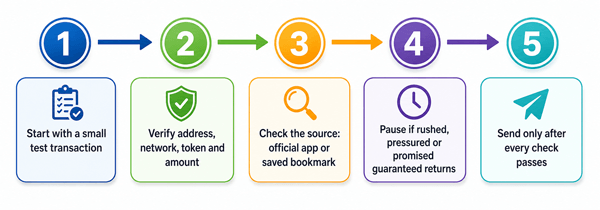
Diagram: A simple safety flow before sending cryptocurrency.
6.6 Be careful with dApps and smart contract approvals
- Do not connect your main wallet to unknown websites.
- Read the wallet prompt before signing. “Sign in” is different from “Approve unlimited spending.”
- Use token approval checkers periodically to revoke permissions you no longer need.
- Be cautious with free mints, surprise airdrops and links from Discord or X accounts that may be hacked.
- Keep a separate wallet for DeFi and NFT activity.
6.7 Secure your devices and browsing habits
- Keep your phone, computer, browser and wallet apps updated.
- Download wallet software only from official websites or app stores linked by official sources.
- Avoid pirated software, cracked trading bots and suspicious browser extensions.
- Do not access crypto accounts on shared or public computers.
- Be cautious on public Wi-Fi. Wait until you are on a trusted network for important transactions.
- Bookmark important crypto sites instead of searching for them every time, because search ads can be malicious.
7. Crypto safety checklist before you buy, store or send
| Check |
Question to ask |
Done? |
|---|---|---|
| Wallet backup |
Have I backed up my recovery phrase offline and stored it safely? |
|
| No digital seed copy |
Is my seed phrase absent from screenshots, cloud storage, email and chat apps? |
|
| 2FA enabled |
Have I enabled strong 2FA on exchange and email accounts? |
|
| Official source |
Am I using the official website/app, not a link from a message or ad? |
|
| Address verified |
Have I checked the first and last characters of the address? |
|
| Network verified |
Am I using the correct blockchain network? |
|
| Test transaction |
For a large transfer, have I sent a small test first? |
|
| No pressure |
Am I making this decision calmly, without urgency or pressure? |
|
| No guaranteed returns |
Has anyone promised profit, fixed returns or special access? |
|
| Withdrawal tested |
If using a platform, have I tested a small withdrawal? |
|
| Approval reviewed |
If using a dApp, do I understand exactly what I am signing? |
|
| Second opinion |
For a major decision, have I asked a trusted independent person? |
8. What to do if you think you made a mistake or got scammed
- Stop sending money. Scammers often ask for more money to unlock withdrawals, pay taxes or recover funds.
- Disconnect the wallet from suspicious websites and revoke risky token approvals if possible.
- Move remaining funds to a new, clean wallet if your seed phrase or private key may be exposed.
- Change passwords and 2FA on email, exchange accounts and other related services.
- Document everything: wallet addresses, transaction hashes, dates, amounts, website URLs, usernames and messages.
- Report the incident to your exchange, wallet provider, local cybercrime authority and relevant consumer protection or law enforcement channels.
- Watch for recovery scams. Real investigators do not guarantee recovery in exchange for upfront crypto payments.
In the United States, the FBI’s Internet Crime Complaint Center asks victims to report cryptocurrency scams and include transaction hashes, addresses, amounts, cryptocurrency types, dates and times when possible. Users outside the United States should use their local cybercrime reporting channel.
9. Benefits and limitations of crypto security tools
| Tool or habit |
Main benefit |
Important limitation |
|---|---|---|
| Password manager |
Creates unique strong passwords and reduces reuse. |
Does not protect you if you approve a scam transaction. |
| Authenticator app |
Stronger than password-only login. |
Can be phished if you enter codes on fake sites. |
| Hardware security key |
Strong protection against many phishing attacks. |
Not supported everywhere; needs backup planning. |
| Hardware wallet |
Keeps private keys offline. |
Cannot save you from revealing your seed phrase or signing malicious approvals. |
| Withdrawal allowlist |
Limits where exchange withdrawals can go. |
May not protect funds already in a self-custody wallet. |
| Multisig |
Reduces single point of failure. |
Setup and recovery are more complex. |
| Test transaction |
Catches many address/network mistakes. |
Adds fees and still requires careful checking. |
10. Common beginner mistakes and misconceptions
| Mistake or misconception |
Reality |
Better approach |
|---|---|---|
| “My wallet company can recover my seed phrase.” |
Non-custodial wallets usually cannot recover it for you. |
Back it up securely before adding significant funds. |
| “A blue check or famous logo means it is safe.” |
Social accounts and ads can be fake or hacked. |
Verify through official websites and multiple trusted sources. |
| “A hardware wallet means I can click anything.” |
You can still approve a malicious transaction. |
Read signing prompts and use separate wallets. |
| “If a platform shows profit, it must be real.” |
Fake platforms can display fake balances. |
Test withdrawals and verify platform legitimacy. |
| “I only need to check the address, not the network.” |
Wrong network transfers can lead to loss or difficult recovery. |
Check coin, network, address and memo/tag. |
| “Recovery services can always get stolen crypto back.” |
Many recovery offers are scams targeting victims again. |
Report properly and be skeptical of upfront-fee recovery promises. |
11. A practical setup for beginners
11.1 For small amounts
- Use a reputable exchange or simple wallet app.
- Enable strong 2FA and a unique password.
- Learn with small amounts you can afford to lose.
- Practice sending and receiving before making larger transfers.
11.2 For medium amounts
- Move long-term holdings to a hardware wallet.
- Keep a separate hot wallet for small spending and dApps.
- Store the recovery phrase offline in at least one secure backup location.
- Use exchange withdrawal allowlists.
11.3 For large amounts
- Consider multisig, legal/inheritance planning and professional security advice.
- Separate storage locations and reduce single points of failure.
- Document recovery instructions carefully for trusted heirs without exposing funds today.
- Avoid discussing holdings publicly.
12. Quick answer: the 10 most important crypto safety rules
- Never share your recovery phrase or private key.
- Use a unique password and strong 2FA for every crypto account.
- Prefer authenticator apps or hardware security keys over SMS when available.
- Use a hardware wallet for long-term holdings.
- Keep your main wallet away from unknown dApps.
- Verify address, network, token and amount before every transfer.
- Send a small test transaction before large transfers.
- Ignore guaranteed-profit offers and high-pressure messages.
- Download wallet software only from official sources.
- Report scams and keep evidence such as transaction hashes and wallet addresses.
13. FAQs
13.1 What is the safest way to store crypto?
For many users, the safest practical setup is a hardware wallet for long-term storage, an offline recovery phrase backup, strong account security, and a separate small wallet for everyday use. Very large holdings may need multisig and professional planning.
13.2 Is keeping crypto on an exchange safe?
It can be convenient, especially for buying and selling, but it carries platform, account and withdrawal risks. Avoid keeping long-term holdings on an exchange unless you understand and accept those risks.
13.3 Can stolen crypto be recovered?
Sometimes investigators or exchanges can freeze or trace funds, but recovery is not guaranteed. Document the incident quickly and report it. Be especially careful of “recovery agents” asking for upfront payment.
13.4 Should I store my seed phrase in a password manager?
Beginners are usually safer keeping seed phrases offline. A password manager is excellent for exchange passwords, but storing seed phrases digitally creates a different risk if the password manager, device or cloud account is compromised.
13.5 Is SMS two-factor authentication enough?
SMS is better than no 2FA, but it is vulnerable to SIM-swap and phone-number takeover attacks. Use an authenticator app or hardware security key when possible.
13.6 What is a test transaction?
A test transaction is a small transfer sent first to confirm the address and network are correct before sending a larger amount. It costs extra fees but can prevent expensive mistakes.
13.7 What should I do if a dApp asks for unlimited approval?
Pause and check whether unlimited approval is necessary. Use a separate wallet, limit approvals where possible, and revoke permissions you no longer need.
13.8 Do crypto wallets get hacked?
Sometimes the wallet software, device, browser extension or user behavior is compromised. Most losses happen through phishing, stolen recovery phrases, malicious approvals, malware or scams rather than someone “breaking” the blockchain itself.
13.9 How do I know if a crypto website is real?
Use official links from the project’s verified channels, check the domain carefully, avoid sponsored search ads, bookmark important sites, and be suspicious of sites pushed through DMs or urgent announcements.
13.10 What is the biggest crypto security mistake beginners make?
The biggest mistake is treating crypto like a normal app where support can reverse errors. In crypto, revealing a seed phrase, signing a bad approval or sending to a scam address can cause permanent loss.
14. Final thoughts
Good crypto security is mostly about slowing down and reducing single points of failure. You do not need to become a cybersecurity expert to be safer than most beginners. Start with the basics: protect your recovery phrase, secure your email and exchange accounts, verify transactions, use separate wallets, and avoid anyone promising easy money. The more money you hold, the more careful your setup should become.
Sources Consulted and Checked
The following sources were consulted and checked while preparing this article and reviewing its accuracy.
- Federal Trade Commission (FTC): What To Know About Cryptocurrency and Scams.
- Federal Bureau of Investigation (FBI): Cryptocurrency Investment Fraud.
- FBI Internet Crime Complaint Center (IC3): Cryptocurrency crime reporting guidance.
- FBI: 2025 Internet Crime Report press release: Cryptocurrency and AI Scams Bilk Americans of Billions.
- New York State Office of Information Technology Services: Cybersecurity for Cryptocurrency.
- NIST: Digital Identity Guidelines, SP 800-63-4.
- California DFPI: Crypto Scam Tracker.
Reader Advice
This article is provided for educational and informational purposes only. It is not personalized legal, financial, investment, tax, cybersecurity, or recovery advice, and it does not recommend any specific cryptocurrency, wallet, exchange, platform, or transaction. Crypto assets, self-custody, online accounts, and smart-contract activity can involve significant risks, including scams, hacking, irreversible transfers, loss of access, platform failure, price volatility, and partial or total loss of funds. Rules, policies, laws, reporting procedures, technical standards, and statistics can change over time and vary by country or region. Before acting, verify current information through official sources, carefully assess the risks, and seek qualified professional advice when your circumstances or holdings warrant it.