How to Research a Crypto Project Safely: Step-by-Step Guide, Tips, Fees, Risks and Best Practices
Beginner takeaway: Researching a crypto project safely means checking whether the project is real, useful, transparent, liquid, secure, and legally risky before you put money into it. Crypto can be innovative, but it can also be highly volatile, difficult to value, and full of scams. This guide gives you a practical process you can follow before buying any token, joining a presale, using a DeFi protocol, or connecting your wallet.
1. What Is Crypto Project Research?
Crypto project research is the process of investigating a blockchain-based project before you interact with it or invest in its token. The goal is not to predict the future perfectly. The goal is to reduce avoidable mistakes: fake teams, copied whitepapers, broken tokenomics, hidden unlocks, weak security, low liquidity, misleading marketing, high fees, and scams.
A crypto project may be a layer-1 blockchain, a layer-2 network, a DeFi app, a gaming token, an NFT collection, an AI-related token, a memecoin, a bridge, a wallet, or a centralized exchange product. Each type has different risks, but the research habits are similar: verify claims, understand incentives, check security, estimate costs, and decide whether the risk is acceptable for you.
2. How Crypto Projects Work in Simple Terms
Most crypto projects combine four pieces:
- A problem or use case: what the project says it is trying to solve.
- A network, app, or protocol: the technology people use.
- A token: the digital asset connected to the project, if one exists.
- A community and market: users, developers, investors, exchanges, liquidity providers, and speculators.
The token is not always the same thing as the business or technology. A project can have interesting technology but a weak token. A token can rise in price for hype-driven reasons even if the product is not useful. Safe research separates the project, the token, the market, and your own risk tolerance.
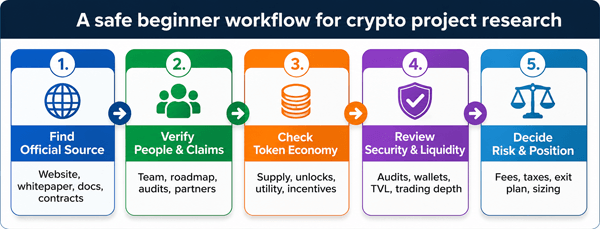
Diagram: A five-step beginner workflow for researching a crypto project safely.
| Research area | Beginner question | Why it matters |
|---|---|---|
| Problem and product | What does this project actually do? | A project without a clear use case may rely mainly on hype. |
| Team and governance | Who controls decisions and funds? | Anonymous or concentrated control can increase risk. |
| Tokenomics | Why should the token have value? | Bad supply design, unlocks, or weak utility can hurt holders. |
| Security | Has the code been audited and tested? | Smart contract bugs, bridge exploits, and wallet approvals can cause losses. |
| Liquidity | Can you buy and sell without large slippage? | Low liquidity makes it hard to exit, especially during market stress. |
| Legal and tax | Could this trigger reporting, restrictions, or taxable events? | Rules vary, but ignoring them can create future problems. |
Step 1: Start With the Official Sources
Begin by finding the project’s official website, documentation, whitepaper, blog, GitHub, social channels, smart contract addresses, and exchange listings. Do not use links from random social media comments, Telegram messages, Discord DMs, or sponsored posts until you have verified them.
Practical example: Suppose you hear about a new token on X. Instead of clicking the first link under a post, search for the official project name, compare the website with verified social profiles, and check whether the contract address shown on the website matches the address listed on reputable block explorers and data platforms.
Warning signs include misspelled domains, recently created websites with no documentation, fake “claim” pages, pressure to connect your wallet, copied branding, and social channels full of bots rather than real discussion.
Step 2: Understand the Use Case Before the Token
Ask what problem the project solves and who would use it even if the token price stopped going up. A strong project should be explainable in simple terms. If the only reason to buy is “number go up,” you are not researching a product; you are speculating on attention.
Look for evidence of real usage: active users, transactions, developer activity, integrations, revenue, total value locked, active apps, or partnerships that can be independently verified. Be careful with vanity numbers. A project can have many followers and still have few real users.
Beginner test: Try to explain the project to a friend in two sentences. If you cannot explain the problem, customer, product, and token role, keep researching or skip it.
Step 3: Check the Team, Backers, and Reputation
Research founders, core contributors, advisors, investors, and major partners. Look for professional history, previous projects, public talks, code contributions, legal issues, failed launches, and conflicts of interest. A public team does not guarantee safety, but it gives you more information to verify.
For anonymous teams, the risk is higher because accountability is weaker. Some legitimate crypto projects have anonymous contributors, but beginners should treat anonymity as a risk factor, not as a cool feature.
Also verify backer and partner claims. “Partnered with Google,” “backed by Binance,” or “audited by CertiK” should be confirmed on the partner’s own website, official announcement, or audit page, not only on the project’s marketing materials.
Step 4: Read the Whitepaper and Documentation Critically
A whitepaper should explain the project’s goal, architecture, token design, roadmap, risks, and assumptions. It does not need to be full of complex math, but it should be specific enough that you can understand what is being built and how the token fits in.
Look for vague language such as “revolutionary ecosystem,” “AI-powered blockchain of the future,” or “guaranteed passive income” without technical or economic details. Check whether the whitepaper is copied from another project by searching a few unique sentences online.
Good documentation usually includes user guides, developer docs, contract addresses, risk disclosures, protocol parameters, governance details, and clear explanations of fees.
Step 5: Review Tokenomics: Supply, Utility, Unlocks, and Incentives
Tokenomics means how the token is created, distributed, used, and economically incentivized. Beginners often focus on price and ignore supply. That is a mistake. A token with a low price can still be expensive if the supply is huge. A token with a high market cap can still fall if large unlocks hit the market.
Check total supply, circulating supply, inflation, vesting schedules, token unlock dates, insider allocations, treasury control, staking rewards, burn mechanisms, and real utility. Ask who benefits if new buyers enter. If insiders, influencers, or early investors can sell large amounts soon, late buyers carry more risk.
A useful token should have a clear reason to exist: paying fees, securing a network, participating in governance, accessing services, or aligning incentives. A token that exists mainly for fundraising may be fragile.
| Tokenomics item | What to check | Beginner red flag |
|---|---|---|
| Circulating vs total supply | How many tokens are already tradable compared with the maximum supply. | Tiny circulating supply with huge future unlocks. |
| Allocation | How much goes to team, investors, treasury, ecosystem, public sale. | Very high insider allocation with short vesting. |
| Unlock schedule | When locked tokens become sellable. | Major unlocks near your planned holding period. |
| Utility | Why the token is needed. | No clear use beyond speculation. |
| Inflation/rewards | How new tokens are issued. | High yields paid mostly with newly printed tokens. |
| Treasury control | Who controls project funds. | Single wallet or small group with no transparency. |
Step 6: Check Security: Audits, Smart Contracts, Wallet Permissions, and Bridges
Crypto security is not just about the project website looking professional. You need to think about smart contracts, admin keys, bridges, wallets, phishing links, and user permissions. A smart contract audit is useful, but it is not a guarantee. Audits can miss bugs, audits may be outdated, and projects can change code after an audit.
Look for recent audits from reputable firms, bug bounty programs, open-source code, clear contract addresses, multisig wallets, timelocks for major upgrades, and transparent incident history. For DeFi, check whether contracts are upgradeable and who has power to pause, change fees, or move funds.
Before connecting a wallet, use a separate wallet with limited funds. Never connect your main wallet to a new or unverified site. Review token approvals and revoke permissions you no longer need.
Step 7: Study Market Data: Liquidity, Volume, Market Cap, and Holders
Market data tells you whether the token is actually tradable. Price alone is not enough. Check market capitalization, fully diluted valuation, 24-hour trading volume, exchange quality, liquidity pools, order book depth, holder concentration, and price history.
Low liquidity can trap beginners. A token may show a high price, but selling even a modest amount can move the market sharply. This is called slippage. For small tokens, compare the amount you want to trade with available liquidity before buying.
Also check holder distribution. If a few wallets hold most of the supply, they may be able to move the market by selling.
Step 8: Estimate All Fees Before You Buy
Crypto fees can be confusing because you may pay more than one type of fee. Common costs include exchange trading fees, spreads, blockchain gas fees, withdrawal fees, bridge fees, swap fees, slippage, network congestion costs, and tax preparation costs. A trade that looks cheap can become expensive after all costs are counted.
Example: You buy a token on a centralized exchange, pay a trading fee, withdraw to a wallet, pay a withdrawal fee, bridge to another network, pay a bridge fee and gas, then swap in DeFi with slippage. If you later sell, you may pay fees again and may also create a taxable event depending on your jurisdiction.
Before buying, write down your entry cost, expected exit cost, and worst-case liquidity cost. This helps prevent small positions from being eaten by fees.
Step 9: Look for Common Crypto Scams and Manipulation
Scams often rely on urgency, secrecy, social proof, and unrealistic returns. Be especially careful with presales, airdrops, “guaranteed yield,” celebrity endorsements, romance or friendship-based investment tips, fake support accounts, fake exchange websites, pump-and-dump groups, and “recovery experts” who promise to get stolen crypto back for a fee.
Official investor protection sources repeatedly warn that crypto investments can be extremely volatile and speculative, may lack protections found in regulated markets, and are frequently used in scams. Treat guaranteed high returns with little or no risk as a major warning sign.
Never share your seed phrase. Never enter it into a website. Never send crypto to “unlock” a larger withdrawal. Never pay taxes, fees, or deposits to someone who says your investment profits are frozen.
Step 10: Check Legal, Regulatory, and Tax Considerations
Crypto rules differ by country and change over time. Some tokens, platforms, or investment products may be restricted, unregistered, or subject to securities, commodities, anti-money-laundering, or consumer protection rules. Beginners should not assume that a token is safe or legal simply because it is listed on an exchange.
In the United States, the IRS says digital asset transactions may need to be reported, and income from digital assets is taxable. The IRS also says virtual currency is treated as property for federal income tax purposes. Other countries have different rules, but the broader lesson is the same: keep records from day one.
Track purchase date, sale date, cost basis, fees, wallet addresses, exchange statements, staking income, airdrops, DeFi transactions, and transfers. Good records are much easier to keep before problems appear.
Step 11: Build a Simple Risk Score Before Deciding
After research, summarize your findings in a one-page risk score. You do not need a complex model. Rate each area as low, medium, high, or unknown risk. Unknown should not be treated as safe. For beginners, too many unknowns should usually mean “skip.”
Your decision should include position size, entry plan, exit plan, maximum loss you can tolerate, security plan, and what would make you change your mind. A disciplined “no” is a successful research outcome.
| Fee type | Where it appears | How to reduce the risk |
|---|---|---|
| Trading fee | Centralized exchanges and some broker apps. | Compare fee tiers and avoid overtrading. |
| Spread | Difference between buy and sell price. | Use limit orders where appropriate and compare venues. |
| Gas fee | On-chain transactions such as swaps, transfers, mints. | Check network fees before transacting; avoid congested periods. |
| Withdrawal fee | Moving crypto off an exchange. | Check the fee schedule before buying. |
| Bridge fee | Moving assets between blockchains. | Use reputable bridges; consider whether bridging is necessary. |
| Slippage | Swaps and low-liquidity tokens. | Set a reasonable slippage limit and avoid illiquid markets. |
| Tax/reporting cost | Tax software or professional help. | Keep clean transaction records from the start. |
| Safe sign | Risk sign |
|---|---|
| Clear docs, verified contract addresses, transparent risks. | Unverified links, rushed launch, vague whitepaper. |
| Audits plus bug bounty plus open-source code. | Audit logo with no report or outdated audit. |
| Real users, active development, realistic roadmap. | Hype-heavy marketing and little product evidence. |
| Reasonable token distribution and long vesting. | Large insider allocation and near-term unlocks. |
| Healthy liquidity across reputable venues. | Thin liquidity, wash-trading suspicion, concentrated holders. |
| No pressure to buy immediately. | Guaranteed returns, secret groups, influencer pump campaigns. |
3. Benefits of Researching a Crypto Project Safely
- You avoid many obvious scams before they reach your wallet.
- You understand what you are buying instead of following hype.
- You can estimate fees, liquidity, and tax recordkeeping needs before entering.
- You become less vulnerable to social pressure, fake urgency, and influencer marketing.
- You can compare projects more fairly instead of judging by price alone.
4. Limitations: Research Reduces Risk, But It Cannot Remove Risk
Even strong research cannot prevent all losses. Crypto prices can fall suddenly. Good teams can fail. Audited code can still have bugs. Liquidity can disappear. Regulators can change rules. Exchanges can freeze withdrawals. A community can lose interest. Research helps you make a more informed decision, but it does not turn crypto into a safe investment.
5. Common Beginner Mistakes to Avoid
- Buying because a token is “cheap” without checking supply and market cap.
- Trusting influencer screenshots, profit claims, or private groups.
- Connecting a main wallet to new websites.
- Ignoring unlock schedules and insider allocations.
- Assuming an audit means the project cannot be hacked.
- Forgetting fees, slippage, and tax records.
- Putting too much money into one small or illiquid token.
- Believing “guaranteed yield” or “risk-free passive income” claims.
6. Beginner Crypto Research Checklist
- Find the official website and verify all links from multiple sources.
- Read the docs and whitepaper; summarize the use case in plain English.
- Confirm contract addresses on official docs and block explorers.
- Research founders, developers, advisors, partners, and backers.
- Check GitHub or development activity if the project is open source.
- Review token supply, allocation, vesting, unlocks, and utility.
- Check audits, bug bounty, admin keys, multisig, and timelocks.
- Review liquidity, trading volume, exchange quality, and holder concentration.
- Estimate trading fees, gas, withdrawals, bridges, spreads, and slippage.
- Check for scam signals: urgency, guaranteed returns, fake support, DMs, copycat domains.
- Understand tax and reporting obligations in your country.
- Decide your maximum loss, position size, exit plan, and wallet security setup.
7. Real-World Scenario: Researching a New DeFi Token
Imagine a friend sends you a token that promises 120% annual yield. The website looks modern, the Telegram group is busy, and several influencers are posting about it. A beginner may feel pressure to buy quickly. A safer process looks different:
- You verify the domain and contract address from official sources, not from the Telegram chat.
- You read the docs and discover the yield is paid mostly with newly issued tokens.
- You check token unlocks and see that early investors can sell next month.
- You find an audit, but it is for an older contract version, not the current one.
- You check liquidity and realize that selling a normal-sized position could cause high slippage.
- You decide not to buy, or you use only a very small amount in a separate wallet after accepting the risk.
This is what safe research is supposed to do. It does not always lead to buying. Often, it helps you avoid a bad decision.
8. Best Practices for Safer Crypto Research
8.1. Use a two-wallet setup
Keep a main cold or long-term wallet separate from a small “testing” wallet used for new apps, mints, and DeFi experiments.
8.2. Verify before clicking
Type official URLs yourself, bookmark verified sites, and avoid links sent through DMs or comments.
8.3. Write a one-page thesis
Before buying, write why the project might succeed, why it might fail, and what evidence would change your mind.
8.4. Size positions conservatively
The riskier and less liquid the project, the smaller the position should be. Many beginners lose money because their position size is too large for the risk.
8.5. Avoid deadline pressure
Scammers use countdowns, private allocations, fake scarcity, and “last chance” language. Real opportunities do not require you to ignore basic checks.
8.6. Keep records
Save transaction IDs, exchange statements, cost basis, wallet notes, and screenshots of important project details.
8.7. Review after buying
Research does not stop after purchase. Monitor unlocks, governance votes, security updates, liquidity changes, and team behavior.
9. FAQs About Researching Crypto Projects Safely
9.1. How long should I research a crypto project before buying?
For a beginner, take at least several hours for any meaningful investment and longer for small, risky, or new projects. The less information available, the more cautious you should be.
9.2. Is a crypto audit enough to trust a project?
No. An audit can reduce some technical risk, but it does not guarantee safety. Check audit date, scope, contract version, unresolved issues, admin controls, bug bounty, and project behavior.
9.3. What is the biggest red flag in a crypto project?
Guaranteed high returns with little or no risk is one of the biggest red flags. Other major red flags include fake links, anonymous pressure selling, hidden token unlocks, low liquidity, and requests for your seed phrase.
9.4. Should beginners buy presales or new token launches?
Presales and new launches are often high risk because information is limited, liquidity may be weak, and scams are common. Beginners should be very cautious and avoid rushing into launches they do not fully understand.
9.5. How do I know if a crypto project is legit?
You cannot know with certainty, but you can look for verified official sources, transparent team or governance, clear documentation, real usage, reasonable tokenomics, audits, healthy liquidity, and no scam-like pressure.
9.6. What tools can help with crypto research?
Useful tools include official project docs, block explorers, reputable market data sites, audit reports, GitHub, governance forums, token unlock calendars, exchange fee pages, wallet approval checkers, and regulator investor alerts.
9.7. Can I lose more than I invest?
If you simply buy a token with cash and do not borrow, your direct token loss is generally limited to what you put in. But leverage, borrowing, margin, derivatives, smart contract approvals, scams, taxes, and hacked wallets can create additional losses.
9.8. Do crypto trades create taxes?
Tax treatment depends on your country. In the United States, the IRS says digital asset transactions may need to be reported and income from digital assets is taxable. Keep records even if you are unsure.
9.9. Is it safer to use a centralized exchange or DeFi?
Each has trade-offs. Centralized exchanges may be easier for beginners but add custody and platform risk. DeFi gives more control but adds smart contract, wallet, phishing, approval, bridge, and gas-fee risks.
9.10. What should I do if I think I was scammed?
Stop sending money. Do not pay “recovery” fees. Save transaction IDs, screenshots, wallet addresses, emails, and chat logs. Report the incident to the relevant platform, wallet provider, exchange, and local consumer protection or law enforcement agency.
10. Final Takeaway
The safest way to research a crypto project is to slow down, verify everything, and separate hype from evidence. Start with official sources, understand the product, check the team, review tokenomics, study security, estimate fees, evaluate liquidity, and watch for scam signals. If the project still makes sense after that, decide with a clear risk limit and a security plan. If too many answers are missing, skipping the project is not a missed opportunity - it is good risk management.
Reader Advice
This article is provided for educational and informational purposes only and is not personalized financial, legal, tax, investment, or professional advice or a recommendation to buy, sell, hold, or use any crypto asset, platform, or service. Crypto projects may involve substantial risks, including volatility, scams, hacking, smart-contract failures, loss of access, illiquidity, regulatory action, tax consequences, and the possible loss of all funds committed. Rules, policies, laws, fees, market data, and statistics change over time and vary by country or region, so readers should verify current information through official sources and consider qualified professional advice before making decisions. Never invest more than you can afford to lose, and independently assess whether any project or transaction suits your circumstances and risk tolerance.
Sources Consulted and Checked
These sources were consulted and checked while preparing this document to support accuracy and reliability:
- SEC Investor.gov: Exercise Caution with Crypto Asset Securities: Investor Alert - warns that crypto asset securities can be exceptionally volatile and speculative and may lack important investor protections.
- FTC Consumer Advice: What To Know About Cryptocurrency and Scams - explains common crypto scam tactics and consumer warning signs.
- FINRA: Crypto Assets and Crypto Assets - Risks - discusses crypto risks, fraud types, and the importance of researching brokers and investment professionals.
- CFTC: Investor Alert: Watch Out for Fraudulent Digital Asset and Cryptocurrency Trading Websites - warns about fake trading businesses and guaranteed-return claims.
- IRS: Digital Assets and Virtual Currency FAQs - explains that digital asset transactions may need to be reported and that income from digital assets is taxable in the United States.