Exchange Collapse Risk: Complete Guide, Examples, Risks and Best Practices
1. What Is Exchange Collapse Risk?
Exchange collapse risk is the risk that a trading platform, crypto exchange, broker, or similar marketplace suddenly becomes unable or unwilling to return customer assets, process withdrawals, or continue normal operations.
In simple terms, it is the danger that the place where you buy, sell, or store assets breaks down financially, legally, technically, or operationally. The result can be frozen withdrawals, missing funds, forced claims, long delays, or permanent losses.
The phrase is most often used in crypto because many centralized crypto exchanges hold customer assets directly. However, the same basic idea can apply to any platform that combines custody, trading, lending, leverage, or market-making in one place.
2. Why This Matters for Beginners
Many beginners think an exchange works like a bank account. That assumption can be dangerous. A bank deposit may have deposit insurance in some countries. A brokerage account may have investor protection for certain securities. Crypto held on an exchange usually does not receive the same protection.
The U.S. FTC warns that cryptocurrency accounts are not backed by a government and crypto held in accounts is not insured like dollars in an FDIC-insured bank account. The CFTC also warns that cash-market crypto platforms may lack critical safeguards and customer protections. These warnings do not mean every platform is unsafe, but they do mean users should understand the difference between convenience and custody risk.
3. Quick Answer: What Happens When an Exchange Collapses?
- Withdrawals may be paused or limited.
- Trading may continue for a while, become unreliable, or stop completely.
- Customer support may become overwhelmed or disappear.
- The company may enter bankruptcy, restructuring, liquidation, or administration.
- Users may need to file claims and wait months or years.
- Recoveries may be partial and may be paid based on the asset value at a specific legal date, not today's market price.
- Scammers may target affected users with fake claim portals, phishing emails, and recovery scams.
4. How Exchanges Work: The Beginner Version
A centralized exchange is a platform that matches buyers and sellers. In crypto, it often also holds users' coins and tokens. When you see a balance inside your account, you may not personally control the private keys. The exchange usually controls the wallets and internal ledger.
That creates convenience. You can trade quickly, reset passwords, use mobile apps, and access many markets in one place. But it also creates a single point of failure. If the exchange mismanages funds, is hacked, has poor internal controls, becomes insolvent, or is shut down by regulators, your balance may become a claim against the company rather than assets you can immediately withdraw.
4.1 Custody vs. Trading: The Key Difference
| Concept | What it means | Why it matters |
|---|---|---|
| Trading | Buying and selling assets on a platform. | You use the exchange for price discovery, liquidity, and execution. |
| Custody | Who controls the asset or private keys. | If the exchange controls custody, you depend on it to return your funds. |
| Self-custody | You control the private keys in your own wallet. | You reduce exchange collapse risk, but you become responsible for security and backups. |
| Claim | A legal right to ask for repayment after failure. | A claim is not the same as instant access to your original coins. |
5. Common Causes of Exchange Collapse
5.1 Insolvency
An exchange is insolvent when it cannot meet its obligations. This can happen if customer funds were lost, loaned out, misused, stolen, or invested in assets that fell sharply in value.
5.2 Bank Runs and Liquidity Crises
Even a platform with some assets can fail if too many users withdraw at once and the exchange does not have enough liquid assets available. A bank run often begins with rumors, leaked balance-sheet concerns, social media panic, or a large competitor withdrawing support.
5.3 Commingling of Customer and Company Funds
Commingling means customer assets are mixed with company funds or affiliate accounts. This makes it harder to know what belongs to users and can create major problems in bankruptcy.
5.4 Excessive Leverage and Risky Lending
Some platforms offer margin, futures, staking, lending, or high-yield products. These services can be legitimate, but they add risk. If the platform lends customer assets to risky borrowers or uses leverage poorly, losses can spread quickly.
5.5 Hacks, Private Key Theft, and Security Failures
Crypto exchanges are high-value targets. A single compromised wallet, smart contract, admin account, or signing process can lead to large losses. In 2024, WazirX suffered a major security breach of more than $230 million and later pursued restructuring before operations resumed in 2025, according to public reports and restructuring commentary.
5.6 Fraud or Misleading Accounting
A collapse can also happen because management lies about reserves, uses customer assets without permission, or hides losses. Fraud is especially dangerous because public signs may appear only after the damage is already severe.
5.7 Regulatory or Legal Shutdowns
Regulators may restrict or shut down a platform if it violates securities, commodities, anti-money-laundering, sanctions, consumer-protection, or licensing laws. Even when users did nothing wrong, legal action can freeze access while courts decide what happens next.
6. Real-World Examples of Exchange Collapse Risk
The examples below are not included to create fear. They show how different failure paths can produce similar user outcomes: withdrawal freezes, claims, delays, uncertainty, and sometimes partial recovery.
| Example | What happened | Main lesson for users |
|---|---|---|
| Mt. Gox (2014) | Once a major bitcoin exchange, Mt. Gox collapsed after large bitcoin losses. Repayments to creditors became a long legal process, with deadlines extended multiple times. | Recovery can take many years. Keeping all coins on one platform creates concentration risk. |
| QuadrigaCX (2019) | The Canadian exchange failed after its founder died; investigations later raised serious questions about asset control and missing funds. | Key-person risk and poor governance can be as dangerous as market risk. |
| FTX (2022) | FTX filed for bankruptcy in November 2022 after a liquidity crisis and revelations about misuse of customer funds. Its court-approved Chapter 11 plan became effective on January 3, 2025. | A large brand, celebrity marketing, and high trading volume do not prove safety. |
| Celsius, Voyager, BlockFi (2022) | These crypto lenders and platforms froze withdrawals and entered bankruptcy after market stress and exposure to risky counterparties. | Yield products add credit, liquidity, and counterparty risk beyond simple spot trading. |
| WazirX (2024-2025) | A large hack led to withdrawal disruption and restructuring. Public reports say WazirX resumed operations in October 2025 after court-approved restructuring. | Security failures can become solvency and legal problems, even if the original cause was a hack. |
7. A Simple Scenario: How Collapse Risk Can Affect a Regular User
Imagine Sara keeps $8,000 worth of crypto on a centralized exchange because she trades occasionally. The exchange announces a temporary withdrawal pause after “unusual market activity.” Sara assumes it will be fixed in a day.
Over the next week, rumors spread that the exchange loaned customer assets to a related company. Trading prices on the platform become strange because users cannot withdraw. The company files for restructuring. Sara now has to download account records, verify her claim, watch court deadlines, and wait for distributions. Even if she eventually recovers money, she may not receive the exact same coins or the full current market value.
The lesson is not that every exchange will fail. The lesson is that exchange balances are exposed to platform risk, not just asset price risk.
8. Warning Signs of a Potential Exchange Collapse
No single warning sign proves that an exchange will fail. But several warning signs appearing together should make you cautious.
- Withdrawals become slow, limited, or inconsistent.
- The exchange offers unusually high yields without clear risk disclosure.
- Proof-of-reserves claims are vague, incomplete, or not matched with liabilities.
- Executives leave suddenly or stop communicating clearly.
- The company relies heavily on its own token as collateral or balance-sheet support.
- There are reports of commingled funds, related-party loans, or hidden leverage.
- Customer support responses become generic, delayed, or contradictory.
- The exchange changes terms of service in a way that weakens customer rights.
- Prices on the platform trade far away from other markets.
- Regulators, auditors, or banking partners publicly raise concerns.
9. Proof of Reserves: Helpful but Not Enough
Proof of reserves is a process where an exchange tries to show that it holds assets on-chain. It can be useful, but it is not a complete safety guarantee.
| What proof of reserves can show | What it may not show |
|---|---|
| Some wallet balances controlled by the exchange. | Whether the exchange has equal or larger customer liabilities. |
| That certain assets existed at a snapshot time. | Whether assets were borrowed temporarily for the snapshot. |
| A basic transparency signal. | Full audited financial statements, internal controls, related-party exposure, or legal ownership of assets. |
| On-chain visibility for some crypto assets. | Off-chain debts, fiat banking problems, derivatives exposure, or operational risks. |
A stronger approach is proof of reserves plus proof of liabilities, independent audits, clear legal segregation of customer assets, strong governance, and transparent risk reporting.
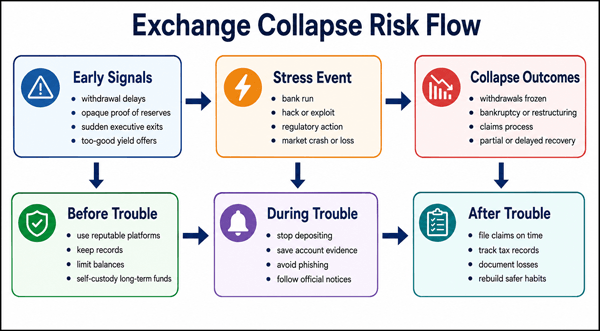
10. Exchange Collapse Risk Diagram
The diagram below summarizes the typical path from early warning signs to collapse outcomes, plus practical actions at each stage.
11. Benefits of Using Exchanges Despite the Risk
Exchanges exist because they solve real problems and offer benefits as well as risks.
- Easy onboarding for beginners.
- Fast buying, selling, and swapping.
- Access to many assets and trading pairs.
- Fiat deposits and withdrawals through banks or cards.
- Customer support and password recovery.
- Advanced order types, charts, tax reports, and APIs.
- Liquidity that may be hard to find in peer-to-peer markets.
The practical goal is not necessarily to avoid exchanges forever. The goal is to use them for what they are good at while limiting the damage if one fails.
12. Main Risks for Users
| Risk | What it means | Practical protection |
|---|---|---|
| Custody risk | The platform controls your assets or private keys. | Withdraw long-term holdings to a secure personal wallet. |
| Liquidity risk | The exchange cannot process withdrawals quickly. | Do not keep emergency funds or all assets on one platform. |
| Counterparty risk | The exchange or its partners fail. | Research ownership, audits, banking partners, and exposure to affiliates. |
| Legal risk | Claims depend on bankruptcy law and user agreements. | Read terms of service and keep records of deposits, trades, and balances. |
| Security risk | A hack or account takeover causes loss. | Use strong 2FA, withdrawal allowlists, and hardware security keys where available. |
| Phishing risk | Scammers target users during panic. | Use official URLs, bookmark portals, and never share seed phrases. |
| Market risk | Asset prices move while withdrawals are frozen. | Avoid using exchanges as your only risk-management tool. |
13. Best Practices to Reduce Exchange Collapse Risk
13.1 Use Exchanges for Trading, Not Long-Term Storage
A common rule in crypto is: “Not your keys, not your coins.” The phrase is simplified, but the idea is important. If you plan to hold an asset for months or years, consider moving it to self-custody after purchase.
13.2 Keep Only an Operational Balance on Exchanges
Decide how much you actually need for active trading. For example, a trader might keep 5-20% of crypto holdings on exchanges and store the rest in self-custody. The right percentage depends on your experience, transaction costs, tax rules, and security setup.
13.3 Diversify Platform Risk
Do not assume that using many assets on one exchange is diversification. If all assets are held by one platform, you still have one major point of failure. Diversifying platform risk may mean using more than one reputable venue, combining exchange use with self-custody, and avoiding dependence on a single stablecoin, bank rail, or yield provider.
13.4 Learn Basic Self-Custody Before You Need It
Self-custody can reduce exchange collapse risk, but it introduces personal responsibility. Start small. Practice sending a small amount. Learn how seed phrases work. Understand hardware wallets, backup storage, phishing risks, and inheritance planning before moving large amounts.
13.5 Keep Independent Records
Download trade history, deposit and withdrawal records, tax reports, account statements, wallet addresses, and screenshots of balances. Store copies outside the exchange. If the platform goes offline, records may become hard to retrieve.
13.6 Avoid “Guaranteed” High Yields
High yields usually come from risk: lending, leverage, market making, token incentives, or new-user subsidies. A yield product is not the same as a bank savings account. Ask where the yield comes from, who borrows the assets, what collateral exists, and what happens if borrowers default.
13.7 Check Security Features Before Depositing
- Two-factor authentication using an authenticator app or hardware key.
- Withdrawal address allowlisting.
- Anti-phishing codes in emails.
- Device management and login alerts.
- Clear cold-storage and hot-wallet policy.
- Bug bounty or independent security testing.
- Transparent incident history and response process.
13.8 Review Legal Terms
Terms of service may explain whether assets are held in trust, whether the exchange can rehypothecate or lend assets, where disputes are handled, and what rights users have in insolvency. Legal language can be difficult, but ignoring it can be costly.
13.9 Watch for Changes, Not Just Reputation
A platform can be strong today and weaker later. Monitor withdrawal speed, public audits, regulatory actions, leadership changes, token exposure, banking relationships, and major incident announcements.
13.10 Make a Personal Emergency Plan
Before a crisis, decide what you will do if withdrawals slow or rumors emerge. A simple plan prevents panic decisions.
- Stop new deposits until facts are clear.
- Withdraw excess funds if withdrawals still work.
- Download account records immediately.
- Save official announcements and transaction IDs.
- Avoid clicking links from social media, DMs, or unknown emails.
- Follow court, administrator, or official restructuring pages if a legal process begins.
14. Exchange Safety Checklist Before You Deposit
| Question | Good sign | Bad sign |
|---|---|---|
| Is the exchange licensed or registered where required? | Clear licenses, regulator names, and legal entities. | Vague “global” claims with no verifiable entity. |
| Does it separate customer assets? | Clear custody terms and segregation policies. | Terms allow broad use of customer funds. |
| Does it publish credible transparency reports? | Regular reports, liabilities disclosure, and audits. | Only marketing claims or one-time wallet snapshots. |
| Are withdrawals reliable? | Fast normal withdrawals with clear limits. | Frequent unexplained delays. |
| Is there related-party exposure? | Transparent structure and limited conflicts. | Heavy reliance on affiliates or own token. |
| What security tools are available? | 2FA, allowlists, alerts, cold storage, and incident disclosure. | Weak account controls and poor communication. |
| How does support respond? | Specific, documented answers. | Generic scripts, disappearing support, or contradictory statements. |
15. What To Do If Your Exchange Looks Unstable
When an exchange looks unstable, speed matters, but panic can make things worse. Use a calm sequence.
- Do not deposit more money or crypto.
- Try a small withdrawal first if you are unsure whether withdrawals work.
- Withdraw assets you do not need for immediate trading, if withdrawals are still available.
- Save account statements, transaction history, screenshots, emails, and support tickets.
- Use only official websites and verified announcements.
- Beware of “recovery agents” who ask for upfront fees, seed phrases, remote access, or wallet signatures.
- If a formal claims process opens, read deadlines carefully and consider professional legal or tax advice for large balances.
16. What To Do After an Exchange Collapses
If the exchange has already frozen withdrawals or filed for bankruptcy, your options may be limited, but there are still important steps to take.
- Collect evidence: balances, deposits, withdrawals, trades, emails, KYC records, and wallet addresses.
- Identify the official claims administrator, court docket, trustee, or restructuring website.
- Calendar every deadline. Missing a claims deadline can reduce or eliminate recovery rights.
- Compare your records with the platform's claim amount before accepting anything.
- Track tax implications. Loss timing, recovery payments, and valuation rules can be complex.
- Stay alert for phishing. Collapse victims are prime targets for fake portals and fake support teams.
- Be patient and realistic. Recoveries can take months or years and may not match peak market value.
17. Common Mistakes and Misconceptions
| Misconception | Reality |
|---|---|
| “Big exchanges cannot fail.” | Large platforms can still fail through fraud, leverage, hacks, or liquidity crises. |
| “Proof of reserves means everything is safe.” | It may show some assets, but not full liabilities, legal ownership, debts, or controls. |
| “My balance is definitely insured.” | Crypto exchange balances are often not protected like insured bank deposits. |
| “High yield is passive income.” | Yield usually means someone is taking risk with the assets. |
| “Self-custody solves every problem.” | Self-custody removes exchange custody risk but adds personal security, backup, and transfer risks. |
| “I can always withdraw when trouble starts.” | During a run, withdrawals may stop before most users react. |
18. Pros and Cons of Keeping Assets on an Exchange
| Pros | Cons |
|---|---|
| Convenient trading and easy access. | You rely on the platform to return assets. |
| Password recovery and customer support. | Withdrawal freezes can trap funds. |
| Fiat on/off ramps. | Legal rights may be unclear in bankruptcy. |
| Charts, order types, APIs, and liquidity. | Hacks, insider fraud, and operational failures can affect users. |
| Tax exports and account history. | Records can become unavailable if the platform shuts down. |
19. Best Beginner Strategy: A Balanced Approach
For many beginners, the safest practical approach is not extreme. You can use exchanges for buying, selling, and small active balances, while learning self-custody for long-term holdings.
A simple beginner model looks like this:
- Use one or two reputable exchanges with strong security and clear legal information.
- Keep only the amount needed for near-term trades on the exchange.
- Move long-term holdings to a wallet you understand and can secure.
- Back up records monthly or after major trades.
- Avoid products you cannot explain, especially high-yield, leverage, or complex derivatives.
- Review your setup every few months and after major market events.
20. FAQ: Exchange Collapse Risk
20.1 What does exchange collapse risk mean?
It means the risk that a trading platform fails financially, legally, technically, or operationally and users cannot access their assets normally.
20.2 Is exchange collapse risk only a crypto problem?
No. It is discussed most in crypto because exchanges often hold customer assets directly, but platform failure can affect other markets too.
20.3 Can I lose all my money if an exchange collapses?
Yes, total loss is possible, although some collapses lead to partial or substantial recovery. The outcome depends on asset shortfalls, legal structure, fraud, insurance, bankruptcy rules, and recovery efforts.
20.4 Does proof of reserves protect me?
It helps with transparency but is not a complete guarantee. It should be combined with liabilities disclosure, audits, asset segregation, and strong governance.
20.5 Should I withdraw everything from exchanges?
Not necessarily. Exchanges are useful for trading and fiat access. The safer practice is to avoid keeping more on an exchange than you need for active use.
20.6 What is the safest place to store crypto?
There is no perfect answer. A well-secured hardware wallet can reduce exchange risk, but users must protect seed phrases, avoid phishing, and plan backups carefully.
20.7 What should I do first if withdrawals slow down?
Stop depositing, download records, verify official announcements, and consider withdrawing excess funds if withdrawals still work.
20.8 Are crypto exchange balances FDIC or SIPC insured?
Usually not. FDIC insurance does not protect against the failure of non-bank crypto exchanges, and SIPC protection generally does not cover crypto assets that are not securities.
20.9 Can an exchange collapse even if prices are rising?
Yes. Collapse can result from fraud, hacks, legal action, or hidden liabilities, not only falling market prices.
20.10 How often should I review exchange risk?
Review it whenever you deposit significant funds, after major market news, and at least every few months.
21. Final Takeaway
Exchange collapse risk is not about assuming every platform is dishonest. It is about recognizing that an exchange is a counterparty. When you leave assets there, you accept risks beyond price volatility: custody, liquidity, legal, operational, cyber, and governance risk.
The best protection is practical discipline: use exchanges for convenience, keep long-term assets under a custody model you understand, avoid opaque yield products, keep records, watch warning signs, and never assume that a screen balance is the same as guaranteed ownership.
Sources Consulted and Checked
These sources were consulted and checked while preparing this document to support accuracy and reliability.
- U.S. Federal Trade Commission, “What To Know About Cryptocurrency and Scams” - notes that cryptocurrency accounts are not backed by a government like FDIC-insured bank deposits.
- U.S. Commodity Futures Trading Commission, “Understand the Risks of Virtual Currency Trading” - explains risks of cash-market platforms, including limited safeguards and customer protections.
- SEC Investor.gov, “Crypto Asset Custody Basics for Retail Investors” and crypto investor alerts - explains custody concepts and investor protection concerns.
- SIPC, “What SIPC Protects” - explains limits of SIPC protection for digital or crypto assets that do not qualify as securities.
- FTX Trading Ltd. restructuring announcements and Kroll case information - confirms the Chapter 11 plan effective date of January 3, 2025.
- Mt. Gox official rehabilitation notices - document repayment deadline changes and creditor repayment process.
- Reuters, AP, Investopedia, and public restructuring reports - background on FTX, BlockFi, Voyager, Celsius, and related market events.
- Public reports and restructuring commentary on WazirX - background on the 2024 hack and 2025 restructuring/resumption of operations.
Reader Advice
This article is provided for educational and informational purposes only and is not personalized legal, tax, investment, financial, cybersecurity, or other professional advice or a recommendation to use, avoid, buy, sell, or store assets through any particular exchange or custody method. Exchange rules, platform policies, laws, regulatory protections, court processes, insurance arrangements, market conditions, and statistics can change over time and vary by country or region, so verify important information through current official sources and seek qualified professional advice where appropriate before making a decision. Crypto and other financial assets can involve substantial risks, including price loss, fraud, hacking, withdrawal restrictions, insolvency, tax consequences, and irreversible self-custody mistakes; use only methods you understand and never risk funds you cannot afford to lose.