Is Cryptocurrency Safe? Complete Guide, Examples, Risks and Best Practices
Cryptocurrency can be safe to use in some situations, but it is not risk-free. The technology behind major cryptocurrencies is designed to make transactions hard to fake. However, people still lose money through price crashes, scams, hacked accounts, fake investment platforms, lost passwords, bad wallet habits, and risky exchanges.
The best beginner answer is this: cryptocurrency is safer when you understand what you are doing, use reputable tools, keep your private keys secure, avoid “guaranteed profit” offers, and only risk money you can afford to lose. It is unsafe when you treat it like a bank account, believe hype, or send money under pressure.
This guide explains what crypto is, how it works, where the main risks come from, and how to protect yourself with practical examples.
1. Quick Answer
Cryptocurrency is not automatically safe or unsafe. Blockchains can be technically secure, but crypto investing and payments carry serious risks: volatility, scams, irreversible transfers, exchange failures, wallet mistakes, phishing, malware, and limited consumer protections. A beginner should start small, use trusted platforms, enable strong security, back up recovery phrases offline, verify every address, and avoid anyone promising guaranteed returns.
2. What Is Cryptocurrency?
Cryptocurrency is a form of digital asset that can be transferred over the internet without relying on a traditional bank for every transaction. Bitcoin, Ethereum, stablecoins such as USDC or USDT, and thousands of other tokens are examples of crypto assets.
Instead of a bank ledger controlled by one institution, many cryptocurrencies use a blockchain. A blockchain is a shared record of transactions maintained by a network of computers. Once a transaction is confirmed, it is usually difficult or impossible to reverse.
People use crypto for different reasons: investing, sending value internationally, using decentralized finance apps, buying digital collectibles, or experimenting with new technology. But each use case has different risks.
3. How Cryptocurrency Works in Simple Terms
Here is the basic flow: you create or use a wallet, the wallet controls private keys, you sign a transaction, the network checks it, and the transaction is recorded on the blockchain.
A public address is like an account number you can share. A private key or seed phrase is like the master key. Anyone who gets it can move the crypto. If you lose it, there may be no company that can reset it for you.
Crypto transactions are also “push” payments. You send money to another address. Unlike many card payments or bank transfers, there is often no chargeback process if you send to the wrong address or to a scammer.
4. Is Cryptocurrency Safe for Beginners?
For beginners, cryptocurrency is best understood as a high-risk financial and technology activity. You are not just choosing an investment; you are also managing cybersecurity, app security, passwords, recovery phrases, tax records, and scam detection.
A beginner can use crypto more safely by starting with simple, low-risk habits: learn before buying, use small test amounts, avoid leverage, avoid unknown tokens, and never click links from strangers. The danger rises quickly when a person starts chasing fast profits, using complex decentralized finance apps, borrowing against crypto, or storing large balances on poorly protected accounts.
Official investor-protection sources such as the SEC and FINRA warn that crypto assets can be exceptionally risky, volatile, speculative, and may lack protections common in traditional securities markets.
5. Crypto Safety at a Glance
| Question | Beginner-friendly answer |
|---|---|
| Is the blockchain itself secure? | Major networks such as Bitcoin and Ethereum are difficult to alter, but smaller networks and smart contracts can have weaknesses. |
| Is my crypto safe on an exchange? | It depends on the exchange, account security, custody controls, and local regulation. Exchange failure or account takeover can still cause losses. |
| Can I reverse a crypto payment? | Usually no. If you send crypto to the wrong address or a scammer, recovery is difficult and often impossible. |
| Can crypto lose value? | Yes. Prices can rise or fall sharply, sometimes in hours. |
| Is crypto insured like a bank account? | Usually no. Bank deposit insurance and brokerage protections generally do not apply to ordinary crypto holdings. |
| Should a beginner invest everything in crypto? | No. Crypto should be a small, optional part of a financial plan, not emergency savings or rent money. |
6. Why People Say Cryptocurrency Is Safe
There are real safety strengths in crypto technology. The problem is that these strengths do not remove every risk.
| Potential safety benefit | What it means | Important limitation |
|---|---|---|
| Strong cryptography | Transactions are secured with cryptographic signatures. | Your wallet can still be compromised if your private key, seed phrase, device, or exchange account is stolen. |
| Transparent public ledger | Many blockchains let anyone view transaction history. | Transparency does not stop scams, bad investments, or stolen keys. |
| No single bank needed | Users can move assets without relying on one bank’s database. | You may also lose bank-like customer support and reversal options. |
| Self-custody option | You can hold assets in your own wallet. | You become responsible for backups, device security, and safe transaction signing. |
| Global transfers | Crypto can move across borders quickly. | Fast movement also helps criminals move stolen funds quickly. |
7. Why People Say Cryptocurrency Is Risky
Most crypto losses happen because of market risk, human error, scams, or weak security practices. The following risks matter most for beginners.
- Price volatility: A coin can fall 20%, 50%, or more, and some tokens go to zero.
- Scams: Fake investment sites, romance scams, “pig butchering,” giveaway scams, fake support, and recovery scams are common.
- Irreversible transfers: Sending to the wrong address is usually final.
- Private key loss: If you lose your recovery phrase for a self-custody wallet, your funds may be gone.
- Exchange and platform risk: A platform can freeze withdrawals, be hacked, become insolvent, or fail to protect customer assets.
- Smart contract risk: DeFi apps can contain coding errors, economic design flaws, or malicious permissions.
- Regulatory and tax uncertainty: Rules vary by country and can change.
- Liquidity risk: Some tokens are hard to sell without a large price drop.
- Fake tokens and impersonation: Scammers create look-alike websites, fake coins, and fake social media accounts.
8. Real-World Examples and Scenarios
| Scenario | What happens | How to reduce the risk |
|---|---|---|
| The wrong address | A beginner copies a wallet address incorrectly and sends funds to the wrong place. | Send a small test transaction first, use address books carefully, and verify the first and last characters. |
| Fake support message | A person on social media says they are exchange support and asks for a seed phrase. | Real support should never need your seed phrase. Never share it. |
| “Guaranteed 2% daily returns” | A website shows fake profits and asks for more deposits before withdrawals. | Treat guaranteed returns as a red flag. Check registration, reviews, domain age, and independent sources. |
| Exchange account takeover | A hacker gets into an email account, resets an exchange password, and withdraws crypto. | Use unique passwords, app-based or hardware 2FA, withdrawal allowlists, and secure email. |
| Lost recovery phrase | A user stores the phrase in a phone photo, then loses access or gets hacked. | Write it on paper or metal and keep it offline in secure locations. |
| Token hype | A beginner buys a trending meme token after a social post. Liquidity disappears. | Research token distribution, liquidity, team transparency, and avoid FOMO. |
9. Crypto vs Traditional Banking and Investing
| Feature | Traditional bank/brokerage | Cryptocurrency |
|---|---|---|
| Customer support | Usually available; disputes may have formal processes. | Support varies. Self-custody wallets may have no recovery service. |
| Transaction reversal | Some card payments and bank transfers may be disputed. | Blockchain transactions are usually irreversible. |
| Insurance/protection | Bank deposit insurance or securities protections may apply, depending on country and account type. | Often no comparable protection for direct crypto holdings. |
| Access | May depend on banking hours, region, and institution. | Global 24/7 markets and transfers. |
| Volatility | Cash is relatively stable; investments vary by asset. | Many crypto assets are highly volatile. |
| Responsibility | Institution handles much of custody and record keeping. | User may be responsible for keys, addresses, wallet approvals, and security. |
10. Pros and Cons of Cryptocurrency
| Pros | Cons |
|---|---|
| Can provide direct ownership and self-custody. | High volatility can cause large losses. |
| Can enable fast global transfers. | Payments are usually irreversible. |
| Open networks can support innovation and financial apps. | Scams, hacks, and fake platforms are common. |
| Some blockchains are transparent and auditable. | Transparency does not equal safety or value. |
| May diversify a small portion of a portfolio for some investors. | Regulatory, tax, custody, and liquidity risks can be complex. |
11. Best Practices: How to Use Cryptocurrency More Safely
No checklist can make crypto risk-free, but these habits dramatically reduce common beginner mistakes.
11.1 Start with education before money
- Learn the difference between a coin, token, wallet, exchange, blockchain, stablecoin, and private key.
- Understand how the specific asset works before buying it.
- Do not buy because of celebrity posts, social media hype, or a friend’s urgent recommendation.
11.2 Use money rules
- Do not use emergency savings, rent, debt money, or money needed soon.
- Avoid leverage and borrowing to buy crypto.
- Decide your maximum loss before buying.
11.3 Choose reputable platforms carefully
- Use well-known exchanges with strong security features, transparent leadership, and clear legal terms.
- Check whether the platform is registered or licensed where required in your country.
- Avoid platforms promoted only through direct messages, romance contacts, WhatsApp/Telegram groups, or random ads.
11.4 Secure every account
- Use a unique password generated by a password manager.
- Turn on two-factor authentication, preferably an authenticator app or hardware security key instead of SMS.
- Secure your email account because it can be used to reset exchange passwords.
- Enable withdrawal allowlists if available.
11.5 Protect your seed phrase
- Never type your seed phrase into a website claiming to “verify,” “recover,” or “sync” your wallet.
- Do not store the seed phrase in screenshots, cloud notes, email drafts, or chat apps.
- Write it offline and keep backups in secure physical locations.
- Consider a hardware wallet for meaningful amounts.
11.6 Verify before sending
- Check the network. Sending a token on the wrong network can result in loss.
- Confirm the recipient address carefully. Malware can replace copied addresses.
- Send a small test transaction before a large transfer.
- Be cautious with QR codes from unknown people or websites.
11.7 Avoid high-risk products until you understand them
- Be careful with DeFi lending, staking, bridges, yield farms, perpetual futures, options, and new token launches.
- Read wallet approval prompts. Do not approve unlimited spending permissions unless you understand the risk.
- Use a separate wallet for experiments and keep long-term holdings separate.
11.8 Keep records for taxes and recovery
- Record purchase dates, amounts, sale dates, fees, and wallet addresses.
- Save transaction hashes for important transfers.
- If scammed, report quickly and keep addresses, hashes, communication records, websites, phone numbers, and payment details. The FBI advises victims to provide transaction details when filing complaints.
12. Diagram: Where Crypto Safety Depends on You
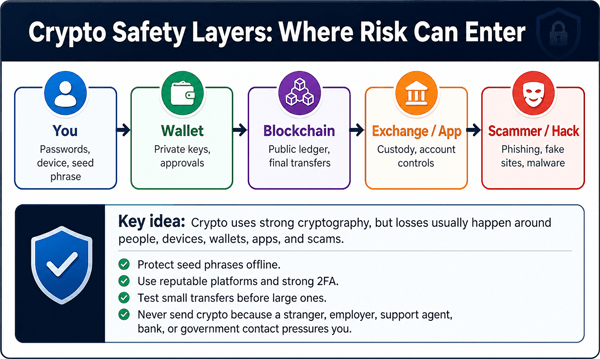
Where Crypto Safety Depends on You
13. How to Spot a Crypto Scam
Scams often look professional. A nice website, polished dashboard, or friendly contact does not prove legitimacy. Use the warning signs below.
| Red flag | Why it matters |
|---|---|
| Guaranteed profit or “no risk” language | All real investments carry risk. Guaranteed high returns are a classic scam sign. |
| Someone you met online pushes crypto | Romance and friendship-based investment scams often develop slowly and feel personal. |
| You must pay fees or taxes to withdraw | Fake platforms commonly show fake profits, then demand extra deposits. |
| Pressure to act now | Urgency is used to stop you from checking facts. |
| Support asks for your seed phrase | Legitimate support never needs it. |
| Government, bank, or business asks for crypto payment | The FTC warns that real businesses and government agencies do not tell you to use Bitcoin ATMs, gift cards, or crypto to fix a problem. |
| Recovery company asks for an upfront fee | The FBI warns people to be wary of crypto recovery services that charge upfront fees. |
| Only communicates through messaging apps | Many fraudulent crypto/forex schemes begin through social media or messaging apps, according to CFTC education materials. |
14. What to Do If You Think You Were Scammed
- Stop sending money. Do not pay “release,” “tax,” “verification,” or “recovery” fees.
- Take screenshots of the website, app, chats, usernames, email addresses, phone numbers, wallet addresses, and transaction IDs.
- Contact the exchange or wallet provider immediately if the transfer involved a custodial account.
- Report the incident to the appropriate authority in your country. In the United States, the FBI’s IC3 accepts cryptocurrency-related complaints.
- Warn your bank or card provider if you bought crypto with a linked payment method.
- Be careful of recovery scams. Scammers often target victims again by pretending they can recover stolen crypto for a fee.
15. Common Beginner Mistakes to Avoid
- Buying first and learning later.
- Keeping all crypto on one exchange without strong account security.
- Using SMS 2FA when stronger options are available.
- Sharing seed phrases with fake support agents.
- Clicking wallet connection links from social media.
- Approving unlimited token spending in unknown DeFi apps.
- Ignoring tax reporting obligations.
- Assuming a coin is safe because it is listed on a popular app.
- Believing a screenshot of profits means money is real or withdrawable.
- Sending large transfers without a test transaction.
16. Is Bitcoin Safer Than Other Cryptocurrencies?
Bitcoin is often considered less experimental than many small tokens because it has a long operating history, a large network, high liquidity, and a simple main use case compared with many smart-contract platforms. But this does not make bitcoin risk-free. Its price can still drop sharply, users can still lose keys, exchanges can still fail, and scammers often use bitcoin because transactions move quickly.
For beginners, a large, liquid asset may be easier to research than a new token. But “bigger” does not mean “safe like a savings account.”
17. Are Stablecoins Safe?
Stablecoins are crypto tokens designed to track another asset, usually the U.S. dollar. They can reduce price volatility compared with assets like bitcoin, but they introduce different risks: reserve quality, issuer transparency, redemption rules, regulatory risk, blockchain network risk, and smart contract risk.
A stablecoin can be useful for transfers or trading, but beginners should not assume every stablecoin is fully backed, redeemable, or protected like a bank deposit.
18. Is Cryptocurrency Safe for Payments?
Crypto can be useful for certain payments, especially cross-border transfers or situations where both parties understand the asset and network fees. But it is risky for beginners because payment mistakes are hard to reverse.
- Use crypto payments only with trusted recipients.
- Confirm the exact asset, network, amount, and address.
- Avoid paying anyone who says you must use crypto to resolve a legal, tax, bank, job, or government problem. That is a major scam signal.
- Understand that price changes can affect the real cost between sending and receiving.
19. Is Cryptocurrency Safe as an Investment?
Crypto can be an investment, but it should be treated as speculative. Unlike a profitable business, many tokens do not produce cash flow. Prices can depend heavily on supply and demand, liquidity, market sentiment, regulation, interest rates, token unlocks, hacks, and social media attention.
A practical beginner approach is to use a small allocation, diversify outside crypto, avoid leverage, and make sure your financial basics are already covered: emergency fund, debt plan, insurance, and retirement savings where appropriate.
20. Simple Beginner Safety Plan
| Step | Action |
|---|---|
| 1 | Learn the asset and the platform before depositing money. |
| 2 | Start with a small amount you can afford to lose. |
| 3 | Use a reputable exchange and secure email/password/2FA. |
| 4 | Write down your seed phrase offline if using self-custody. |
| 5 | Make a small test transfer before moving larger amounts. |
| 6 | Keep long-term holdings separate from experimental wallets. |
| 7 | Ignore guaranteed-profit offers and unsolicited investment advice. |
| 8 | Review account activity and keep tax records. |
21. Myths and Misconceptions About Crypto Safety
| Myth | Reality |
|---|---|
| “Blockchain means impossible to steal.” | The blockchain may be hard to alter, but wallets, users, smart contracts, and exchanges can be attacked. |
| “If it is on an app store, it is safe.” | Fake or malicious apps can appear legitimate. Always verify official sources. |
| “A public ledger means criminals cannot use crypto.” | Transactions can be traceable, but criminals still use crypto and try to launder funds. |
| “Stablecoin means no risk.” | Stablecoins can face issuer, reserve, regulatory, and technical risks. |
| “I can always recover lost crypto.” | Many crypto losses are difficult or impossible to reverse. Be skeptical of paid recovery promises. |
| “A celebrity endorsement proves it is real.” | Endorsements, influencer posts, and ads can be paid, hacked, fake, or misleading. |
22. Frequently Asked Questions
22.1 Is cryptocurrency safe?
Cryptocurrency can be used more safely with good security habits, but it is not inherently safe. It carries market, scam, custody, technology, and regulatory risks.
22.2 Can cryptocurrency be hacked?
A major blockchain is difficult to hack directly, but exchanges, wallets, smart contracts, devices, passwords, and users can be attacked.
22.3 Can I lose all my money in crypto?
Yes. A token can collapse, an exchange can fail, a scam can steal funds, or a user can lose access to a wallet.
22.4 What is the safest way to store crypto?
For small amounts, a reputable exchange with strong 2FA may be convenient. For larger long-term holdings, many users prefer a hardware wallet with offline seed phrase backups. Both require careful security.
22.5 Should beginners use DeFi?
Most beginners should wait. DeFi can involve smart contract bugs, phishing links, malicious approvals, impermanent loss, bridge risk, and complex tax records.
22.6 Is crypto safer than stocks?
Not generally. Stocks and regulated funds often have more disclosure, custody rules, and investor protections. Crypto may offer upside and innovation, but it is usually more volatile and operationally risky.
22.7 Are crypto ETFs safer than buying crypto directly?
A regulated exchange-traded product can remove wallet-management risk, but it does not remove price volatility or all product risks. It also does not mean the regulator endorses the underlying crypto asset.
22.8 What should I do before buying my first crypto?
Learn the basics, choose a reputable platform, secure your email and account, start small, avoid leverage, and write down your plan before buying.
22.9 How much crypto should a beginner own?
There is no universal amount. Many conservative beginners choose zero or a very small percentage of their overall portfolio. Never invest money you need for bills, emergency savings, or debt repayment.
22.10 How do I know if a crypto website is fake?
Check the URL carefully, search independent sources, avoid sites sent by strangers, verify registration claims, test withdrawals cautiously, and treat guaranteed returns as a scam warning.
23. Final Verdict: Is Cryptocurrency Safe?
Cryptocurrency is safest when treated as a powerful but risky tool. The technology can be robust, but the user experience is unforgiving. Beginners should not think of crypto as a guaranteed investment, a protected bank account, or a shortcut to wealth.
A balanced view is best: crypto may be useful for some investors and users, but only after learning the basics, securing accounts, avoiding scams, managing volatility, and limiting exposure. If you cannot explain how the wallet, platform, asset, and transaction work, you are not ready to risk meaningful money.
Reader Advice
This article is provided for educational and informational purposes only. It is not personalized financial, investment, legal, tax, cybersecurity, or other professional advice, and it does not recommend any cryptocurrency, platform, wallet, or transaction. Cryptocurrency can involve substantial risks, including sharp price losses, scams, hacking, lost access, irreversible transfers, platform failure, and limited consumer protection. Rules, policies, laws, products, security practices, and statistics change over time and vary by country or region, so readers should verify current information through relevant official sources and consider qualified professional advice before making decisions. Never risk money needed for essential expenses or that you cannot afford to lose.
Sources Consulted and Checked
These sources were consulted and checked while preparing this document to support accuracy and responsible guidance.
- SEC Investor.gov, “Exercise Caution with Crypto Asset Securities: Investor Alert”
- FINRA, “Crypto Assets” and “Crypto Assets - Risks”
- FTC Consumer Advice, “What To Know About Cryptocurrency and Scams”
- FTC Data Spotlight, “Bitcoin ATMs: A payment portal for scammers”
- FBI IC3 Cryptocurrency complaint guidance
- FBI IC3 2025 Annual Report, cryptocurrency investment fraud losses
- CFTC, “10 Signs of a Scam Crypto or Forex Trading Website”
- SEC Chair statement on spot Bitcoin ETP approval and investor caution