Optimistic Rollups vs zk-Rollups
Rollups are one of the main ways Ethereum and other smart contract blockchains scale. They move most transaction work away from the base chain, bundle many transactions together, and then publish enough information back to the base chain so users can still rely on the security of the underlying network.
The two best-known rollup designs are optimistic rollups and zero-knowledge rollups, usually called zk-rollups. They have the same broad goal: faster and cheaper transactions without simply trusting a separate blockchain. Their biggest difference is how they prove that the off-chain work was done correctly.
Quick answer: Optimistic rollups assume transactions are valid unless someone challenges them with a fraud proof. zk-rollups prove transactions are valid upfront using a cryptographic validity proof. Optimistic rollups are generally simpler and have strong EVM compatibility, but withdrawals to Ethereum can be slower. zk-rollups can offer faster finality and stronger mathematical guarantees, but they are more complex to build and audit.
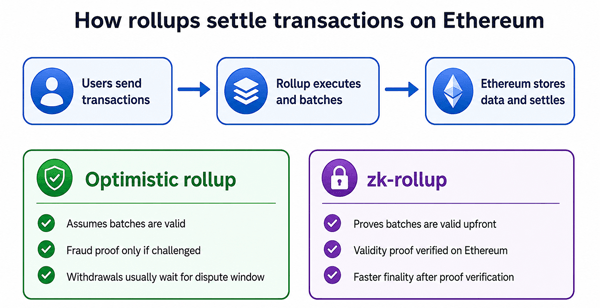
Diagram: A simplified comparison of how optimistic rollups and zk-rollups settle transactions on Ethereum.
1. What Are Rollups?
A rollup is a Layer 2 scaling system that processes transactions outside the main blockchain and then posts compressed transaction data, state updates, or proofs back to the main chain. In Ethereum discussions, the main chain is often called Layer 1 or L1, while the rollup is Layer 2 or L2.
The idea is simple: Ethereum is very secure but limited in how much computation it can process directly. Instead of forcing every Ethereum node to re-run every transaction from every application, a rollup executes many transactions elsewhere and uses Ethereum as the settlement and security layer.
This can reduce fees and increase throughput, but it does not remove all risk. Users still need to understand bridges, upgrade controls, sequencer centralization, data availability, and whether the rollup has a working proof system.
1.1 Why Rollups Exist
- Lower transaction costs by batching many transactions together.
- Faster user experience for swaps, transfers, games, social apps, and DeFi.
- Less congestion on the base chain.
- A way to scale while still anchoring security to Ethereum or another settlement layer.
2. What Are Optimistic Rollups?
An optimistic rollup is a Layer 2 system that assumes transaction batches are valid by default. The word optimistic means the system does not prove every batch immediately. Instead, it gives users or validators a challenge period. If someone sees an invalid state update, they can submit a fraud proof to prove that the batch was wrong.
This design reduces the amount of proof-generation work needed during normal operation. Most of the time, batches are accepted without dispute. If something dishonest happens, the fraud-proof system is supposed to catch it and prevent an invalid state from settling permanently on L1.
2.1 How optimistic rollups work, step by step
- Users submit transactions to the rollup.
- A sequencer orders transactions and gives users a fast confirmation on the L2.
- The rollup batches many transactions together.
- The batch data and state commitment are posted to Ethereum or the relevant settlement chain.
- A challenge window begins. During this time, watchers can dispute an invalid batch.
- If no valid challenge is submitted, the batch becomes final after the challenge period.
- If a fraud proof succeeds, the invalid state is rejected and the dishonest actor may be penalized.
2.2 Examples of optimistic rollups
- Optimism and OP Mainnet, along with networks built using the OP Stack.
- Arbitrum One and related Arbitrum chains.
- Base, which is built using the OP Stack and is often discussed as part of the optimistic rollup ecosystem.
3. What Are zk-Rollups?
A zk-rollup is a Layer 2 system that proves transaction batches are valid using cryptographic validity proofs. The term zk originally comes from zero-knowledge proofs, but in rollup discussions the most important feature is not always privacy. The key feature is validity: the rollup submits a proof that the new state follows the rules.
Instead of saying, “trust this batch unless someone challenges it,” a zk-rollup says, “here is a proof that this batch is correct.” Ethereum verifies the proof much more cheaply than it would verify every transaction one by one.
3.1 How zk-rollups work, step by step
- Users submit transactions to the rollup.
- The rollup executes transactions off-chain.
- A prover generates a validity proof showing that the state transition followed the rules.
- The proof and required data are submitted to Ethereum or another settlement layer.
- The L1 smart contract verifies the proof.
- Once the proof is accepted, the state update can settle without waiting for a long fraud-challenge window.
3.2 Examples of zk-rollups and validity-proof systems
- Starknet, which uses STARK-based validity proofs.
- zkSync Era, which focuses on zkEVM-style smart contract execution.
- Scroll, Linea, and Polygon zkEVM-style systems, which aim to bring EVM-like developer experience to validity-proof rollups.
4. Optimistic Rollups vs zk-Rollups: Quick Comparison Table
| Feature | Optimistic rollups | zk-rollups |
|---|---|---|
| Core idea | Assume batches are valid unless challenged. | Prove batches are valid before settlement. |
| Proof type | Fraud proofs. | Validity proofs, often ZK proofs. |
| Withdrawal to L1 | Often delayed by the challenge period, commonly around 7 days on many optimistic systems. | Usually faster after proof verification, though bridge and app design still matter. |
| Complexity | Simpler conceptually and historically easier for EVM compatibility. | More complex cryptography, proving systems, circuits, and audits. |
| Security model | Depends on at least one honest watcher and a functional challenge process. | Depends on correctness of proof system, circuits, verifier contracts, and data availability. |
| Developer experience | Often strong EVM compatibility and mature tooling. | Improving quickly; some zkEVMs are close to EVM experience, but details vary. |
| Best fit | General-purpose DeFi, consumer apps, EVM apps needing mature tooling. | Payments, exchanges, games, high-throughput apps, apps needing faster finality, and ZK-native designs. |
5. Main Difference: Fraud Proofs vs Validity Proofs
The easiest way to understand the comparison is to focus on proofs. Both designs need a way to convince Ethereum that the rollup state is correct. They just do it in opposite ways.
Optimistic rollups use a challenge-based model. They post a result first, then allow people to object. zk-rollups use a proof-first model. They post a result with a cryptographic proof that the result is valid.
| Question | Optimistic answer | ZK answer |
|---|---|---|
| When is correctness checked? | After posting, only if challenged. | Before or during settlement through proof verification. |
| Who catches bad batches? | Watchers, validators, or challengers. | The verifier contract rejects invalid proofs. |
| What happens when something is wrong? | A fraud proof can dispute and reject the bad state. | The invalid state should fail proof verification. |
| Main trade-off | Simpler normal path, slower final withdrawal. | Faster settlement, higher technical complexity. |
6. Pros and Cons of Optimistic Rollups
6.1 Benefits
- Strong ecosystem maturity: many major Ethereum L2s and apps have used optimistic rollup designs.
- Good EVM compatibility: developers can often deploy Solidity smart contracts with fewer changes.
- Lower proof overhead in the normal case: no expensive validity proof is needed for every batch.
- Useful for general-purpose smart contracts, DeFi apps, NFT platforms, games, and consumer apps.
6.2 Drawbacks
- Delayed L1 withdrawals: users may need to wait through the challenge period unless they use a liquidity bridge.
- Reliance on challengers: the security model assumes invalid batches can be detected and challenged in time.
- Fraud-proof systems must be live and reliable; a rollup without effective fraud proofs has weaker security than beginners may assume.
- Sequencer centralization can create downtime, censorship, or MEV-related concerns, especially while networks are still maturing.
7. Pros and Cons of zk-Rollups
7.1 Benefits
- Validity proofs provide strong mathematical assurance that state transitions followed the rules.
- Faster L1 finality compared with optimistic challenge windows once proofs are verified.
- Attractive for high-volume transfers, trading, payments, gaming, and applications that need quick settlement.
- Can support new privacy, identity, account abstraction, and proof-based application designs.
7.2 Drawbacks
- Harder to build: proving systems, circuits, zkVMs, and verifier contracts are technically complex.
- Proof generation can be computationally expensive, although performance continues to improve.
- Some zkEVM systems may have subtle differences from Ethereum, so developers must check compatibility carefully.
- Circuit bugs, trusted setups, upgrade controls, and prover centralization can create risks that are not obvious to beginners.
8. Practical Examples
8.1 Example 1: A DeFi swap on an optimistic rollup
A user swaps tokens on an optimistic L2 such as Arbitrum or Optimism. The transaction feels fast because the sequencer confirms it quickly. The final settlement on Ethereum depends on the rollup posting data and passing the challenge window. If the user wants to withdraw directly to Ethereum, the withdrawal can take days. Many users avoid the wait by using third-party bridges, but those bridges add counterparty, liquidity, and smart contract risk.
8.2 Example 2: A token transfer on a zk-rollup
A user sends funds on a zk-rollup. The rollup batches the transfer with many others and generates a validity proof. Once Ethereum verifies the proof, the state update can settle without waiting for a fraud window. This is useful when users care about faster finality, but they still need to understand bridge design, fees, and whether the network is mature.
8.3 Example 3: A developer choosing where to launch an app
A Solidity team launching a standard DeFi app may choose an optimistic rollup because tooling, wallets, and liquidity are mature. A team building a high-throughput payment app or proof-based identity system may prefer a zk-rollup because validity proofs and faster settlement fit the product better.
9. Risks and Limitations Beginners Should Understand
9.1 Bridge risk
Most users move funds to and from rollups through bridges. Bridges are complex and have historically been high-value targets. Prefer official bridges for large transfers, check the destination chain, and test with a small amount first.
9.2 Sequencer centralization
Many rollups still use centralized or limited sequencers. A sequencer can affect ordering, cause temporary downtime, or delay inclusion. This does not always mean funds are lost, but it can affect user experience and censorship resistance.
9.3 Upgrade and governance risk
Many L2 contracts can be upgraded. Upgrades are useful for fixing bugs, but they also create trust assumptions. Check whether upgrades have time delays, multisig controls, security councils, or emergency powers.
9.4 Proof-system maturity
Optimistic rollups need working fraud proofs and active challengers. zk-rollups need correct circuits, proof systems, verifiers, and provers. Both designs can be weakened by immature implementations.
9.5 Data availability risk
A rollup must make enough data available for users and independent parties to reconstruct the state. If data is not available, users may be unable to verify balances or exit safely.
9.6 Liquidity fragmentation
Assets can exist on many L2s at once. A token on one rollup is not automatically the same as the token on another rollup. Users should confirm contract addresses and bridge routes.
9.7 Not all “rollups” are equal
Some systems use external data availability, validium designs, or app-specific security assumptions. Marketing language can be confusing, so evaluate the actual design rather than relying on the label.
10. Best Use Cases: When Each Rollup Type Makes Sense
| Use case | Better fit | Why |
|---|---|---|
| General EVM DeFi app | Often optimistic rollup | Mature liquidity, tooling, wallets, and EVM compatibility. |
| Fast withdrawals to Ethereum | Often zk-rollup | Validity proofs avoid a long fraud challenge period. |
| High-volume payments | Often zk-rollup | Proof-based settlement can support fast, efficient batching. |
| Existing Solidity app with minimal changes | Often optimistic rollup | Historically simpler migration path, though zkEVMs are improving. |
| ZK-native apps, identity, proof-based privacy features | zk-rollup | Validity proof infrastructure aligns with the product design. |
| Consumer app needing low fees and easy onboarding | Either | Choose based on liquidity, wallet support, bridges, uptime, and ecosystem. |
| Maximum implementation simplicity today | Often optimistic rollup | Less cryptographic complexity, but security still depends on fraud proofs and governance controls. |
11. How to Choose Between Optimistic and zk-Rollups
For users, the best choice is not always the rollup category. It is the specific network, bridge, wallet support, liquidity, fees, app quality, and risk profile. A mature optimistic rollup may be safer for a specific task than a very new zk-rollup, and a mature zk-rollup may be better for fast settlement than an optimistic system with long withdrawal delays.
11.1 User checklist
- Check whether the app is official and the URL is correct.
- Use a small test transaction before moving large funds.
- Understand withdrawal times before bridging in.
- Check whether the token contract is the real token on that chain.
- Review L2 risk pages, audits, and bridge documentation when moving meaningful value.
- Do not assume that low fees mean low risk.
11.2 Developer checklist
- Confirm EVM compatibility details and unsupported opcodes or precompiles.
- Test contracts on the target rollup, not only on Ethereum mainnet forks.
- Plan for cross-chain messaging delays and bridge assumptions.
- Monitor sequencer downtime, RPC reliability, gas pricing, and indexing support.
- Review upgrade controls, proof system status, and data availability model.
- Design clear user warnings for withdrawal delays and bridge risks.
12. Common Misconceptions
12.1 “ZK means private.”
Not necessarily. In rollups, ZK often refers to validity proofs. Many zk-rollups are not private by default.
12.2 “Optimistic rollups are insecure.”
Not automatically. A well-designed optimistic rollup can be secure, but its security depends on working fraud proofs, available data, active monitoring, and mature governance.
12.3 “zk-rollups are always better.”
Not always. zk-rollups can offer faster finality and strong proofs, but they can be harder to build, harder to audit, and may have compatibility trade-offs.
12.4 “All L2s inherit Ethereum security fully.”
This is too broad. Security depends on the exact rollup design, proof system, upgrade powers, bridges, data availability, and maturity stage.
12.5 “A fast bridge removes optimistic withdrawal risk.”
Liquidity bridges can provide faster access to funds, but they introduce their own smart contract, liquidity, and counterparty assumptions.
13. Optimistic Rollups vs zk-Rollups: Summary
Optimistic rollups and zk-rollups are both important Layer 2 scaling designs. Optimistic rollups assume transactions are valid and rely on fraud proofs during a challenge period. zk-rollups use validity proofs to show that transaction batches are correct before they settle. Optimistic rollups are often easier for general EVM applications and have mature ecosystems, but direct withdrawals to L1 can be slow. zk-rollups can provide faster settlement and strong cryptographic guarantees, but their implementation is more complex. The best choice depends on the specific network, app, bridge, liquidity, security maturity, and user needs.
14. FAQs About Optimistic Rollups vs zk-Rollups
14.1 What is the main difference between optimistic rollups and zk-rollups?
Optimistic rollups assume transaction batches are valid unless someone challenges them with a fraud proof. zk-rollups submit validity proofs that prove the batch is correct before it is accepted.
14.2 Which is faster: optimistic rollups or zk-rollups?
For normal in-app transactions, both can feel fast. For direct settlement and withdrawals back to Ethereum, zk-rollups are often faster because they do not need a long fraud-challenge window.
14.3 Why do optimistic rollup withdrawals take so long?
They need a challenge period so anyone can submit a fraud proof if a batch is invalid. Many optimistic systems have used a window of around seven days, though details vary by network and design.
14.4 Are zk-rollups private?
Not automatically. The “zk” term can suggest privacy, but many zk-rollups use validity proofs for correctness, not privacy. Transactions may still be publicly visible.
14.5 Are rollups safer than sidechains?
Rollups generally aim to inherit more security from the settlement layer than sidechains, but safety depends on the exact design. Bridges, upgrade controls, proof systems, and data availability still matter.
14.6 Which rollup type is best for beginners?
Beginners should start with well-known networks supported by reputable wallets and applications. The rollup type matters, but the practical safety of the specific app, bridge, and network matters more.
14.7 Can optimistic rollups and zk-rollups both support smart contracts?
Yes. Optimistic rollups have historically been strong for EVM smart contracts. zk-rollups increasingly support smart contracts through zkEVMs and other execution environments, but compatibility details vary.
14.8 Do rollups eliminate gas fees?
No. They reduce costs by batching transactions, but users still pay L2 fees and sometimes L1-related costs, especially during deposits, withdrawals, or periods of congestion.
14.9 What is a sequencer?
A sequencer is the component that orders transactions on many rollups and gives users fast confirmations. If a sequencer is centralized, it can create downtime and ordering risks, although users may still have escape routes depending on the design.
14.10 What should I check before using a rollup?
Check the official bridge, withdrawal time, token contract, network status, audits, L2 risk information, and whether the app has a history of secure operation.
Sources Consulted and Checked
These sources were consulted and checked while preparing this document to support accuracy and clarity.
- Ethereum.org - Optimistic rollups
- Ethereum.org - Zero-knowledge rollups
- Ethereum.org - Scaling overview
- Ethereum.org - Zero-knowledge proofs overview
- L2BEAT - Layer 2 ecosystem and risk research
- L2BEAT forum - Stages framework
Reader Advice
This article is provided for educational and informational purposes only. It is not legal, financial, investment, technical, or other personalized professional advice, and it should not be treated as a recommendation to use any particular rollup, bridge, token, application, or network. Blockchain systems, rules, policies, laws, fees, security conditions, and statistics can change over time and may differ by region. Before making a decision or transferring funds, verify current information through official sources, review the specific network and bridge risks, and consider qualified professional advice where appropriate. Digital assets and cross-chain transactions can involve smart-contract, liquidity, operational, regulatory, and loss-of-funds risks, so proceed carefully and test with a small amount first.