Sidechains Explained: Meaning, How It Works, Examples, Benefits and Risks
1. Sidechains Explained in Simple Terms
A sidechain is a separate blockchain that runs next to a main blockchain, such as Ethereum or Bitcoin, and is connected to it through a bridge. The bridge lets users move assets between the two chains, usually by locking the original asset on one chain and creating a usable version of it on the other chain.
The main idea is simple: instead of doing every transaction on a busy or expensive base chain, users can move assets to a sidechain where transactions may be faster, cheaper, or designed for a specific purpose. However, a sidechain usually has its own validators, consensus rules, and security model. That means it does not automatically get the same security guarantees as the main chain.
For beginners, the easiest way to understand a sidechain is to think of it as a connected but independent road beside a major highway. The main highway may be more secure and established, but it can become crowded and expensive to use. The side road may be faster and cheaper, but it has its own rules, maintenance, and safety risks.
2. Quick Definition
A sidechain is an independent blockchain connected to a main blockchain by a two-way bridge or peg. It can process transactions separately, use its own consensus mechanism, support different features, and allow assets to move between chains.
3. Why Sidechains Exist
Sidechains were created to solve practical problems that appear when a major blockchain becomes expensive, slow, or limited in functionality. A base chain such as Bitcoin or Ethereum prioritizes decentralization and security. That is valuable, but it can limit speed, cost, and experimentation.
- Lower fees: Sidechains can process transactions more cheaply because they are not competing directly for main-chain block space.
- Faster transactions: They can use shorter block times or lighter consensus rules.
- More experimentation: Developers can test new virtual machines, fee models, privacy features, or app-specific rules without changing the main chain.
- Specialized use cases: Gaming, payments, DeFi, NFTs, enterprise networks, and app-specific ecosystems can run on sidechains.
- Interoperability: Bridges let users move assets between networks and access applications on different chains.
4. How a Sidechain Works
A sidechain has three basic parts: the main chain, the sidechain, and the bridge that connects them. The exact design varies, but the user experience usually follows a similar pattern.
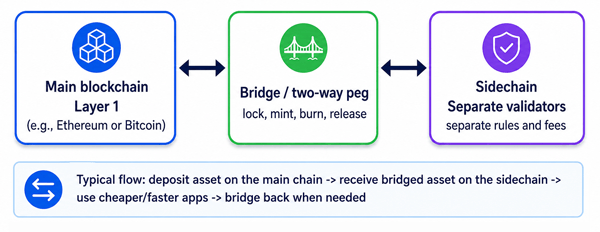
Figure: Basic sidechain and bridge model.
4.1 The User Deposits an Asset on the Main Chain
A user sends an asset, such as ETH, BTC, or a token, to a bridge contract or peg mechanism on the main chain. The original asset is locked, escrowed, or otherwise held according to the bridge design.
4.2 A Bridged Version Is Created on the Sidechain
After the deposit is confirmed, the sidechain gives the user a corresponding asset. For example, a user may lock a token on Ethereum and receive a bridged version of that token on a sidechain. The bridged asset is useful inside the sidechain ecosystem, but it depends on the bridge continuing to work correctly.
4.3 Transactions Happen on the Sidechain
The user can now trade, lend, borrow, play games, buy NFTs, or use apps on the sidechain. These transactions are processed by the sidechain’s own validators or miners, not by the main chain’s validators.
4.4 The User Can Bridge Back
When the user wants to return to the main chain, the sidechain version is burned or locked, and the original asset is released on the main chain. Withdrawals can be fast or slow depending on the bridge design, security checks, and congestion.
5. What Makes a Sidechain Different From the Main Chain?
A sidechain is not just a copy of the main chain. It can have different technical and economic rules. These choices are what make sidechains flexible, but they also create risk.
| Feature | What can be different on a sidechain? |
|---|---|
| Consensus | The sidechain may use proof of stake, proof of authority, merged mining, or another model. |
| Validators or miners | The sidechain usually has its own set of participants responsible for block production and validation. |
| Fees | Fees may be paid in a native sidechain token or in a bridged asset. |
| Block time | The sidechain may confirm blocks faster than the main chain. |
| Smart contracts | Some sidechains are EVM-compatible; others use different virtual machines. |
| Security | The sidechain normally relies on its own security, not the full security of the main chain. |
| Bridge model | Assets depend on bridge contracts, validator signatures, federations, or other cross-chain mechanisms. |
6. Sidechains vs Layer 2 Rollups
Many beginners confuse sidechains with layer 2 networks. The confusion is understandable because both can make blockchain transactions cheaper and faster. The key difference is security inheritance.
A sidechain is an independent blockchain connected to a main chain by a bridge. It usually relies on its own validator set and does not post all transaction data and state changes back to the main chain. A rollup, by contrast, processes transactions off-chain but posts data or proofs back to the base chain, so it is designed to inherit more security from the base chain.
| Category | Sidechain | Layer 2 rollup |
|---|---|---|
| Basic idea | Separate blockchain connected by bridge | Scaling network that posts data/proofs to the base chain |
| Security source | Own validators, miners, or federation | Base chain security plus rollup design assumptions |
| Connection to main chain | Bridge or two-way peg | Smart contracts and proof/data publication |
| Cost and speed | Often cheap and fast | Often cheap and fast |
| Withdrawal risk | Depends heavily on bridge and validator model | Depends on rollup type and challenge/proof system |
| Best for | Custom rules, experiments, app ecosystems, lower-cost transactions | Scaling while retaining stronger base-chain security assumptions |
7. Sidechains vs Bridges
A sidechain and a bridge are related, but they are not the same thing. The sidechain is the separate blockchain. The bridge is the connection that lets assets or messages move between chains. A sidechain can have one or more bridges, and a bridge can connect many types of blockchains, not only sidechains.
8. Real-World Examples of Sidechains
The crypto industry does not always use labels consistently. Some projects may describe themselves as sidechains, commit chains, appchains, scaling networks, or Bitcoin sidechains depending on their architecture and marketing. The examples below are useful for understanding common sidechain-style designs.
| Example | Connected ecosystem | Why it matters |
|---|---|---|
| Polygon PoS | Ethereum ecosystem | An EVM-compatible proof-of-stake chain connected to Ethereum by bridges. It is widely used for lower-cost DeFi, NFTs, games, and consumer apps. |
| Rootstock (RSK) | Bitcoin ecosystem | A Bitcoin sidechain designed for EVM-compatible smart contracts. It uses a two-way peg model and is associated with Bitcoin merged mining. |
| Gnosis Chain | Ethereum ecosystem | An EVM-compatible chain with its own validator set, often used for payments, DAOs, and lower-cost applications. |
| Liquid Network | Bitcoin ecosystem | A federated Bitcoin sidechain focused on faster settlement and asset issuance, often used by exchanges and institutions. |
| Ronin | Gaming ecosystem | An app-focused chain built for blockchain games. It shows how sidechain-like networks can optimize for a specific application category. |
8.1 Example Scenario: Using a Sidechain for a Small Transaction
Imagine a user wants to buy a low-cost NFT or make a small DeFi transaction. Doing this directly on Ethereum during a busy period may cost more in gas than the transaction itself. The user may bridge funds to a sidechain, make several low-fee transactions there, and bridge back later only if needed. The benefit is lower cost. The trade-off is that the user now depends on the sidechain and bridge security.
9. Benefits of Sidechains
9.1 Lower Transaction Costs
Sidechains can reduce fees by processing transactions outside the main chain’s limited block space. This is useful for small payments, gaming actions, NFT minting, and frequent DeFi interactions.
9.2 Faster User Experience
Many sidechains are designed with faster block times and higher throughput. This can make apps feel closer to normal web or mobile apps.
9.3 Flexibility for Developers
Developers can build with different rules, gas models, virtual machines, and governance systems. They can also deploy applications without waiting for changes to the main chain.
9.4 Easier Experimentation
Sidechains allow new ideas to be tested in production-like environments. If an experiment fails, the main chain is not directly changed.
9.5 Specialized Ecosystems
A sidechain can focus on one use case, such as gaming, payments, institutional settlement, privacy, or enterprise workflows. This can improve performance and user experience for that niche.
10. Risks and Limitations of Sidechains
Sidechains can be useful, but they are not risk-free. In many cases, the biggest risks are not obvious to beginners because the app may look and feel like a normal crypto network.
10.1 Sidechains Usually Do Not Inherit Main-Chain Security
This is the most important point. If a sidechain is connected to Ethereum, it does not automatically have Ethereum-level security. If it is connected to Bitcoin, it does not automatically have Bitcoin-level security. Its safety depends on its own validators, miners, bridge design, governance, and software.
10.2 Bridge Risk
Bridges are one of the most sensitive parts of cross-chain systems. If a bridge contract, validator set, private key system, or message verification process fails, users can lose funds or receive assets that are no longer fully backed.
10.3 Validator or Federation Risk
Some sidechains rely on a smaller group of validators, signers, or federation members than the main chain. A smaller or more centralized validator set can make censorship, downtime, collusion, or governance capture more likely.
10.4 Smart Contract Risk
Sidechains often support smart contracts. Bugs in DeFi protocols, bridges, wallets, or token contracts can still cause losses, even if the sidechain itself keeps running.
10.5 Liquidity Risk
A token on a sidechain may have lower liquidity than the same token on a main chain. Large trades can have more slippage, and some assets may be harder to exit during market stress.
10.6 Withdrawal and Exit Risk
Some bridges have waiting periods, manual review, validator checkpoints, or liquidity limits. In a crisis, users may not be able to exit as quickly as expected.
10.7 User Mistake Risk
Users can send assets to the wrong network, use a fake bridge, approve a malicious contract, or assume a bridged token is the same as the original token. These mistakes are common and can be expensive.
11. Common Misconceptions About Sidechains
| Misconception | Reality |
|---|---|
| “A sidechain is always a layer 2.” | Not always. Some people use layer 2 broadly, but technically many sidechains do not inherit base-chain security like rollups do. |
| “A bridged token is identical to the original token.” | It may track the original asset, but it depends on bridge backing and redemption. |
| “Lower fees mean lower risk.” | Lower fees are useful, but they do not remove bridge, validator, or smart contract risk. |
| “If it connects to Ethereum or Bitcoin, it is just as secure.” | Connection does not equal shared security. Always check the actual security model. |
| “All sidechains work the same way.” | Sidechains can use very different consensus, governance, bridge, and fee designs. |
12. How to Evaluate a Sidechain Before Using It
Before moving funds to a sidechain, use this practical checklist.
- Check the bridge. Is it official, audited, widely used, and clearly documented? Avoid random bridge links from ads, social media replies, or direct messages.
- Understand who secures the chain. Look for the validator set, federation model, staking mechanism, mining model, and governance process.
- Check whether assets are truly backed. Make sure the bridged asset can be redeemed and that the bridge has enough reserves or a credible peg mechanism.
- Look at ecosystem maturity. More mature networks usually have better wallets, explorers, documentation, monitoring, and support.
- Start with a test transaction. Send a small amount first, especially when using a bridge for the first time.
- Review withdrawal times and fees. Do not assume you can exit instantly.
- Use a trusted wallet and block explorer. Confirm you are on the correct network before signing transactions.
- Limit approvals. Revoke token approvals you no longer need, especially for bridges and DeFi apps.
13. Best Practices for Users
- Use official bridge links from the project’s documentation, not links from social media ads.
- Do a small test transfer before moving a large amount.
- Keep enough native gas token on the sidechain to pay transaction fees.
- Check the destination address, network name, and token contract before sending funds.
- Understand whether you are holding the original asset or a bridged representation.
- Avoid keeping more funds on a sidechain than you need for your activity.
- Use hardware wallets for larger balances when supported.
- Track announcements about bridge pauses, validator issues, migrations, or token changes.
14. Best Practices for Developers and Projects
- Document the security model clearly. Users should know whether the chain inherits security, uses its own validators, or relies on a federation.
- Make bridge risks visible in the interface. Do not hide withdrawal times, limits, or trust assumptions.
- Use audits, bug bounties, monitoring, and incident response plans for bridge contracts and validator infrastructure.
- Design safe upgrade processes. Multisigs, governance contracts, and admin keys should be transparent and limited where possible.
- Support reliable explorers, RPC endpoints, wallets, and documentation.
- Avoid misleading language. Do not call a chain “Ethereum-secured” or “Bitcoin-secured” unless the architecture truly supports that claim.
15. When a Sidechain Makes Sense
| Use case | Why a sidechain can help |
|---|---|
| Gaming and NFTs | Many small actions need low fees and fast confirmation. |
| Payments | Users may need cheap, frequent transfers. |
| App-specific ecosystems | A project can tune rules for one product or community. |
| Enterprise or institutional workflows | Participants may prefer a controlled validator or federation model. |
| Testing new blockchain features | Developers can experiment without changing a major base chain. |
16. When a Sidechain May Not Be the Best Choice
- You need the strongest possible base-chain security for high-value assets.
- You cannot tolerate bridge or withdrawal risk.
- Liquidity is too thin for your trade size.
- The validator set is too centralized or poorly documented.
- The bridge is new, unaudited, paused often, or controlled by unclear administrators.
- You are not comfortable managing multiple networks, gas tokens, and bridged assets.
17. Sidechain Pros and Cons
| Pros | Cons |
|---|---|
| Lower fees | Bridge and validator risks |
| Faster transactions | Usually less secure than the base chain |
| More design flexibility | Can be more centralized |
| Useful for games, NFTs, payments, and apps | Liquidity may be fragmented |
| Can add smart contracts to ecosystems with limited scripting | Withdrawals can be delayed or dependent on bridge design |
| Good for experimentation | Users must understand multiple networks and token versions |
18. Simple Sidechain Glossary
| Term | Meaning |
|---|---|
| Main chain / Layer 1 | The base blockchain, such as Ethereum or Bitcoin. |
| Sidechain | A separate blockchain connected to a main chain. |
| Bridge | A system that moves assets or messages between blockchains. |
| Two-way peg | A mechanism that lets assets move from the main chain to the sidechain and back. |
| Validator | A participant that helps confirm blocks or messages on a proof-of-stake network. |
| Federation | A selected group of entities that help operate or secure a network or bridge. |
| Bridged token | A token on one chain that represents an asset locked or referenced on another chain. |
| EVM-compatible | Able to run Ethereum-style smart contracts and tools. |
19. FAQs About Sidechains
19.1 What is a sidechain in crypto?
A sidechain is a separate blockchain connected to a main blockchain through a bridge or two-way peg. It processes transactions independently and may have its own validators, fees, and rules.
19.2 Are sidechains safe?
Some sidechains are mature and widely used, but they are not risk-free. Their safety depends on the sidechain’s validators, bridge security, smart contracts, governance, liquidity, and operational history.
19.3 Is a sidechain the same as a layer 2?
Not exactly. Some people use the term layer 2 broadly, but a technical distinction matters: rollups are designed to inherit more security from the base chain, while sidechains usually rely on their own security.
19.4 What is the main benefit of a sidechain?
The main benefit is flexibility. Sidechains can offer lower fees, faster transactions, custom rules, and specialized ecosystems for apps such as games, payments, NFTs, and DeFi.
19.5 What is the biggest risk of using a sidechain?
The biggest risk is usually the combination of bridge risk and separate security. If the bridge fails or the sidechain validators behave dishonestly, users may lose access to funds or face disrupted withdrawals.
19.6 Can Bitcoin have sidechains?
Yes. Bitcoin sidechains are designed to add features such as faster settlement, asset issuance, or smart contracts while keeping a connection to Bitcoin through a peg or federation model. Rootstock and Liquid are common examples.
19.7 Can Ethereum have sidechains?
Yes. Ethereum-connected sidechains can support EVM-compatible applications and lower-cost transactions. Polygon PoS is a common example in the Ethereum ecosystem, although terminology can vary across projects.
19.8 Do sidechains reduce gas fees?
They can reduce transaction costs for activity that happens on the sidechain. However, bridging in and out may still require main-chain fees, and fees can change depending on network demand.
19.9 What happens if a sidechain bridge is hacked?
Depending on the bridge design, users may lose funds, bridged assets may become undercollateralized, withdrawals may pause, or the project may need emergency governance action. This is why bridge security is one of the most important factors to review.
19.10 Should beginners use sidechains?
Beginners can use sidechains, but they should start small, use official bridges, double-check networks, understand bridged assets, and avoid moving large amounts until they are comfortable with the process and risks.
20. Final Thoughts
Sidechains are an important part of the crypto ecosystem because they help blockchains scale, experiment, and serve specialized use cases. They can make transactions cheaper and faster, support new applications, and connect communities across chains.
The trade-off is that sidechains are not automatically as secure as the main chains they connect to. Users should pay close attention to bridge design, validator security, liquidity, withdrawal rules, and smart contract risk. The right way to think about a sidechain is not “better” or “worse” than a main chain. It is a different environment with different benefits and different risks.
For most beginners, the safest approach is simple: learn the security model, use official tools, test with small amounts, and never assume that a bridged asset or sidechain has the same guarantees as the original asset on the base chain.
Sources Consulted and Checked
The following sources were consulted and checked while preparing this document for clarity and accuracy:
- Ethereum.org - Sidechains
- Ethereum.org - Layer 2 Overview
- Polygon Developer Documentation - Polygon PoS
- Rootstock - Build on Bitcoin
- Rootstock White Paper
Reader Advice
This article is provided for educational and informational purposes only. It is not personalized financial, investment, legal, tax, or technical advice, and it is not a recommendation to use any sidechain, bridge, token, wallet, or protocol. Crypto assets and cross-chain systems involve significant risks, including loss of funds, bridge exploits, smart-contract failures, validator or governance failures, liquidity problems, price volatility, delayed withdrawals, and irreversible user errors. Rules, policies, laws, technical designs, fees, and statistics can change over time and may vary by country or region. Before making a decision, verify current information through official project documentation and relevant authorities, assess whether the risks suit your circumstances, use trusted tools, and consider qualified professional advice where appropriate.