Data Availability Explained: Meaning, How It Works, Examples, Benefits and Risks
1. Quick Answer: What Is Data Availability?
Data availability, often shortened to DA, means that the data needed to check and verify blockchain transactions has actually been published and can be downloaded by network participants. It does not simply mean that the data exists somewhere. It means the data is accessible enough for users, nodes, validators, or light clients to independently verify what happened.
In simple terms: a blockchain can only be trusted if people can check it. Data availability is what makes that checking possible.
| Beginner question | Simple answer |
|---|---|
| What data are we talking about? | Transaction data, block data, rollup batch data, proofs, and other information needed to verify state changes. |
| Why is it important? | Without available data, users may be unable to detect invalid or fraudulent state updates. |
| Is data availability the same as storage? | No. DA is about publishing enough data for verification. Long-term storage and indexing are separate concerns. |
| Who uses DA? | Layer 1 blockchains, rollups, modular blockchains, bridges, wallets, explorers, and developers building blockchain apps. |
2. Why Data Availability Matters
Blockchains are valuable because users do not have to blindly trust one company, server, or database administrator. They can verify the system for themselves. But verification needs data.
Imagine a bank says, “Your balance changed, but we will not show you the transactions.” You would not be able to check whether the balance is correct. The same idea applies to blockchains. If a block producer or rollup operator publishes only a final result but hides the underlying transaction data, users may not be able to confirm whether the result is valid.
Ethereum describes data availability as confidence that the data required to verify a block is available to network participants. Full nodes can check this by downloading data; newer scaling systems use more efficient methods so users do not need to download everything.
3. The Core Problem: Data Withholding
The main risk DA solves is called a data withholding attack. This happens when a block producer, sequencer, or operator commits to a block or rollup update but does not make the underlying data available.
- Users see a state update, such as new balances or contract results.
- The data needed to verify that update is hidden or incomplete.
- Full nodes may reject the block if they can detect missing data, but light clients may not be able to check it alone.
- In rollups, missing data can stop users from reconstructing the chain state or exiting safely.
This is why DA is not a small technical detail. It is part of the security model of modern blockchain scaling.
4. Data Availability vs Data Storage vs Data Retrieval
These terms are often confused, but they mean different things.
| Concept | What it means | Example |
|---|---|---|
| Data availability | Data was published so participants can verify the blockchain or rollup. | A rollup posts batch data to Ethereum blobs or a DA layer. |
| Data storage | Data is kept for later use, often for months or years. | An archive node, indexer, IPFS pinning service, or data warehouse keeps historical records. |
| Data retrieval | Users can fetch data when they need it. | A wallet or explorer pulls old transaction details from an RPC provider or indexer. |
A DA layer may make data available for verification during a defined period, but that does not always guarantee permanent storage forever. Users and developers should understand each network’s retention policy and use independent storage or indexing when long-term records matter.
5. How Data Availability Works
Different systems handle DA in different ways, but the basic flow is usually similar.
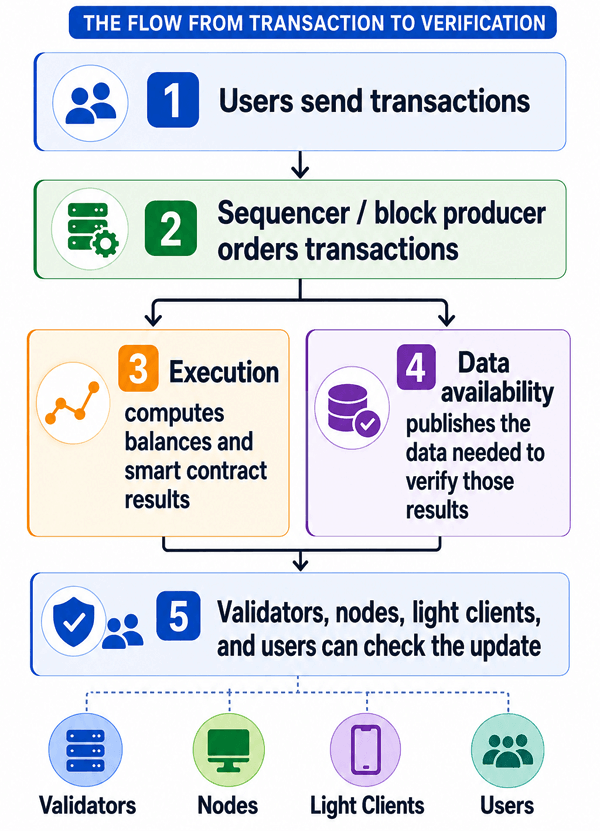
- Transactions are collected. Users send transactions to a blockchain, rollup, or sequencer.
- A block or batch is created. The producer orders transactions and computes the resulting state.
- The producer publishes data. The raw transaction or batch data is posted to a base chain or DA layer.
- Nodes check availability. Full nodes may download all data, while light clients may use sampling or proofs.
- The state update becomes safer to accept. Once enough participants can verify the data, users have stronger confidence that the update is not hiding fraud or missing information.
5.1 Simple Diagram: Where Data Availability Fits
6. Data Availability in Rollups
Data availability is especially important for rollups. A rollup executes many transactions outside the base layer, bundles them together, and posts a compressed record back to a base chain or DA layer. The rollup may be faster and cheaper because it does not force the base chain to execute every transaction directly.
However, users still need enough data to reconstruct the rollup state. If the operator posts a state root but withholds the transaction data behind it, users may be unable to prove fraud, challenge invalid updates, or recover balances. This is why rollups usually publish data somewhere outside their own private servers.
| Rollup type | How DA matters |
|---|---|
| Optimistic rollups | Fraud proofs require the data needed to check whether a disputed state update was valid. |
| ZK-rollups | Validity proofs show computation was correct, but users still need data to reconstruct state and independently follow the chain. |
| Validiums | Use validity proofs but keep data off-chain or in a separate DA committee/layer, which can reduce cost but adds DA assumptions. |
| Sovereign rollups | Often rely on a DA layer for ordering and publication, while the rollup community defines its own execution rules. |
7. Common Data Availability Approaches
| Approach | How it works | Strengths | Trade-offs |
|---|---|---|---|
| Publish data on Layer 1 | Rollup data is posted directly to a base chain such as Ethereum. | Strong security inheritance and broad verification. | Can be expensive when blockspace demand is high. |
| Blob data | Temporary data space designed for rollup data, such as Ethereum blobs introduced by EIP-4844. | Lower rollup data costs than traditional calldata. | Blob data is not intended as permanent storage. |
| Specialized DA layer | A network such as Celestia, EigenDA, or Avail focuses on publishing and verifying data availability. | Can offer high throughput and modular design. | Adds separate trust, integration, and bridge assumptions. |
| Data availability committee | A smaller group signs that data is available. | Fast and cheap for some apps. | More trust-based and less decentralized than public DA networks. |
| Centralized operator storage | The app operator stores and serves the data. | Simple and cheap. | Weakest trust model; users depend heavily on the operator. |
8. What Is Data Availability Sampling?
Data availability sampling, or DAS, is a technique that lets nodes gain confidence that a block’s data is available without downloading the entire block. Instead of checking every piece of data, a light node randomly checks small pieces. If many independent nodes sample random pieces and the data has been encoded with redundancy, hiding a meaningful part of the data becomes very difficult without being detected.
A simple analogy is checking a large shipment of boxes. You may not open every box, but if many inspectors randomly open boxes across the shipment, a seller hiding missing boxes has a much higher chance of being caught. Blockchain DAS uses cryptography, random sampling, and erasure coding rather than human inspection.
Ethereum’s danksharding roadmap uses data availability sampling so validators can efficiently verify blob data without every validator downloading everything. Celestia also uses DAS so light nodes can verify availability without downloading full blocks.
8.1 Erasure Coding in Plain English
Erasure coding adds extra pieces of data, similar to backup fragments. If some pieces are missing, the original data may still be reconstructed from the remaining pieces. This makes withholding attacks harder because an attacker often has to hide a large amount of encoded data before the original block becomes unrecoverable.
9. Real-World Examples of Data Availability
9.1 Ethereum Blobs and Proto-Danksharding
Ethereum introduced blob-carrying transactions through EIP-4844, also known as proto-danksharding. Blobs give rollups a cheaper place to publish data than regular calldata. This helps reduce layer-2 costs while keeping rollup data available to the Ethereum network for verification during the relevant availability window.
Ethereum’s longer-term danksharding roadmap aims to expand blob capacity further and use data availability sampling so validators can verify blob availability efficiently.
9.2 Celestia
Celestia is a modular data availability network. It focuses on ordering data and making it available, while execution can happen in separate rollups or chains. Celestia uses data availability sampling and namespaced Merkle trees so light nodes and rollups can verify or download the data relevant to them more efficiently.
9.3 EigenDA
EigenDA is a data availability service built as an actively validated service on EigenLayer. It is designed to provide scalable DA for Ethereum layer-2 networks and other applications by using operators and restaking-based security assumptions.
9.4 Avail
Avail is a data availability layer built for modular blockchain systems. It is designed to help rollups and other execution environments publish data without each team needing to bootstrap its own DA security from scratch.
9.5 Data Availability Committees
Some systems use a committee of trusted or semi-trusted parties to attest that data is available. This can be efficient, but users must understand who controls the committee, how many signatures are required, and what happens if the committee fails or colludes.
10. Benefits of Strong Data Availability
- Independent verification: Users and nodes can check the blockchain instead of trusting an operator.
- Better rollup security: Rollup users can reconstruct state and respond to invalid or unavailable updates.
- Scalability: Specialized DA systems and blob markets can support more transaction data at lower cost.
- Modular design: Developers can separate execution, settlement, consensus, and data availability.
- More resilient ecosystems: Multiple DA options reduce reliance on one overloaded network.
- Lower user fees: Cheaper data publication can reduce transaction costs for layer-2 users.
11. Risks and Limitations of Data Availability
| Risk | What it means | How to reduce it |
|---|---|---|
| Data withholding | A producer commits to a result but hides the data needed to verify it. | Use strong DA guarantees, sampling, full nodes, and well-audited rollup designs. |
| Weak committee trust model | A small group controls DA attestations. | Check committee size, threshold rules, reputation, and fallback exits. |
| Temporary data retention | Some DA data may only be guaranteed for a limited period. | Use archival nodes, indexers, or independent storage for long-term access. |
| Bridge and integration risk | A rollup may rely on contracts, bridges, or proof systems connecting to a DA layer. | Review audits, battle-testing, and emergency procedures. |
| Centralization of sequencers or operators | Even with good DA, transaction ordering or posting may be controlled by few parties. | Prefer transparent roadmaps, decentralized sequencing plans, and fallback mechanisms. |
| Cost volatility | DA fees can rise when demand increases. | Design fee buffers, choose scalable DA, and monitor data compression. |
| User misunderstanding | Users may assume “ZK proof” or “L2” automatically means all data risks are solved. | Read the project’s DA model, not just its marketing label. |
12. Data Availability and the Modular Blockchain Stack
Traditional blockchains often do many jobs in one system: consensus, execution, settlement, and data availability. Modular blockchains separate these jobs so each layer can specialize.
| Layer | Main job | Beginner example |
|---|---|---|
| Execution | Runs transactions and smart contracts. | A rollup processes swaps, transfers, and app logic. |
| Settlement | Finalizes disputes, proofs, and asset movement. | Ethereum verifies rollup commitments or proofs. |
| Consensus | Orders blocks and agrees on the canonical chain. | Validators agree which data or blocks came first. |
| Data availability | Publishes data so others can verify state changes. | Blobs or DA layers make rollup batch data accessible. |
13. How to Evaluate a DA Layer or Rollup DA Model
For investors, users, and developers, the best question is not “Does this project use DA?” The better question is “What exact DA assumptions am I relying on?”
- Where is the transaction data published: Ethereum, another L1, a DA layer, a committee, or a centralized server?
- Who can verify availability: full nodes only, light clients, validators, or an external committee?
- Is data availability proven with sampling, signatures, validity proofs, or simple trust?
- How long is the data retained, and who stores old data after the availability window?
- What happens if data becomes unavailable: can users exit, challenge, pause, or recover?
- How decentralized are the operators, validators, sequencers, and committee members?
- Has the DA integration been audited and used in production?
- What are the fee trade-offs and how are DA costs passed to users?
14. Practical Example: A Rollup Posting Data to a DA Layer
Suppose a game uses a rollup so players can trade items cheaply. The rollup processes thousands of item transfers per minute. Instead of posting every transaction as expensive base-chain calldata, the rollup compresses the transaction batch and publishes the data to a DA layer.
- Players get faster and cheaper transactions.
- The rollup posts enough data so anyone can reconstruct the item ownership state.
- Light clients or validators check that the data is available.
- If the game operator disappears, the community has a better chance of recovering the state from the published data.
This is the practical value of DA: it turns a private promise into publicly checkable information.
15. Common Misconceptions About Data Availability
| Misconception | Reality |
|---|---|
| “Data availability means data is stored forever.” | Not necessarily. DA is mainly about making data available for verification. Long-term storage may require archive nodes or separate services. |
| “A validity proof removes the need for DA.” | Validity proofs help prove computation, but users still need data to reconstruct state and use the system independently. |
| “All layer-2 networks have the same DA security.” | They do not. Some post data to Ethereum, some use external DA, some use committees, and some rely on more centralized setups. |
| “Cheapest DA is always best.” | Lower cost can come with different trust assumptions, retention limits, or integration risks. |
| “Light clients cannot verify anything meaningful.” | With techniques like DAS, light clients can gain strong confidence without downloading the full block. |
16. Best Practices for Users
- Do not judge a rollup only by transaction fees. Check where its data is published.
- For large funds, prefer systems with clear DA documentation, mature audits, and credible exit mechanisms.
- Understand whether the system is a rollup, validium, optimistic chain, appchain, or sidechain.
- Be careful with new chains that advertise high throughput but do not clearly explain DA assumptions.
- Use reputable wallets, explorers, and bridges, but remember they are not substitutes for strong protocol-level DA.
17. Best Practices for Developers
- Choose DA based on security needs, expected throughput, cost sensitivity, and user risk tolerance.
- Compress transaction data carefully, but do not remove data users need for verification or recovery.
- Build monitoring for DA posting failures, delayed batches, data retrieval errors, and fee spikes.
- Document your DA model in plain English for users, including retention periods and failure modes.
- Plan for fallback exits, emergency pauses, and recovery procedures before launch.
- Do not rely only on one centralized server for data retrieval if user funds or important state are at risk.
18. Pros and Cons Summary
| Pros | Cons / trade-offs |
|---|---|
| Improves transparency and independent verification. | Can increase system complexity. |
| Helps rollups scale without fully sacrificing security. | External DA layers add new trust and integration assumptions. |
| Can lower transaction fees by reducing expensive base-layer data costs. | Fee markets can still become congested. |
| Supports modular blockchain design and app-specific chains. | Users may misunderstand the difference between DA, settlement, and execution. |
| Makes data withholding attacks harder. | Long-term storage may still need separate infrastructure. |
19. FAQs About Data Availability
19.1 What does data availability mean in crypto?
It means the data needed to verify blockchain or rollup activity has been published and is accessible to network participants.
19.2 Why is data availability important for rollups?
Rollups process transactions off-chain or outside the base layer, so users need access to batch data to reconstruct state, challenge invalid updates, or verify the system independently.
19.3 Is data availability the same as decentralization?
No. DA is one part of decentralization and security. A system can have good DA but still have centralized sequencers, admin keys, or governance risks.
19.4 What is a data availability layer?
A DA layer is a blockchain or network specialized for publishing and verifying that transaction data is available. Examples include Ethereum blob space, Celestia, EigenDA, and Avail.
19.5 What is data availability sampling?
DAS lets nodes check random pieces of data instead of downloading the entire block. With enough sampling and redundancy, nodes can gain high confidence that the full data is available.
19.6 Can a blockchain work without strong data availability?
It can operate, but users may need to trust operators more. Weak DA can make it harder to verify state or recover funds if something goes wrong.
19.7 Do ZK-rollups still need data availability?
Yes. ZK proofs prove that a computation followed rules, but users still need the underlying data to reconstruct state and independently track balances.
19.8 What is the biggest risk of poor data availability?
The biggest risk is hidden or missing data that prevents users from verifying the chain, challenging fraud, or recovering the correct state.
20. Final Takeaway
Data availability is one of the most important ideas behind blockchain scaling. It answers a simple but powerful question: can users actually access the data they need to verify what happened?
For beginners, the key lesson is this: low fees and fast transactions are not enough. A trustworthy blockchain or rollup also needs a clear way to publish data, prove that it is available, and help users recover or verify state if something goes wrong. Strong DA does not remove every risk, but without it, many scaling systems become much more trust-based than they appear.
Sources Consulted and Checked
The following sources were consulted and checked while preparing this article and supporting its accuracy:
- Ethereum.org - Data availability documentation
- Ethereum.org - Danksharding roadmap
- Celestia - Data availability sampling glossary
- Celestia - What is data availability?
- EigenDA specification
- Layr Labs EigenDA GitHub overview
- Chainlink - What is EIP-4844?
- Avail - Guide to selecting the right data availability layer
Reader Advice
This article is provided for general educational and informational purposes. It is not personalized legal, financial, investment, technical, or professional advice, and it should not be treated as a recommendation to use any blockchain, rollup, data availability layer, token, bridge, or related service. Blockchain systems can involve data-withholding, smart-contract, bridge, operational, cybersecurity, centralization, fee, liquidity, and loss-of-funds risks. Rules, policies, laws, technical specifications, network conditions, and statistics may change over time and may vary by region. Before making a decision, verify important information through current official sources, review the relevant project documentation and risk disclosures, and seek qualified professional advice where appropriate.