Blockchain Bridges Explained: Meaning, How It Works, Examples, Benefits and Risks
A blockchain bridge is a tool that connects two separate blockchain networks so users or applications can move tokens, data, or instructions between them. Because blockchains normally operate as separate systems, a bridge acts like infrastructure between them. The most common bridge model locks tokens on one chain and creates a wrapped version on another chain. Bridges are useful, but they are also one of the highest-risk areas in crypto because they often hold large amounts of assets and depend on complex smart contracts, validators, relayers, or liquidity pools.
1. What Is a Blockchain Bridge?
A blockchain bridge, also called a cross-chain bridge, is a protocol or application that helps two blockchain networks communicate. For example, Bitcoin, Ethereum, Solana, BNB Chain, Polygon, Arbitrum, and Avalanche are separate networks. An asset on one chain cannot automatically appear on another chain unless a bridge, exchange, or other interoperability system is involved.
In simple terms, a bridge lets value or information move from one blockchain environment to another. It may move tokens, NFTs, stablecoins, governance messages, or smart contract instructions. Some bridges are focused only on tokens, while others support broader cross-chain messaging.
| Term | Simple meaning |
|---|---|
| Source chain | The blockchain where the transaction starts. |
| Destination chain | The blockchain where the asset or message arrives. |
| Wrapped token | A token on one chain that represents an asset locked or accounted for on another chain. |
| Relayer | A service that passes information from one chain to another. |
| Validator / guardian | An entity or group that confirms cross-chain messages or withdrawals. |
| Liquidity pool bridge | A bridge that uses pools of native tokens on both chains instead of always minting wrapped tokens. |
2. Why Blockchain Bridges Exist
Crypto has become a multi-chain ecosystem. Different chains optimize for different goals: security, low fees, fast transactions, specific apps, developer tooling, privacy, or gaming. The problem is that these networks do not naturally share state with each other. A wallet balance on one blockchain is not automatically recognized by another blockchain.
Bridges try to solve this fragmentation. They help users access apps, liquidity, lower fees, or assets on other networks without selling through a centralized exchange every time.
- A user might bridge ETH from Ethereum to Arbitrum to use lower-fee DeFi apps.
- A gamer might bridge assets into a gaming-focused chain.
- A DeFi user might move stablecoins from one ecosystem to another to access lending or trading opportunities.
- A developer might use cross-chain messaging so an app on one chain can trigger an action on another chain.
3. How Blockchain Bridges Work
Although bridge designs differ, most follow the same basic idea: prove that something happened on Chain A, then perform a related action on Chain B. The exact action depends on the bridge model.
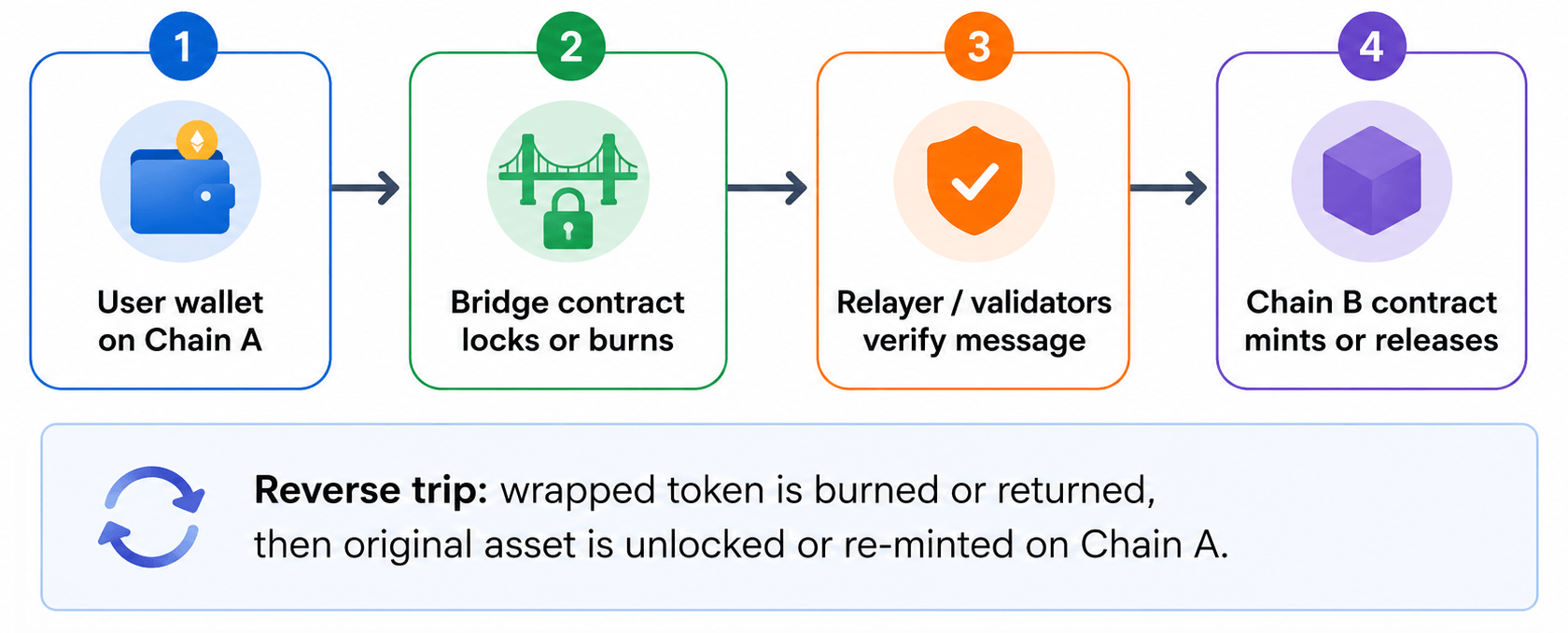
Diagram: simplified lock, verify, mint/release bridge flow.
3.1 Lock and Mint
This is the easiest bridge model to understand. The original token is locked in a smart contract on the source chain. Then the bridge mints a wrapped version of that token on the destination chain.
- You deposit 1 ETH into a bridge contract on Ethereum.
- The bridge confirms the deposit.
- The bridge mints 1 wrapped ETH on another chain, such as a layer 2 or sidechain.
- When you return, the wrapped ETH is burned and the original ETH is unlocked.
3.2 Burn and Mint
In a burn-and-mint bridge, tokens are burned on the source chain and newly minted on the destination chain. This model is often used when the token issuer controls minting across multiple chains and wants one official supply system rather than wrapped IOUs.
3.3 Lock and Unlock Through Liquidity Pools
Some bridges maintain liquidity pools on multiple chains. Instead of minting a wrapped token, the bridge releases existing liquidity on the destination chain. This can feel faster and more convenient, but it depends on the bridge having enough liquidity where the user wants to receive funds.
3.4 Cross-Chain Messaging
More advanced systems do not only transfer tokens. They pass messages between smart contracts. For example, a lending app on one chain could send an instruction to repay, borrow, vote, stake, or trigger a swap on another chain. This is powerful, but it increases complexity and risk.
4. Types of Blockchain Bridges
| Bridge type | How it works | Main benefit | Main risk |
|---|---|---|---|
| Token bridge | Moves tokens or creates wrapped tokens across chains. | Simple for users moving assets. | Wrapped asset or bridge contract failure. |
| Liquidity bridge | Uses pools of assets on each chain. | Often faster and may deliver native assets. | Liquidity shortage, pool imbalance, or pool exploit. |
| Message bridge | Transfers data or instructions between smart contracts. | Enables cross-chain apps. | More complex attack surface. |
| Centralized bridge | A company or small group controls custody or validation. | Usually simple and fast. | Custody, censorship, key compromise, counterparty risk. |
| Federated / multisig bridge | A group of validators signs bridge messages. | More distributed than one operator. | Validator collusion or private key compromise. |
| Light-client / trust-minimized bridge | Verifies the other chain with cryptographic proofs or light clients. | Stronger security assumptions. | Can be expensive, slower, and harder to build. |
5. Common Examples of Blockchain Bridges
The bridge landscape changes quickly, so users should always verify the official links from the source chain, destination chain, or project website before using any bridge. Common bridge categories include:
- Layer-2 bridges: move assets between Ethereum and layer-2 networks such as Arbitrum, Optimism, Base, zkSync, Linea, or Starknet.
- Ecosystem bridges: connect major layer-1 networks and sidechains, such as Ethereum, Polygon, Avalanche, BNB Chain, Solana, or Cosmos-based networks.
- Stablecoin issuer bridges or transfer systems: allow approved versions of stablecoins to move across supported chains.
- Application-specific bridges: built for games, NFT platforms, DeFi protocols, or appchains.
- Centralized exchange transfers: not usually called bridges by users, but depositing on one chain and withdrawing on another can achieve a similar practical result with exchange custody risk.
6. Real-World Scenario: Bridging ETH to a Layer 2
Imagine Sara has ETH on Ethereum mainnet, but she wants to use a DeFi app on Arbitrum because transactions may be cheaper and faster. She connects her wallet to the official bridge, chooses Ethereum as the source chain and Arbitrum as the destination chain, enters the amount, and approves the transaction. The bridge records her deposit on Ethereum and makes the corresponding ETH available on Arbitrum. From that point, Sara must use Arbitrum-compatible apps and pay Arbitrum transaction fees.
The important beginner lesson: after bridging, the asset exists in a different blockchain environment. Sending it back to the wrong network, using fake bridge links, or ignoring withdrawal times can cause losses or delays.
7. Benefits of Blockchain Bridges
- Access to more apps: Users can reach DeFi, gaming, NFT, and social applications on other chains.
- Lower transaction costs: Bridging to a layer 2 or lower-fee network can reduce routine transaction costs.
- Better liquidity movement: Traders and protocols can move capital where it is needed.
- More flexible development: Developers can build apps that use the strengths of multiple networks.
- Improved user choice: Users are not locked into one chain’s apps, fees, or speed.
- Cross-chain composability: Advanced bridges can let smart contracts coordinate activity across chains.
8. Risks and Limitations of Blockchain Bridges
Blockchain bridges are useful, but they are not risk-free. In fact, bridge security is one of the most important topics a beginner should understand before moving funds.
8.1 Smart Contract Bugs
Many bridges depend on smart contracts that lock, mint, burn, or release tokens. A bug in these contracts can allow unauthorized withdrawals, fake deposits, infinite minting, or stuck funds.
8.2 Validator or Private Key Compromise
Some bridges rely on validators, guardians, operators, or multisig signers. If attackers compromise enough keys, they may approve fake bridge messages and drain locked funds.
8.3 Wrapped Asset Risk
A wrapped token is only as reliable as the system backing it. If the bridge reserve is hacked, frozen, mismanaged, or undercollateralized, the wrapped token on the destination chain may lose value.
8.4 Liquidity Risk
Liquidity-based bridges need enough assets on the destination chain. If liquidity is low, users may face delays, high fees, poor rates, or failed transfers.
8.5 Finality and Reorg Risk
A bridge must decide when a source-chain transaction is final enough to trust. If a chain reorganizes or is attacked after the bridge accepts a transfer, the bridge may release assets based on a transaction that later disappears.
8.6 User Error
Many bridge losses come from simple mistakes: using fake websites, choosing the wrong network, misunderstanding gas fees, sending assets to unsupported addresses, or failing to account for withdrawal delays.
8.7 Regulatory and Operational Risk
A bridge frontend, operator, or liquidity provider may become unavailable because of legal, governance, technical, or business issues. Even decentralized systems often depend on websites, RPC providers, validators, or offchain monitoring.
9. Why Bridges Have Been Major Hack Targets
Bridges are attractive targets because they can concentrate large amounts of value in a small number of contracts or liquidity pools. They also require coordination across multiple chains and sometimes offchain infrastructure. That creates a larger attack surface than a typical single-chain application.
Major bridge-related incidents have included the Ronin Bridge exploit, Wormhole exploit, Nomad exploit, Poly Network exploit, and BNB Bridge exploit. The details differ, but common themes include compromised keys, flawed message verification, smart contract bugs, and poor operational controls.
10. How to Evaluate a Bridge Before Using It
| Question to ask | Why it matters |
|---|---|
| Is this the official bridge link? | Fake bridge websites are common phishing traps. Confirm links from official project documentation. |
| Who validates messages? | A small signer set can create key compromise or collusion risk. |
| Has the bridge been audited? | Audits do not guarantee safety, but no serious review is a warning sign. |
| Is there a bug bounty? | A meaningful bounty can help security researchers report issues responsibly. |
| How much value is locked? | Very high TVL can attract attackers; very low TVL can indicate weak liquidity. |
| Are there rate limits or pause controls? | These can reduce damage during an exploit, but they may also introduce admin trust. |
| What is the withdrawal time? | Some bridges, especially optimistic rollup bridges, may have long challenge windows. |
| What asset will you receive? | Native assets and wrapped assets have different risks. |
| What happens if something fails? | Check support docs, transaction explorers, and retry/refund processes. |
11. Practical Safety Tips for Beginners
- Start with a small test transfer before moving a meaningful amount.
- Use official documentation to find the bridge, not ads or random search results.
- Check the source chain, destination chain, token, receiving address, and gas token before confirming.
- Keep enough native gas token on both chains for approvals, claiming, swaps, or return transfers.
- Understand whether you are receiving a native token or a wrapped version.
- Avoid bridging during network congestion unless the transfer is urgent.
- Do not approve unlimited token allowances unless you understand the risk; revoke old approvals when appropriate.
- Avoid bridges with anonymous teams, no audits, no monitoring, weak documentation, or unrealistic yield incentives.
- For large transfers, consider splitting the transfer, using more established routes, or consulting a qualified security professional.
12. Blockchain Bridge vs Centralized Exchange Transfer
| Feature | Blockchain bridge | Centralized exchange transfer |
|---|---|---|
| Custody | Usually self-custody, but bridge contracts or validators may hold risk. | Exchange controls funds while deposited. |
| Speed | Can be fast or slow depending on bridge design and finality. | Often convenient, but deposits and withdrawals depend on exchange processing. |
| Privacy | Onchain transactions are public. | Exchange activity is tied to account records and KYC where required. |
| Asset support | Depends on bridge routes and liquidity. | Depends on exchange listing and supported withdrawal networks. |
| Main risk | Smart contract, validator, liquidity, and wrapped asset risk. | Exchange custody, withdrawal suspension, account restrictions, and platform risk. |
| Best for | Self-custody users and DeFi/app access. | Users who already trust and use an exchange for swaps or withdrawals. |
13. Common Misconceptions About Bridges
- “Bridging is the same as sending tokens.” Not exactly. A normal transfer stays on one blockchain; bridging involves two networks and extra verification.
- “Wrapped tokens are identical to native tokens.” They may trade similarly, but they carry bridge and reserve risk.
- “Audited means safe.” Audits reduce risk but cannot eliminate bugs, governance issues, key compromise, or economic attacks.
- “Fast bridges are always better.” Fast bridges may rely on liquidity providers, trusted validators, or different security assumptions.
- “All bridges work the same way.” Bridge designs vary widely, and the safest choice depends on chain, asset, amount, and use case.
14. Best Use Cases for Blockchain Bridges
- Moving funds from Ethereum to a reputable layer 2 to reduce fees.
- Accessing an app that only exists on another chain.
- Moving stablecoins or liquidity between DeFi ecosystems.
- Using official ecosystem bridges for supported assets.
- Developing cross-chain applications that need verified messaging between smart contracts.
15. When You Should Avoid Bridging
- You do not understand which asset you will receive on the destination chain.
- The bridge link came from an ad, direct message, or unknown social media account.
- The bridge has little documentation, no public security information, or a history of unresolved issues.
- You cannot afford to lose or delay the funds.
- The transfer amount is large and you have not tested the route first.
- The destination chain is not supported by your wallet, app, or exchange withdrawal route.
16. Beginner Checklist Before Bridging
- Confirm the official bridge URL from the project’s official website or documentation.
- Check that your wallet is connected to the correct source chain.
- Confirm the destination chain and token contract.
- Read the estimated fee, bridge time, and any withdrawal delay.
- Make a small test transfer.
- Wait for the test to arrive and verify the token in your wallet.
- Only then move the larger amount, if the route worked as expected.
- Save the transaction hashes from both chains for troubleshooting.
17. FAQs About Blockchain Bridges
17.1 Are blockchain bridges safe?
Some bridges are safer than others, but no bridge is risk-free. Security depends on the bridge design, code quality, validator set, liquidity model, monitoring, audits, and operational controls.
17.2 Can I lose money using a bridge?
Yes. Losses can happen because of bridge hacks, smart contract bugs, fake websites, wrong network choices, unsupported tokens, liquidity problems, or user mistakes.
17.3 What is a wrapped token?
A wrapped token is a token on one blockchain that represents an asset associated with another blockchain. For example, a bridged version of ETH on another chain may represent ETH locked or accounted for elsewhere.
17.4 Is bridging the same as swapping?
No. Bridging moves value between chains. Swapping exchanges one asset for another. Some services combine both actions in one transaction, but the concepts are different.
17.5 Why do some withdrawals take days?
Some bridges, especially those connected to optimistic rollups, may include challenge periods so invalid transactions can be disputed before final withdrawal.
17.6 What is the safest way to bridge crypto?
Use official bridge links, start with a test transfer, understand the asset you will receive, check security documentation, and avoid moving more than you can afford to lose.
17.7 Do I need a bridge if I use a centralized exchange?
Not always. You may deposit on one network and withdraw on another if the exchange supports both. That is convenient but introduces exchange custody and account risk.
17.8 What is cross-chain messaging?
Cross-chain messaging lets smart contracts or protocols send instructions or data between blockchains, not just tokens. It enables more advanced apps but adds complexity.
17.9 Can a bridge be decentralized?
Yes, but decentralization varies. Some bridges use small multisigs, some use large validator networks, and some use more trust-minimized cryptographic verification.
17.10 Should beginners use bridges?
Beginners can use bridges carefully, but they should start small, use official links, avoid unknown bridges, and learn the destination chain before sending large amounts.
18. Conclusion: Bridges Are Useful, But Security Comes First
Blockchain bridges are important infrastructure for a multi-chain crypto world. They help users move assets, access lower fees, reach new applications, and connect liquidity across ecosystems. But bridges also introduce extra trust assumptions and technical risk. A bridge is not just a “send” button; it is a system of smart contracts, validators, relayers, liquidity pools, wrapped assets, and operational controls.
For beginners, the best approach is simple: use official routes, start with small test transfers, understand what asset you are receiving, and treat bridge security as seriously as wallet security. The more money you move, the more carefully you should evaluate the bridge.
Sources Consulted and Checked
These sources were consulted and checked while preparing this article to support clarity and accuracy.
- Chainlink Education Hub: “What Is a Cross-Chain Bridge?” Updated January 9, 2026.
- Chainlink Documentation: “Cross-chain bridges and associated risks.” Accessed June 24, 2026.
- Chainlink: “Understanding Cross-Chain Bridge Hacks and Security Standards.” Updated April 21, 2026.
- arXiv: “SoK: A Review of Cross-Chain Bridge Hacks in 2023.” Published January 2025.
- Ethereum.org documentation on bridges and layer-2 ecosystem concepts.
Reader Advice
This article is provided for educational and informational purposes only and is not personalized financial, legal, investment, tax, or security advice. Blockchain bridges can involve smart-contract failures, compromised validators or keys, phishing, liquidity shortages, wrapped-asset risk, transaction delays, irreversible user errors, and possible loss of funds. Rules, policies, laws, platform features, security conditions, fees, and statistics can change over time and may vary by country or region. Before acting, verify current information through official project documentation, relevant regulators, and other authoritative sources, test unfamiliar routes with a small amount, and seek qualified professional advice when appropriate.