Interoperability in Crypto: Complete Guide, Examples, Risks and Best Practices
1. Quick Answer: What Is Interoperability in Crypto?
Interoperability in crypto means the ability of different blockchains, applications, wallets, and digital assets to communicate and work together. In simple terms, it is what allows value or information to move between separate blockchain networks instead of being trapped inside one chain.
For example, Bitcoin, Ethereum, Solana, Cosmos-based chains, Polkadot parachains, and many layer 2 networks are separate systems. They often have different rules, programming environments, token standards, transaction formats, and security models. Interoperability tools try to connect these separate systems so users and developers can move assets, send messages, trigger smart contracts, and build multi-chain applications.
The idea is powerful, but it is not risk-free. Cross-chain systems can add new smart contract risk, validator risk, oracle risk, bridge risk, liquidity risk, and user-error risk. Good interoperability improves the user experience. Poorly designed interoperability can become one of the weakest links in a crypto setup.
2. Why Crypto Interoperability Matters
Most blockchains were originally designed as independent networks. That independence is useful because each chain can make its own trade-offs around speed, cost, decentralization, privacy, governance, and developer experience. The problem is that users do not want to live inside isolated networks. They want to move assets, use the best apps, trade where liquidity exists, and interact with communities across chains.
Interoperability matters because it helps crypto feel less like a collection of disconnected islands and more like a connected financial and application network. Without it, a user may hold tokens on one chain but need them on another chain to use a DeFi app, buy an NFT, vote in a DAO, play a blockchain game, or pay a fee.
For developers, interoperability can expand the market for an application. A lending protocol, game, decentralized exchange, or payment app may serve users on multiple chains instead of forcing everyone onto one network. For institutions, it can make tokenized assets, settlement systems, identity tools, and compliance workflows easier to connect across private and public blockchain environments.
3. A Simple Analogy: Blockchains as Countries
Think of each blockchain like a country with its own language, laws, currency, roads, and border rules. Interoperability is like passports, currency exchange, shipping routes, messaging standards, and international agreements. It does not make every country the same. It creates reliable ways for them to interact.
A bridge may act like a border crossing for assets. A messaging protocol may act like an international postal system for instructions. A shared security network may act like a common legal framework. The better the rules and security checks, the safer and smoother the movement becomes.
4. Diagram: How Cross-Chain Interoperability Usually Works
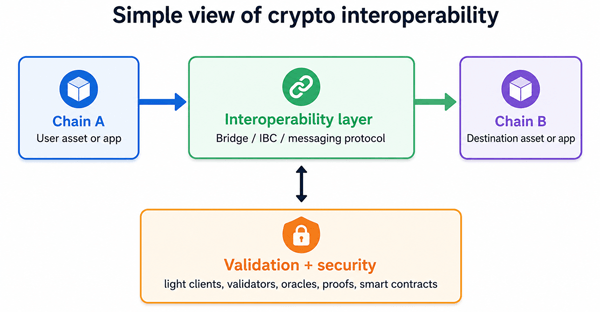
Diagram: A simplified flow showing how a user or application on Chain A can interact with Chain B through an interoperability layer that validates and transports messages or assets.
5. Core Types of Crypto Interoperability
Interoperability is not one single technology. It is a broad category that includes several approaches. Some systems only move tokens. Others send general messages. Some are protocol-native, while others are third-party services built on top of existing chains.
| Type | What it does | Simple example | Main risk |
|---|---|---|---|
| Token bridges | Move or represent assets across chains. | Move ETH from Ethereum to an L2 or wrapped BTC to a smart contract chain. | Bridge contract or validator compromise. |
| Cross-chain messaging | Send data or instructions between smart contracts on different chains. | A contract on Chain A tells a contract on Chain B to release funds or update a state. | Message validation failure or replay attacks. |
| Interoperability protocols | Provide standardized communication frameworks. | IBC in Cosmos, XCM in Polkadot, CCIP for supported chains. | Protocol bugs, integration mistakes, or economic assumptions. |
| Atomic swaps | Exchange assets across chains without a traditional intermediary. | Swap BTC for another asset through cryptographic conditions. | Poor UX, liquidity limits, timing errors. |
| Omnichain apps and tokens | Apps or tokens designed to operate across multiple networks. | A token that can be transferred across supported chains through a messaging layer. | Complex supply accounting and integration risk. |
| Shared security ecosystems | Multiple chains rely on a common security or coordination layer. | Polkadot parachains or Cosmos chains using shared/interconnected security patterns. | Governance, validator, or ecosystem-level risk. |
6. How Interoperability Works Step by Step
The exact process depends on the design, but most cross-chain systems follow a similar pattern: detect an event on one chain, verify that the event is real, then perform an action on another chain.
- A user or smart contract starts an action on the source chain. This could be a token transfer, a message, a deposit, or a contract call.
- The interoperability system observes the action. This may be done by relayers, validators, oracles, light clients, or other off-chain/on-chain components.
- The system verifies the source-chain event. Verification may use cryptographic proofs, validator signatures, oracle networks, light clients, fraud proofs, or trusted/multisig controls.
- A message is delivered to the destination chain. The destination chain receives instructions such as mint a wrapped asset, unlock funds, update a contract, or trigger a function.
- The destination-side contract executes the action. The user sees the result on the target chain, often after a delay and after paying fees.
The key question is always: who or what confirms that the message is true? A system that uses strong verification may be safer but more complex. A system that relies on a small trusted group may be faster or easier to deploy but introduces more trust risk.
7. Common Models Used in Cross-Chain Systems
| Model | How it works | Pros | Cons |
|---|---|---|---|
| Lock and mint | Tokens are locked on the source chain and a wrapped version is minted on the destination chain. | Common, easy to understand, supports assets that are not native to the target chain. | Wrapped token depends on bridge solvency and security. |
| Burn and mint | Tokens are burned on one chain and minted on another, often for natively cross-chain tokens. | Cleaner supply accounting than lock-and-mint when designed well. | Requires strong control of token contracts on each chain. |
| Liquidity network | Liquidity providers hold funds on multiple chains and fulfill transfers from local liquidity. | Can be fast and user-friendly. | Liquidity may dry up, pricing can vary, and LPs add counterparty/economic assumptions. |
| Light-client verification | One chain verifies proofs about another chain directly or through a light client. | Can reduce reliance on trusted intermediaries. | Technically complex and may be expensive on some chains. |
| External validator/oracle network | A separate network observes and signs or attests to cross-chain events. | Flexible and supports many chains. | Security depends on the network design, incentives, and implementation. |
| Centralized or multisig bridge | A company, small signer set, or multisig controls movement of assets/messages. | Simple and often fast. | Higher trust risk and attractive target for attackers. |
8. Real-World Examples of Crypto Interoperability
8.1 Cosmos IBC
IBC, or Inter-Blockchain Communication, is a protocol associated with the Cosmos ecosystem. It is designed to let independent blockchains communicate by using standardized data structures and message-passing rules. Cosmos documentation describes IBC as a way to support token transfers, atomic swaps, multi-chain smart contracts, and cross-chain account control when chains meet the protocol requirements.
Practical example: a user can move assets between Cosmos-based chains that support IBC, such as moving a token from one appchain to another where it can be traded, staked, or used in an application.
8.2 Polkadot XCM
XCM, or Cross-Consensus Messaging, is used in the Polkadot ecosystem as a messaging format and language for communication between consensus systems. It is not just a simple token bridge. It is a way to express instructions between parachains and other connected systems.
Practical example: one parachain can send instructions or assets to another parachain through the Polkadot interoperability model, depending on the configuration and supported XCM functionality.
8.3 Chainlink CCIP
CCIP, or Cross-Chain Interoperability Protocol, is a Chainlink protocol for cross-chain token transfers, messaging, and programmable token transfers across supported chains. It is designed for developers building applications that need to send tokens, data, or both between blockchains.
Practical example: a DeFi application can use a cross-chain message to coordinate activity between smart contracts on two supported networks, such as transferring value and passing an instruction in one workflow.
8.4 Ethereum Bridges and Layer 2 Connections
Ethereum users often use bridges to move assets between Ethereum mainnet and layer 2 networks or other chains. Ethereum documentation highlights key bridge considerations such as destination-chain connectivity and whether the bridge can pass complex data or only transfer assets. This matters because some bridges are simple token movers, while others support broader cross-chain communication.
Practical example: a user may bridge ETH or a stablecoin from Ethereum mainnet to an L2 network to use lower-fee DeFi applications, then bridge back later when needed.
8.5 Wrapped Bitcoin and Cross-Chain Liquidity
Bitcoin does not natively run Ethereum-style smart contracts. Wrapped Bitcoin designs allow BTC exposure to appear on smart contract chains, usually through custody, locking, minting, or other representation models. This gives users access to DeFi liquidity, but it also introduces wrapper, custodian, bridge, and smart contract risk.
9. Benefits of Interoperability in Crypto
- Better user experience: Users can access more apps and networks without being trapped on one chain.
- More liquidity: Assets and users can move to where markets, lending pools, games, or payment systems are active.
- Developer flexibility: Builders can choose the chain that fits their needs while still reaching users elsewhere.
- Specialized blockchains: Different chains can focus on speed, privacy, gaming, DeFi, identity, or institutional use while remaining connected.
- More resilient ecosystems: A multi-chain world may reduce dependence on one network, though it can also increase complexity.
- New application designs: Cross-chain governance, omnichain lending, cross-chain NFTs, and multi-chain payments become possible.
10. Risks and Limitations of Crypto Interoperability
Interoperability can solve real problems, but it can also create new ones. Many of the largest crypto losses have involved bridges or cross-chain infrastructure, which is why users should treat cross-chain activity as higher risk than a simple transfer inside one chain.
10.1 Bridge Hacks and Smart Contract Bugs
Bridges often hold large amounts of assets or control minting rights for wrapped tokens. That makes them attractive targets. A bug in a bridge contract, validator logic, upgrade key, or message verification process can lead to serious losses.
10.2 Trust and Validator Risk
Some bridges depend on a small set of signers, validators, or operators. If enough of them are compromised, careless, or malicious, user funds may be at risk. Always understand whether a bridge is trust-minimized, economically secured, permissionless, or controlled by a small group.
10.3 Wrapped Asset Risk
A wrapped token is not always the same as the original asset. It is a claim or representation. If the backing asset is stolen, frozen, mismanaged, or not redeemable, the wrapped version can lose value.
10.4 Liquidity and Slippage Risk
Cross-chain liquidity networks depend on available liquidity. A transfer may be delayed, expensive, or priced poorly during congestion or market stress.
10.5 Finality and Reorg Risk
Blockchains confirm transactions differently. Some have fast finality. Others may reorganize recent blocks. A cross-chain system must decide how many confirmations are enough before trusting a source-chain event.
10.6 User-Error Risk
Users can choose the wrong network, paste the wrong address, use an unsupported token version, or interact with a fake bridge website. In crypto, a small mistake can be irreversible.
10.7 Regulatory and Compliance Risk
Cross-chain tools can interact with many jurisdictions, assets, and counterparties. Some interfaces may restrict users, certain assets may be frozen, and institutions may require compliance checks before using cross-chain systems.
11. Best Practices for Safer Cross-Chain Use
These practices do not remove risk, but they can reduce common mistakes.
- Use official links. Access bridges and interoperability tools from official project websites or documentation, not from ads or random social media links.
- Start with a small test transfer. Before moving a large amount, send a small amount and confirm it arrives on the correct chain.
- Check supported assets and networks. The same token symbol can exist in different forms across chains. Confirm the exact contract address when possible.
- Understand the security model. Look for information about audits, bug bounties, validator sets, upgrade keys, proof mechanisms, and incident history.
- Avoid moving more than you can afford to lose through a new or unaudited bridge. Higher yield or faster transfers do not automatically mean better security.
- Watch fees and timing. Cross-chain actions can require source-chain gas, destination-chain gas, bridge fees, relayer fees, and waiting periods.
- Be careful with approvals. Revoke or limit token approvals when a bridge or app does not need ongoing spending permission.
- Prefer mature, well-documented systems for important transfers. New systems can be innovative, but they may not have been battle-tested.
- Keep records. Save transaction hashes on both chains, the bridge route used, token contract addresses, and the time of transfer.
- Do not rush during outages or congestion. Failed or delayed transfers can happen. Check official status pages and announcements before retrying.
12. How to Evaluate a Bridge or Interoperability Protocol
| Question to ask | Why it matters | Good signs |
|---|---|---|
| Who verifies messages? | This is the core security assumption. | Clear documentation, decentralized validation, or strong cryptographic verification. |
| Is the code audited and open? | Audits do not guarantee safety, but they improve transparency. | Recent audits, public repos, bug bounty, clear issue history. |
| How are upgrades controlled? | Admin keys can be a major risk. | Timelocks, multisig transparency, governance process, emergency procedures. |
| What happens if validators fail? | Cross-chain systems need failure handling. | Documented pause, recovery, and dispute mechanisms. |
| How much value is secured? | Large TVL can mean battle-testing, but also larger attack incentives. | Transparent dashboards and risk disclosures. |
| Does it support the asset natively? | Wrapped and synthetic assets have different risk profiles. | Clear redemption path and supply accounting. |
| What is the incident history? | Past behavior matters. | Public postmortems, fixes, and responsible communication. |
13. Common Misconceptions About Crypto Interoperability
13.1 Misconception 1: A bridged token is always the same as the original token
Not always. A bridged token may be backed by locked collateral, minted by a bridge contract, issued by a custodian, or created through a liquidity system. Its value depends on the bridge design and redemption path.
13.2 Misconception 2: Interoperability removes the need to trust anyone
Some systems reduce trust assumptions, but many do not remove them completely. You may still rely on smart contracts, validators, relayers, oracles, governance, or multisigs.
13.3 Misconception 3: More chains always means better user experience
More chains can mean more choice, but also more confusion. Users may face fragmented liquidity, wrong-network errors, different token versions, and different wallets or gas tokens.
13.4 Misconception 4: The cheapest bridge is the best bridge
Cheap and fast can be useful, but security, liquidity, reliability, and support are often more important, especially for large transfers.
14. Interoperability vs Bridges vs Cross-Chain Messaging
| Term | Meaning | Beginner-friendly explanation |
|---|---|---|
| Interoperability | The broad ability for blockchains and apps to communicate or work together. | The overall category. |
| Bridge | A tool or protocol that moves assets or messages between chains. | A common way to achieve interoperability. |
| Cross-chain messaging | Sending instructions or data between smart contracts on different chains. | Like a blockchain-to-blockchain message service. |
| Wrapped asset | A token on one chain that represents an asset from another chain. | A receipt-like version of another asset. |
| Relayer | A participant or service that submits messages or proofs between chains. | A courier that helps deliver cross-chain information. |
15. Use Cases: Where Interoperability Is Useful
15.1 DeFi
A user may hold assets on one chain but want to lend, borrow, trade, or provide liquidity on another. Interoperability can help move assets or coordinate positions across markets.
15.2 Gaming and NFTs
A game may want assets to move between a gaming chain, an NFT marketplace, and a general-purpose smart contract network. Interoperability can support cross-chain items, ownership records, and payments.
15.3 Payments
A merchant or wallet may want to accept stablecoins from several chains and settle on a preferred network. Cross-chain routing can make payments more flexible, although the user experience must be carefully designed.
15.4 DAOs and Governance
A DAO may have token holders across several chains. Cross-chain voting and governance messages can help coordinate decisions, but governance bridges must be designed very carefully because a bad message could affect treasury funds or protocol control.
15.5 Tokenized Real-World Assets
Institutions exploring tokenized assets may need controlled interoperability between private ledgers, public blockchains, identity systems, settlement rails, and compliance tools.
16. Pros and Cons Summary
| Pros | Cons |
|---|---|
| Access to more apps, users, assets, and liquidity. | Adds technical complexity and new failure points. |
| Enables multi-chain applications and better capital efficiency. | Bridge hacks and smart contract bugs can cause large losses. |
| Lets chains specialize while still connecting to broader ecosystems. | Wrapped assets may carry redemption and backing risk. |
| Can improve user choice and reduce dependence on one network. | Different chain finality, fees, and token standards can confuse users. |
| Supports new designs such as cross-chain governance and omnichain apps. | Security assumptions are often hard for beginners to evaluate. |
17. Practical Checklist Before Using a Cross-Chain Tool
- Am I using the official website or app?
- Does the tool support the exact source chain, destination chain, and token I want?
- Do I understand whether I will receive a native asset, wrapped asset, or synthetic version?
- Have I checked fees, estimated time, and required gas on both chains?
- Have I tested with a small amount first?
- Do I know where to find the source-chain and destination-chain transaction hashes?
- Is the amount small enough that I can tolerate the risk?
- Have I checked recent announcements for pauses, incidents, or network congestion?
18. What the Future of Crypto Interoperability May Look Like
The long-term goal is for users to interact with crypto applications without constantly thinking about chains, bridges, wrapped assets, gas tokens, or network settings. Wallets and apps may handle routing in the background, while users simply choose what they want to do.
However, hiding complexity can be dangerous if it hides risk. The best future designs will combine smoother user experiences with clear risk disclosures, better defaults, stronger verification, safer smart contracts, and simple recovery information when transfers are delayed.
Interoperability will likely remain a major part of crypto because no single blockchain is likely to satisfy every use case. The challenge is not only to connect chains, but to connect them safely, transparently, and in a way normal users can understand.
19. FAQs About Interoperability in Crypto
19.1 What does interoperability mean in crypto?
It means different blockchains, wallets, apps, and assets can communicate or work together. It can include token transfers, cross-chain smart contract calls, messaging, and shared application experiences.
19.2 Is interoperability the same as a bridge?
No. A bridge is one tool used for interoperability. Interoperability is the broader concept of connecting blockchain systems.
19.3 Are crypto bridges safe?
Some are safer than others, but no bridge is risk-free. Bridges can involve smart contracts, validators, relayers, wrapped assets, liquidity providers, or administrators. Users should understand the security model before using one.
19.4 Why do bridged tokens sometimes have different names?
A bridged token may represent an original asset on another chain. Different bridges may issue different versions, so symbols alone are not enough. Always check the contract address and redemption path.
19.5 What is cross-chain messaging?
Cross-chain messaging lets one blockchain send data or instructions to another. This can allow smart contracts on different chains to coordinate actions.
19.6 What is the difference between multichain and cross-chain?
Multichain usually means an app or token exists on several chains. Cross-chain means those chains can communicate or transfer value/data between each other.
19.7 Can interoperability make crypto easier for beginners?
Yes, if designed well. It can reduce the need to manually move between networks. But it can also create confusion if users do not understand token versions, fees, or bridge risks.
19.8 What is the safest way to move assets across chains?
There is no universally safest option for every asset and chain. In general, use official tools, read documentation, start with a small test, avoid unknown bridges, and do not move more than you can afford to risk.
19.9 Do all blockchains support interoperability?
No. Some chains support specific interoperability standards or bridges, while others have limited support. Compatibility depends on technical design, ecosystem support, and available infrastructure.
19.10 Why is interoperability important for Web3?
It helps users, assets, and applications move across separate ecosystems. This can improve liquidity, access, developer flexibility, and the usefulness of decentralized applications.
20. Final Takeaway
Interoperability in crypto is the technology and design philosophy that connects separate blockchains. It makes multi-chain activity possible, from moving tokens between networks to sending smart contract messages across ecosystems. It can improve access, liquidity, user experience, and developer flexibility.
But interoperability also creates some of crypto's most important risks. Bridges and cross-chain systems can fail because of bugs, poor security assumptions, compromised validators, liquidity problems, or simple user mistakes. The practical rule is simple: use cross-chain tools when they solve a real problem, but treat every cross-chain transaction as a higher-risk action that deserves careful checking.
Sources Consulted and Checked
These sources were consulted and checked while preparing this article to support clarity and accuracy.
- Ethereum.org Developers: Bridges documentation, including bridge connectivity and cross-chain data considerations.
- Cosmos Network documentation: IBC-Go introduction and Inter-Blockchain Communication protocol overview.
- Polkadot Wiki and Polkadot Developer Docs: XCM and cross-consensus messaging documentation.
- Chainlink Documentation: CCIP overview, CCIP architecture, and cross-chain bridge risk resources.
- Academic and industry research on cross-chain bridge security, including analyses of implementation, economic, and environment risks.
Reader Advice
This article is provided for educational and informational purposes only and is not personalized financial, legal, tax, investment, or security advice. Crypto interoperability, bridges, wrapped assets, and cross-chain transactions can involve smart-contract failures, validator or custodian risk, liquidity problems, fraud, irreversible user errors, and partial or total loss of funds. Rules, policies, laws, technical standards, fees, network conditions, and statistics can change over time and may vary by country or region, so verify important details through current official documentation and qualified local professionals before making a decision. Use trusted official interfaces, test with a small amount, and never commit more value than you can afford to lose.