Rollups Explained: Meaning, How It Works, Examples, Benefits and Risks
1. Quick Answer: What Is a Rollup?
A rollup is a blockchain scaling system that processes many transactions outside the main blockchain, bundles them together, and posts compressed transaction data plus a state update back to the main chain. In simple terms, a rollup does the heavy work elsewhere but still uses the base chain, such as Ethereum, for settlement, data availability, and security.
Rollups are mostly discussed in the Ethereum ecosystem because Ethereum has followed a rollup-centric scaling roadmap. They are also relevant across the wider crypto industry because they show how blockchains can support more users without forcing every base-layer node to process every transaction directly.
2. Simple Rollup Diagram
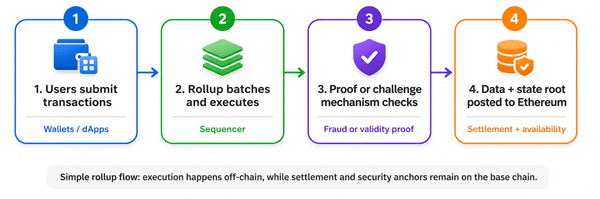
Figure 1: A simplified rollup workflow. The rollup handles execution, while Ethereum or another base layer provides final settlement and security guarantees.
3. What Does “Rollup” Mean in Crypto?
A rollup is a Layer 2 scaling solution. “Layer 2” means it sits on top of a base blockchain, often called Layer 1. Ethereum, Bitcoin, Solana and other major blockchains are Layer 1 networks. A rollup is not just an app; it is usually its own execution environment with its own blocks, transaction ordering, fees, bridges, and smart contracts.
The word “rollup” comes from the idea of rolling many transactions into one batch. Instead of sending every small transaction directly to Ethereum mainnet, the rollup collects many transactions, processes them off-chain or on a separate chain, compresses the results, and sends summary information back to Ethereum.
A useful analogy is a busy restaurant bill. Instead of the cashier recording every item from every table one by one in the main ledger, each waiter groups orders, calculates totals, and sends a neat summary to the cashier. The cashier still keeps the official record, but the work is organized more efficiently.
4. Why Do Blockchains Need Rollups?
Blockchains are designed to be secure and verifiable. The tradeoff is that they can become slow or expensive when too many users want to transact at the same time. On a base chain, many independent nodes must store, verify, and agree on the same activity. That is good for security, but it limits throughput.
Rollups exist to reduce this pressure. They move execution away from the base chain while keeping important security links to it. This can lower fees, improve speed, and make decentralized applications easier to use.
Without scaling systems, simple actions such as swapping tokens, minting NFTs, playing blockchain games, or making small payments can become too expensive during periods of heavy network demand.
5. How Rollups Work Step by Step
Although each rollup has its own design, most follow a similar pattern.
- Users send transactions to the rollup. A user connects a wallet to a rollup network and submits an action such as transferring tokens, swapping on a decentralized exchange, or interacting with a smart contract.
- A sequencer orders transactions. Most rollups use a sequencer to collect transactions, decide their order, and produce rollup blocks. Many current rollups rely on centralized or semi-centralized sequencing, which is a major risk to understand.
- The rollup executes transactions off the base chain. The rollup updates account balances, smart contract states, and transaction records in its own environment.
- Transactions are compressed into batches. Instead of posting every transaction separately to Ethereum, the rollup posts a batch. This spreads the cost of the base-layer transaction across many users.
- The rollup posts data and a state commitment to the base chain. A state commitment, often called a state root, is a compact record of the rollup’s updated state.
- The batch is verified. Optimistic rollups rely on a challenge period and fraud proofs. ZK rollups use validity proofs that mathematically prove the batch is correct.
- The final result settles on the base chain. Once the relevant proof or challenge process is complete, the rollup state is accepted by the base chain.
6. The Main Parts of a Rollup
| Component | What it does | Why it matters |
|---|---|---|
| Sequencer | Orders user transactions and creates rollup blocks. | Affects speed, censorship resistance, and transaction ordering risk. |
| Batcher | Groups many rollup transactions and posts them to the base chain. | Helps reduce cost by spreading base-layer fees across many transactions. |
| Rollup smart contracts | Contracts on Ethereum or another base chain that manage deposits, withdrawals, proofs, and state updates. | These contracts are the bridge between the rollup and the base chain. |
| Data availability layer | Where transaction data is published so others can reconstruct and verify the rollup state. | Poor data availability can make it hard or impossible for users to exit safely. |
| Proof system | Fraud proofs for optimistic rollups or validity proofs for ZK rollups. | This is how the base chain knows whether the rollup update should be accepted. |
| Bridge | Moves assets between the base chain and the rollup. | Bridge design is one of the biggest sources of user risk. |
7. Types of Rollups
7.1 Optimistic Rollups
Optimistic rollups assume transactions are valid by default. They post transaction data and state updates to the base chain. If someone believes a batch is wrong, they can challenge it during a dispute window by submitting a fraud proof.
The word “optimistic” means the system is optimistic that batches are correct unless proven otherwise. This design can be easier to make compatible with Ethereum smart contracts, which is why many major EVM rollups use optimistic technology.
- Common examples: Arbitrum One, OP Mainnet, Base, Blast, Mantle and other OP Stack or Arbitrum Orbit-based chains.
- Main advantage: strong EVM compatibility and mature developer ecosystem.
- Main drawback: withdrawals to Ethereum can take several days if using the canonical bridge because users must wait for the challenge period.
7.2 ZK Rollups / Validity Rollups
ZK rollups, often called validity rollups, use cryptographic proofs to prove that a batch of transactions was executed correctly. The base chain verifies the proof instead of re-executing every transaction.
The term “ZK” stands for zero knowledge, but not every ZK rollup focuses on privacy. In many scaling rollups, the main purpose of the proof is validity, not hiding transaction details.
- Common examples: zkSync Era, Starknet, Linea, Scroll, Polygon zkEVM and Taiko.
- Main advantage: faster finality and stronger upfront validity guarantees.
- Main drawback: proof systems are complex, and some ZK rollups still have upgrade keys, prover centralization, or incomplete decentralization.
| Feature | Optimistic Rollups | ZK / Validity Rollups |
|---|---|---|
| Verification method | Assume valid unless challenged with fraud proofs. | Submit validity proofs that prove correctness up front. |
| Withdrawal experience | Canonical withdrawals often involve a challenge delay. | Can support faster finality, depending on design and bridge. |
| EVM compatibility | Historically easier and more mature. | Improving quickly, but technical complexity is higher. |
| Complexity | Simpler proof mechanism compared with ZK systems. | More complex cryptography and proving infrastructure. |
| Typical user impact | Low fees and familiar Ethereum-style apps. | Low fees, faster settlement potential, and advanced scaling design. |
| Main risks | Challenge period, sequencer centralization, fraud proof maturity. | Proof system bugs, prover centralization, upgrade control, bridge risk. |
8. Real-World Examples of Rollups
| Rollup / Ecosystem | Type | Beginner-friendly description |
|---|---|---|
| Arbitrum One | Optimistic rollup | A major Ethereum Layer 2 used for DeFi, trading, gaming, and general smart contract activity. |
| OP Mainnet | Optimistic rollup | The original Optimism network and a key part of the broader Superchain ecosystem. |
| Base | Optimistic rollup | A Coinbase-incubated Ethereum Layer 2 built with the OP Stack, popular for consumer apps and on-chain social activity. |
| zkSync Era | ZK / validity rollup | A ZK-based Ethereum scaling network focused on smart contracts and lower transaction costs. |
| Starknet | ZK / validity rollup | A validity rollup using STARK proofs and the Cairo programming language. |
| Scroll | ZK / validity rollup | An EVM-compatible ZK rollup designed to make Ethereum apps easier to deploy on ZK infrastructure. |
| Linea | ZK / validity rollup | A Consensys-backed ZK rollup focused on Ethereum-compatible applications. |
| Polygon zkEVM | ZK / validity rollup | A ZK rollup built to support Ethereum-like smart contract execution. |
9. Rollups vs Sidechains vs Validiums
Beginners often confuse rollups with other scaling networks. The difference usually comes down to where data is posted and what security assumptions users accept.
| Scaling design | Where transactions execute | Where data is available | Security model | Simple explanation |
|---|---|---|---|---|
| Rollup | Off the base chain | On the base chain or in a base-chain-backed data format | Inherits meaningful security from the base chain if implemented correctly. | Best known Layer 2 model for Ethereum-aligned security. |
| Sidechain | On a separate blockchain | On the sidechain | Depends mostly on the sidechain’s own validators or consensus. | Can be cheaper, but does not inherit the same security as a rollup. |
| Validium | Off the base chain | Off-chain data availability | Uses validity proofs but keeps data outside the base chain. | Can be cheaper than rollups, but adds data availability trust assumptions. |
| Plasma-like system | Off the base chain | Often off-chain or partially on-chain | Relies on exits and dispute mechanisms. | Useful for some cases, but less general than modern rollups. |
10. Benefits of Rollups
10.1 Lower Transaction Fees
Rollups reduce cost by sharing one base-layer posting cost across many users. This is especially useful when base-layer fees are high. Ethereum’s blob-based data system, introduced through proto-danksharding, was designed to make rollup data cheaper than older calldata-heavy methods.
10.2 Higher Throughput
Because rollups execute transactions outside the base chain, they can process more activity than the base chain alone. This helps decentralized exchanges, games, NFT markets, social apps, and payment systems serve more users.
10.3 Base-Layer Security Anchoring
A properly designed rollup anchors its state and data to Ethereum or another base chain. This gives users stronger security than many independent sidechains, although the exact level of security depends on the rollup’s implementation and maturity.
10.4 Better User Experience
Lower fees and faster confirmations make ordinary crypto actions more practical. A transaction that might be too expensive on Ethereum mainnet can become reasonable on a rollup.
10.5 More Room for App Innovation
Rollups allow developers to build apps that would be impractical on a congested base layer. Some rollups are general-purpose, while others can be app-specific, optimized for gaming, exchanges, payments, identity, or enterprise use cases.
11. Risks and Limitations of Rollups
| Risk | What it means | How beginners can reduce the risk |
|---|---|---|
| Bridge risk | Funds often move through smart contracts that can have bugs or admin controls. | Use official bridges for large transfers, verify URLs, and test with small amounts first. |
| Sequencer centralization | Many rollups rely on one main sequencer today. | Understand that a sequencer can affect ordering, uptime, and censorship resistance. |
| Upgrade key risk | Teams may retain the ability to upgrade contracts. | Check whether the project has timelocks, multisigs, audits, and transparent governance. |
| Withdrawal delays | Optimistic rollup canonical bridges can require waiting through a challenge period. | Use canonical bridges when security matters; use fast bridges only after understanding liquidity and counterparty risk. |
| Proof system risk | Fraud proofs or validity proofs may be incomplete, centralized, or still maturing. | Review independent risk dashboards and project documentation before moving significant value. |
| Data availability risk | If transaction data is not available, users may struggle to verify or exit. | Prefer rollups with clear data availability guarantees and transparent architecture. |
| Liquidity fragmentation | Assets may be split across many rollups and bridges. | Keep funds on networks you actually use and avoid chasing every new chain. |
| Fake networks and phishing | Scammers copy rollup names, bridges, and airdrop pages. | Use official links from trusted sources and never enter seed phrases. |
12. Practical Examples: How a Rollup Feels to a User
12.1 Example 1: Swapping Tokens on a Rollup
A user bridges ETH from Ethereum mainnet to Arbitrum, connects a wallet to a decentralized exchange, and swaps ETH for another token. The transaction is confirmed on the rollup at a lower cost than a similar swap on Ethereum mainnet. Later, if the user wants to return funds to Ethereum, they can use the official bridge or a third-party liquidity bridge.
12.2 Example 2: Minting an NFT
An NFT project launches on Base or OP Mainnet. Users mint NFTs with much lower transaction costs than on Ethereum mainnet. The NFT exists on the rollup, and the project may later support bridging or cross-chain display, depending on its design.
12.3 Example 3: Blockchain Gaming
A game uses a rollup so players can make frequent in-game actions without paying expensive base-layer fees for every move. The rollup handles frequent activity, while important settlement data remains connected to Ethereum.
13. Best Practices for Beginners Using Rollups
- Start with small amounts. Before bridging a large balance, test the network with a small transfer and a simple transaction.
- Use official websites and verified RPC details. Many losses happen because users visit fake bridge or airdrop pages.
- Understand withdrawal timing. Moving from a rollup back to Ethereum can be fast or slow depending on the bridge and rollup type.
- Keep gas tokens available. You usually need ETH or the rollup’s required gas token to pay transaction fees.
- Do not assume every Layer 2 is equally secure. Check whether the network is a true rollup, a validium, a sidechain, or a hybrid design.
- Review risk dashboards. Independent sites such as L2Beat can help users compare maturity, upgrade risk, proof systems, and data availability assumptions.
- Avoid chasing suspicious airdrops. Rollup ecosystems attract scammers who imitate official campaigns.
- Use hardware wallets for larger balances. Rollups lower transaction costs, but wallet security still matters.
14. Common Misconceptions About Rollups
| Misconception | Reality |
|---|---|
| Rollups are completely separate from Ethereum. | Rollups are separate execution environments, but they rely on Ethereum or another base chain for settlement and security anchoring. |
| All Layer 2 networks are rollups. | No. Some are sidechains, validiums, state channels, or hybrid systems. |
| ZK rollups always mean private transactions. | Not necessarily. Many ZK rollups use zero-knowledge proofs for validity, not privacy. |
| Rollups remove all fees. | They reduce fees, but users still pay for execution, data posting, and network operation. |
| Bridging is always safe. | Bridges are complex and can introduce smart contract, liquidity, and phishing risks. |
| A rollup is fully decentralized just because it is a Layer 2. | Many rollups are still working toward decentralizing sequencers, provers, governance, and upgrades. |
15. How to Evaluate a Rollup Before Using It
A beginner does not need to read every smart contract, but it is wise to check a few practical points before using a rollup seriously.
- Security stage: Has the rollup reached a higher maturity stage, or is it still highly dependent on team control?
- Proof system: Are fraud proofs or validity proofs live, permissionless, and well documented?
- Data availability: Is transaction data posted to Ethereum, blobs, or a separate data availability layer?
- Bridge design: Is the official bridge audited, widely used, and transparent about withdrawal rules?
- Sequencer design: Is there one sequencer, a decentralized set, or a roadmap toward decentralization?
- Ecosystem quality: Are major apps, wallets, explorers, and infrastructure providers supporting it?
- Costs and reliability: Are fees consistently low, and does the network have a good uptime history?
- Team transparency: Are upgrades, incidents, governance decisions, and risk assumptions clearly disclosed?
16. The Future of Rollups
Rollups are likely to remain central to Ethereum scaling. The major direction is toward cheaper data availability, more decentralized sequencing, better proof systems, smoother cross-rollup communication, and safer bridges. Ethereum’s roadmap includes further improvements to data availability so rollups can scale without putting all execution back on the base chain.
At the same time, the rollup ecosystem is becoming more complex. There are general-purpose rollups, app-specific rollups, rollup-as-a-service platforms, shared sequencing networks, alternative data availability layers, and modular blockchain designs. For users, this means more choice but also more responsibility to understand trust assumptions.
17. Rollups: Pros and Cons Summary
| Pros | Cons |
|---|---|
| Lower fees than congested base-layer transactions. | Bridge and smart contract risks remain important. |
| Higher throughput for apps and users. | Many rollups are still not fully decentralized. |
| Can inherit strong security from Ethereum when designed correctly. | Liquidity can be fragmented across many networks. |
| Useful for DeFi, NFTs, gaming, payments, and social apps. | Withdrawals can be delayed, especially on optimistic rollups. |
| Encourages experimentation without changing the base chain too quickly. | Users must understand network, bridge, and wallet details. |
18. FAQs About Rollups
18.1 Are rollups safe?
Rollups can be safer than many sidechains because they anchor data and settlement to a base chain like Ethereum. However, safety depends on the specific rollup. Bridge contracts, upgrade keys, sequencers, proof systems, and data availability all matter.
18.2 What is the difference between Layer 2 and rollups?
Layer 2 is the broad category of scaling systems built on top of a base chain. Rollups are one type of Layer 2. Not every Layer 2 is a rollup.
18.3 Why are rollups cheaper?
They batch many transactions together and post compressed information to the base chain. This spreads expensive base-layer costs across many users.
18.4 Do rollups have their own tokens?
Some do, some do not. Arbitrum has ARB, Optimism has OP, and Starknet has STRK. Base does not have its own token as of this writing. Always check official sources because token claims are a common scam area.
18.5 Can I use the same wallet on a rollup?
Usually yes. Many Ethereum rollups work with familiar wallets such as MetaMask, Rabby, Coinbase Wallet, and hardware wallets. You may need to add the rollup network and hold the correct gas token.
18.6 What is a sequencer in a rollup?
A sequencer orders transactions and produces rollup blocks. It makes the rollup feel fast, but centralized sequencing can create censorship, downtime, and transaction ordering concerns.
18.7 What is the difference between fraud proofs and validity proofs?
Fraud proofs are used by optimistic rollups to challenge incorrect batches after they are posted. Validity proofs are used by ZK rollups to prove correctness before or when a batch is accepted.
18.8 Are ZK rollups better than optimistic rollups?
Not always. ZK rollups have strong technical advantages, especially around validity proofs and faster settlement potential. Optimistic rollups often have mature Ethereum compatibility and large ecosystems. The best choice depends on security, apps, fees, liquidity, and user needs.
18.9 Can rollups fail?
Yes. A rollup can suffer from bugs, governance mistakes, sequencer downtime, bridge exploits, or proof system problems. Good design reduces risk but does not remove it.
18.10 Should beginners use rollups?
Beginners can use reputable rollups, but they should start small, use official bridges, verify links, understand withdrawal times, and avoid fake airdrops or unknown networks.
19. Final Thoughts
Rollups are one of the most important ideas in blockchain scaling. They make crypto networks more usable by moving execution away from the base chain while still anchoring important security and settlement data back to it. For beginners, the key idea is simple: rollups bundle many transactions together so users can pay lower fees and enjoy faster activity without completely leaving the security orbit of the base chain.
The practical lesson is to treat rollups as useful but not risk-free. Use reputable networks, understand the bridge, check the withdrawal process, and remember that many rollups are still developing toward full decentralization. Used carefully, rollups can make DeFi, NFTs, games, payments, and everyday on-chain activity far more practical.
Sources Consulted and Checked
The following sources were consulted and checked while preparing this article to support clarity and accuracy.
- Ethereum.org: Zero-knowledge rollups documentation.
- Ethereum.org: Danksharding and proto-danksharding documentation.
- L2Beat: Layer 2 ecosystem definitions and risk analysis.
- Vitalik Buterin: Different types of Layer 2s and Ethereum scaling roadmap essays.
- MDPI Future Internet: Survey on data availability in Layer 2 blockchain rollups.
- Optimism documentation and educational materials on rollups.
Reader Advice
This article is provided for educational and informational purposes only and should not be treated as personalized financial, investment, legal, tax, or technical advice or as a recommendation to use any particular blockchain, rollup, token, bridge, wallet, or service. Crypto and blockchain activity involves risks, including loss of funds, smart-contract or bridge failures, phishing, network outages, changing fees, governance or upgrade controls, and regulatory uncertainty. Rules, policies, laws, project features, security arrangements, and statistics may change over time and may vary by country or region. Before making a decision or transferring significant value, verify current information through official sources, consider your circumstances and risk tolerance, and seek qualified professional advice where appropriate.