Layer 2 Crypto Explained: Meaning, How It Works, Examples, Benefits and Risks
1. Introduction: Why Layer 2 Crypto Matters
Layer 2 crypto is one of the most important ideas in blockchain because it tries to solve a simple but painful problem: popular blockchains can become slow and expensive when too many people use them at the same time. A Layer 2 network helps by moving some activity away from the main blockchain while still using the main chain for settlement, security, or final verification.
For beginners, the easiest way to understand Layer 2 is to think of a busy highway. The main blockchain is the highway. A Layer 2 is like an express lane or side road that lets many small trips happen faster, then reports the important summary back to the main highway system. The goal is not to replace the main chain. The goal is to make it more usable.
Layer 2 solutions are especially common around Ethereum, where rollups such as Arbitrum, Optimism, Base, Starknet and zkSync aim to reduce fees and increase transaction capacity. Bitcoin also has Layer 2-style systems, most notably the Lightning Network, which is designed for faster, lower-cost payments.
2. What Is Layer 2 Crypto?
Layer 2 crypto refers to a network, protocol, or scaling system built on top of a base blockchain, known as Layer 1. The Layer 1 blockchain provides the core settlement and security layer. The Layer 2 handles transactions more efficiently and then sends compressed data, proofs, or settlement results back to the Layer 1.
In simple terms, Layer 2 means: do more work away from the main chain, but keep a meaningful connection to the main chain so users can still benefit from its security and finality.
- Layer 1 examples: Bitcoin, Ethereum, Solana, Cardano and other base blockchains.
- Layer 2 examples: Arbitrum, Optimism, Base, Starknet, zkSync, Polygon zkEVM, Loopring and Bitcoin Lightning Network.
- Common Layer 2 purpose: lower fees, faster transactions, higher throughput and better user experience.
3. Layer 1 vs Layer 2: Simple Comparison
| Feature | Layer 1 | Layer 2 |
|---|---|---|
| Basic meaning | The main blockchain where final settlement happens. | A scaling network or protocol built on top of Layer 1. |
| Main job | Security, consensus, settlement and data availability. | Faster and cheaper execution of transactions. |
| Examples | Ethereum, Bitcoin. | Arbitrum, Optimism, Base, Starknet, zkSync, Lightning Network. |
| Fees | Usually higher during congestion. | Usually lower because many transactions are bundled or handled off-chain. |
| Security model | Secured directly by its own validators or miners. | Depends on design; many rollups inherit security from Layer 1, while other systems add extra trust assumptions. |
| Best for | Final settlement, high-value transactions, base infrastructure. | Payments, DeFi, gaming, NFTs, frequent small transactions and apps needing lower costs. |
4. How Layer 2 Crypto Works
Different Layer 2 systems work in different ways, but most follow the same general pattern: users transact on the Layer 2, the Layer 2 processes many transactions efficiently, and important results are sent back to the Layer 1 blockchain.
- A user moves funds to Layer 2, often through a bridge or exchange withdrawal.
- The user makes transactions on the Layer 2 network, such as swapping tokens, minting NFTs, playing a blockchain game or sending payments.
- The Layer 2 groups many transactions together instead of sending each one separately to Layer 1.
- The Layer 2 posts transaction data, state updates, proofs or commitments back to the Layer 1.
- The Layer 1 acts as the settlement and security layer, depending on the design of the Layer 2.
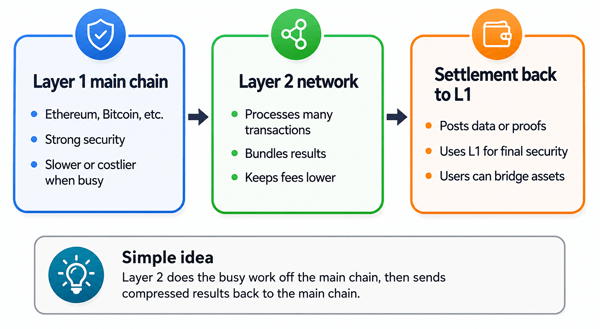
Diagram: A simplified view of how a Layer 2 processes transactions and settles results back to Layer 1.
5. The Main Types of Layer 2 Solutions
Layer 2 is a broad category. Not every scaling system is the same, and not every project marketed as an L2 has the same security assumptions. The most common types are rollups, payment channels, state channels, validiums and related designs.
5.1 Rollups
Rollups are currently the most important Layer 2 approach in the Ethereum ecosystem. A rollup processes transactions outside Ethereum Mainnet, bundles them together, and posts data or proofs back to Ethereum. Ethereum.org explains that rollups can increase throughput by moving computation and state storage off-chain while using Mainnet for verification or settlement.
5.2 Optimistic Rollups
Optimistic rollups assume transactions are valid by default. They are called 'optimistic' because they do not immediately prove every transaction. Instead, there is a challenge period during which someone can submit a fraud proof if a transaction batch is wrong. Arbitrum and Optimism are well-known examples.
- Main advantage: strong compatibility with Ethereum-style smart contracts and mature developer tools.
- Main drawback: withdrawals back to Ethereum can take longer because of the challenge period.
- Common examples: Arbitrum One, OP Mainnet, Base and other OP Stack-based chains.
5.3 Zero-Knowledge Rollups
Zero-knowledge rollups, often called ZK-rollups, generate cryptographic validity proofs that show the Layer 2 state update is correct. Instead of waiting for someone to challenge a bad batch, the proof is verified on Layer 1. Ethereum.org describes ZK-rollups as systems that move computation and state storage off-chain and submit a proof that the changes are correct.
- Main advantage: faster finality and strong cryptographic verification.
- Main drawback: proof generation and EVM compatibility can be technically complex.
- Common examples: Starknet, zkSync Era, Scroll, Linea, Polygon zkEVM and Loopring.
5.4 Payment Channels
Payment channels allow two or more parties to make many transactions privately or off-chain, then settle the final result on the base chain. The Bitcoin Lightning Network is the best-known example. It is often used to explain how Bitcoin can support faster, smaller payments without writing every payment directly to the Bitcoin blockchain.
5.5 State Channels
State channels are similar to payment channels but can support more than simple payments. Participants lock funds or state on-chain, interact off-chain, and later close the channel by settling the final state on-chain. They can be efficient for repeated interactions between known participants, but they are less flexible than general-purpose rollups.
5.6 Validiums and Volitions
Validiums use validity proofs like ZK-rollups, but they may keep transaction data off-chain instead of posting it directly to Layer 1. This can reduce costs further, but it introduces additional data availability assumptions. Volitions let users or applications choose between on-chain and off-chain data availability modes.
6. Rollups Compared: Optimistic vs ZK
| Category | Optimistic rollups | ZK-rollups |
|---|---|---|
| Validation method | Assume transactions are correct unless challenged by a fraud proof. | Submit validity proofs that mathematically prove state updates are correct. |
| Withdrawal experience | Often slower when exiting to Layer 1 due to challenge windows. | Can support faster finality, though bridge and app design still matter. |
| Developer compatibility | Usually strong EVM compatibility. | Improving quickly, but some systems may have special tooling or compatibility limits. |
| Complexity | Simpler proof model, but depends on working fraud proof and challenge systems. | More complex cryptography and proving systems. |
| Examples | Arbitrum, Optimism, Base. | Starknet, zkSync Era, Scroll, Linea, Polygon zkEVM, Loopring. |
| Best fit | General Ethereum apps, DeFi, NFT marketplaces and EVM-compatible apps. | Apps that need cryptographic validity, faster finality, privacy-adjacent designs or high throughput. |
7. Real-World Examples of Layer 2 Crypto
Here are common Layer 2 examples beginners are likely to see. They are included to explain how different Layer 2 systems are used in practice.
| Layer 2 | Base chain | Type | Common use cases |
|---|---|---|---|
| Arbitrum One | Ethereum | Optimistic rollup | DeFi, trading, NFTs, gaming, general smart contracts. |
| OP Mainnet / Optimism | Ethereum | Optimistic rollup | DeFi, governance, apps built in the Optimism ecosystem. |
| Base | Ethereum | Optimistic rollup using OP Stack technology | Consumer apps, DeFi, NFTs, social apps and Coinbase ecosystem access. |
| Starknet | Ethereum | ZK-rollup / validity rollup | High-throughput apps, games, DeFi and apps using Cairo. |
| zkSync Era | Ethereum | ZK-rollup | EVM-style apps, DeFi, payments and smart contract use. |
| Scroll | Ethereum | ZK-rollup | Ethereum-compatible DeFi and smart contract apps. |
| Lightning Network | Bitcoin | Payment channel network | Fast, lower-cost Bitcoin payments. |
| Loopring | Ethereum | ZK-rollup | Trading, payments and NFT-related activity. |
8. Benefits of Layer 2 Crypto
8.1 Lower transaction fees
The most visible benefit is lower fees. When a Layer 2 bundles many transactions together, the cost of posting data or settlement to Layer 1 can be spread across many users. This often makes small transfers, swaps, NFT mints and gaming actions more practical.
8.2 Faster user experience
Layer 2 networks can confirm user actions faster than a congested main chain. This makes blockchain apps feel closer to normal web or mobile apps, especially for transactions that would be too slow or expensive on Layer 1.
8.3 More capacity for decentralized apps
Layer 2 scaling helps blockchains support more activity without forcing every single transaction to compete for limited Layer 1 block space. This matters for DeFi, gaming, social apps, tokenized assets and high-volume payments.
8.4 Preserving Layer 1 security in many designs
Many rollups are designed to inherit security from Ethereum by posting transaction data, commitments or proofs to Ethereum. This is different from a completely separate blockchain that depends only on its own validator set. However, users should still check the exact design because security assumptions vary by project.
8.5 Better experimentation
Layer 2 networks can experiment with faster upgrades, custom fee markets, account abstraction, gaming-focused features, developer incentives and app-specific infrastructure without changing the base chain itself.
9. Risks and Limitations of Layer 2 Crypto
Layer 2 is powerful, but it is not magic. Lower fees do not remove risk. Beginners should understand the main trade-offs before bridging funds or using unfamiliar networks.
| Risk | What it means | Practical beginner advice |
|---|---|---|
| Bridge risk | Moving assets between chains can expose users to bridge bugs, contract risks, fake bridge websites or wrong-network mistakes. | Use official bridges or reputable exchange withdrawals. Verify URLs and network names carefully. |
| Sequencer centralization | Many Layer 2 networks rely on sequencers that order transactions. If a sequencer has problems, the network may slow down or pause. | Do not assume every L2 is fully decentralized. Check project documentation and risk dashboards. |
| Upgrade/admin keys | Some projects have security councils, multisigs or upgrade keys that can change contracts in emergencies. | Understand who can upgrade the system and whether there are timelocks. |
| Withdrawal delays | Optimistic rollups may have slower withdrawals to Layer 1 because of challenge windows. | Plan ahead. Use reputable fast bridges only if you understand the added bridge risk. |
| Smart contract bugs | Layer 2 apps and bridges can still have bugs even if the base chain is secure. | Start with small test transactions and avoid unaudited apps. |
| Liquidity fragmentation | Tokens and liquidity can be split across many Layer 2 networks. | Make sure you are using the correct token on the correct network. |
| Data availability assumptions | Some systems do not post all transaction data to Layer 1, which may add extra trust assumptions. | Learn whether the system is a rollup, validium, sidechain or something else. |
| User mistakes | Wrong network withdrawals, fake tokens and phishing are common. | Send a small test amount first and use bookmarks for official apps. |
10. Layer 2 vs Sidechains: Are They the Same?
No. A Layer 2 usually depends on a base chain for security or settlement. A sidechain is a separate blockchain that runs alongside a main chain and usually has its own validators and security model. Some people casually call many scaling networks 'L2s', but the difference matters.
| Question | Layer 2 rollup | Sidechain |
|---|---|---|
| Where does security come from? | Typically from the base chain plus the rollup design. | Mostly from the sidechain validator set and bridge design. |
| Does it post data/proofs to Layer 1? | Usually yes, depending on rollup type. | Usually not in the same way. |
| Main benefit | Lower fees while retaining a strong link to Layer 1. | Flexibility, lower costs and independent design choices. |
| Main risk | Bridge, sequencer, upgrade and proof system risks. | Separate validator/security assumptions and bridge risk. |
11. How to Use a Layer 2 Network Safely: Beginner Steps
- Choose a well-known Layer 2 network and learn its official website, bridge and wallet instructions.
- Add the network to a reputable wallet such as MetaMask, Rabby or another wallet that supports the chain.
- Move a small test amount first. Never bridge your full amount in the first transaction.
- Check that you have the right gas token. Some Layer 2 networks use ETH for gas, while others may use different fee tokens.
- Use the official bridge, a trusted exchange withdrawal, or a reputable bridge aggregator only after checking risks.
- Confirm token contract addresses. A token with the same ticker can be fake or exist in multiple bridged versions.
- Keep records for taxes, accounting and portfolio tracking.
- Avoid rushing. Most costly mistakes happen when users click a fake link or choose the wrong network.
12. Common Layer 2 Use Cases
- DeFi trading: swapping tokens with lower fees than on Ethereum Mainnet.
- NFT minting and trading: making small NFT transactions more affordable.
- Blockchain gaming: supporting frequent in-game actions without high gas costs.
- Payments: sending smaller amounts more quickly and cheaply.
- Social and consumer apps: enabling user actions that would be too expensive on Layer 1.
- Enterprise or app-specific chains: giving projects more control over fees, throughput and user experience.
13. Common Misconceptions About Layer 2 Crypto
13.1 Misconception 1: Layer 2 is always safer than Layer 1
Layer 2 can inherit important security from Layer 1, but it can also introduce new risks such as bridge bugs, sequencer issues, upgrade controls and immature proof systems. Security depends on the exact design.
13.2 Misconception 2: Lower fees mean no risk
Low fees only solve the cost problem. They do not protect users from phishing, fake tokens, weak smart contracts or poor project design.
13.3 Misconception 3: All Layer 2 networks work the same way
A rollup, payment channel, validium and sidechain can feel similar in a wallet, but they have very different security assumptions. Always look beyond the brand name.
13.4 Misconception 4: Bridged tokens are always identical
A bridged token may represent the same underlying asset, but it can depend on a bridge contract or issuer. Liquidity and risk can differ between versions of the same token on different networks.
14. Best Practices for Layer 2 Users
- Use official documentation and bookmarked links instead of ads or random social posts.
- Check a network's bridge, sequencer, proof system, data availability and upgrade controls before moving large amounts.
- Use small test transactions when bridging or withdrawing.
- Keep enough gas token on the Layer 2 to pay for future transactions.
- Avoid signing approvals you do not understand. Revoke old token approvals when appropriate.
- For large amounts, consider splitting funds across time and using hardware wallets.
- Treat fast bridges as separate risk layers, not as the same thing as native rollup withdrawals.
- Remember that Layer 2 fees can still rise during congestion or major market events.
15. What to Check Before Choosing a Layer 2
| Checklist item | Why it matters |
|---|---|
| Security model | Tells you whether the system is a rollup, validium, sidechain or another design. |
| Proof system | Shows whether the network uses fraud proofs, validity proofs or another mechanism. |
| Data availability | Determines whether transaction data is posted to Layer 1 or stored elsewhere. |
| Withdrawal process | Affects how long it takes to exit and what risks apply. |
| Sequencer design | Shows whether transaction ordering is centralized or decentralized. |
| Upgrade controls | Reveals whether admins, multisigs or security councils can change contracts. |
| Ecosystem liquidity | Affects trading costs, slippage and app availability. |
| Wallet and exchange support | Makes deposits, withdrawals and recovery easier. |
| Track record | Older, heavily used networks may have more battle-tested infrastructure, though this is not a guarantee. |
16. Layer 2 Crypto and Fees: Why It Is Usually Cheaper
On Layer 1, every transaction competes for limited block space. On a rollup, many transactions can be compressed into a batch. Instead of each user paying for a full Layer 1 transaction, users share the cost of posting the batch. This is why Layer 2 fees are often much lower.
However, fees are not always fixed. Layer 2 fees can depend on network demand, Layer 1 data costs, the complexity of the transaction and the design of the Layer 2. A simple token transfer may be cheap, while a complex DeFi interaction can still cost more.
17. The Future of Layer 2 Crypto
The Layer 2 ecosystem is moving toward more rollups, better wallet experiences, stronger proof systems, cheaper data availability, account abstraction, app-specific chains and more decentralized sequencers. The long-term goal is to make blockchain apps cheaper and easier to use without sacrificing the security and openness that make public blockchains useful.
At the same time, the number of networks can make crypto more confusing. Users may need better wallets, safer bridges and clearer risk labels. A more scalable future is useful only if normal users can navigate it safely.
18. Beginner Summary: Layer 2 in Plain English
Layer 2 crypto means building a faster, cheaper system on top of a main blockchain. It helps reduce congestion by processing many transactions away from the base chain and sending important results back. Rollups are the most common Layer 2 design on Ethereum, while the Lightning Network is a well-known Bitcoin scaling system. Layer 2 can make crypto easier to use, but users must understand bridge risk, smart contract risk, sequencer centralization, withdrawal delays and the difference between rollups, sidechains and validiums.
19. FAQs About Layer 2 Crypto
19.1 What does Layer 2 mean in crypto?
Layer 2 means a scaling network or protocol built on top of a base blockchain. It handles transactions more efficiently while relying on the base chain for settlement, security or final verification, depending on the design.
19.2 Is Ethereum a Layer 1 or Layer 2?
Ethereum is a Layer 1 blockchain. Networks such as Arbitrum, Optimism, Base, Starknet and zkSync are commonly described as Ethereum Layer 2 networks.
19.3 Is Bitcoin Lightning Network a Layer 2?
Yes. The Lightning Network is commonly described as a Bitcoin Layer 2 payment network because it allows faster, lower-cost payments that eventually settle back to Bitcoin.
19.4 Are Layer 2 fees always cheaper?
Usually they are cheaper than Layer 1 fees, but not always. Fees can rise during congestion, and complex smart contract actions can cost more than simple transfers.
19.5 Are Layer 2 networks safe?
Some Layer 2 networks are designed to inherit security from a Layer 1 blockchain, but they can still have bridge risks, smart contract bugs, sequencer issues and governance risks. Safety depends on the design and maturity of the network.
19.6 What is the difference between an optimistic rollup and a ZK-rollup?
An optimistic rollup assumes transactions are valid unless challenged during a dispute window. A ZK-rollup submits cryptographic validity proofs that show the state update is correct.
19.7 Why do withdrawals from some Layer 2 networks take days?
Optimistic rollups often have a challenge period to allow fraud proofs. This can make native withdrawals to Ethereum slower. Fast bridges may be quicker, but they add separate bridge risks.
19.8 Do I need a new wallet for Layer 2?
Often no. Many Ethereum Layer 2 networks work with common wallets such as MetaMask or Rabby. You usually need to add the correct network and hold the right gas token.
19.9 Can I lose money using Layer 2?
Yes. You can lose money through phishing, fake tokens, wrong-network transfers, bridge bugs, smart contract exploits, or risky apps. Always test with small amounts first.
19.10 Is a sidechain the same as Layer 2?
Not exactly. A sidechain is usually a separate blockchain with its own validators and security assumptions. A true rollup-style Layer 2 has a stronger settlement or security connection to the base chain.
Sources Consulted and Checked
These sources were consulted and checked while preparing this document and reviewing its accuracy.
- Ethereum.org - What is layer 2? and Ethereum scaling documentation.
- Ethereum.org - Optimistic rollups and zero-knowledge rollups developer documentation.
- L2BEAT - Layer 2 ecosystem overview and rollup stages framework.
- Project documentation for Arbitrum, Optimism, Base, Starknet, zkSync, Scroll and Lightning Network.
Reader Advice
This article is provided for educational and informational purposes only. It is not personalized financial, investment, tax, legal, or professional advice, and the examples discussed are not recommendations or endorsements. Crypto networks, bridges, fees, security models, project features, rules, policies, laws, and statistics can change over time and may vary by country or region. Before moving funds or making any decision, verify current details through official project documentation and relevant authorities, consider your circumstances, and seek qualified professional advice where appropriate. Crypto and Layer 2 activity can involve loss of funds, smart-contract failures, bridge or sequencer problems, phishing, incorrect-network transfers, liquidity issues, and other technical or market risks; use care, test with small amounts, and never commit funds you cannot afford to lose.