What Is Growth Investing? A Beginner's Guide for Stock Investors
1. What Is Growth Investing?
Growth investing is a stock investing strategy where you look for companies that can grow faster than the average business. Instead of buying a stock mainly because it looks cheap today or pays a large dividend, a growth investor asks: 'Can this company become much bigger in the future, and can its earnings, revenue, cash flow, and market value grow with it?'
A simple example: imagine two companies. One sells a stable product and grows sales 3% per year. The other sells cloud software, keeps winning new customers, and grows sales 25% per year. A growth investor is usually more interested in the second company, even if its stock looks expensive by traditional measures, because the future business may become much larger.
The U.S. SEC's Investor.gov describes growth stocks as companies whose earnings grow faster than the market average, usually paying little or no dividends because investors buy them for capital appreciation rather than income. FINRA also reminds investors that all investments carry risk and that stocks can be volatile, especially when used for short-term goals. Sources are listed at the end of this document.
SImple definition
Growth investing means buying shares of companies you believe can increase their sales, profits, and business value faster than the market over several years. The reward is potential capital appreciation. The risk is that the expected growth may not happen, or the stock may already be priced for perfection.
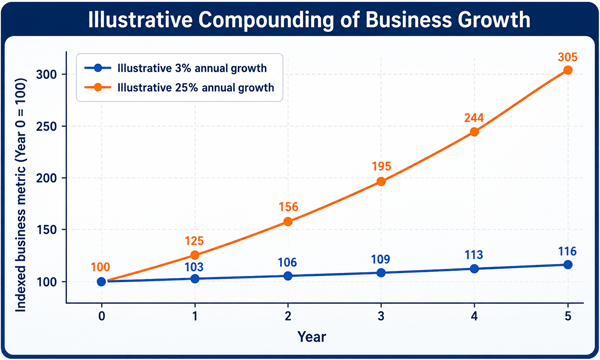
Figure 1. Illustrative compounding effect of stronger business growth. Indexed values show business growth only and do not represent or promise investment returns.
2. How Growth Investing Works
Growth investing works because stock prices tend to follow business performance over long periods, although not in a straight line. When a company grows revenue, improves profit margins, expands into new markets, and reinvests wisely, investors may become willing to pay more for each share. That combination of business growth and investor confidence can push the stock price higher.
However, the market does not reward growth automatically. A company can grow revenue but still destroy shareholder value if it spends too much, takes on excessive debt, issues too many new shares, or competes in a market where profits never appear. Beginner investors should learn to separate real business growth from hype.
| Growth driver | What it means | Practical example |
|---|---|---|
| Revenue growth | Sales are increasing because more customers are buying, existing customers are spending more, or the company is entering new markets. | A software company grows annual recurring revenue from $500 million to $700 million. |
| Earnings growth | Profit grows as the business scales. | A retailer improves logistics, so profit grows faster than sales. |
| Cash-flow growth | The business generates more cash after expenses and reinvestment needs. | A subscription company collects cash upfront and keeps churn low. |
| Multiple expansion | Investors pay a higher valuation because future growth looks more reliable. | A stock moves from 25x earnings to 35x earnings as confidence improves. |
| Reinvestment | The company uses profits to build new products, hire talent, acquire customers, or expand globally. | An e-commerce platform reinvests in fulfillment and advertising to win market share. |
3. Why Investors Like Growth Stocks
People are attracted to growth investing because the biggest long-term stock market winners often looked expensive early in their journey. A great growth company can compound for many years as its market expands. This is why investors study companies in technology, healthcare innovation, digital payments, artificial intelligence, cybersecurity, cloud computing, consumer brands, and other areas where demand can rise quickly.
From real investor experience, the appeal is emotional as well as financial. Growth stocks are exciting. They often have clear stories: a founder-led company, a breakthrough product, a new industry, or a service people use every day. But that excitement can become dangerous if investors confuse a good story with a good investment.
- Growth stocks can produce strong returns when business results keep improving for years.
- They can help a portfolio participate in innovation and economic change.
- They are often easier for beginners to understand at the product level because many are familiar brands or apps.
- They can fall sharply when expectations, interest rates, earnings, or investor sentiment change.
4. Growth Investing vs. Value Investing
Growth investing and value investing are not enemies. They are different ways to answer the same question: 'Is this stock worth buying today?' Growth investors focus on future expansion. Value investors focus on buying assets, earnings, or cash flows at a discount to what they believe the business is worth.
| Factor | Growth investing | Value investing |
|---|---|---|
| Main question | How fast can this company grow? | Is this company cheaper than its true value? |
| Typical company | Fast-growing, innovative, often reinvesting heavily | Mature, overlooked, cyclical, or temporarily unpopular |
| Dividend profile | Often low or no dividend | May pay dividends, but not always |
| Valuation | Often higher P/E, P/S, or EV/sales | Often lower valuation multiples |
| Main risk | Paying too much for growth that disappoints | Buying a cheap stock that stays cheap or declines |
| Best fit | Long time horizon, higher risk tolerance | Patient investors who like margin of safety |
A smart beginner does not need to choose only one style. Many successful portfolios blend growth stocks, value stocks, index funds, ETFs, and cash reserves depending on goals and risk tolerance.
5. What Makes a Good Growth Stock?
A good growth stock is not simply a company with a rising share price. It is a business with evidence that growth can continue and eventually translate into durable shareholder value.
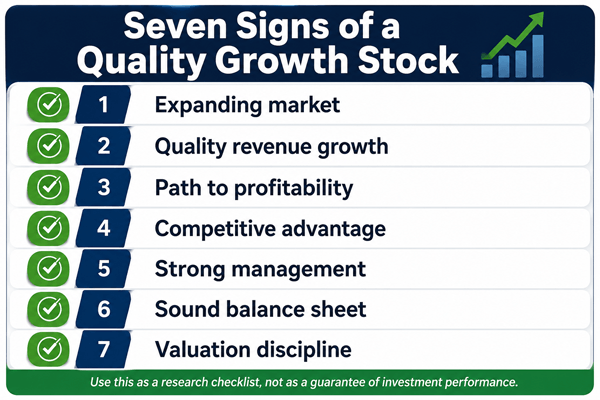
Figure 2. Beginner checklist for evaluating growth stocks.
| Quality | Why it matters | What to check |
|---|---|---|
| Large or expanding market | The company has room to grow for many years. | Total addressable market, industry reports, customer adoption trends |
| Revenue growth with quality | Sales are growing because demand is real, not only because of discounts. | Revenue growth rate, customer retention, recurring revenue, pricing power |
| Path to profitability | Even if profits are low today, management can explain how margins improve. | Gross margin, operating margin trend, free cash flow |
| Competitive advantage | The company has something competitors cannot easily copy. | Brand, network effects, patents, data, switching costs, scale |
| Strong management | Leaders allocate capital well and communicate honestly. | Founder ownership, insider ownership, clear targets, consistent execution |
| Reasonable balance sheet | Growth is not built on dangerous debt. | Debt-to-equity, interest coverage, cash reserves |
| Valuation discipline | The stock price leaves room for mistakes. | P/E, P/S, EV/sales compared with growth rate and peers |
6. Key Metrics Beginners Should Know
You do not need to become a Wall Street analyst to start learning growth investing, but you should understand a few numbers. These metrics help you avoid buying purely on hype.
| Metric | Meaning | How beginners can use it |
|---|---|---|
| Revenue growth | How quickly sales are growing. | Strong growth can show customer demand, but growth should be sustainable. |
| Earnings per share (EPS) | Profit per share. | Rising EPS often supports long-term stock price growth. |
| Gross margin | Profit after direct costs. | High or improving gross margins may show pricing power or scalable economics. |
| Operating margin | Profit after operating expenses. | Shows whether the company can turn growth into real profitability. |
| Free cash flow | Cash left after operating costs and capital spending. | A business that grows cash flow has more flexibility. |
| P/E ratio | Price divided by earnings. | Useful for profitable growth companies; high P/E needs strong future growth. |
| P/S ratio | Price divided by sales. | Useful for early-stage companies, but dangerous if margins never improve. |
| PEG ratio | P/E divided by expected earnings growth. | A rough tool to compare valuation with growth; estimates can be wrong. |
| Share dilution | Increase in shares outstanding. | Too much dilution can reduce each shareholder’s claim on future profits. |
7. Practical Example: Comparing Two Growth Stocks
Imagine you are comparing two fictional companies in the same industry. Both are called growth stocks by investors, but their quality is different.
| Factor | Company A | Company B |
|---|---|---|
| Revenue growth | 28% | 35% |
| Gross margin | 72% | 38% |
| Free cash flow | Positive and growing | Negative and worsening |
| Debt level | Low | High |
| Customer retention | Strong | Weak |
| Valuation | 12x sales | 10x sales |
| Beginner interpretation | Slower top-line growth, but much higher quality | Faster growth, but riskier business model |
A beginner might first be attracted to Company B because its revenue growth is higher and its valuation looks slightly lower. But Company A may be the better long-term growth investment because its margins, cash flow, balance sheet, and customer retention are stronger. This is a key lesson: the best growth stock is not always the one growing fastest today.
8. Risks of Growth Investing
Growth investing can be rewarding, but it is not safe or guaranteed. Growth stocks often trade at higher valuations because investors expect strong future results. When those expectations are disappointed, the stock can fall quickly.
| Risk | What can go wrong | Practical protection |
|---|---|---|
| Valuation risk | The company does well, but the stock still falls because it was too expensive. | Compare valuation with realistic growth, not best-case growth. |
| Execution risk | Management fails to deliver promised growth. | Track quarterly results, margins, and guidance changes. |
| Competition risk | A rival copies the product or cuts prices. | Look for durable competitive advantages. |
| Interest-rate risk | Higher rates can reduce the value investors place on future earnings. | Avoid overconcentration in expensive long-duration stocks. |
| Hype risk | Investors buy a theme instead of a business. | Read financial statements and avoid buying only because of social media. |
| Portfolio risk | Too much money is placed in one stock or sector. | Use position sizing and diversification. |
Beginner mistake to avoid
Do not buy a growth stock just because the price has already gone up. Price momentum can continue, but it can also reverse sharply. First ask whether business results justify the valuation.
9. How Beginners Can Use Growth Investing
The safest way for many beginners to use growth investing is not to put all their money into a few exciting stocks. A more balanced approach is to build a diversified core first, then add selected growth exposure as a smaller part of the portfolio.
| Investor type | Possible approach | Illustrative allocation only |
|---|---|---|
| Conservative beginner | Mostly broad index funds or diversified ETFs; small growth allocation. | 80-90% diversified funds, 10-20% growth stocks or growth ETF |
| Balanced long-term investor | Core index funds plus selected high-quality growth companies. | 60-75% diversified funds, 25-40% growth exposure |
| Aggressive investor | Higher growth allocation, but still diversified and risk-controlled. | 40-60% diversified funds, 40-60% growth exposure |
10. A Step-by-Step Growth Investing Process
- Start with your goal. Decide whether you are investing for retirement, wealth building, education, a home purchase, or general long-term growth.
- Set your time horizon. Growth investing usually works best with a multi-year time frame because short-term prices can be unpredictable.
- Build a watchlist. Look for companies with strong revenue growth, expanding markets, competitive advantages, and improving financials.
- Read the latest annual report and quarterly report. Focus on revenue growth, margins, cash flow, debt, share dilution, and management commentary.
- Compare valuation with growth. A great company can still be a poor investment if the stock price already assumes perfect execution.
- Decide position size before buying. Beginners often keep individual stocks small so one mistake does not damage the entire portfolio.
- Write down your investment thesis. Explain in plain English why you are buying, what could go wrong, and what would make you sell.
- Review regularly, not emotionally. Check business results, not daily price moves.
10.1 Simple Growth Stock Thesis Template
| Thesis section | Question to answer |
|---|---|
| Business | What does the company sell, and who buys it? |
| Growth engine | Why can revenue and earnings grow for years? |
| Moat | What protects the company from competitors? |
| Financial quality | Are margins, cash flow, and balance sheet improving? |
| Valuation | What future growth is already priced into the stock? |
| Risks | What could break the thesis? |
| Sell rules | What facts would make you reduce or sell the position? |
11. Growth Stocks vs. Growth ETFs
Beginners do not have to pick individual growth stocks. Growth ETFs and growth mutual funds can provide diversified exposure to many growth companies in one investment. This can reduce company-specific risk, although it does not remove market risk.
| Option | Potential benefit | Potential drawback |
|---|---|---|
| Individual growth stocks | More control; potential for higher returns if you choose well. | Higher research burden; higher risk from single-company mistakes. |
| Growth ETFs | Instant diversification; easier for beginners; lower research burden. | Less control; can still be concentrated in popular sectors; fees vary. |
| Index funds | Broad market exposure; simple; often low cost. | May include slower-growth companies; less targeted growth exposure. |
| Actively managed growth funds | Professional portfolio management. | Higher fees; manager may underperform; style can drift. |
12. When Should You Buy a Growth Stock?
There is no perfect entry price, but beginners can improve their process by avoiding emotional buying. Consider buying only when you can clearly explain the business, the growth opportunity, the valuation, and the risk. Some investors use dollar-cost averaging, which means investing a fixed amount over time instead of trying to guess the perfect day.
- Consider buying when the company is growing revenue and profits, not just telling a good story.
- Look for temporary market fear that does not damage the long-term business thesis.
- Avoid buying after a huge price jump unless the business results truly justify the move.
- Do not use money you need soon. Stock investing for short-term goals can be risky because prices fluctuate.
13. When Should You Sell a Growth Stock?
Selling is often harder than buying. Growth investors can become attached to their winners or refuse to admit when the thesis has changed. A practical sell decision should be based on facts, not embarrassment, greed, or panic.
| Sell reason | What it means |
|---|---|
| The thesis is broken | Growth slows for structural reasons, not just one weak quarter. |
| Valuation becomes extreme | The stock price assumes unrealistic future success. |
| Better opportunity exists | You find a stronger business with a better risk-reward profile. |
| Position becomes too large | A winner grows into an unsafe percentage of your portfolio. |
| Management quality declines | Accounting concerns, poor capital allocation, or misleading communication appear. |
14. Lessons from Real Investor Experience
Investors who have lived through bull markets and bear markets often learn the same lessons. First, growth investing feels easiest near market tops, when every exciting company seems to be winning. Second, it feels hardest during downturns, when even strong companies can fall sharply. Third, the investor's behavior often matters as much as stock selection.
- The story is not enough. A popular product does not automatically mean a profitable investment.
- Quality matters more during downturns. Companies with cash, high margins, and loyal customers usually have more staying power.
- Valuation still matters. Even excellent businesses can disappoint investors who pay too much.
- Diversification prevents one bad decision from becoming a financial disaster.
- Patience works only when the thesis remains strong. Holding blindly is not the same as long-term investing.
15. Example: Why Valuation Matters Even for a Great Company
Suppose a company earns $1 per share today and grows earnings 25% per year for five years. Earnings would rise to about $3.05 per share. That is excellent business growth. But if investors paid 80x earnings at the start and the market later values the company at 30x earnings, the stock may rise much less than the business, or even disappoint, despite strong operating performance.
| Item | Illustration |
|---|---|
| Starting EPS | $1.00 |
| Annual EPS growth | 25% |
| EPS after 5 years | About $3.05 |
| Starting P/E | 80x |
| Starting stock price | $80 |
| Ending P/E | 30x |
| Ending stock price | About $91.50 |
| Lesson | The business grew strongly, but valuation compression limited the stock return. |
16. Beginner Checklist Before Buying a Growth Stock
- I understand how the company makes money.
- Revenue growth is strong and supported by real customer demand.
- Margins or cash flow are stable or improving, or there is a believable path to improvement.
- Debt and share dilution are not excessive.
- The company has a competitive advantage that may last.
- The valuation is reasonable compared with realistic future growth.
- I know the main risks and what could break my thesis.
- The position size is small enough that I can handle a large decline.
- This investment fits my broader portfolio, not just my excitement about one stock.
- I am not buying because of fear of missing out, social media hype, or a short-term price spike.
17. Frequently Asked Questions About Growth Investing
17.1 Is growth investing good for beginners?
It can be, but only if beginners use risk controls. A diversified growth ETF may be easier than choosing individual stocks. Beginners should avoid putting too much money into one company or one theme.
17.2 Are growth stocks risky?
Yes. Growth stocks can be volatile because their prices depend heavily on future expectations. If growth slows, interest rates rise, or valuations fall, the stock can decline sharply.
17.3 Do growth stocks pay dividends?
Many growth stocks pay little or no dividend because they reinvest cash into expansion. Some mature growth companies may eventually pay dividends, but income is usually not the main goal.
17.4 What is the difference between growth investing and day trading?
Growth investing focuses on long-term business growth over years. Day trading focuses on short-term price movements. They require different skills, risk controls, and mindsets.
17.5 Can I use growth investing in a retirement account?
Many investors use growth exposure in retirement accounts through stocks, mutual funds, or ETFs. The right amount depends on age, risk tolerance, time horizon, and overall retirement plan.
17.6 What is a growth ETF?
A growth ETF is an exchange-traded fund that holds a basket of growth-oriented stocks. It can offer diversified exposure without requiring the investor to pick every stock individually.
17.7 How many growth stocks should a beginner own?
There is no universal number, but owning only one or two individual stocks is usually risky. Beginners often use diversified funds as a core and keep individual stocks as smaller satellite positions.
17.8 What is the biggest mistake in growth investing?
The biggest mistake is paying any price for an exciting story. A company can be excellent and still be a poor investment if the valuation is unrealistic.
18. Final Thoughts: Growth Investing in One Sentence
Growth investing is the search for companies that can become much bigger and more profitable over time, but the strategy only works well when investors combine optimism with discipline, valuation awareness, diversification, and honest risk management.
For beginners, the best approach is simple: learn the business, check the numbers, respect valuation, size positions carefully, and never confuse a popular stock with a safe investment.
Sources Consulted and Checked
The following sources were consulted and checked while preparing this article and reviewing its accuracy:
- U.S. SEC Investor.gov, Introduction to Investing: compound growth and investor education basics. Accessed June 23, 2026.
- U.S. SEC Investor.gov, Stocks FAQ: definition of growth stocks as companies with earnings growing faster than the market average, usually paying little or no dividends. Accessed June 23, 2026.
- FINRA, Risk: all investments carry risk; stocks, bonds, mutual funds, and ETFs can lose value if market conditions sour. Accessed June 23, 2026.
- FINRA, Stocks: stock prices fluctuate and investing in stocks for short-term goals can be risky due to volatility. Accessed June 23, 2026.
- FINRA Investor Education Foundation, How Consumers Think About Investment Risk, December 2024: many consumers understand risk generally, but fewer recognize risk-mitigation strategies. Accessed June 23, 2026.
Reader Advice
This article is provided solely for educational and general information purposes. It does not constitute personalized financial, investment, tax, or legal advice, and it does not recommend any particular stock, fund, allocation, or strategy. Growth stocks and other investments can rise or fall sharply, and investors may lose some or all of the money invested. The allocations and fictional examples in this article are illustrations only, not recommendations or forecasts.
Before making any decision, readers should consider their goals, time horizon, risk tolerance, income stability, emergency savings, debt, tax circumstances, diversification needs, and ability to withstand losses. Where appropriate, obtain advice from a qualified and properly licensed financial, tax, or legal professional who understands your circumstances.
Market conditions, interest rates, company information, laws, tax rules, regulations, product features, fees, and official guidance can change. Readers should verify current facts, figures, filings, costs, eligibility requirements, and rules directly from official regulators, fund providers, company filings, and other authoritative sources before acting. Past performance and illustrative growth rates do not guarantee future results.