Best Mid-Cap Growth Stocks to Watch in 2026
1. Quick Answer
Mid-cap growth stocks are shares of companies that are no longer tiny start-ups but are still small enough to grow faster than many mature mega-cap stocks. In practical U.S. investing, many investors think of mid-caps as roughly $2 billion to $10 billion in market value, but some indexes and market conditions push the range higher. The real idea is simple: these are businesses in the middle stage of their public-company life cycle.
For 2026, the most interesting mid-cap growth themes include AI infrastructure, data-center cooling, semiconductor equipment, specialty healthcare, fast-casual restaurants, beauty, fitness drinks, and niche industrial technology. The stocks below are watchlist candidates, not automatic buys. A good investor still checks valuation, earnings quality, debt, insider behavior, competition, and whether the stock price already assumes perfect execution.
2. What Is a Mid-Cap Growth Stock?
Market capitalization, or market cap, means the stock market value of a company. The formula is easy: share price multiplied by shares outstanding. FINRA explains that market cap is a quick gauge of where a company stands in its business development process and how volatile it may be compared with smaller or larger companies.
A growth stock is a company expected to increase revenue, earnings, cash flow, or market share faster than the average business. Growth investors are usually not buying because the stock looks statistically cheap today. They are buying because they believe the business can become much larger over time.
| Type | Simple meaning | Typical beginner takeaway |
|---|---|---|
| Small-cap | Earlier-stage public company | Higher potential upside, but often higher business and liquidity risk |
| Mid-cap | Established but still expanding | A possible balance between growth potential and business maturity |
| Large-cap | Big, widely followed company | Often more stable, but the fastest growth years may be behind it |
2.1 Why mid-caps can be attractive in 2026
- Many mid-cap companies are focused enough to benefit strongly from one powerful trend, such as AI data centers or medical innovation.
- They may still be under-followed compared with mega-cap technology stocks, creating more room for discovery by institutional investors.
- Good mid-caps can be acquisition targets for larger companies that want growth, technology, brands, or distribution.
- The best mid-caps often already have revenue, customers, and public financial statements, which makes research easier than with early-stage private businesses.
3. The 2026 Mid-Cap Growth Watchlist
The following list is built for research. It favors companies with visible growth drivers, real products, and current 2026 catalysts. Market caps are approximate and can change quickly with stock prices. Always verify live data in your brokerage account or financial data platform before making decisions.
| Stock | Ticker | Theme | Approx. market cap, June 2026 | Why beginners may watch it | Main risk |
|---|---|---|---|---|---|
| DigitalOcean | DOCN | AI-native cloud for developers and smaller businesses | ~$18.6B | Q1 2026 revenue grew 22%; AI customer ARR grew 221%; management raised 2026/2027 outlook | High valuation and intense cloud competition |
| Modine Manufacturing | MOD | Data-center cooling and thermal management | ~$15.4B | AI data centers need cooling; company signed a major long-term capacity agreement and data-center demand is accelerating | Execution risk, customer concentration, cyclicality |
| Onto Innovation | ONTO | Semiconductor inspection and metrology | ~$17.3B | Expected 2026 revenue growth above 30% from advanced packaging and semiconductor demand | Semiconductor cycle risk and premium valuation |
| CAVA Group | CAVA | Fast-casual restaurant expansion | ~$9.7B | Q1 2026 revenue grew 32.2%; same-restaurant sales rose 9.7%; store base is still expanding | Restaurant valuation risk, food/labor costs |
| TransMedics | TMDX | Organ transplant technology and logistics | ~$2.8B | Q1 2026 revenue rose 21%; niche platform with life-saving use case | Regulatory, reimbursement, and margin pressure |
| Celsius Holdings | CELH | Functional energy drinks | ~$7.6B | Brand awareness and distribution can support long-term category growth | Consumer demand swings and beverage competition |
| e.l.f. Beauty | ELF | Value beauty and skincare | ~$3.8B | Affordable beauty positioning, social media strength, and Rhode expansion potential | Consumer slowdown, tariffs, acquisition integration |
| Allegro MicroSystems | ALGM | Automotive and industrial chips | ~$11.8B | Exposure to electrification, sensors, and industrial automation | Auto cycle weakness and chip inventory cycles |
Practical note: Some investors define mid-cap strictly as $2 billion to $10 billion. Others use broader “SMID” or index-based ranges. A company near $15 billion to $20 billion may be called upper mid-cap by one analyst and small large-cap by another. For reader usefulness, this article treats the watchlist as mid-cap/upper-mid-cap growth candidates rather than a rigid label.
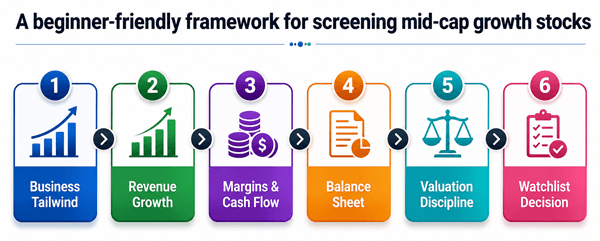
4. How to Research a Mid-Cap Growth Stock Step by Step
4.1 Start with the business, not the stock chart
A beginner mistake is asking, “Will the stock go up next week?” A better first question is, “What does this company sell, who buys it, and why should demand grow?” For example, Modine is interesting because AI data centers require advanced cooling. DigitalOcean is interesting because developers and smaller companies want simpler cloud infrastructure for AI and software workloads. CAVA is interesting because it is still opening restaurants while maintaining strong unit economics.
4.2 Check revenue growth and whether it is organic
Revenue growth is the oxygen of growth investing. But not all growth is equal. A company can grow because customers are buying more, because it raised prices, because it opened new locations, or because it acquired another company. Organic growth is usually higher quality than growth bought through expensive acquisitions.
| Question | Why it matters | Beginner example |
|---|---|---|
| Is revenue growing above 15-20%? | Shows demand is expanding | DigitalOcean Q1 2026 revenue grew 22% year over year |
| Is growth coming from real customers? | Avoids accounting-only stories | CAVA same-restaurant sales rose 9.7%, including traffic growth |
| Is management raising guidance? | Suggests demand is better than expected | DigitalOcean raised 2026 and 2027 revenue outlook |
| Are margins improving? | Growth should eventually become profit | Watch TransMedics margins because spending is rising |
4.3 Study margins and cash flow
A stock can look exciting because sales are rising, but the business may still be burning cash. Beginners should learn the difference between revenue growth and profitable growth. A high-quality mid-cap usually shows at least one of these patterns: positive free cash flow, improving operating margin, strong gross margin, or clear evidence that losses are shrinking as scale improves.
4.4 Look at the balance sheet
Debt is not automatically bad, but high debt can become dangerous when interest rates are high or revenue slows. For mid-cap growth stocks, a strong balance sheet gives management options. It can fund expansion, survive a downturn, and avoid selling new shares at a bad price.
4.5 Do not ignore valuation
A great company can still be a poor investment if the entry price is too high. In 2026, many AI-related and growth stocks already price in strong future results. Beginners should compare price-to-sales, forward P/E, free-cash-flow yield, and growth rate. The key question is not “Is this company good?” It is “How much future success is already priced into the stock?”
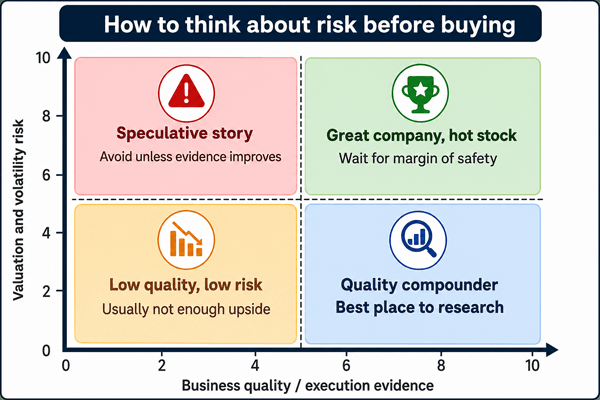
5. Focused Stock Notes: What to Watch in 2026
5.1 DigitalOcean (DOCN): AI cloud without mega-cap complexity
DigitalOcean serves developers, start-ups, and small to mid-sized businesses that want cloud tools without the complexity of the largest hyperscale platforms. In Q1 2026, the company reported $258 million of revenue, up 22% year over year, and AI customer ARR rose 221% to $170 million. That makes it a clear AI infrastructure watchlist name.
What to watch: AI customer ARR, gross margin, data-center capacity, customer retention, and whether 2027 growth above 50% becomes realistic or overly ambitious. The risk is that the stock can move sharply if AI demand disappoints or if larger cloud providers cut pricing.
5.2 Modine Manufacturing (MOD): the picks-and-shovels AI cooling play
Modine is not a flashy software company. Its appeal is practical: AI data centers create heat, and heat requires engineered cooling. In 2026, investors have focused on Modine because its data-center cooling business is becoming a much larger part of the story. The company has reported strong Climate Solutions momentum and a major long-term capacity agreement tied to hyperscale data-center demand.
What to watch: data-center revenue growth, backlog quality, factory expansion, customer concentration, and whether margins remain healthy as Modine scales production.
5.3 Onto Innovation (ONTO): advanced semiconductor manufacturing tools
Onto Innovation provides process control, inspection, and metrology tools used in semiconductor manufacturing. This is a “behind the scenes” AI and chip infrastructure idea. If advanced packaging, memory, and semiconductor complexity keep rising, companies that help manufacturers improve yield can benefit.
What to watch: order trends, exposure to advanced packaging, China and export-control risk, and whether expected 2026 revenue growth above 30% translates into earnings and cash flow.
5.4 CAVA Group (CAVA): restaurant growth with premium fast-casual demand
CAVA is a restaurant growth story. The company reported Q1 2026 revenue growth of 32.2%, same-restaurant sales growth of 9.7%, and 20 net new restaurant openings in the quarter. The key attraction is simple: if a restaurant concept can keep opening profitable locations while keeping customer traffic strong, the business can compound for years.
What to watch: same-restaurant sales, new-store productivity, labor costs, food costs, digital mix, and whether valuation already assumes flawless expansion.
5.5 TransMedics (TMDX): healthcare technology with a real-world mission
TransMedics develops organ transplant technology and logistics built around its Organ Care System. In Q1 2026, revenue increased 21% year over year to $173.9 million. The business is compelling because it targets a serious medical bottleneck: preserving and transporting donor organs more effectively.
What to watch: liver and heart procedure growth, reimbursement, regulatory scrutiny, logistics costs, operating margin, and whether hospital adoption remains strong.
5.6 Celsius Holdings (CELH): brand growth in functional beverages
Celsius is a consumer growth stock tied to energy drinks, fitness, and convenience-store distribution. It can be attractive when sales velocity, shelf space, and repeat purchasing are improving. However, beverage stocks can be volatile because trends shift quickly and distribution partnerships matter a lot.
What to watch: scanner data, category share, international expansion, gross margin, promotional spending, and competition from Monster, Red Bull, and private-label drinks.
5.7 e.l.f. Beauty (ELF): affordable beauty with social-media power
e.l.f. Beauty built a strong position by offering affordable cosmetics and skincare with effective digital marketing. For 2026, the practical question is whether value beauty can keep winning while the company integrates Rhode and manages consumer price sensitivity.
What to watch: sales growth excluding acquisitions, retail shelf productivity, gross margin, inventory, tariff effects, and whether lower pricing supports loyalty without hurting profitability.
5.8 Allegro MicroSystems (ALGM): sensors and chips for electrification
Allegro makes semiconductor products used in automotive, industrial, and power applications. It is a cyclical growth idea: long-term demand for electrification and automation can be attractive, but near-term auto and inventory cycles can pressure results.
What to watch: design wins, electric-vehicle and hybrid exposure, industrial demand, inventory normalization, and gross margin recovery.
6. Beginner Checklist Before Buying Any Mid-Cap Growth Stock
| Checklist item | Green flag | Red flag |
|---|---|---|
| Business model | You can explain how the company makes money in one sentence | You only understand the hype, not the revenue source |
| Revenue growth | Growth is broad, recurring, or supported by customer demand | Growth comes mainly from one-time price increases or acquisitions |
| Margins | Gross margin is stable and operating leverage is visible | Expenses rise faster than revenue without explanation |
| Balance sheet | Cash and debt look manageable | Debt is high and refinancing risk is unclear |
| Valuation | Price is reasonable relative to growth and margins | Stock requires perfect execution for years |
| Management | Guidance is realistic and communication is clear | Frequent surprises, vague metrics, or aggressive promotion |
| Risk control | Position size fits your portfolio | One stock becomes a life-changing bet |
7. How Beginners Can Use This Watchlist
Use this list as a research starting point, not as a shopping list. A practical beginner process looks like this:
- Open each company investor-relations page and read the latest earnings release.
- Write a one-sentence business summary in your own words.
- Check three numbers: revenue growth, operating margin, and debt/cash position.
- Compare valuation with at least two competitors or peers.
- Add the stock to a watchlist with a target research price, not an emotional buy price.
- Review the thesis after each quarterly earnings report.
7.1 Example: how a beginner might research CAVA
A beginner should not buy CAVA just because “everyone likes the restaurant.” Instead, research the unit economics. Ask: How many restaurants does it have? How many can it open? Are existing restaurants still growing sales? Are customers visiting more often, or is revenue only rising because prices went up? In Q1 2026, CAVA reported 459 restaurants, 20 net new openings, 9.7% same-restaurant sales growth, and 6.8% guest traffic growth. Those details help separate a real growth story from a simple popularity story.
7.2 Example: how a beginner might research DigitalOcean
For DigitalOcean, the thesis is not “AI is hot.” The thesis is that many developers and businesses need simpler AI-native cloud infrastructure. The beginner should track ARR, AI customer ARR, capacity expansion, margins, and whether the company can compete against Amazon Web Services, Microsoft Azure, and Google Cloud without sacrificing profitability.
8. Common Mistakes to Avoid
- Chasing a stock after a huge one-day move without reading the earnings report.
- Confusing a good product with a good stock price.
- Putting too much money into one speculative company.
- Ignoring dilution from stock-based compensation or secondary offerings.
- Using social media excitement as a substitute for financial statements.
- Buying only AI-related stocks and calling it diversification.
- Selling a quality business because of normal quarterly volatility, or holding a broken thesis because of pride.
9. Mid-Cap Growth Stocks vs. ETFs
| Approach | Best for | Pros | Cons |
|---|---|---|---|
| Individual mid-cap growth stocks | Investors willing to research companies | Higher upside if you choose well; more control | Single-stock risk; requires time and discipline |
| Mid-cap ETF | Beginners wanting broad exposure | Instant diversification; lower research burden | Less upside from one winner; still market risk |
| Hybrid approach | Most practical beginners | Core ETF plus a small watchlist of researched stocks | Requires rules for position sizing and rebalancing |
A sensible beginner approach is often a core diversified portfolio first, then a smaller satellite allocation for individual growth stocks. The SEC’s investor education material emphasizes diversification as a way to reduce risk by spreading money among different investments. That does not eliminate risk, but it can reduce the damage from one bad pick.
10. Risk Management: The Part Most Articles Skip
Mid-cap growth investing can be rewarding, but it is not gentle. A company can beat revenue estimates and still fall if margins disappoint. A stock can drop 30% because guidance is slightly weaker than expected. A high-valuation stock can be punished even when the business is still growing.
10.1 Practical position-sizing rule
For beginners, a single mid-cap growth stock should usually be small enough that a 30-50% decline would be painful but not financially damaging. Many investors use 2-5% of a portfolio as a maximum for one higher-risk growth stock, but the right size depends on age, income, emergency savings, goals, and risk tolerance.
10.2 When to reconsider the thesis
- Revenue growth slows for reasons that are not temporary.
- Customer demand weakens while management keeps blaming “timing.”
- Margins deteriorate for several quarters without a credible plan.
- Debt rises sharply or cash flow turns negative unexpectedly.
- The original growth driver becomes less important or more competitive.
- The stock valuation rises so much that future returns depend on perfection.
11. Final Verdict: Best Mid-Cap Growth Stocks to Watch in 2026
The best mid-cap growth stocks for 2026 are not necessarily the ones with the loudest headlines. They are the companies where growth is visible, the business model is understandable, management is executing, and valuation still leaves room for mistakes. DigitalOcean, Modine, Onto Innovation, CAVA, TransMedics, Celsius, e.l.f. Beauty, and Allegro MicroSystems each offer a different way to study growth: cloud software, AI infrastructure, chips, restaurants, healthcare, consumer brands, beauty, and electrification.
For a beginner, the winning habit is not predicting the next 10-bagger. The winning habit is building a repeatable process: understand the business, check the numbers, respect valuation, manage risk, and keep learning from every earnings report.
12. FAQs
12.1 Are mid-cap growth stocks safe?
No stock category is completely safe. Mid-cap growth stocks can be less fragile than many small caps, but they can still be volatile. Their prices often depend on future expectations, so any slowdown can cause sharp declines.
12.2 How many mid-cap growth stocks should a beginner own?
There is no universal number. Many beginners are better served by a diversified ETF as a core holding and a smaller number of individual stocks for learning and targeted exposure.
12.3 What is the best metric for growth stocks?
There is no single best metric. Revenue growth, gross margin, operating margin, free cash flow, net retention, same-store sales, unit growth, and valuation all matter. The right metric depends on the business model.
12.4 Should I buy these stocks now?
This article is a research guide, not a buy list. Before buying, compare the current stock price with your estimate of fair value, read the latest filings, and consider speaking with a licensed financial advisor.
Sources Consulted and Checked
The following sources were consulted and checked while preparing this article and reviewing its accuracy. Readers should verify time-sensitive facts, market data, company results, and regulatory information from the latest official sources.
- FINRA investor education: market capitalization, company size, volatility, and diversification concepts.
- U.S. Securities and Exchange Commission investor education: asset allocation and diversification.
- S&P Dow Jones Indices: S&P MidCap 400 benchmark description.
- DigitalOcean Q1 2026 financial results, May 5, 2026.
- CAVA Group Q1 2026 earnings release, May 19, 2026.
- TransMedics Q1 2026 financial results, May 5, 2026.
- Modine Manufacturing investor materials and 2026 data-center cooling coverage.
- Onto Innovation 2026 revenue-growth coverage and investor information.
- Current market-cap snapshots used for watchlist context were checked on June 22-23, 2026 and can change quickly.
Reader Advice
This article is provided solely for general educational and informational purposes. It does not constitute tax, legal, accounting, investment, or financial advice, and it should not be relied upon as a substitute for advice based on your individual circumstances. Any mid-cap growth stocks or companies mentioned are presented for informational purposes only and should not be viewed as recommendations or endorsements to buy, sell, or hold any particular security. Stocks identified as ones to “watch” may not perform as expected, and all investments involve risk, including the possible loss of principal.
Tax treatment may vary according to account type, filing status, income, holding period, ETF structure, state or local law, and other factors. Rules, thresholds, forms, and official guidance may change over time. Before buying, selling, harvesting a loss, selecting an account, filing a return, or making any other decision, verify current information through the IRS, relevant state tax authorities, the ETF sponsor, and your brokerage records, and consult a qualified tax professional or other appropriately licensed adviser when needed.