How to Find Growth Stocks: Key Metrics and Strategies
1. Quick answer
To find growth stocks, look for companies that can grow revenue, earnings, and cash flow faster than the broader market for several years - but do not stop there. The best candidates usually combine a large market opportunity, rising sales, improving margins, strong customer retention, a healthy balance sheet, capable management, and a valuation that still leaves room for future returns. A fast-growing company can still be a bad investment if the stock price already assumes perfection.
1.1 A simple beginner rule:
Do not buy a stock only because its price is going up, its product is popular, or someone online says it is the next big thing. First ask: Is the business growing? Is the growth profitable or moving toward profitability? Is the balance sheet safe? Is the valuation reasonable compared with the company’s future potential? What could prove my thesis wrong?
2. What is a growth stock?
A growth stock is a share of a company that investors expect to grow faster than the average company in the market. Growth can come from rising revenue, expanding profits, entering new markets, launching new products, gaining market share, or turning a small business model into a much larger one.
In plain English, a growth stock is a business where investors are paying today for what they believe the company can become tomorrow. That is why growth stocks often look expensive based on current earnings. Investors may accept a high price-to-earnings ratio if they believe future earnings will grow fast enough to justify it.
But this is also the danger. Growth investing works only when the future growth is real, durable, and not already fully priced into the stock.
| Type of stock | What investors usually expect | Common signs | Main risk |
|---|---|---|---|
| Growth stock | Fast future growth in sales, earnings, cash flow, or users | High revenue growth, expanding market, reinvestment, premium valuation | Expectations are too high; stock falls if growth slows |
| Value stock | Market has underpriced the business compared with current fundamentals | Lower P/E, price-to-book, or price-to-cash-flow ratios | Cheap stock may stay cheap because the business is weak |
| Dividend/income stock | Regular cash income from dividends | Stable cash flows, mature business, dividend history | Lower growth; dividend may be cut if profits weaken |
| Speculative stock | Big potential but uncertain business quality | Early-stage product, high hype, little profit visibility | Permanent loss if the business model fails |
3. How growth stock investing works
Growth stock investing is based on compounding. If a company can increase revenue and profits at high rates for many years, the value of the business can rise dramatically. A company that earns $1 billion today and can become a $5 billion earnings business in the future may deserve a higher valuation than a slow-growth company.
However, stock returns do not come only from business growth. They come from the relationship between business performance and investor expectations. A company can grow revenue by 30% and still disappoint investors if the market expected 50%. This is why experienced growth investors focus on both the company and the price paid.
3.1 The growth-stock screening funnel
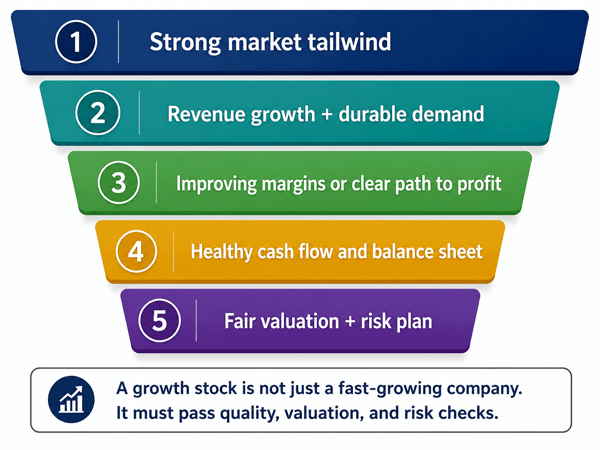
Figure 1: A practical screening funnel for separating durable growth from hype.
4. The beginner’s mindset: business first, stock second
Many beginners start by looking at stock charts, trending tickers, or analyst price targets. A better approach is to think like a part-owner of a business. Before asking whether the stock will rise next week, ask whether the company can become larger, stronger, and more profitable over the next three to five years.
A practical growth investor usually wants to answer five questions:
- What problem does this company solve, and is demand growing?
- Can the company keep growing without constantly spending more than it earns?
- Does it have a competitive advantage that protects margins?
- Is management allocating capital wisely?
- Is the current stock price reasonable compared with realistic future outcomes?
5. Key metrics to find growth stocks
No single metric can identify a great growth stock. Metrics are clues. You use them together to build a picture of business quality, growth durability, and valuation risk.
| Metric | What it tells you | Healthy sign | Beginner warning sign |
|---|---|---|---|
| Revenue growth | Whether customer demand is expanding | Consistent double-digit growth, especially above industry average | One-time jump from acquisition, price increases, or temporary demand spike |
| Gross margin | How much money remains after direct costs | Stable or rising margin, especially in software, platforms, or branded products | Falling margin may show competition or discounting |
| Operating margin | Whether the business model can become profitable at scale | Improving margin as revenue grows | Revenue grows but losses widen every year |
| Free cash flow | Cash left after operating costs and capital spending | Positive or improving free cash flow | Accounting profit but weak cash generation |
| Earnings growth | Whether profits are growing | Profits grow faster than revenue over time | Earnings depend on one-time gains or cost cuts only |
| Return on invested capital (ROIC) | How efficiently management uses capital | High and stable ROIC, or clear improvement | Growth requires heavy capital with low returns |
| Debt-to-equity / net debt | Balance sheet risk | Low debt or manageable debt relative to cash flow | High debt plus rising interest expense |
| PEG ratio | Valuation compared with expected earnings growth | Lower PEG may suggest valuation is more reasonable, but use estimates carefully | A low PEG based on unrealistic forecasts |
| Price-to-sales (P/S) | Valuation for companies with little profit yet | Reasonable compared with margin potential and peers | Very high P/S with slowing growth and no profit path |
5.1 Revenue growth: the starting point, not the finish line
Revenue growth shows whether more customers are buying, existing customers are spending more, or the company is entering new markets. For beginners, this is often the easiest metric to understand. If revenue grows from $1 billion to $1.25 billion, sales grew 25%.
But revenue growth needs context. A company can grow revenue by cutting prices, spending heavily on advertising, or buying another company. Those are not automatically bad, but they are different from organic growth driven by real customer demand.
Practical check: read the latest annual report and quarterly results. Look for management’s explanation of growth. Separate organic growth from acquisition-driven growth. Check whether growth is broad-based or dependent on one product, one customer, or one geography.
5.2 Gross margin: the quality of sales
Gross margin tells you how much of each dollar of revenue is left after direct production or service costs. If a company has 70% gross margin, it keeps 70 cents from each sales dollar before operating expenses. High gross margins often give a company more room to invest in product development, sales teams, and expansion.
For growth stocks, rising or stable gross margin is often a sign of pricing power, scale benefits, or a strong business model. Falling gross margin may show competition, discounting, higher input costs, or a product mix problem.
5.3 Operating margin: can growth become profit?
A company can grow fast and still lose money. That is not always a problem. Early-stage companies often spend aggressively to build products, acquire customers, and expand infrastructure. The key question is whether losses are narrowing as the company scales.
Look for operating leverage. This means revenue grows faster than operating expenses. For example, if revenue grows 30% but operating expenses grow 15%, the business may be becoming more profitable as it scales. If expenses keep growing faster than revenue, the company may be buying growth rather than building a durable engine.
5.4 Free cash flow: the reality check
Free cash flow is one of the most useful reality checks because it focuses on cash rather than accounting profit. A company with strong free cash flow can fund growth, survive downturns, buy back shares, pay down debt, or make acquisitions without constantly raising new capital.
CFA Institute notes that cash-flow-based measures can be less subject to manipulation than earnings measures, although every cash-flow approximation still has limitations. That is a good reminder: use cash flow as an important signal, not as a magic answer.
5.5 Earnings growth: growth that reaches shareholders
Revenue is important, but shareholders ultimately need profits and cash flow. Earnings growth shows whether sales growth is turning into bottom-line value. For mature growth companies, earnings growth should eventually become a major part of the investment case.
Be careful with “adjusted earnings.” Many companies report adjusted numbers that remove stock-based compensation, restructuring costs, or other expenses. Adjusted numbers can be useful, but always compare them with GAAP or IFRS earnings and free cash flow.
5.6 Valuation metrics: paying a smart price
Valuation is where many beginners make mistakes. A great company can be a poor investment if bought at a price that already assumes perfect execution. Useful valuation tools for growth stocks include P/E ratio, forward P/E, PEG ratio, price-to-sales, enterprise value to revenue, and enterprise value to free cash flow.
| Valuation tool | Best used for | How to interpret it carefully |
|---|---|---|
| P/E ratio | Profitable companies | A high P/E can be justified by high earnings growth, but it leaves less room for mistakes. |
| Forward P/E | Companies with visible earnings growth | Depends heavily on analyst forecasts, which can be wrong. |
| PEG ratio | Profitable growth companies | Compares P/E with expected earnings growth. Useful, but only as good as the growth estimate. |
| Price-to-sales | Unprofitable or early-stage companies | Must be compared with gross margin, future margin potential, and growth durability. |
| EV/revenue | Companies with different debt/cash levels | Better than P/S when balance sheets differ. |
| EV/free cash flow | Cash-generating growth companies | Helpful for mature growth companies; less useful when FCF is temporarily depressed by investment. |
6. A simple practical example
Imagine two companies in the same industry:
| Metric | Company A: Fast but fragile | Company B: Quality growth |
|---|---|---|
| Revenue growth | 45% | 25% |
| Gross margin | 38% and falling | 68% and stable |
| Operating margin | -22%, losses widening | 12%, improving |
| Free cash flow | Negative and worsening | Positive and growing |
| Debt | High debt, rising interest cost | Low debt, strong cash balance |
| Valuation | 12x sales | 8x sales |
| Beginner takeaway | High growth, but risky quality and valuation | Slower growth, but stronger business fundamentals |
Company A looks exciting because revenue is growing faster. But Company B may be the better growth stock because its growth is more profitable, more durable, and less financially risky. This is a common experience among investors: the highest revenue growth is not always the best investment.
6.1 Growth quality vs. valuation: the decision map
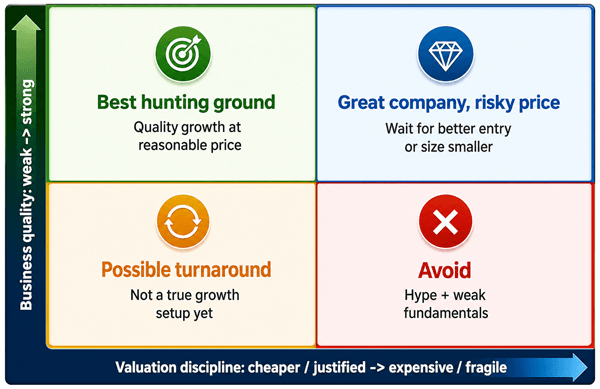
Figure 2: Strong growth investing is not about buying any fast-growing company. It is about balancing quality with valuation discipline.
7. How to screen for growth stocks step by step
A stock screener can help you reduce thousands of stocks into a smaller research list. It should not make the final decision for you. Think of screening as the first filter, then research as the real work.
7.1 Start with a market or industry you understand
Beginners often chase complicated companies because they sound impressive. A better starting point is a business model you can explain simply. For example: cloud software, digital payments, medical devices, cybersecurity, semiconductors, e-commerce, renewable energy infrastructure, or consumer brands. Understanding the industry helps you judge whether growth is real or just hype.
7.2 Use basic growth filters
| Screening filter | Beginner-friendly starting range | Why it helps |
|---|---|---|
| Revenue growth | 15%+ year over year, or clearly above industry average | Finds companies with real demand expansion |
| Gross margin | Stable or improving over 3 years | Shows pricing power or business-model strength |
| Operating margin | Positive or improving | Shows a path from growth to profit |
| Free cash flow margin | Positive or improving | Checks whether growth converts into cash |
| Debt level | Net debt manageable relative to cash flow | Avoids companies that need perfect markets to survive |
| Share dilution | Stable or modest share count growth | Protects investors from ownership dilution |
7.3 Compare with peers, not with random stocks
A 10x sales multiple may be expensive for a retailer but not automatically expensive for a high-margin software company growing rapidly. Always compare a company with peers that have similar business models, margins, growth rates, and capital needs.
7.4 Read the company filings
Do not rely only on short summaries, social media posts, or stock-screening websites. Read the annual report, quarterly reports, investor presentations, and earnings-call transcripts. Look especially for risk factors, customer concentration, segment growth, margin trends, and management’s capital allocation priorities.
7.5 Build an investment thesis in one paragraph
Before buying, write a short thesis. If you cannot explain why the company should be worth more in the future, you probably do not understand it well enough yet.
Template: “I believe [company] can grow because [market tailwind], [competitive advantage], and [financial evidence]. The key metrics I will monitor are [revenue growth, margin, cash flow, retention, debt]. I may be wrong if [main risks]. I will review the thesis when [specific metric or event changes].”
8. What beginners should know before buying growth stocks
| Beginner lesson | Why it matters | Practical action |
|---|---|---|
| Growth stocks can fall hard | High expectations make them sensitive to disappointment | Use position sizing and avoid putting too much money into one stock |
| Interest rates matter | Many growth companies are valued on future cash flows, which can be more sensitive to discount rates | Do not assume high valuations will always expand |
| Narratives can be dangerous | A great story can hide weak numbers | Confirm the story with revenue, margins, cash flow, and balance sheet data |
| Diversification is essential | A few individual stocks do not provide enough protection | Use diversified funds or hold enough carefully selected positions |
| Time horizon matters | Growth theses often need years to play out | Avoid using money you may need soon |
| Risk control is part of the strategy | Even good investors are wrong often | Define what would make you sell before the stock falls sharply |
9. Common beginner mistakes and how to avoid them
| Mistake | What it looks like | Better practice |
|---|---|---|
| Chasing recent winners | Buying only because the stock rose 80% in a few months | Study business fundamentals and valuation before buying |
| Ignoring valuation | Saying “it is a great company, price does not matter” | Estimate realistic future revenue, margins, and valuation multiples |
| Confusing product popularity with profits | Assuming a famous app or product means a good stock | Check margins, customer acquisition cost, retention, and cash flow |
| Overconcentration | Putting most money in one exciting stock | Limit single-stock exposure and diversify |
| Not reading risk factors | Skipping filings and only watching videos | Read annual report risk factors and earnings call commentary |
| Selling only because of volatility | Panic-selling during normal growth-stock swings | Separate price volatility from thesis damage |
| Holding after thesis breaks | Refusing to sell when facts change | Use a written thesis and review key metrics |
10. How experienced investors often think about growth stocks
Experienced growth investors usually do not ask, “What stock will go up tomorrow?” They ask, “What business can become much larger than the market currently appreciates?” They also know that the best growth investments often feel uncomfortable at first because the valuation looks high on current numbers. The skill is learning when a high valuation is justified and when it is simply hype.
In practice, experienced investors often look for these patterns:
- A large and expanding total addressable market, not a tiny niche already close to saturation.
- A product or service customers keep using, renewing, or expanding over time.
- Evidence of pricing power, such as stable or rising gross margins.
- Operating leverage, where profit margins improve as the company scales.
- Founder-led or high-quality management with disciplined capital allocation.
- A balance sheet strong enough to survive recessions or funding shocks.
- A valuation that can still produce returns under realistic, not heroic, assumptions.
11. A practical growth stock checklist
| Question | Yes/No | Notes |
|---|---|---|
| Can I explain the business in one sentence? | ||
| Is revenue growing faster than the industry average? | ||
| Is growth organic, not mainly acquisition-driven? | ||
| Are gross margins stable or improving? | ||
| Is operating margin positive or clearly improving? | ||
| Is free cash flow positive or moving in the right direction? | ||
| Is debt manageable? | ||
| Is share dilution reasonable? | ||
| Does the company have a real competitive advantage? | ||
| Is the valuation reasonable under conservative assumptions? | ||
| Do I know the top 3 risks? | ||
| Have I written down what would make me sell? |
12. How to value a growth stock without overcomplicating it
You do not need a complex Wall Street model to avoid obvious mistakes. Start with a simple scenario approach.
- Estimate revenue in five years using realistic growth assumptions.
- Estimate a mature operating margin or free cash flow margin.
- Convert that into future earnings or free cash flow.
- Apply a reasonable valuation multiple based on quality, growth, and peers.
- Compare the possible future value with today’s market value.
- Build a bull case, base case, and bear case instead of relying on one forecast.
12.1 Example valuation logic
Suppose a company has $2 billion in revenue today. You believe it can grow revenue 20% per year for five years. Revenue would become about $5 billion. If the company can eventually earn a 20% free cash flow margin, that would be about $1 billion in free cash flow. If a quality business like this deserves a 25x free-cash-flow multiple, the business might be worth $25 billion in five years. If today’s market value is already $30 billion, the stock may not offer enough upside unless your assumptions are too conservative. If today’s value is $12 billion, the opportunity may be more interesting - but only if the assumptions are realistic.
The point is not to predict perfectly. The point is to see whether the current price requires normal success or near-perfect success.
13. Risk management: how to use growth stocks responsibly
Growth stocks can be rewarding, but they can also be volatile. Responsible investing means protecting yourself from both market risk and your own emotions.
| Risk control | Practical guideline |
|---|---|
| Position sizing | Keep each individual stock small enough that a large decline would not damage your financial life. |
| Diversification | Hold different companies, sectors, and asset classes. Investor.gov notes that true stock diversification requires more than only a few individual stocks. |
| Time horizon | Use growth stocks for long-term capital growth, not short-term cash needs. |
| Thesis review | Review the business after earnings reports, not every price move. |
| Stop-loss vs thesis-based selling | A stop-loss may help some traders, but long-term investors often prefer selling when the business thesis breaks. |
| Cash and bonds | Keep emergency savings and lower-risk assets separate from aggressive stock investing. |
14. When to sell a growth stock
Selling is harder than buying because emotions get involved. A practical sell decision should be based on facts, not only fear or excitement.
Consider selling or reducing when:
- Revenue growth slows for reasons that appear structural, not temporary.
- Margins deteriorate while management cannot explain a credible recovery path.
- Free cash flow worsens and the company needs repeated financing.
- Debt becomes risky or interest costs pressure the business.
- Management changes strategy in a way you do not understand or trust.
- The valuation becomes so extreme that even strong execution may not justify the price.
- You discover your original thesis was wrong.
15. Best tools and sources for researching growth stocks
| Source/tool | How to use it |
|---|---|
| Company annual reports and quarterly filings | Primary source for financial statements, risk factors, segment performance, and management discussion. |
| Investor presentations | Useful for strategy, market size, product roadmap, and long-term targets; verify with filings. |
| Earnings-call transcripts | Helpful for understanding management tone, guidance, and analyst concerns. |
| Stock screeners | Good for filtering by revenue growth, margins, valuation, market cap, and sector. |
| Competitor filings | Great for comparing margins, growth rates, and risks across the same industry. |
| Investor.gov and FINRA education pages | Useful for beginner risk education, diversification, and investor protection. |
16. Frequently Asked Questions
16.1 What is the easiest way to find growth stocks?
Use a stock screener to filter for companies with above-average revenue growth, improving margins, manageable debt, and reasonable valuation. Then read filings to confirm whether growth is durable.
16.2 What is a good revenue growth rate for a growth stock?
There is no universal number. Many investors start by looking for 15%+ annual revenue growth or growth clearly above the company’s industry average. The quality and durability of growth matter more than one headline number.
16.3 Is a high P/E ratio bad for a growth stock?
Not always. A high P/E may be justified if earnings can grow quickly for years. But it becomes dangerous when the valuation assumes unrealistic growth or perfect execution.
16.4 Are growth stocks good for beginners?
They can be part of a beginner portfolio, but beginners should understand volatility, diversify, avoid hype, and never invest money they need soon. Broad index funds may be a better foundation before selecting individual growth stocks.
16.5 What is the PEG ratio?
The PEG ratio compares a company’s P/E ratio with its expected earnings growth rate. It can help judge whether valuation is reasonable relative to growth, but it depends on forecasts that may be wrong.
16.6 How many growth stocks should I own?
There is no perfect number, but owning only one or two individual stocks is highly concentrated. Diversification across companies, industries, and asset classes is important for risk control.
16.7 Should I buy growth stocks when the market is falling?
Sometimes market sell-offs create opportunities, but falling prices alone do not make a stock attractive. Recheck the business fundamentals, valuation, balance sheet, and long-term thesis.
16.8 What is the biggest mistake in growth investing?
The biggest mistake is confusing a great story with a great investment. Strong narratives need to be backed by revenue growth, margins, cash flow, competitive advantage, and a fair price.
17. Final takeaway
Finding growth stocks is not about guessing the next hot ticker. It is about identifying companies that can grow faster than average while maintaining business quality, financial strength, and valuation discipline. For beginners, the safest path is to learn the metrics, write a thesis, diversify, and avoid any investment that requires blind faith. Good growth investing is patient, evidence-based, and honest about risk.
Sources Consulted and Checked
These sources were consulted and checked while preparing this article to support accuracy, clarity, and responsible presentation of the subject.
| Source | URL | Article use |
|---|---|---|
| Investor.gov - Stocks FAQs | https://www.investor.gov/introduction-investing/investing-basics/investment-products/stocks | Used for basic stock-type definitions and beginner framing. |
| Investor.gov - Beginner’s Guide to Asset Allocation, Diversification, and Rebalancing | https://www.investor.gov/additional-resources/general-resources/publications-research/info-sheets/beginners-guide-asset | Used for diversification and risk-management principles. |
| FINRA - Asset Allocation and Diversification | https://www.finra.org/investors/investing/investing-basics/asset-allocation-diversification | Used for diversification and rebalancing principles. |
| CFA Institute - Market-Based Valuation: Price and Enterprise Value Multiples | https://www.cfainstitute.org/insights/professional-learning/refresher-readings/2026/market-based-valuation-price-enterprise-value-multiples | Used for valuation multiples and cash-flow-based measure context. |
Reader Advice
This article is provided solely for educational and general informational purposes. It is not personalized financial, investment, legal, tax, or other professional advice, and it does not consider any reader’s financial circumstances, objectives, risk tolerance, tax position, or time horizon. Investing involves risk, including the possible loss of principal.
Before making any investment or financial decision, readers should conduct their own research, verify all facts, figures, rules, fees, market data, and regulatory requirements through current official or primary sources, and consider consulting an appropriately licensed and qualified professional. Laws, regulations, market conditions, company information, financial metrics, and investment products may change over time or differ by country, platform, and individual circumstances. No return, outcome, or suitability is guaranteed.