Solana Explained: Meaning, How It Works, Examples, Benefits and Risks
1. Quick Answer: What Is Solana?
Solana is a public Layer 1 blockchain designed for fast, low-cost digital transactions and decentralized applications. Like Ethereum, it supports smart contracts, tokens, DeFi apps, NFTs, games, payments, and other crypto services. Its native cryptocurrency is SOL, which is used to pay transaction fees, stake with validators, and participate in the network economy.
The main idea behind Solana is simple: make blockchain apps feel closer to normal internet apps by processing many transactions quickly and cheaply. To do this, Solana combines Proof of Stake with a timing system called Proof of History. Proof of History is not a separate coin and not a replacement for validators. It is a way to order events efficiently so validators can coordinate with less delay.
| Term | Simple meaning |
|---|---|
| Solana | A high-performance Layer 1 blockchain for apps and payments. |
| SOL | The native coin used for fees, staking, and network incentives. |
| Proof of History | A cryptographic clock that helps order transactions before consensus. |
| Proof of Stake | The validator system that helps secure the network using staked SOL. |
| SPL token | A token built on Solana, similar in idea to an ERC-20 token on Ethereum. |
| Validator | A network participant that processes transactions and votes on blocks. |
2. Why Solana Matters
Solana became popular because it tries to solve a common blockchain problem: many networks become slow or expensive when activity rises. On some chains, a simple swap, transfer, or NFT purchase can become costly during busy periods. Solana was built with a different design goal: high throughput, low latency, and low fees on a single shared blockchain.
This does not mean Solana is perfect or risk-free. It has had reliability concerns in its history, including network outages. It also has technical trade-offs, such as higher validator hardware demands than some simpler blockchains. A balanced view is important: Solana is useful and innovative, but beginners should understand both its strengths and its risks before using it or investing in SOL.
3. Solana in One Table
| Feature | Beginner explanation |
|---|---|
| Blockchain type | Layer 1 public blockchain. It has its own network and native coin. |
| Native asset | SOL. Used for fees, staking, and incentives. |
| Main design goal | Fast, low-cost transactions for apps, markets, payments, NFTs, and DeFi. |
| Consensus model | Proof of Stake, supported by Proof of History for transaction ordering. |
| Smart contracts | Yes. Solana calls smart contracts programs. |
| Token standard | SPL tokens and Token-2022 tokens. |
| Typical user actions | Send SOL, use wallets, swap tokens, mint NFTs, stake SOL, use DeFi apps. |
| Main risks | Price volatility, scams, smart contract bugs, outages, congestion, custody mistakes, regulatory uncertainty. |
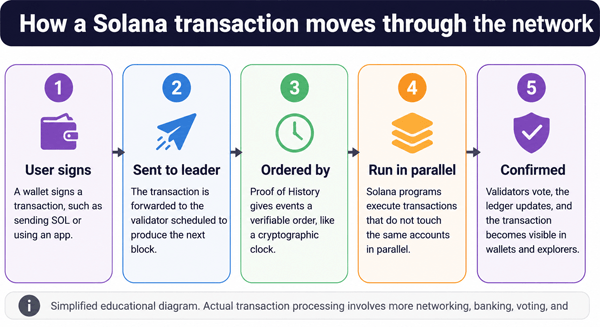
Figure: Simplified Solana transaction flow.
4. What Does Solana Do?
Solana lets people and developers move value and run applications without relying on one central company to maintain the ledger. The network can be used for simple payments, token transfers, trading, lending, digital collectibles, games, infrastructure tools, identity systems, and tokenized real-world assets.
A beginner can think of Solana as a shared global computer and payment network. Users connect through wallets. Developers build applications called programs. Validators run the network, process transactions, and keep the ledger synchronized. SOL is the asset that pays for the work needed to use the network.
5. How Solana Works: A Beginner-Friendly Explanation
When you use Solana, you usually begin in a wallet such as Phantom, Solflare, Backpack, or a wallet built into an exchange or app. The wallet creates and signs a transaction. That transaction might say, “send 0.2 SOL,” “swap USDC for another token,” or “interact with this lending app.”
After you approve the transaction, it is sent to the network. Validators check that the transaction is valid, that your signature is correct, that the account has enough SOL for fees, and that the transaction follows the rules of the program it is calling. If accepted, it is added to the ledger and becomes visible in your wallet or on a block explorer.
5.1 Proof of History: Solana’s “Clock”
In many blockchains, validators spend a lot of time agreeing on the order of events. Solana’s Proof of History helps by creating a verifiable sequence of time. This sequence acts like a cryptographic timestamp system. It helps validators know which events came before others without needing as much back-and-forth communication.
A simple analogy: imagine a classroom where students submit papers. If every paper already has a trusted timestamp, the teacher does not need to ask everyone what arrived first. Proof of History works in a much more technical way, but the mental model is similar: it helps order events efficiently.
5.2 Proof of Stake and Validators
Solana still needs validators to secure the chain. Validators run specialized software, process transactions, and vote on blocks. SOL holders can delegate their SOL to validators. Delegation does not mean giving the validator ownership of the SOL; it means assigning stake weight to help that validator participate in consensus and potentially earn rewards.
Validators with more delegated stake are more likely to be selected for leader duties. A leader is responsible for producing blocks during assigned time slots. Users who stake should choose validators carefully because validator performance, commission, reliability, and concentration all matter.
5.3 Smart Contracts on Solana Are Called Programs
On Ethereum, people often say smart contracts. On Solana, the same broad idea is usually called a program. A program is code deployed on the blockchain. It defines rules for actions such as swapping tokens, minting NFTs, lending crypto, creating games, or managing a stablecoin payment.
Programs can hold and update data stored in accounts. This account-based model is one reason Solana can process certain tasks in parallel. If two transactions do not try to change the same account at the same time, Solana can often execute them side by side.
5.4 Parallel Processing: Why Solana Can Be Fast
A useful way to understand Solana is to compare it with a checkout line. Some blockchains process many actions more like one long line. Solana tries to identify which transactions are independent and process them at the same time, more like opening several checkout lanes.
This parallel runtime is often called Sealevel. It is powerful, but it also means developers must design applications carefully. If too many users interact with the exact same hot account, bottlenecks can still happen. Fast blockchains can still experience congestion when demand is intense or when apps are poorly designed.
6. What Is SOL Used For?
| Use of SOL | What it means in practice |
|---|---|
| Transaction fees | Every Solana transaction requires a small fee paid in SOL. |
| Priority fees | Users may add optional priority fees to improve the chance of faster processing during busy periods. |
| Staking | SOL holders can delegate SOL to validators to help secure the network and potentially earn staking rewards. |
| DeFi collateral or liquidity | Some Solana apps allow SOL to be used in lending, borrowing, liquidity pools, or trading. |
| NFTs and apps | Many Solana apps use SOL for purchases, minting, gaming actions, or marketplace activity. |
| Network incentives | Validators and delegators may receive rewards depending on network conditions and validator performance. |
7. Solana Fees Explained
Solana fees are usually low compared with many older blockchains, but they are not always zero and can vary depending on the transaction. The official Solana fee model includes a base fee per signature and optional priority fees. A base fee pays for signature verification and helps compensate validators. Priority fees are extra fees users or apps can add when they want a transaction to be scheduled more competitively during heavy activity.
For beginners, the practical lesson is simple: always keep a small amount of SOL in your wallet for fees. If you move all your SOL out of a self-custody wallet, you may not be able to perform later transactions until you add more SOL.
8. Examples of Solana in Real Life
| Example | How Solana is used | Beginner note |
|---|---|---|
| Sending money | A user sends SOL or a stablecoin such as USDC to another wallet. | Check the address and network carefully before sending. |
| Trading tokens | A user swaps tokens on a decentralized exchange. | Slippage, fake tokens, and liquidity risks matter. |
| NFTs | Artists or projects mint digital collectibles on Solana. | Not every NFT has lasting value or real utility. |
| Gaming | Games can use Solana for in-game assets or marketplace transactions. | Blockchain games can still fail like normal games. |
| DeFi | Users lend, borrow, provide liquidity, or use yield apps. | Smart contract risk and liquidation risk are real. |
| Payments | Businesses or apps may accept Solana-based stablecoin payments. | Stablecoin issuer and wallet risks remain important. |
9. Solana vs Ethereum vs Bitcoin: Simple Comparison
| Feature | Solana | Ethereum | Bitcoin |
|---|---|---|---|
| Main purpose | Fast apps, payments, DeFi, NFTs, tokens | Smart contracts, DeFi, NFTs, broad app ecosystem | Digital money and settlement network |
| Native coin | SOL | ETH | BTC |
| Smart contracts | Yes, called programs | Yes, smart contracts | Limited scripting, not general app platform in the same way |
| Consensus | Proof of Stake plus Proof of History timing | Proof of Stake | Proof of Work |
| Typical strength | Speed and low fees | Developer ecosystem and liquidity | Security, simplicity, monetary brand |
| Typical trade-off | Reliability history and higher technical complexity | Fees can rise during congestion | Slower and less flexible for apps |
10. Benefits of Solana
- Low-cost transactions: Small transactions are more practical when fees are low. This can help payments, gaming, NFTs, and frequent app interactions.
- Fast user experience: Transactions often feel quick from a user perspective, which can make crypto apps easier for beginners to use.
- Growing app ecosystem: Solana supports wallets, DEXs, NFT marketplaces, stablecoins, DeFi protocols, infrastructure tools, and developer platforms.
- Good fit for high-frequency activity: Apps that need many small actions, such as games or order-book trading, may benefit from Solana’s design.
- Staking participation: SOL holders can delegate to validators and participate in network security without running their own validator.
11. Risks and Limitations of Solana
- Price volatility: SOL can rise or fall sharply. A useful network does not guarantee a rising token price.
- Network reliability risk: Solana has experienced outages in its history. Reliability has improved, but users should not ignore this risk.
- Congestion and failed transactions: During very busy periods, transactions may fail, require priority fees, or need to be retried.
- Smart contract bugs: DeFi and NFT apps can have code errors, oracle problems, admin-key risks, or economic design flaws.
- Scams and fake tokens: Low fees make it easy for scammers to create fake tokens, spam NFTs, phishing links, and malicious approvals.
- Validator and infrastructure concentration: A blockchain can be public yet still depend heavily on certain validator groups, data centers, client software, RPC providers, or developer teams.
- Self-custody mistakes: If you lose your seed phrase, sign a malicious transaction, or send funds to the wrong network, recovery may be impossible.
- Regulatory uncertainty: Crypto rules are still changing in many countries, which can affect exchanges, tokens, staking, and access to services.
12. Is Solana Decentralized?
Solana is a public blockchain with many independent validators, but decentralization is not a yes-or-no label. It depends on validator distribution, stake distribution, client diversity, hardware requirements, governance, infrastructure dependencies, and how much influence core teams or large holders have.
A fair beginner view is this: Solana is not a centralized database controlled by one company, but it also has decentralization trade-offs. Its high-performance design can increase hardware and operational demands for validators. This may affect who can realistically participate as a validator. Users should compare decentralization claims carefully instead of accepting marketing slogans from any blockchain project.
13. How to Use Solana Safely: Practical Beginner Checklist
- Start with a reputable wallet and download it only from the official website or app store link.
- Keep a small amount of SOL for fees before using DeFi, NFTs, or token swaps.
- Send a small test transaction before moving a large amount.
- Double-check the network. Do not send Solana assets to an unsupported address or chain.
- Use official links for apps; avoid links from random social media replies, DMs, or ads.
- Be suspicious of free airdrops, urgent claims, “wallet verification,” and guaranteed-profit offers.
- Review token contract addresses carefully because fake tokens can copy real names and logos.
- Do not invest money you cannot afford to lose. Treat SOL and Solana tokens as high-risk crypto assets.
- For staking, compare validator commission, uptime, history, and stake concentration.
- Consider using a hardware wallet for larger amounts.
14. Common Beginner Mistakes
| Mistake | Why it is risky | Better practice |
|---|---|---|
| Buying SOL only because it is “fast” | Technology does not remove market risk. | Understand price volatility and use position sizing. |
| Sending all SOL out of a wallet | You may lack SOL to pay future fees. | Leave a small SOL balance for transactions. |
| Trusting token logos | Scam tokens can copy names and images. | Verify official token addresses. |
| Ignoring failed transactions | A failed transaction may still have cost a small fee. | Check wallet history and explorer details. |
| Using random RPCs or unknown apps | Bad interfaces can mislead users or expose data. | Use reputable wallets, RPCs, and dApps. |
| Chasing very high yield | High yield often means high risk. | Understand the source of yield before depositing. |
15. Solana Investment Considerations
Before buying SOL, ask why you want exposure. Are you using the network, diversifying a crypto portfolio, speculating on ecosystem growth, or staking for rewards? Each reason has different risks.
A practical approach is to separate the technology from the token price. Solana can have strong technology and real usage while SOL still falls in price. The reverse is also true: a token can rise because of market excitement even when risks remain. Beginners should avoid all-in bets, borrowed money, and decisions based only on social media hype.
16. Frequently Asked Questions About Solana
16.1 Is Solana the same as SOL?
No. Solana is the blockchain network. SOL is the native cryptocurrency used on that network.
16.2 Is Proof of History a consensus mechanism?
Not by itself. Proof of History is best understood as a time-ordering system that supports Solana’s Proof of Stake consensus.
16.3 Can I build tokens on Solana?
Yes. Tokens on Solana are commonly called SPL tokens, and newer token features can use Token-2022.
16.4 Are Solana fees always cheap?
They are often low, but not always fixed for every situation. Priority fees and congestion can affect the final cost or success of a transaction.
16.5 Can Solana go down?
It has experienced outages in the past. Network reliability has improved, but outage and congestion risk should still be considered.
16.6 Is staking SOL risk-free?
No. Staking can involve validator performance risk, lockup or unstaking delays, custody risk, price volatility, and changing reward conditions.
16.7 Is Solana better than Ethereum?
It depends on the use case. Solana often emphasizes speed and low fees. Ethereum has a larger, mature smart-contract ecosystem and different security and decentralization trade-offs.
16.8 Do I need SOL to use Solana apps?
Usually yes. Even if you mainly use stablecoins or other tokens, you normally need a small SOL balance to pay network fees.
16.9 What is an SPL token?
An SPL token is a Solana-based token standard. It is similar in concept to Ethereum’s ERC-20 token standard, although the technical model is different.
16.10 Should beginners use Solana DeFi?
Beginners should be careful. Start small, learn how wallets and transactions work, and avoid complex DeFi strategies until you understand smart contract, liquidation, and scam risks.
17. Final Thoughts
Solana is one of the most important high-performance Layer 1 blockchains. Its core promise is a fast, low-cost environment for digital payments, decentralized apps, tokens, DeFi, NFTs, and emerging internet capital-market use cases. Its design combines Proof of Stake with Proof of History, plus parallel processing and other engineering choices aimed at scale.
The best way to understand Solana is to see both sides. It offers practical benefits for users and developers, especially where speed and low fees matter. But it also carries real risks: token volatility, scams, smart contract bugs, congestion, infrastructure dependencies, and a history of outages. Beginners should start small, use trusted tools, verify every transaction, and treat every crypto asset as high risk.
Sources Consulted and Checked
These sources were consulted and checked while preparing this document to support accuracy and clarity.
- Solana official website.
- Solana documentation.
- Solana fees documentation.
- Solana tokens documentation.
- Solana staking information.
- Solana Network Health Report: June 2025.
- Solana Proof of History explainer.
- Solana Gulf Stream and core innovations explainer.
- Helius: Solana outage history and technical background.
- Anza/Solana ecosystem validator and staking references.
Reader Advice
This article is provided for educational and informational purposes only and is not personalized financial, investment, legal, tax, or other professional advice or a recommendation to buy, sell, stake, or use any crypto asset or service. Crypto assets, including SOL and Solana-based tokens, can be highly volatile and may involve loss of funds, scams, technical failures, smart-contract vulnerabilities, custody mistakes, network disruption, and regulatory or tax risks. Rules, policies, laws, fees, network conditions, and statistics can change over time and vary by country or region, so readers should verify important information through current official sources and, where appropriate, consult a qualified professional before making a decision.