Meme Coins Explained: Meaning, How It Works, Examples, Benefits and Risks
1. What Are Meme Coins?
Meme coins are cryptocurrencies inspired by internet jokes, viral images, animals, celebrities, online communities, or cultural trends. Unlike Bitcoin, which was designed as a peer-to-peer electronic cash system, or Ethereum, which supports smart contracts and decentralized applications, many meme coins begin as a joke or social experiment.
The best-known example is Dogecoin, which started in 2013 as a playful cryptocurrency based on the popular “Doge” Shiba Inu meme. Dogecoin’s own website describes it as an open-source peer-to-peer digital currency and an “accidental crypto movement.”
A meme coin can still run on real blockchain technology, be traded on exchanges, and have a large market value. The important point is that its price is often driven more by attention, community activity, social media trends, and speculation than by business revenue, technical utility, or cash flow.
| Term | Simple meaning |
|---|---|
| Meme coin | A cryptocurrency mainly inspired by an internet meme, joke, animal, trend, celebrity, or online community. |
| Token | A crypto asset created on an existing blockchain, such as Ethereum, Solana, BNB Chain, or Base. |
| Coin | A crypto asset with its own blockchain, such as Dogecoin, Bitcoin, or Litecoin. |
| Market cap | Token price multiplied by circulating supply. It is more useful than price alone. |
| Liquidity | How easy it is to buy or sell without causing a large price move. |
| Rug pull | A scam where creators or insiders abandon the project or drain liquidity after attracting buyers. |
2. Why Do Meme Coins Become Popular?
Meme coins become popular because they combine finance, internet culture, humor, speculation, and community identity. They are easy to understand emotionally: a funny dog, frog, cat, political joke, or viral phrase can spread faster than a technical blockchain whitepaper.
In practice, meme coin popularity usually comes from several forces working together:
- A simple story that people can share quickly.
- A recognizable image, mascot, or phrase.
- Active communities on X, Telegram, Discord, Reddit, TikTok, or Farcaster.
- Low unit price, which can make beginners feel the coin is “cheap,” even when market cap is already high.
- Listings on exchanges, which make the coin easier to buy.
- Influencer attention, celebrity mentions, or viral social media posts.
- Speculation that early buyers may profit if the coin becomes the next big trend.
3. How Meme Coins Work
A meme coin works like other crypto assets at the technical level. It is recorded on a blockchain, transferred between wallets, and traded on centralized or decentralized exchanges. What makes it different is usually the reason people value it.
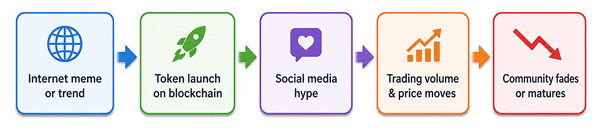
Diagram: A typical meme coin lifecycle from internet trend to token launch, hype, trading, and either decline or community development.
3.1 Creation or Launch
Some meme coins are independent blockchains, but most new meme coins are tokens launched on existing blockchains. A creator can use a token standard, such as ERC-20 on Ethereum or SPL tokens on Solana, to create a supply, name, ticker, and contract. Some launch platforms make this process very easy, which is why thousands of meme tokens can appear quickly.
3.2 Token Supply and Distribution
The token supply may be fixed, inflationary, or extremely large. A common beginner mistake is judging a meme coin by price per token alone. A coin priced at $0.000001 is not automatically cheap if there are hundreds of trillions of tokens. Market cap, liquidity, ownership concentration, and unlocks matter more than the number of zeros in the price.
3.3 Liquidity and Trading
To trade on a decentralized exchange, a token needs liquidity. Liquidity is usually provided in a pool, such as TOKEN/SOL, TOKEN/ETH, or TOKEN/USDC. If liquidity is small, even modest buying or selling can move the price sharply. If liquidity is removed by insiders, buyers may be unable to sell at a fair price.
3.4 Community and Attention
Meme coin prices often react to social attention. A viral post, meme campaign, exchange listing, celebrity mention, or online challenge can trigger rapid buying. The same process can reverse quickly when attention moves elsewhere.
3.5 Possible Development
Some meme coins try to develop additional features, such as payments, games, NFTs, decentralized applications, merchandise, or community grants. However, added features do not automatically make a project valuable. Beginners should check whether the features are actually used, not just promised.
4. Meme Coin Examples
The examples below are for education, not recommendations. Market rankings and prices change constantly, so always check current data before making any decision.
| Example | What it is known for | Beginner note |
|---|---|---|
| Dogecoin (DOGE) | One of the earliest and most famous meme coins, inspired by the Doge meme and launched in 2013. | It has its own blockchain and a long-running community, but its price is still highly volatile. |
| Shiba Inu (SHIB) | A dog-themed token that became popular as an Ethereum-based meme coin ecosystem. | It expanded into community projects, but remains speculative and attention-driven. |
| Pepe (PEPE) | A meme token inspired by the Pepe the Frog internet meme. | Shows how quickly meme culture can move into crypto speculation. |
| Bonk (BONK) | A dog-themed meme token associated with the Solana ecosystem. | Often discussed as an example of chain-specific meme coin culture. |
| Floki (FLOKI) | A dog-themed meme coin that markets itself with ecosystem products and branding. | Claims of utility should be checked against real usage and adoption. |
5. Meme Coins vs Other Cryptocurrencies
| Feature | Meme coins | Bitcoin | Ethereum / smart-contract platforms | Stablecoins |
|---|---|---|---|---|
| Main value driver | Attention, community, culture, speculation | Scarcity, network security, store-of-value narrative | Application ecosystem, developers, fees, smart contracts | Peg stability and reserves |
| Typical utility | Often limited; may include tipping, payments, community perks, or ecosystem features | Peer-to-peer value transfer and long-term holding | Apps, tokens, DeFi, NFTs, infrastructure | Payments, trading, remittances, cash-like settlement |
| Risk profile | Very high; often extreme volatility and scam risk | High volatility but more established | High volatility plus technical and ecosystem risks | Peg, issuer, reserve, regulatory and counterparty risks |
| Research focus | Ownership, liquidity, community quality, insiders, hype cycle | Security, adoption, custody, macro conditions | Developer activity, fees, ecosystem, security | Reserve transparency, regulation, issuer risk |
6. Benefits of Meme Coins
Meme coins are risky, but people are attracted to them for reasons that are worth understanding. The benefits below are potential benefits, not guarantees.
6.1 Easy Entry Into Crypto Culture
Meme coins are simple to explain. A beginner may not understand rollups, validator economics, or zero-knowledge proofs, but they can understand a funny dog token. This can make meme coins a gateway into learning wallets, exchanges, gas fees, private keys, and blockchain transactions.
6.2 Strong Communities
A meme coin community can create memes, educational content, charitable campaigns, online events, and social identity. Dogecoin is a good example of a meme coin that built a long-running community beyond short-term trading.
6.3 High Liquidity in Major Meme Coins
Large meme coins can have significant trading volume and broad exchange availability. This can make them easier to buy and sell than tiny tokens. However, liquidity can disappear quickly in smaller meme coins.
6.4 Potential for Viral Growth
Because meme coins are built around shareable internet culture, they can grow quickly when a story catches attention. This is also the reason they can crash quickly. Viral growth is not the same as sustainable value.
7. Risks of Meme Coins
The biggest danger is that meme coins can look fun and harmless while behaving like extremely risky speculative assets. Regulators have repeatedly warned that crypto assets can be highly volatile and that investors may lose all the money they put in. The U.S. SEC staff has specifically noted that meme coins tend to have significant price volatility and often lack utility beyond entertainment or non-functional purposes. The UK FCA has warned that cryptoasset investors should be prepared to lose all their money.
| Risk | What it means | Practical warning sign |
|---|---|---|
| Extreme volatility | Prices can rise or fall very quickly. | A coin doubles or crashes within hours based only on social media hype. |
| No real utility | The token may not do anything beyond trading. | Website uses vague words like “revolutionary” but gives no working product. |
| Rug pull risk | Insiders may drain liquidity or abandon the project. | Liquidity is unlocked, team is anonymous, and ownership is concentrated. |
| Pump-and-dump behavior | Early promoters may sell into later buyers. | Aggressive calls to buy now, guaranteed profit claims, or “next 100x” marketing. |
| Whale concentration | A few wallets may control a large share of supply. | Top wallets hold a large percentage of tokens. |
| Smart contract risk | Code bugs or malicious contract functions can harm holders. | Contract is not verified, unaudited, or has suspicious permissions. |
| Liquidity trap | You may not be able to sell without huge slippage. | Low liquidity compared with market cap or trading volume. |
| Regulatory uncertainty | Rules may change and platforms may restrict trading. | Token depends on exchange access or aggressive promotions. |
8. Common Meme Coin Mistakes Beginners Make
- Buying because the token price looks low. A low unit price does not mean the coin is undervalued. Always compare market cap and supply.
- Confusing popularity with safety. A coin can be trending and still be risky, manipulated, or overvalued.
- Ignoring liquidity. A chart may show paper gains, but selling can be difficult if liquidity is thin.
- Trusting influencers without checking incentives. Some promoters may already own the token and benefit when followers buy.
- Going all-in. Meme coins should never replace emergency savings or money needed for bills, rent, education, or family needs.
- Not checking the contract address. Fake tokens often copy popular names and logos.
- Buying after a vertical price spike. Late buyers often provide exit liquidity for early insiders.
9. How to Evaluate a Meme Coin Before Buying
A beginner does not need to become a blockchain developer, but basic checks can reduce avoidable mistakes. Use the checklist below before touching any meme coin.
| Check | Question to ask | Why it matters |
|---|---|---|
| Contract address | Is it the correct official contract address? | Fake copycat tokens are common. |
| Market cap | How large is the coin compared with similar meme coins? | Price per token alone is misleading. |
| Liquidity | Can buyers and sellers trade without huge slippage? | Low liquidity can trap holders. |
| Holder distribution | Do a few wallets control most of the supply? | Large holders can crash the price by selling. |
| Liquidity lock | Is liquidity locked or controlled by the team? | Unlocked liquidity increases rug pull risk. |
| Contract permissions | Can the owner mint, freeze, blacklist, or change fees? | Hidden permissions can harm holders. |
| Team transparency | Are creators known, credible, and accountable? | Anonymous teams are not automatically scams, but risk is higher. |
| Community quality | Is discussion useful, or only hype and spam? | Healthy communities answer questions and discuss risks. |
| Exchange listings | Where can it be traded? | Unknown exchanges and thin DEX pools add risk. |
| Personal risk limit | How much can you lose without stress? | Position sizing matters more than predictions. |
10. A Practical Beginner Safety Plan
If you decide to explore meme coins despite the risks, use a conservative process.
- Start with education, not buying. Learn how wallets, seed phrases, networks, gas fees, and exchange orders work.
- Use a small test amount first. Send a tiny transaction before moving larger amounts.
- Create a strict limit. Decide the maximum amount you can lose before you buy.
- Avoid leverage. Borrowed money and meme coin volatility are a dangerous mix.
- Use limit orders when available. Market orders can execute at poor prices in volatile conditions.
- Check slippage settings on decentralized exchanges. High slippage can expose you to bad execution and MEV bots.
- Do not connect your main wallet to unknown websites. Use a separate wallet for risky experiments.
- Take screenshots or notes of your reasoning. This helps you avoid emotional decisions later.
- Have an exit plan. Know whether you are trading short term, holding for community reasons, or simply experimenting.
- Protect your seed phrase. Never type it into a website, share it with support, or store it in a public cloud note.
11. Are Meme Coins Good Investments?
For most beginners, meme coins should be treated as speculation, not traditional investing. A stock may represent ownership in a company with revenue and assets. A bond may pay interest. A rental property may produce income. Many meme coins do not give holders a claim on revenue, profits, assets, or voting power that has economic value.
That does not mean nobody can make money from meme coins. Some early buyers have made large gains. But the same market structure also creates large losses for late buyers. A more honest question is not “Can meme coins go up?” They can. The better question is “Do I understand the risk well enough, and can I afford to be wrong?”
12. When a Meme Coin May Be Less Risky Than Average
No meme coin is safe, but some are less fragile than others. A meme coin may be relatively stronger when it has:
- A long operating history and active community.
- Broad liquidity across reputable exchanges.
- Transparent contract information and fewer dangerous permissions.
- A lower concentration of supply among insiders and whales.
- Clear communication that avoids guaranteed profit claims.
- Real usage, even if modest, such as tipping, payments, or community-funded activity.
13. When You Should Avoid a Meme Coin
- The website or social accounts promise guaranteed returns.
- The team pressures people to buy immediately before “the listing.”
- The token launched minutes ago and already has aggressive influencer promotion.
- Liquidity is tiny, unlocked, or controlled by unknown wallets.
- You cannot find the official contract address from reliable sources.
- The chart has already gone vertical and social media is full of “100x” claims.
- You feel fear of missing out rather than calm understanding.
14. Real-World Scenarios
14.1 Scenario 1: The Viral Coin
A meme token trends on social media after a celebrity joke. The price rises 300% in one day. A beginner buys because everyone is talking about it. The next day, early buyers take profits, liquidity thins out, and the price falls sharply. Lesson: virality creates opportunity and danger at the same time.
14.2 Scenario 2: The Fake Copycat
A user wants to buy a popular meme coin but searches by name on a decentralized exchange. Several tokens with the same name appear. The user buys the wrong contract and cannot sell later. Lesson: always verify the official contract address.
14.3 Scenario 3: The Strong Community Coin
A meme coin has existed for years, has active developers, broad exchange support, and a recognizable community. It still moves with market sentiment and hype, but it may be less fragile than a brand-new token created yesterday. Lesson: history and liquidity matter, but they do not remove risk.
15. Best Practices for Writing About or Promoting Meme Coins
If you run a blog, social account, or community page, responsible communication matters. Meme coins can attract beginners who do not understand risk.
- Clearly separate education from promotion.
- Disclose if you own the coin or have any financial relationship with the project.
- Avoid price predictions that sound certain.
- Do not use “guaranteed,” “risk-free,” or “easy money.”
- Explain market cap, liquidity, and supply instead of only showing price charts.
- Mention that crypto rules and consumer protections vary by country.
- Encourage readers to use official sources and verify contract addresses.
16. Quick Checklist: Should You Buy This Meme Coin?
- I found the official contract address from a reliable source.
- I checked market cap, liquidity, and holder concentration.
- I understand that the coin may have little or no practical utility.
- I am not buying because of panic or FOMO.
- I can afford to lose the full amount.
- I am not using leverage or borrowed money.
- I have a secure wallet setup and know how to protect my seed phrase.
- I understand my local tax and legal responsibilities.
17. FAQs About Meme Coins
17.1 What is a meme coin in simple words?
A meme coin is a cryptocurrency based on an internet joke, image, animal, trend, or online community. It can be traded like other crypto assets, but its value is often driven mainly by attention and speculation.
17.2 Are meme coins real cryptocurrencies?
Yes, many meme coins are real blockchain-based assets. Some have their own blockchain, while many are tokens on networks such as Ethereum, Solana, BNB Chain, or Base. Being real does not mean they are safe or valuable.
17.3 Why do meme coins go up?
They can rise because of social media attention, community buying, exchange listings, influencer mentions, market speculation, or a broader crypto bull market. These same forces can reverse quickly.
17.4 Can meme coins go to zero?
Yes. A meme coin can lose most or all of its value if attention disappears, liquidity dries up, insiders sell, the project is abandoned, or the token turns out to be a scam.
17.5 Is Dogecoin a meme coin?
Yes. Dogecoin is the most famous meme coin and began as a joke inspired by the Doge meme. It also has its own blockchain and a long-running community.
17.6 What is the difference between a meme coin and a utility token?
A utility token is designed to be used for a specific function, such as paying fees or accessing a service. A meme coin is usually driven more by culture, humor, and community. Some meme coins later try to add utility, but beginners should check whether that utility is real.
17.7 Are meme coins legal?
Legality depends on the country, token structure, marketing, and platform. Rules can change. A token being available online does not mean it is approved by regulators or protected by investor compensation schemes.
17.8 How much money should a beginner put into meme coins?
There is no universal amount. A safer rule is to use only money you can afford to lose completely. For many beginners, the best first step is learning with no purchase or a very small test amount.
17.9 How do I spot a meme coin scam?
Watch for guaranteed profit claims, anonymous teams with no accountability, unlocked liquidity, suspicious contract permissions, fake contract addresses, aggressive influencer promotion, and communities that ban basic risk questions.
17.10 Do meme coins have long-term value?
Some may survive for years if they maintain culture, liquidity, and community activity. Many will not. Long-term value is uncertain because many meme coins do not produce revenue or provide strong practical utility.
18. Final Thoughts
Meme coins are one of the clearest examples of how internet culture and financial speculation can merge. They can be fun, creative, and community-driven, but they are also risky, volatile, and often short-lived. Beginners should not treat meme coins as easy money. The smarter approach is to understand how they work, check the basics, avoid hype-driven decisions, and protect your capital first.
The key lesson is simple: meme coins can create big stories, but stories are not the same as safety. If you explore them, do it carefully, with small amounts, clear limits, and a strong habit of verifying everything.
Sources Consulted and Checked
These sources were consulted and checked while preparing this document to support accuracy and reliability.
- U.S. SEC Staff Statement on Meme Coins, February 27, 2025
- SEC Investor.gov Investor Alert on Crypto Asset Securities, March 23, 2023
- UK Financial Conduct Authority warning on cryptoasset risks
- Dogecoin official website
- CoinGecko meme token category page for current market examples and rankings
Reader Advice
This article is provided for educational and informational purposes only and does not constitute personalized financial, investment, legal, tax, or other professional advice or a recommendation to buy, sell, or hold any crypto asset. Meme coins are highly speculative and may involve extreme volatility, fraud, liquidity, technology, custody, regulatory, and total-loss risks. Rules, policies, laws, market data, and statistics can change over time and may vary by country or region, so verify important information through current official sources and consider qualified professional advice before making decisions. Never invest money you cannot afford to lose, avoid borrowed funds or leverage, and independently check contract addresses, platform legitimacy, fees, and security before acting.