BNB Chain Explained: Meaning, How It Works, Examples, Benefits and Risks
1. Quick Answer: What Is BNB Chain?
BNB Chain is a blockchain ecosystem built around BNB, the native coin used for gas fees, staking, governance, and ecosystem activity. For most beginners, the most important part of BNB Chain is BNB Smart Chain, often called BSC. BSC is an Ethereum-compatible smart contract blockchain where people can use decentralized apps, swap tokens, trade NFTs, play blockchain games, and send BEP-20 tokens.
BNB Chain is not just one product. It now includes BNB Smart Chain as the main smart-contract network, opBNB as a Layer 2 scaling network for cheaper and faster activity, and BNB Greenfield as a decentralized storage network. The older BNB Beacon Chain was retired as part of BNB Chain Fusion, with its functions migrated toward BNB Smart Chain.
In plain English: BNB Chain is a fast, low-cost blockchain environment for apps and digital assets. Its biggest strengths are low fees, EVM compatibility, large user activity, and a broad app ecosystem. Its biggest concerns are validator centralization, smart contract risk, bridge risk, scams, and regulatory uncertainty.
2. BNB Chain at a Glance
| Feature | Simple explanation |
|---|---|
| Main smart-contract chain | BNB Smart Chain (BSC), an EVM-compatible blockchain for decentralized applications. |
| Native coin | BNB, used mainly for gas fees, staking, governance participation, and ecosystem utility. |
| Token standard | BEP-20 is the common token standard on BNB Smart Chain, similar to ERC-20 on Ethereum. |
| Consensus model | Proof of Staked Authority (PoSA), where validators stake BNB and produce blocks. |
| EVM compatibility | Developers can often adapt Ethereum tools, wallets, and smart contracts for BSC with limited changes. |
| Layer 2 network | opBNB helps scale BSC by processing activity off the main BSC layer and posting data back to it. |
| Storage layer | BNB Greenfield focuses on decentralized storage and data permissions. |
| Best-known use cases | DeFi, token transfers, NFTs, GameFi, stablecoin payments, wallets, and Web3 apps. |
| Main risks | Scams, smart contract bugs, bridge exploits, validator concentration, market volatility, and user mistakes. |
3. Why BNB Chain Exists
Blockchains such as Bitcoin and Ethereum introduced digital ownership, decentralized money, and smart contracts. But early blockchains often faced high fees and congestion when demand increased. BNB Chain was built to offer a more affordable and practical environment for everyday blockchain transactions and decentralized applications.
The core idea is simple: make it easier and cheaper for people to use crypto applications. On BNB Smart Chain, a user can connect a wallet, pay gas with BNB, swap tokens on a decentralized exchange, mint or trade NFTs, use lending protocols, or interact with a game. Developers can build these apps using familiar Ethereum-style tools because BSC is compatible with the Ethereum Virtual Machine.
That convenience comes with trade-offs. BNB Smart Chain uses a smaller validator set than very decentralized networks. This helps performance, but it also means users should understand the decentralization and governance risks before relying on the network for large amounts of money.
4. Important Names: BNB Chain, BNB Smart Chain, BSC, and Binance Smart Chain
The naming can confuse beginners because the ecosystem has changed over time.
- Binance Smart Chain was the earlier name for BSC. It launched in 2020 as an EVM-compatible smart contract chain.
- BNB Smart Chain is the current expanded name of BSC. Many people still simply call it BSC.
- BNB Chain is the broader ecosystem brand. It includes BNB Smart Chain, opBNB, BNB Greenfield, and related infrastructure.
- BNB Beacon Chain was the older chain used for staking and governance functions. It has been shut down as part of BNB Chain Fusion, with functionality moved to BSC.
- BNB is the native coin. It is not the same thing as the chain, although the chain depends on it for gas and staking.
For a beginner, the easiest way to think about it is this: BNB Chain is the ecosystem, BNB Smart Chain is the main smart-contract blockchain, and BNB is the coin used to pay for transactions.
5. How BNB Chain Works
5.1 Users connect through a crypto wallet
Most users access BNB Smart Chain through a wallet such as MetaMask, Trust Wallet, Safe, or another wallet that supports BSC. A wallet stores private keys and lets users approve transactions. To use BSC, a wallet must be connected to the BNB Smart Chain network and must hold a small amount of BNB to pay gas fees.
5.2 Transactions are paid with BNB
Every on-chain action costs gas. Sending tokens, approving a token spend, swapping on a decentralized exchange, claiming rewards, minting an NFT, or interacting with a smart contract all require BNB for transaction fees. Fees are often lower than Ethereum mainnet fees, but they are not always zero. Users should always keep extra BNB for future transactions so they do not get stuck with tokens they cannot move.
5.3 Smart contracts run decentralized applications
BNB Smart Chain supports smart contracts, which are programs stored on the blockchain. A decentralized exchange uses smart contracts to hold liquidity and execute swaps. A lending protocol uses smart contracts to manage deposits, loans, collateral, and liquidations. An NFT marketplace uses smart contracts to mint, transfer, and sell NFTs.
5.4 Validators produce blocks
BNB Smart Chain uses Proof of Staked Authority. Validators stake BNB, run blockchain software, validate transactions, and produce blocks. Delegators can also stake BNB with validators. Validators earn transaction fees and share rewards with delegators according to their rules. The official documentation describes an active validator structure with Cabinet and Candidate validators, designed to balance performance and security.
5.5 EVM compatibility makes Ethereum-style apps easier to build
BSC is compatible with the Ethereum Virtual Machine. This matters because many crypto tools were originally built for Ethereum. Developers can often use Solidity, Vyper, Remix, Hardhat, Truffle, MetaMask, and familiar Ethereum-style smart contract patterns. This compatibility helped BSC grow quickly because developers did not have to learn an entirely new programming model.
5.6 opBNB adds Layer 2 scaling
opBNB is a Layer 2 network for BNB Smart Chain. It is based on the Optimism OP Stack. Instead of putting every operation directly on BSC, opBNB processes activity on a separate execution layer and posts data back to BSC. The goal is cheaper, faster, higher-volume transactions for apps such as games, social apps, and frequent DeFi activity.
5.7 BNB Greenfield adds decentralized storage
BNB Greenfield focuses on decentralized data storage and data ownership. Instead of only storing financial transactions, Greenfield is designed for files, permissions, buckets, and data management. It can connect data permissions with BNB Smart Chain, which can be useful for Web3 apps, creator platforms, decentralized websites, and AI or data marketplaces.
6. Simple Diagram: How the BNB Chain Ecosystem Fits Together
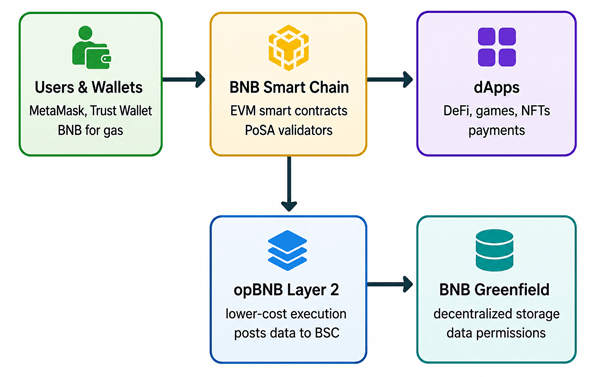
Figure 1: Simplified BNB Chain architecture for beginners.
7. BNB Smart Chain vs opBNB vs BNB Greenfield
| Part of ecosystem | Main purpose | Beginner example |
|---|---|---|
| BNB Smart Chain (BSC) | Main EVM-compatible blockchain for smart contracts, DeFi, NFTs, games, and token transfers. | You swap USDT for another BEP-20 token on a decentralized exchange and pay gas in BNB. |
| opBNB | Layer 2 scaling network that helps reduce cost and increase throughput for apps. | A blockchain game uses opBNB so players can make frequent low-cost in-game transactions. |
| BNB Greenfield | Decentralized storage and data management network connected with BNB Chain. | A creator app stores files and uses blockchain-based permissions to manage who can access them. |
| BNB Beacon Chain | Older chain that previously handled staking/governance-style functions. | Now retired as part of BNB Chain Fusion; beginners should generally focus on BSC instead. |
8. What Is BNB Used For?
BNB is the main utility coin of BNB Chain. It has several practical uses, but users should remember that BNB is still a volatile crypto asset.
- Gas fees: You need BNB to pay transaction fees on BNB Smart Chain.
- Staking: BNB holders can participate in network security by delegating to validators where supported.
- Governance: BNB is connected to governance processes in the BNB Chain ecosystem.
- DeFi utility: BNB is used as collateral, liquidity, trading pairs, and yield-generating assets in DeFi apps.
- Ecosystem access: Some apps, wallets, games, launchpads, and services use BNB for payments or participation.
A practical beginner rule: never spend or bridge all your BNB. Keep a small amount in your wallet for gas so you can move, swap, or recover your funds later.
9. What Are BEP-20 Tokens?
BEP-20 is the common token standard on BNB Smart Chain. It is similar in purpose to ERC-20 on Ethereum. Stablecoins, wrapped assets, governance tokens, meme coins, game tokens, and many DeFi tokens on BSC use the BEP-20 standard.
For example, a user may hold BEP-20 USDT, BEP-20 USDC, CAKE, or another token in a BSC wallet. These tokens are not automatically the same as tokens on Ethereum, Tron, Solana, or other networks, even if the ticker looks identical. A USDT token on BSC is different from USDT on Tron or Ethereum from a network-routing perspective.
9.1 Common beginner mistake: choosing the wrong network
Many crypto losses happen because users send tokens to the wrong chain or wrong address type. Before withdrawing from an exchange or sending from a wallet, confirm the network. If you want BEP-20 tokens, choose BNB Smart Chain or BSC. If you choose another network by accident, recovery may be difficult or impossible depending on the platform.
10. Real-World Examples of BNB Chain Use
10.1 Example 1: Swapping tokens on a decentralized exchange
A user holds BNB and wants to buy a BEP-20 token. They connect a wallet to a decentralized exchange, choose the token pair, review the expected price and slippage, approve the token if needed, and confirm the swap. The transaction is executed by smart contracts, and the user pays gas in BNB.
10.2 Example 2: Sending stablecoins cheaply
Someone wants to send USDT to a friend or business partner. Using BEP-20 USDT on BNB Smart Chain may be cheaper and faster than using some other networks. But both sender and receiver must support BSC, and the receiver must understand that the token is on BNB Smart Chain.
10.3 Example 3: Playing a blockchain game
A game can use BSC or opBNB for in-game items, tokens, and marketplace activity. Low fees make frequent transactions more practical. The risk is that game tokens and NFTs can lose value quickly, and poorly designed game economies often collapse.
10.4 Example 4: Using DeFi lending
A user deposits a token into a DeFi protocol to earn interest or borrow another asset. The protocol uses smart contracts to manage collateral and liquidation rules. This can be useful but risky. If the collateral falls in value, the user can be liquidated. If the smart contract has a bug, funds may be lost.
10.5 Example 5: Storing data with Greenfield
A decentralized app may store user-generated files on BNB Greenfield while using BNB Smart Chain smart contracts to manage permissions or payments. This can support creator platforms, data marketplaces, decentralized hosting, and other apps where data ownership matters.
11. Benefits of BNB Chain
11.1 Low transaction fees
BNB Smart Chain is known for relatively low transaction costs compared with Ethereum mainnet during congested periods. This makes small transactions, gaming interactions, and frequent DeFi activity more practical for everyday users.
11.2 Fast user experience
Short block times and a performance-focused validator model help transactions confirm quickly. This is useful for swaps, games, and applications where users expect near-instant feedback.
11.3 Large app ecosystem
BNB Chain has a broad ecosystem of wallets, decentralized exchanges, lending markets, NFT tools, bridges, analytics platforms, and developer infrastructure. A large ecosystem gives users more options, but it also requires careful due diligence because not every app is safe.
11.4 Ethereum compatibility
EVM compatibility is one of BNB Chain’s biggest strengths. Developers can reuse familiar Ethereum tooling, and users can often use familiar wallets. This reduces friction and makes it easier for apps to launch on BSC.
11.5 Useful for stablecoin transfers and payments
Many people use BSC for stablecoin transfers because fees can be low and wallets are widely available. This can be practical for cross-border transfers, exchange withdrawals, and informal payments, but users must confirm that both sides support the same token and network.
11.6 Scaling through opBNB
opBNB gives developers a lower-cost environment for high-volume apps. This is especially helpful for gaming, social, loyalty, micropayment, and consumer apps where main-chain fees would reduce usability.
11.7 Data use cases through Greenfield
Greenfield extends BNB Chain beyond simple token transfers. By adding decentralized storage and permissions, it may support new applications around data ownership, file monetization, AI datasets, creator content, and Web3 hosting.
12. Risks and Limitations of BNB Chain
12.1 Validator centralization risk
BNB Smart Chain uses a smaller validator set than highly decentralized networks. This helps speed and cost, but it also creates a decentralization trade-off. A smaller validator set can make governance, censorship resistance, and network control more sensitive issues.
12.2 Smart contract risk
A blockchain can work correctly while a specific app on it is unsafe. Smart contracts may contain bugs, poor economic design, weak admin controls, or malicious code. Always check whether an app has audits, a history of safe operation, transparent teams, and clear risk disclosures.
12.3 Bridge risk
Cross-chain bridges are common in crypto, but they are frequent targets for attackers. BNB Chain experienced a major bridge-related exploit in October 2022 involving the BSC Token Hub, where attackers were able to mint extra BNB through a vulnerability. The event showed that bridges can be a weak point even when the base chain remains operational.
12.4 Scams and fake tokens
Low fees make BNB Smart Chain accessible, but they also make it easy for scammers to launch fake tokens, phishing sites, copycat projects, and rug pulls. A token’s ticker or logo is not proof that it is legitimate. Always verify the official contract address from trusted project channels.
12.5 Token volatility
BNB and many BSC tokens can rise or fall sharply. Even stablecoins have issuer, reserve, depeg, regulatory, and liquidity risks. Do not treat any crypto asset as guaranteed safe.
12.6 Regulatory uncertainty
Crypto rules differ by country and can change. Regulations may affect exchanges, stablecoins, wallets, DeFi access, taxation, and reporting obligations. Users should understand local rules before using crypto for trading, payments, or business.
12.7 User-error risk
Blockchain transactions are usually irreversible. If you send funds to the wrong address, approve a malicious contract, lose your seed phrase, or bridge to the wrong network, recovery may be impossible. User safety habits matter as much as the chain itself.
13. BNB Chain Compared With Other Blockchains
| Network | Main strength | Main trade-off | Best beginner use case |
|---|---|---|---|
| BNB Smart Chain | Low fees, EVM compatibility, large DeFi and token ecosystem. | Smaller validator set and scam-heavy token environment. | Low-cost token transfers, DeFi experiments, BEP-20 stablecoin use. |
| Ethereum mainnet | Deep liquidity, strong decentralization, mature security culture. | Higher fees during congestion. | High-value DeFi, NFTs, and applications where security/liquidity matter most. |
| Polygon PoS | Low fees and EVM compatibility. | Bridge and validator/security model trade-offs. | Consumer apps, low-cost DeFi, NFTs. |
| Solana | High throughput and very fast user experience. | Different development environment and past reliability concerns. | High-speed apps, consumer crypto, NFTs, trading apps. |
| Arbitrum/Optimism | Ethereum Layer 2 security alignment and lower fees than Ethereum mainnet. | Bridge delays, sequencer assumptions, ecosystem complexity. | Ethereum-style DeFi at lower cost. |
No blockchain is perfect. The right choice depends on what you need: low fees, deep liquidity, decentralization, app availability, developer tools, or institutional confidence.
14. How to Use BNB Chain Safely: Beginner Checklist
- Use a reputable wallet and download it only from the official website or app store listing.
- Write down your seed phrase offline and never share it with anyone.
- Keep a small amount of BNB for gas before moving BEP-20 tokens.
- Verify the network is BNB Smart Chain before sending BEP-20 tokens.
- Confirm token contract addresses from official project websites, not random social media posts.
- Start with a small test transaction before sending a large amount.
- Avoid approving unlimited token spending unless you trust the app and understand the risk.
- Use a block explorer to check transactions and contract addresses.
- Be careful with bridges; use official or reputable bridges and understand fees and delays.
- Do not chase unrealistic yields. High yield usually means high risk.
- Consider using a hardware wallet for larger balances.
- Revoke risky token approvals if you stop using a dApp.
15. Common Mistakes Beginners Make on BNB Chain
| Mistake | Why it is risky | Better practice |
|---|---|---|
| Sending tokens on the wrong network | Funds may not arrive or may require complex recovery. | Check the exact network before every withdrawal or transfer. |
| Buying a fake token | Scammers copy logos and names of real projects. | Verify the official contract address. |
| Approving malicious contracts | A bad approval can let a contract drain tokens. | Use trusted dApps and review approvals regularly. |
| Using all BNB balance | You may be unable to pay gas for future transactions. | Keep extra BNB for fees. |
| Trusting high APY blindly | Unsustainable yield can come from inflation, leverage, or Ponzi-like mechanics. | Understand where yield comes from before depositing. |
| Ignoring slippage settings | A swap can execute at a much worse price than expected. | Use reasonable slippage and check price impact. |
| Using unknown bridges | Bridges have been a major source of crypto exploits. | Use reputable bridges and small test transfers. |
16. Who Should Consider Using BNB Chain?
BNB Chain may be useful for people who want low-cost blockchain transactions, access to a large DeFi ecosystem, BEP-20 stablecoin transfers, NFT or gaming apps, or Ethereum-style smart contracts without Ethereum mainnet fees. It can also be useful for developers who want an EVM-compatible environment with a large user base.
It may not be the best choice for users who prioritize maximum decentralization, want to avoid smart contract risk entirely, need institutional-grade custody arrangements, or cannot tolerate volatility and irreversible mistakes. Beginners should start slowly and treat BNB Chain as a useful but risky technology, not as a guaranteed investment opportunity.
17. Practical Example: Sending BEP-20 USDT on BNB Smart Chain
1. Open your wallet or exchange account and choose USDT.
2. Select BNB Smart Chain or BEP-20 as the network.
3. Paste the recipient’s BSC-compatible address. BSC addresses usually look like Ethereum addresses and begin with 0x.
4. Confirm the recipient supports BEP-20 USDT.
5. Send a small test amount first if the amount is important.
6. Check the transaction on a BSC block explorer.
7. After the test arrives, send the remaining amount if everything is correct.
This process is simple, but the network choice is critical. A token ticker alone is not enough. USDT can exist on multiple networks, and each network is different for deposits, withdrawals, and wallet routing.
18. Practical Example: Using a BNB Chain DeFi App
1. Research the app: check its official website, documentation, audit history, team transparency, and community reputation.
2. Connect a wallet using the official app URL only.
3. Review what the app asks you to approve. Be cautious with unlimited approvals.
4. Deposit only an amount you can afford to risk.
5. Understand the yield source. Is it trading fees, lending interest, token emissions, leverage, or incentives?
6. Monitor your position. DeFi risks can change quickly when markets move.
7. Withdraw or reduce exposure if risk becomes unclear.
19. Misconceptions About BNB Chain
19.1 Misconception 1: Low fees mean no risk
Low fees make transactions cheaper, but they do not make smart contracts safe. A low-cost scam is still a scam.
19.2 Misconception 2: BNB Chain and Binance exchange are the same thing
They are related historically and by ecosystem association, but using BNB Smart Chain is not the same as holding assets inside a Binance exchange account. On-chain wallets require users to manage private keys and take responsibility for transactions.
19.3 Misconception 3: Every BEP-20 token is trustworthy
Anyone can create a token. A token being on BSC does not prove quality, legitimacy, or liquidity.
19.4 Misconception 4: Stablecoins are always safe
Stablecoins can reduce price volatility compared with regular crypto assets, but they still involve issuer, reserve, smart contract, blacklist, liquidity, and regulatory risks.
19.5 Misconception 5: DeFi yield is passive income without downside
Yield can come with smart contract risk, price risk, liquidation risk, impermanent loss, token inflation, and protocol failure. Always ask where the yield comes from.
20. BNB Chain Pros and Cons
| Pros | Cons |
|---|---|
| Low transaction fees make small transfers and frequent app usage practical. | Smaller validator set creates a decentralization trade-off. |
| EVM compatibility makes it easier for users and developers familiar with Ethereum. | Many fake tokens and scams target beginners. |
| Large ecosystem of wallets, DeFi protocols, games, and infrastructure. | Bridge and smart contract exploits can cause major losses. |
| opBNB can support cheaper, higher-volume activity. | BNB and ecosystem tokens remain volatile. |
| Greenfield expands use cases into decentralized storage and data ownership. | Regulatory treatment may vary by country and change over time. |
21. Is BNB Chain a Good Investment?
BNB Chain itself is a blockchain ecosystem, not a single investment. BNB is the main coin associated with the ecosystem, while thousands of tokens and apps operate on or around BSC. Whether any of these are good investments depends on your risk tolerance, time horizon, local rules, and ability to understand the technology.
Beginners should avoid treating BNB Chain as a shortcut to easy profit. A better approach is to learn how wallets, gas fees, smart contracts, token approvals, and network selection work before risking meaningful money. If you invest, diversify, avoid leverage unless you fully understand it, and never invest funds needed for essential expenses.
22. FAQs About BNB Chain
22.1 What is BNB Chain in simple words?
BNB Chain is a blockchain ecosystem where people can send tokens, use decentralized apps, trade NFTs, play blockchain games, and interact with smart contracts. Its main smart-contract network is BNB Smart Chain, also known as BSC.
22.2 Is BNB Chain the same as BNB Smart Chain?
Not exactly. BNB Chain is the broader ecosystem. BNB Smart Chain is the main EVM-compatible smart-contract blockchain inside that ecosystem.
22.3 What is BNB used for?
BNB is used to pay gas fees, participate in staking and governance-related activity, and interact with many apps and services in the BNB Chain ecosystem.
22.4 What is BEP-20?
BEP-20 is the common token standard on BNB Smart Chain. It is similar to ERC-20 on Ethereum and is used for many stablecoins, DeFi tokens, and app tokens on BSC.
22.5 Is BNB Chain safe?
BNB Chain can be useful, but it is not risk-free. Users face smart contract bugs, scams, bridge risks, token volatility, phishing, wrong-network transfers, and regulatory uncertainty.
22.6 Why are BNB Chain fees low?
BNB Smart Chain uses a performance-focused validator model and EVM-compatible design that generally supports low-cost transactions. Fees can still change with network demand.
22.7 Can I use MetaMask with BNB Chain?
Yes. MetaMask can be configured for BNB Smart Chain. Users must add the correct network settings or use a trusted app prompt, then hold BNB for gas.
22.8 What happened to BNB Beacon Chain?
BNB Beacon Chain was retired as part of BNB Chain Fusion. Its functions were migrated toward BNB Smart Chain to simplify the ecosystem and reduce risks associated with the old dual-chain structure.
22.9 What is opBNB?
opBNB is a Layer 2 scaling network for BNB Smart Chain. It uses the Optimism OP Stack and is designed to make transactions cheaper and faster for high-volume apps.
22.10 What is BNB Greenfield?
BNB Greenfield is a decentralized storage network connected with the BNB Chain ecosystem. It focuses on data ownership, storage, and permissions.
22.11 Can I recover funds sent to the wrong network?
Sometimes, but not always. Recovery depends on the receiving wallet, exchange, address control, and network compatibility. Always do a small test transaction first.
22.12 Is BNB Chain good for beginners?
It can be beginner-friendly because fees are low and wallets are widely supported, but beginners must learn network selection, gas fees, token approvals, and scam prevention before using large amounts.
23. Final Thoughts
BNB Chain is one of the most widely used blockchain ecosystems for low-cost token transfers, DeFi, NFTs, games, and Web3 applications. Its main chain, BNB Smart Chain, is popular because it is fast, relatively inexpensive, and compatible with Ethereum-style tools. opBNB adds Layer 2 scaling, while BNB Greenfield adds decentralized storage and data-management features.
The practical lesson for beginners is balance. BNB Chain can be useful, but it is not risk-free. Use it carefully, verify networks and contract addresses, keep BNB for gas, avoid suspicious tokens and unrealistic yields, and remember that blockchain transactions are usually irreversible. If you treat BNB Chain as a tool rather than a get-rich-quick opportunity, you will make safer and smarter decisions.
Sources Consulted and Checked
These sources were consulted and checked while preparing this document to support clarity and accuracy.
- BNB Chain Docs - BNB Smart Chain introduction
- BNB Chain Docs - BNB Smart Chain overview
- BNB Chain Docs - BSC validator overview
- BNB Chain Docs - BSC staking overview
- BNB Chain Docs - opBNB overview
- BNB Chain Docs - BNB Greenfield overview
- BNB Chain Docs - BNB Chain Fusion overview
- BNB Chain Docs - Token recovery after Beacon Chain shutdown
- Immunefi - Hack Analysis: Binance Bridge, October 2022
- Halborn - Explained: The BNB Chain Hack, October 2022
Reader Advice
This article is provided for educational and informational purposes only. It does not constitute personalized legal, financial, investment, tax, cybersecurity, or other professional advice or a recommendation to buy, sell, hold, transfer, stake, bridge, or use any crypto asset or service. Crypto assets, decentralized applications, bridges, wallets, and smart contracts involve significant risks, including price volatility, scams, hacking, software defects, irreversible transactions, loss of private keys, liquidity problems, and possible loss of some or all funds. Rules, policies, laws, fees, network features, and statistics can change over time and may vary by country or region. Before making a decision, verify current information through official sources, confirm the correct network and contract details, consider your circumstances and risk tolerance, and seek advice from a qualified professional where appropriate.