Crypto Sectors by Use Case: Complete Guide, Examples, Risks and Best Practices
1. Quick Answer: What Are Crypto Sectors by Use Case?
Crypto sectors by use case are groups of crypto projects organized by what they are designed to do, not just by price or popularity. Instead of asking, “Which coin is going up?”, a use-case approach asks, “What real problem is this network, token or application trying to solve?”
For beginners, this is one of the clearest ways to understand the crypto market. Bitcoin is mainly a monetary network and store-of-value asset. Stablecoins are designed for price stability and payments. DeFi apps try to recreate financial services such as trading, lending and borrowing on blockchains. Layer 1 and Layer 2 networks provide infrastructure. NFTs represent digital ownership. Oracles bring external data on-chain. Gaming, real-world assets, decentralized storage, identity and privacy projects serve other specific needs.
Important note: a crypto sector is not a guarantee of quality. A project can have a useful idea and still fail because of weak security, poor economics, low adoption, unclear regulation or bad management.
| Sector | Main purpose | Simple examples | Beginner risk to watch |
|---|---|---|---|
| Bitcoin / store of value | Digital scarcity and censorship-resistant settlement | BTC used for long-term holding or cross-border settlement | Volatility and self-custody mistakes |
| Stablecoins | Digital dollars or other fiat-pegged tokens | USDC or USDT used for payments, trading or remittances | Issuer, reserve and regulatory risk |
| DeFi | On-chain financial apps | Decentralized exchanges, lending markets, liquid staking | Smart-contract hacks and liquidation risk |
| Layer 1 blockchains | Base networks for apps and transactions | Ethereum, Solana, Cardano, BNB Chain, Avalanche | Network congestion, governance and validator centralization |
| Layer 2 scaling | Faster and cheaper blockchain execution | Optimistic and zero-knowledge rollups | Bridge and sequencer risk |
| Oracles | External data for smart contracts | Price feeds for DeFi markets | Bad data or oracle manipulation |
| NFTs and creator economy | Digital ownership and collectibles | Art, memberships, game items, tickets | Illiquidity and copyright confusion |
| Real-world assets | Tokenized off-chain assets | Tokenized treasuries, funds, property claims | Legal enforceability and counterparty risk |
| Gaming and metaverse | Digital items, game economies and communities | Play-and-own assets, in-game tokens | Speculation before real player demand |
2. Why Group Crypto by Use Case?
The crypto market can look confusing because thousands of coins and tokens trade on exchanges. Many have similar names, overlapping claims and fast-moving narratives. Grouping crypto by use case helps you separate function from hype.
A sector-based view helps you answer practical questions:
- What problem does this project try to solve?
- Who would use it if speculation disappeared?
- Does the token actually need to exist?
- What risks are specific to this sector?
- Which projects are competitors or complements?
- What evidence shows real usage, not only marketing?
This approach also prevents a common beginner mistake: comparing every token as if it were the same type of asset. Bitcoin, a decentralized exchange token, a game token, a stablecoin and a governance token all behave differently because they have different roles.
3. How Crypto Sectors Work: The Simple Framework
Most crypto projects combine three layers: the network, the application and the token. Some projects are mainly infrastructure. Others are consumer apps. Some tokens are needed to pay network fees, secure the system, govern the protocol or represent an asset. Others have weaker links to the product.
| Layer | What it means | Example question to ask |
|---|---|---|
| Network | The blockchain or protocol where transactions happen. | Is the network secure, reliable and used by real applications? |
| Application | The product people interact with, such as an exchange, wallet or game. | Does the app solve a real user problem better than alternatives? |
| Token | The digital asset connected to the network or app. | What gives the token demand, and who must buy or hold it? |
A strong use case does not automatically mean a strong token. For example, a blockchain application can become popular while its governance token performs poorly if the token has weak utility, high inflation or poor value capture. Beginners should evaluate both the product and the token design.
4. Visual Map: Major Crypto Sectors by Use Case
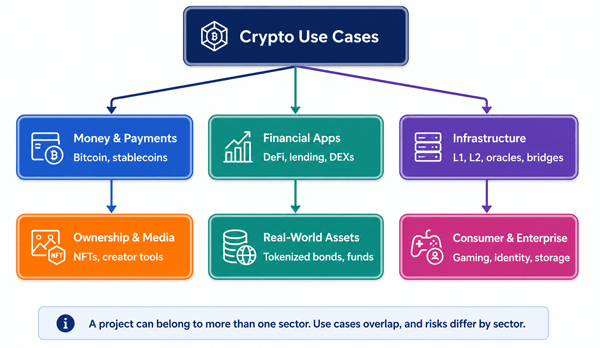
Figure: A beginner-friendly map of major crypto use-case sectors. Many projects overlap across more than one box.
5. Bitcoin and Monetary Crypto Assets
Bitcoin is the best-known example of a crypto asset designed primarily as decentralized digital money and a store of value. Its core idea is simple: a fixed supply schedule, peer-to-peer transfers and a network that does not depend on a single company or government to process transactions.
5.1 How this sector works
Bitcoin transactions are recorded on a public blockchain. Miners secure the network through proof of work, and users can hold BTC in wallets or through custodial platforms. People may use Bitcoin for long-term savings, settlement, donations or cross-border transfers, although everyday payments can be limited by fees, volatility and local regulation.
5.2 Practical example
A freelancer working with international clients might receive Bitcoin where banking access is limited. Another user might hold BTC as a long-term speculative store-of-value asset. In both cases, the user must understand price volatility, transaction fees and wallet security.
5.3 Benefits and risks
- Benefits: high brand recognition, deep liquidity, strong network effects and a transparent monetary policy.
- Risks: large price swings, irreversible transactions, tax complexity, custody mistakes and environmental or regulatory debate in some jurisdictions.
- Best practice: treat Bitcoin as volatile risk capital, learn wallet basics before self-custody and never invest money needed for short-term expenses.
6. Stablecoins for Payments, Trading and Savings Access
Stablecoins are crypto tokens designed to track the value of another asset, usually the U.S. dollar. They are widely used for trading, payments, remittances, treasury management and moving value between crypto platforms. Stablecoins can be useful because they reduce exposure to crypto price swings while keeping transactions on blockchain rails.
6.1 How this sector works
Fiat-backed stablecoins are usually issued by a company that says it holds cash, short-term government securities or similar reserves. Crypto-backed stablecoins use on-chain collateral and smart contracts. Algorithmic stablecoins try to maintain a peg using incentives and supply adjustments, but this model has historically carried serious failure risk.
6.2 Practical example
A person sending money abroad may use a dollar stablecoin to move funds quickly, then the recipient may convert it into local currency. A trader may hold stablecoins between trades instead of returning to a bank account every time.
6.3 Benefits and risks
- Benefits: faster settlement, easier dollar access in some markets, useful trading liquidity and lower volatility than non-stable crypto assets.
- Risks: reserve quality, issuer transparency, frozen addresses, regulatory changes, depegging, smart-contract risk and scams using fake token contracts.
- Best practice: prefer transparent, widely supported stablecoins; verify the token contract and network; avoid high-yield offers that do not clearly explain the source of returns.
7. DeFi: Decentralized Finance
DeFi means decentralized finance: financial services built with smart contracts rather than traditional intermediaries. DeFi includes decentralized exchanges, lending markets, borrowing platforms, liquid staking, derivatives, prediction markets and automated asset-management tools.
7.1 How DeFi works
In DeFi, users connect a crypto wallet to a protocol. Smart contracts execute actions such as swaps, loans or collateral management. Liquidity often comes from users who deposit assets into pools and earn fees or incentives. The rules are visible on-chain, but that does not mean they are easy to understand or risk-free.
7.2 Practical examples
- A user swaps ETH for a stablecoin on a decentralized exchange without opening an account with a centralized broker.
- A borrower deposits ETH as collateral and borrows a stablecoin, while accepting the risk of liquidation if ETH falls sharply.
- A liquidity provider deposits two assets into a trading pool and earns fees, but may suffer impermanent loss if prices move strongly.
7.3 Benefits and risks
- Benefits: open access, transparent rules, composability between protocols and fast settlement.
- Risks: smart-contract bugs, oracle manipulation, liquidation cascades, governance attacks, bridge hacks, phishing and complex tax reporting.
- Best practice: start with small test transactions, use established protocols, read audits but do not rely on audits alone, and understand liquidation rules before borrowing.
8. Layer 1 Blockchains: Base Networks
Layer 1 blockchains are base networks that process transactions and run applications. Examples include Ethereum, Solana, Cardano, BNB Chain, Avalanche, Polkadot and Cosmos-based networks. They compete on security, decentralization, speed, developer tools, fees, ecosystem size and governance.
8.1 How this sector works
A Layer 1 network has validators or miners, a native asset used for fees and security, and rules for how blocks are produced. Developers can build smart contracts, tokens and applications on top of the network. Users pay fees in the network’s native coin, such as ETH on Ethereum or SOL on Solana.
8.2 Beginner comparison
| Feature | Why it matters | Beginner question |
|---|---|---|
| Security | Protects funds and transaction finality. | How long has the chain operated, and has it had major failures? |
| Fees | Affects small payments and frequent app use. | Can normal users afford transactions during busy periods? |
| Speed | Improves user experience for trading, games and payments. | Is speed achieved without too much centralization? |
| Developer ecosystem | More builders can mean more useful apps. | Are there active wallets, tools and documentation? |
| Decentralization | Reduces dependence on a small group of operators. | How many validators matter, and who controls upgrades? |
8.3 Benefits and risks
- Benefits: broad app ecosystems, native assets with clear fee roles and infrastructure for many sectors.
- Risks: chain outages, congestion, validator concentration, governance disputes, ecosystem hacks and intense competition.
- Best practice: do not judge a Layer 1 only by claimed transactions per second. Look at reliability, security history, developer activity and real users.
9. Layer 2 Scaling Networks
Layer 2 networks are built to make blockchains faster and cheaper while relying on a base chain for settlement or security. Ethereum rollups are the most discussed example, but scaling systems exist across several ecosystems.
9.1 How Layer 2 works
A Layer 2 executes many transactions away from the main chain, then posts data or proofs back to the base chain. Optimistic rollups assume transactions are valid unless challenged. Zero-knowledge rollups use cryptographic proofs to show transactions are valid.
9.2 Practical example
A user may use a Layer 2 to swap tokens or mint an NFT with lower fees than on the base chain. The trade-off is that the user must understand bridges, withdrawal times, sequencer risk and which apps are available on that network.
9.3 Benefits and risks
- Benefits: lower fees, faster app experience and improved scalability for payments, games and DeFi.
- Risks: bridge exploits, sequencer centralization, complex withdrawals, fragmented liquidity and unclear token value capture.
- Best practice: use official bridges, confirm the destination network before sending funds and keep records of cross-chain transactions.
10. Oracles and Data Networks
Smart contracts cannot automatically know external information such as asset prices, weather, sports results or bank rates. Oracles solve this by bringing off-chain data on-chain. DeFi especially depends on oracles for price feeds and collateral calculations.
10.1 How oracles work
Oracle networks collect data from multiple sources, validate it and publish it to blockchains. A lending protocol may use an oracle price feed to decide whether a borrower’s collateral is safe or should be liquidated.
10.2 Benefits and risks
- Benefits: enables lending markets, derivatives, insurance, tokenized assets and many automated contracts.
- Risks: bad data, delayed data, low-liquidity price manipulation and dependence on a small set of data providers.
- Best practice: when using DeFi, check whether a protocol uses reputable oracle feeds and how it handles unusual market conditions.
11. NFTs, Digital Ownership and Creator Economy
NFTs, or non-fungible tokens, represent unique digital items. They can be used for art, collectibles, memberships, game items, event tickets, music rights, digital identity badges and access passes. The important idea is not the image itself, but the token record that points to ownership or access rights.
11.1 Practical examples
- A musician sells limited digital collectibles that also unlock private content.
- A game issues items that players can trade outside the game’s own marketplace.
- A conference uses NFT tickets to reduce fraud and provide post-event perks.
11.2 Benefits and risks
- Benefits: programmable ownership, creator royalties in some marketplaces, community access and portable digital items.
- Risks: illiquid markets, fake collections, wash trading, broken image links, unclear copyright rights and hype-driven prices.
- Best practice: verify the official collection link, understand what rights the NFT actually gives, and avoid buying only because of celebrity promotion.
12. Real-World Assets (RWAs) and Tokenization
Real-world assets are off-chain assets represented on-chain. Examples may include tokenized treasury funds, private credit, real estate interests, commodities, carbon credits or invoices. The goal is to bring traditional assets onto blockchain systems for faster settlement, fractional access or programmable finance.
12.1 How RWA tokenization works
An issuer or structure holds or references an off-chain asset. A token represents a claim, share, receipt or record connected to that asset. Unlike a purely on-chain token, an RWA depends heavily on legal documents, custodians, administrators, asset managers and jurisdiction-specific rules.
12.2 Benefits and risks
- Benefits: potential for faster settlement, wider access, automated compliance and integration with DeFi collateral systems.
- Risks: legal enforceability, counterparty default, poor disclosure, asset custody, valuation uncertainty and regulatory restrictions.
- Best practice: read the legal structure, not just the token page. Ask who owns the asset, who audits it, how redemptions work and what happens if the issuer fails.
13. Gaming, Metaverse and Consumer Tokens
Crypto gaming projects use tokens or NFTs for in-game items, player ownership, marketplaces, rewards or community governance. The strongest gaming use cases are not simply “play to earn”; they create fun games where blockchain features improve ownership, trading or interoperability.
13.1 Benefits and risks
- Benefits: player-owned items, open marketplaces, community economies and new funding models for creators.
- Risks: unsustainable rewards, bot farming, poor gameplay, token inflation, unclear regulations and heavy speculation before real users arrive.
- Best practice: evaluate the game like a game first. If people would not play it without token rewards, the economy may be fragile.
14. Decentralized Physical Infrastructure Networks (DePIN)
DePIN projects use tokens to coordinate real-world infrastructure such as wireless coverage, sensors, compute power, mapping, energy or storage. The idea is to reward people or businesses for contributing useful physical resources to a network.
14.1 Practical example
A participant may install a device that provides wireless coverage or collects map data. The network rewards useful contributions with tokens. Customers may then pay to use the network’s service.
14.2 Benefits and risks
- Benefits: community-built infrastructure, lower startup costs for networks and transparent contribution rewards.
- Risks: exaggerated coverage claims, hardware costs, reward dilution, low customer demand and complex token incentives.
- Best practice: separate supply from demand. A network with many reward-seeking contributors still needs paying customers.
15. Decentralized Storage and Compute
Storage and compute projects try to create alternatives to centralized cloud providers. Storage networks may let users rent unused disk space. Compute networks may coordinate GPU or CPU resources for rendering, AI workloads or scientific computing.
15.1 Benefits and risks
- Benefits: alternative infrastructure, open marketplaces for resources and potential cost competition.
- Risks: performance gaps, service reliability, data privacy, unclear enterprise adoption and token rewards that may not match real demand.
- Best practice: look for actual customers, service-level reliability and clear pricing compared with traditional cloud services.
16. Privacy, Identity and Security
Privacy projects aim to protect transaction or user information. Identity projects aim to let users prove something about themselves without revealing unnecessary data. Security projects include wallets, audits, monitoring tools and insurance-like products.
16.1 Benefits and risks
- Benefits: better user control, reduced data exposure, safer access and improved compliance tools.
- Risks: regulatory scrutiny, misuse concerns, technical complexity, weak adoption and false promises of complete anonymity.
- Best practice: distinguish privacy from secrecy. Legitimate privacy tools should still help users manage legal and tax responsibilities.
17. DAOs and Governance Tokens
DAOs, or decentralized autonomous organizations, are groups that coordinate using tokens, smart contracts and community voting. Governance tokens may let holders vote on protocol changes, treasury spending or fee settings.
17.1 Benefits and risks
- Benefits: community participation, transparent treasuries and open proposal systems.
- Risks: voter apathy, whale control, governance attacks, unclear legal responsibility and conflicts between token holders and users.
- Best practice: check voting participation, token concentration and whether governance controls critical smart contracts or treasury funds.
18. How to Evaluate Any Crypto Sector or Project
A beginner does not need to become a developer to evaluate a crypto project more carefully. Use the checklist below before buying, using or recommending any project.
- Identify the real use case. Write one sentence explaining what problem it solves and who uses it.
- Separate the product from the token. Ask whether the token is essential or just attached for fundraising or speculation.
- Check real activity. Look for users, transaction quality, revenue, developer activity, integrations and retention, not only social-media followers.
- Study token supply. Understand inflation, vesting schedules, insider allocations and unlock dates.
- Review security. Look for audits, bug bounties, incident history and whether contracts can be upgraded by insiders.
- Understand custody. Know whether you control the wallet keys or rely on a platform.
- Compare competitors. A project may be good but still lose to a stronger network, app or standard.
- Consider regulation. Some tokens, products or yield programs may face restrictions depending on your country.
- Use small test transactions. Send a small amount first, especially when using a new chain, bridge or wallet.
- Plan your exit. Know how you would sell, redeem, bridge or withdraw before you put significant money in.
19. Common Beginner Mistakes
- Buying a token because the sector sounds promising without checking whether that token benefits from the sector’s growth.
- Confusing market capitalization with safety. A large project can still fail or underperform.
- Ignoring token unlocks and inflation. New supply can pressure prices even when a project is popular.
- Chasing high yields without understanding where the yield comes from.
- Using bridges casually. Cross-chain bridges have been a major source of crypto losses.
- Assuming “decentralized” means no one can change the rules. Many projects have admin keys, upgrade committees or centralized front ends.
- Forgetting taxes, local rules and recordkeeping.
- Leaving funds on platforms without understanding counterparty risk.
20. Crypto Sector Comparison: Benefits, Risks and Best Fit
| Sector | Best fit | Main benefit | Main risk |
|---|---|---|---|
| Bitcoin | Long-term digital scarcity thesis and settlement | Strongest monetary network effect | Volatility and limited programmability |
| Stablecoins | Payments, remittances, trading liquidity | Price stability versus other crypto | Issuer, reserve and depeg risk |
| DeFi | Open financial services | Permissionless trading and lending | Smart-contract and liquidation risk |
| Layer 1s | App ecosystems and base settlement | Broad infrastructure value | Competition and technical failures |
| Layer 2s | Low-fee app usage | Scalability | Bridge and centralization risk |
| NFTs | Digital ownership and access | Unique assets and communities | Illiquidity and copyright issues |
| RWAs | Tokenized traditional assets | On-chain settlement for off-chain value | Legal and counterparty risk |
| Gaming | Player economies and digital items | User-friendly consumer adoption | Weak gameplay and token inflation |
| DePIN | Community-built infrastructure | Real-world utility potential | Hardware costs and weak demand |
| Storage/compute | Cloud alternatives | Marketplace efficiency | Reliability and adoption gaps |
21. What Makes a Crypto Use Case Strong?
A strong crypto use case usually has at least one of these advantages over traditional systems:
- It needs neutral settlement across borders or institutions.
- It benefits from transparent public records.
- It uses programmable ownership or automated rules.
- It coordinates a global network of participants without one central operator.
- It gives users stronger control over assets or identity.
- It lowers friction for payments, markets or digital ownership.
A weak use case often uses a token where a normal database, loyalty point or payment app would work better. Beginners should be cautious when a project cannot explain why blockchain is necessary.
22. Safety Checklist Before Using Any Crypto Sector
| Question | Why it matters |
|---|---|
| Do I understand what this project does? | If you cannot explain it simply, you are more vulnerable to hype. |
| Is this the official website, wallet or contract? | Fake links and fake tokens are common. |
| What can go wrong technically? | Smart contracts, bridges, wallets and chains can fail. |
| Who controls upgrades or admin keys? | Centralized control can change the risk profile. |
| Can I afford to lose this amount? | Crypto assets can fall sharply or become illiquid. |
| How do I exit? | Know the withdrawal, bridge, redemption or selling process. |
| What records do I need? | Taxes and compliance often require transaction history. |
23. Best Practices for Beginners
- Start with education, not investment. Learn the sector before buying any token.
- Use reputable wallets and exchanges, and enable strong security settings.
- Keep seed phrases offline and never share them with anyone.
- Use hardware wallets for larger long-term holdings where appropriate.
- Avoid “guaranteed profit” claims. Real yield has a source and a risk.
- Diversify carefully, but do not collect random tokens just to feel diversified.
- Review official documentation and independent risk resources.
- Be cautious with new sectors where narratives move faster than real adoption.
- Check local laws, taxes and platform availability before using crypto services.
- Remember that no article, influencer or dashboard removes the need for your own judgment.
24. FAQs About Crypto Sectors by Use Case
24.1 What is the biggest crypto sector?
By recognition and market importance, Bitcoin and major Layer 1 assets are among the largest areas of crypto. Stablecoins are also extremely important because they are widely used for trading, payments and on-chain liquidity. Rankings can change quickly depending on market prices and how categories are measured.
24.2 Are crypto sectors the same as crypto narratives?
Not exactly. A sector is based on function, such as payments, DeFi or storage. A narrative is a market story that may become popular for a period, such as AI tokens or real-world assets. A narrative can be useful, but it can also become overhyped.
24.3 Can one project belong to multiple sectors?
Yes. For example, a Layer 1 blockchain may host DeFi apps, NFT marketplaces and gaming projects. A real-world asset token may also be used inside DeFi as collateral. Sector labels are helpful, but they are not perfect boxes.
24.4 Which crypto sector is safest?
No crypto sector is completely safe. Stablecoins may be less volatile than other tokens, but they still carry issuer, reserve, regulatory and technical risks. Bitcoin has strong network effects, but its price can be very volatile. Safety depends on the asset, custody method, platform and user behavior.
24.5 Which sector is best for beginners?
Beginners should usually start by learning Bitcoin, stablecoins, basic wallet security and the difference between Layer 1 networks and applications. DeFi, bridges, yield strategies and small speculative tokens require more caution.
24.6 Do all useful crypto projects need a token?
No. Some blockchain products can be useful without a public token. A token should have a clear role, such as paying network fees, securing the protocol, representing an asset or governing a system. If the token’s purpose is unclear, that is a red flag.
24.7 How do I know whether a crypto project has real adoption?
Look for sustained users, transaction quality, fees or revenue, developer activity, integrations, customer demand and independent data. Be careful with vanity metrics, bot activity, short-term incentives and social-media hype.
24.8 Are crypto sectors regulated?
Rules vary by country and by activity. Stablecoins, exchanges, tokenized assets, lending products, securities-like tokens and privacy tools may face different legal treatment. Always check local rules and use compliant platforms where required.
25. Conclusion
Understanding crypto sectors by use case is one of the best ways to make sense of the market. It helps beginners move beyond hype and ask better questions: What problem does this solve? Who uses it? Why does the token matter? What risks are specific to this sector?
The most important lesson is that crypto is not one single thing. It includes monetary assets, payment tools, financial apps, infrastructure networks, digital ownership systems, tokenized real-world assets and consumer applications. Each sector has different benefits, limitations and risks. A careful beginner should learn the use case first, evaluate the token second and manage risk at every step.
Sources Consulted and Checked
These sources were consulted and checked while preparing this document and reviewing its accuracy.
- Chainalysis, “The 2025 Global Adoption Index” and “2025 Geography of Cryptocurrency Report” - used for current adoption and stablecoin-use context.
- Ethereum.org, “What is DeFi?” - used for DeFi use-case explanations and examples.
- Chainlink Education, “What Is an Oracle in Blockchain?” - used for oracle concepts and use cases.
- CoinGecko and CoinMarketCap category pages - used to confirm common market category labels and sector overlap.
- U.S. SEC Investor.gov, “Exercise Caution with Crypto Asset Securities” - used for investor-risk framing.
- FINRA, “Crypto Assets - Risks” - used for general risk reminders around volatility, liquidity and potential loss.
Reader Advice
This article is provided for educational and informational purposes only and is not personalized financial, legal, tax, or investment advice or a recommendation to buy, sell, or use any crypto asset, platform, or service. Crypto assets and related services can involve substantial risks, including volatility, loss of funds, scams, smart-contract failures, custody errors, liquidity problems, and regulatory or tax consequences. Rules, policies, laws, market conditions, and statistics can change over time and vary by country or region, so readers should verify important information through current official sources and consider qualified professional advice before making significant decisions. Use only funds you can afford to lose, protect wallet credentials, and independently assess each project, token, platform, and transaction.