Layer 1 Blockchains Explained: Meaning, How It Works, Examples, Benefits and Risks
Layer 1 blockchains are the foundation of the crypto world. Bitcoin, Ethereum, Solana, Cardano, BNB Chain, Avalanche and similar networks are often called Layer 1s because they are base blockchains. They do not depend on another blockchain for their core security, transaction history or settlement. Instead, they maintain their own ledger, rules, native coin and network of computers that agree on what is true.
For beginners, the easiest way to understand a Layer 1 blockchain is to think of it as the main road system of a digital economy. Wallets, apps, tokens, games, exchanges and financial tools can use that road system, but the road itself is the base infrastructure. When people say a transaction is settled on Bitcoin or Ethereum, they usually mean it has been recorded on that Layer 1 network.
This guide explains what Layer 1 blockchains mean, how they work, why they matter, how they compare with Layer 2 networks, and what benefits and risks users should understand before using them.
1. Quick Answer: What Is a Layer 1 Blockchain?
A Layer 1 blockchain is a base blockchain network that processes and records transactions on its own main ledger. It has its own consensus mechanism, validators or miners, native cryptocurrency, network rules and security model.
Common examples include Bitcoin, Ethereum, Solana, Cardano, Avalanche, BNB Chain and Litecoin. Some Layer 1s are designed mainly for payments. Others support smart contracts, decentralized apps, tokens, NFTs and DeFi services.
| Term | Simple meaning | Example |
|---|---|---|
| Layer 1 blockchain | The base blockchain that records transactions and secures the network. | Bitcoin, Ethereum, Solana |
| Native coin | The main coin used to pay fees and reward network participants. | BTC on Bitcoin, ETH on Ethereum, SOL on Solana |
| Consensus mechanism | The method used by the network to agree on valid transactions. | Proof of Work, Proof of Stake |
| Validator or miner | A participant that helps confirm transactions and protect the network. | Bitcoin miners, Ethereum validators |
| Layer 2 | A separate scaling network built on top of a Layer 1. | Optimistic rollups, zk-rollups, Lightning Network |
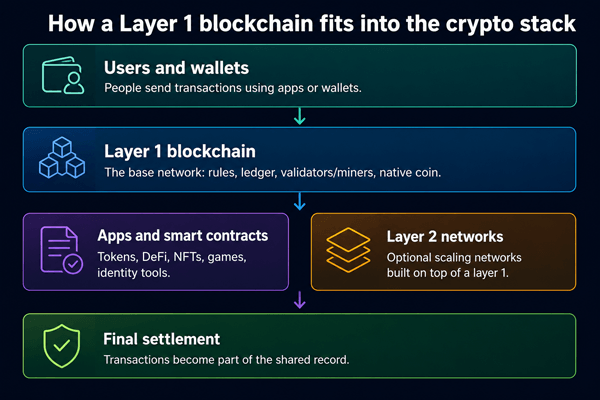
2. Simple Diagram: How Layer 1 Fits Into the Blockchain Stack
3. Why Are They Called “Layer 1”?
The word “layer” is used because blockchain systems are often built in levels. Layer 1 is the base layer. It handles the core ledger, transaction rules, security and final settlement. Layer 2 systems can be built above it to improve speed, reduce fees or support specialized use cases.
For example, Ethereum is a Layer 1 blockchain. Rollups built on Ethereum are Layer 2 networks because they process activity separately but ultimately rely on Ethereum for settlement and security assumptions. Bitcoin is also a Layer 1 blockchain. The Lightning Network is commonly described as a Layer 2 payment network built around Bitcoin.
4. How Layer 1 Blockchains Work
Although each blockchain has different design choices, most Layer 1 networks follow the same basic flow: a user creates a transaction, the transaction is shared with the network, validators or miners check it, the network agrees on the next block, and the accepted block becomes part of the blockchain history.
A blockchain is not a single company database. It is a shared record maintained by many computers. This is why public Layer 1 blockchains are often described as decentralized networks. No single server is supposed to decide everything alone.
4.1 Step-by-Step: What Happens When You Send a Layer 1 Transaction?
- You open a wallet and enter the receiving address, amount and network fee.
- Your wallet signs the transaction with your private key. This proves permission without revealing the private key.
- The transaction is broadcast to the blockchain network.
- Network participants check whether the transaction follows the rules, such as enough balance and a valid signature.
- A miner or validator includes the transaction in a block or similar data structure.
- The network reaches consensus and accepts the block.
- After enough confirmations or finality, the transaction is treated as settled.
5. Main Parts of a Layer 1 Blockchain
| Component | What it does | Why it matters |
|---|---|---|
| Ledger | Stores the history of transactions and balances. | Creates a shared record that users can verify. |
| Consensus | Helps the network agree on valid blocks. | Prevents double spending and conflicting histories. |
| Native coin | Pays transaction fees and often rewards validators or miners. | Gives the network an economic system. |
| Nodes | Computers that store, relay or verify blockchain data. | Improve transparency and resilience. |
| Validators/miners | Produce or confirm blocks depending on the design. | Protect the network and process transactions. |
| Smart contracts | Programs that run on some blockchains. | Enable apps such as DeFi, NFTs and DAOs. |
| Governance | The way upgrades and rule changes are proposed and adopted. | Affects decentralization, stability and future direction. |
6. Layer 1 vs Layer 2: What Is the Difference?
Layer 1 is the base blockchain. Layer 2 is usually a system built on top of a Layer 1 to make transactions faster or cheaper while still connecting back to the base chain in some way. The exact security model varies by design, so users should not assume every Layer 2 is equally safe.
| Feature | Layer 1 | Layer 2 |
|---|---|---|
| Role | Base settlement and security layer. | Scaling or specialized execution layer. |
| Examples | Bitcoin, Ethereum, Solana, Cardano. | Lightning Network, optimistic rollups, zk-rollups. |
| Fees | Can be higher during congestion. | Often lower, but depends on design and demand. |
| Security | Comes from the base network itself. | Often relies partly on the underlying Layer 1 plus its own mechanisms. |
| Best for | Final settlement, high-value transactions, core infrastructure. | Frequent smaller transactions, faster app use, lower-cost activity. |
7. Popular Examples of Layer 1 Blockchains
| Layer 1 | Main purpose | Consensus style | Common use cases |
|---|---|---|---|
| Bitcoin | Decentralized digital money and settlement. | Proof of Work mining. | Payments, store-of-value use, long-term settlement. |
| Ethereum | Programmable blockchain for smart contracts. | Proof of Stake validators. | DeFi, NFTs, stablecoins, DAOs, token issuance, Layer 2 settlement. |
| Solana | High-throughput smart contract platform. | Proof of Stake with Proof of History timing design. | Trading apps, consumer apps, NFTs, payments experiments. |
| Cardano | Research-driven smart contract platform. | Proof of Stake. | Tokens, smart contracts, identity and app development. |
| Avalanche | Smart contract platform with subnet-style architecture. | Proof of Stake. | DeFi, enterprise experiments, custom blockchain environments. |
| BNB Chain | EVM-compatible smart contract ecosystem. | Validator-based proof-of-staked-authority style design. | Trading, DeFi, tokens, consumer crypto apps. |
7.1 Bitcoin as a Layer 1
Bitcoin is the oldest and most recognized Layer 1 blockchain. It was designed as a peer-to-peer electronic cash system that allows value to be transferred without relying on a bank or central payment company. Bitcoin uses Proof of Work, where miners spend computing power to secure the network and add blocks.
Bitcoin is relatively limited in programmability compared with smart contract platforms, but that simplicity is also part of its appeal for users who value security, scarcity and conservative changes.
7.2 Ethereum as a Layer 1
Ethereum is a programmable Layer 1 blockchain. It allows developers to deploy smart contracts, which are blockchain-based programs that can manage tokens, lending markets, NFT collections, games and many other applications.
Ethereum moved from Proof of Work to Proof of Stake in September 2022 through an upgrade known as The Merge. This changed how the network is secured and greatly reduced its energy use compared with the old mining system.
7.3 Solana as a Layer 1
Solana is a Layer 1 blockchain focused on high throughput and low fees. Its design uses Proof of History as a timing method alongside consensus so the network can organize transactions efficiently.
The practical trade-off is that high-performance chains can be more demanding for infrastructure and may face different decentralization and reliability challenges than slower, more conservative networks.
8. What Can Layer 1 Blockchains Be Used For?
Layer 1 blockchains can be used for simple value transfers, token creation, decentralized finance, NFTs, gaming, identity systems, supply chain records, stablecoin settlement and decentralized organization tools. The best use case depends on the design of the chain.
A payment-focused Layer 1 may be good for sending value but weak for complex apps. A smart contract Layer 1 may support thousands of apps but face congestion, contract risk and user experience challenges.
9. Benefits of Layer 1 Blockchains
The biggest benefit of a well-designed Layer 1 blockchain is that it can provide a public, verifiable and censorship-resistant settlement layer. Users can check transactions, developers can build open applications, and the network can operate without a single company controlling the ledger.
Layer 1 blockchains can also create open financial infrastructure. Anyone with an internet connection and compatible wallet may be able to use the network, although access still depends on local laws, internet availability and user knowledge.
10. Key Risks and Limitations
Layer 1 blockchains are powerful, but they are not risk-free. Prices of native coins can be extremely volatile. Transactions can be irreversible. Smart contracts can contain bugs. Network fees can rise during congestion. Some networks are more centralized than their marketing suggests.
Users also face practical risks such as sending assets to the wrong address, choosing the wrong network, losing seed phrases, approving malicious smart contracts, or trusting fake apps. These mistakes can lead to permanent loss.
| Benefit | What it means in practice | Beginner note |
|---|---|---|
| Self-custody | Users can hold assets directly in their own wallets. | You are also responsible for protecting your seed phrase. |
| Transparency | Transactions and smart contracts can often be inspected publicly. | Public does not always mean easy to understand. |
| Open access | Many networks do not require bank-style account approval. | Local regulations and platform rules still matter. |
| Programmability | Smart contracts can automate financial and digital processes. | Code bugs and exploits are real risks. |
| Settlement finality | Confirmed transactions can become difficult or impossible to reverse. | Good for settlement, dangerous for mistakes. |
| Risk | Example | How to reduce it |
|---|---|---|
| Volatility | A native coin can fall sharply in price. | Do not treat crypto holdings as guaranteed savings. |
| Wrong network | Sending tokens on a network the receiver does not support. | Always confirm the exact chain before sending. |
| High fees | A busy network can make simple transfers expensive. | Check fees first and compare suitable networks. |
| Smart contract bugs | A DeFi protocol can be hacked or drained. | Use audited, established apps and avoid risking funds you cannot lose. |
| Centralization risk | A small set of validators, developers or companies may have outsized influence. | Research validator distribution, governance and dependencies. |
| Regulatory risk | Rules for exchanges, tokens or staking can change. | Follow local laws and use compliant services. |
| Custody risk | An exchange or wallet provider can fail or be hacked. | Use reputable providers and consider self-custody only after learning security basics. |
11. The Blockchain Trilemma: Why Layer 1 Design Is Hard
Layer 1 blockchains usually try to balance three goals: decentralization, security and scalability. Improving one area can make another harder. For example, a network can process more transactions by using more powerful hardware, but that may reduce the number of people who can run nodes. A network can be very decentralized and secure, but it may process fewer transactions and charge higher fees during demand spikes.
This is why there is no perfect Layer 1 for every use case. A beginner should compare chains by asking: What is this chain optimized for, and what does it sacrifice?
12. How Layer 1 Blockchains Make Money or Sustain Themselves
Public Layer 1 networks usually sustain themselves through transaction fees, block rewards, token issuance or a combination of these. Miners or validators receive rewards for helping secure the network. Users pay fees to include transactions. In some systems, fees may be burned, redirected to validators, or split according to the chain's economics.
Token economics matter because they affect incentives. A network with weak incentives may struggle to attract validators. A network with excessive token issuance may dilute holders. A network with low fees may be user-friendly but still needs a long-term security budget.
13. How to Evaluate a Layer 1 Blockchain Before Using It
Beginners should not choose a Layer 1 only because it is popular on social media. Practical evaluation is more useful than hype. Look at security history, uptime, developer activity, wallet support, exchange support, fee levels, app quality, decentralization, documentation and community behavior.
Also ask what you are using it for. Sending a small payment, storing long-term value, minting an NFT and using a DeFi lending app are very different activities with different risk profiles.
13.1 Beginner Checklist Before Using Any Layer 1 Blockchain
- Confirm the exact network name before sending funds.
- Send a small test transaction before moving a large amount.
- Use official wallet links and avoid sponsored-search scams.
- Write down your seed phrase offline and never share it.
- Understand whether you are paying fees in BTC, ETH, SOL, ADA or another native coin.
- Check whether the transaction is reversible. Most blockchain transactions are not.
- Research the app or smart contract before approving wallet permissions.
- Do not invest based only on speed, low fees or influencer claims.
14. Common Misconceptions About Layer 1 Blockchains
Misconception 1: All Layer 1 blockchains are basically the same. In reality, they differ greatly in security model, speed, fees, decentralization, governance and developer ecosystem.
Misconception 2: Faster always means better. Speed is useful, but it can come with trade-offs in hardware requirements, decentralization or reliability.
Misconception 3: A low fee chain is automatically safer for beginners. Low fees reduce transaction costs, but they do not remove smart contract risk, wallet risk, token risk or scam risk.
Misconception 4: Layer 1 upgrades are simple. Upgrades can be politically and technically complex because many independent participants must accept the new rules.
15. Layer 1 Blockchains and Smart Contracts
Some Layer 1 blockchains are smart contract platforms. This means developers can build programs that run on the blockchain. A smart contract can hold assets, execute trades, issue tokens, run lending rules or manage digital collectibles.
Smart contracts make blockchains more useful, but they also create new risks. A poorly written contract can lock funds, lose funds or be exploited. Even audited contracts can fail. Beginners should be careful with DeFi apps, bridges and unknown tokens.
16. Layer 1 Fees: Why They Change
Layer 1 fees usually change because block space is limited. When many users want transactions included at the same time, they may compete by paying higher fees. This is similar to rush-hour traffic: the road has limited capacity, and demand affects the cost of getting through quickly.
Different Layer 1s use different fee designs. Some prioritize low fees and high throughput. Others prioritize decentralization and security even if fees rise during heavy demand. There is no single fee model that works best for every use case.
17. Are Layer 1 Blockchains Safe?
A mature Layer 1 blockchain can be technically resilient, but user safety depends on many factors: network design, validator or miner incentives, software quality, wallet security, application risk and user behavior. Bitcoin and Ethereum have long operating histories, but that does not make every asset, app or transaction on related ecosystems safe.
The safest beginner mindset is to separate network risk from user risk. A blockchain may continue working, while a user can still lose money by signing a malicious transaction, buying a worthless token or sending funds to the wrong address.
18. Practical Real-World Scenarios
Scenario 1: You want to send crypto to a friend. A Layer 1 transaction may work, but you must confirm the right network, address and fee. A small test transfer is wise.
Scenario 2: You want to use a DeFi app. You may need a smart contract Layer 1 such as Ethereum or another compatible chain. The main risk is no longer just the blockchain; it includes the app's code, liquidity, oracle design and your wallet approvals.
Scenario 3: You want to hold a native coin long term. You need to understand volatility, custody and the purpose of the network. A strong technology story does not guarantee price performance.
Scenario 4: You are comparing two chains for a project. Look beyond transaction speed. Consider developer tools, wallet support, liquidity, reliability, security assumptions and long-term community health.
| Question | What to look for |
|---|---|
| Is the network secure? | Long operating history, strong consensus incentives, public incident record, quality clients. |
| Is it decentralized enough? | Number and distribution of validators or miners, node requirements, governance concentration. |
| Is it affordable to use? | Typical fees, congestion history, fee predictability. |
| Is the ecosystem useful? | Wallets, exchanges, apps, developer tools, documentation and liquidity. |
| What are the trade-offs? | Speed vs decentralization, low fees vs security budget, flexibility vs complexity. |
19. FAQs About Layer 1 Blockchains
19.1 Is Bitcoin a Layer 1 blockchain?
Yes. Bitcoin is a Layer 1 blockchain because it is a base network with its own ledger, miners, rules and native coin, BTC.
19.2 Is Ethereum a Layer 1 blockchain?
Yes. Ethereum is a Layer 1 blockchain and smart contract platform. Many Layer 2 networks and decentralized applications are built around Ethereum.
19.3 What is the main purpose of a Layer 1 blockchain?
Its main purpose is to provide the base ledger, consensus rules, security and settlement for transactions and applications.
19.4 What is the difference between a Layer 1 coin and a token?
A Layer 1 coin is native to its own blockchain, such as BTC or ETH. A token is usually issued through a smart contract on an existing blockchain, such as an ERC-20 token on Ethereum.
19.5 Can a Layer 1 blockchain be upgraded?
Yes, but upgrades can be difficult because many participants must accept new software or rules. Some networks upgrade more easily than others depending on governance and culture.
19.6 Are Layer 1 blockchains better than Layer 2 networks?
Not always. Layer 1s are usually better for base settlement and security. Layer 2s can be better for lower-cost and higher-frequency activity. The right choice depends on the use case.
19.7 Why do Layer 1 fees get expensive?
Fees can rise when many users compete for limited block space. Higher demand can make users pay more to have transactions included quickly.
19.8 What is the best Layer 1 blockchain?
There is no single best Layer 1 for everyone. Bitcoin, Ethereum, Solana and other chains optimize for different goals and carry different trade-offs.
19.9 Can I lose money using a Layer 1 blockchain?
Yes. You can lose money through market volatility, scams, wrong addresses, wrong networks, wallet compromise, smart contract bugs or failed projects.
19.10 Should beginners use Layer 1 blockchains directly?
Beginners can use them, but they should start slowly, learn wallet safety, send test transactions and avoid complex apps until they understand the risks.
20. Final Takeaway
Layer 1 blockchains are the base networks that make crypto systems possible. They process transactions, maintain the ledger, secure the network and provide final settlement. Bitcoin is a Layer 1 focused mainly on decentralized money. Ethereum is a Layer 1 focused on smart contracts and decentralized applications. Other Layer 1s, such as Solana, Cardano and Avalanche, make different design choices around speed, cost, decentralization and programmability.
For beginners, the most important lesson is that every Layer 1 has trade-offs. Do not judge a blockchain only by price, hype, speed or fees. Understand what it is built for, how it is secured, what risks it carries, and how to use it safely.
Sources Consulted and Checked
The following sources were consulted and checked while preparing this article for context and accuracy:
- Bitcoin white paper: Satoshi Nakamoto, “Bitcoin: A Peer-to-Peer Electronic Cash System,” bitcoin.org.
- Ethereum documentation: “The Merge,” ethereum.org, noting Ethereum’s Proof of Stake transition on September 15, 2022 and energy reduction estimate.
- Ethereum documentation: “What is layer 2?” ethereum.org, for Layer 2 context and scalability trade-offs.
- Solana white paper and Solana documentation, for Proof of History and high-performance blockchain design context.
Reader Advice
This article is provided for educational and informational purposes only. It is not personalized financial, investment, legal, tax, or other professional advice, and the blockchain examples mentioned are not recommendations. Crypto assets and blockchain applications involve significant risks, including price volatility, irreversible transactions, scams, software or smart-contract failures, custody loss, network disruption, and possible regulatory restrictions. Rules, policies, laws, fees, technical features, and statistics can change over time and may vary by country or region, so readers should verify important information through current official sources and seek appropriate professional advice before making financial, legal, tax, or high-risk decisions. Never use funds you cannot afford to lose.