What Are Altcoins? Meaning, How It Works, Examples, Benefits and Risks
Key Takeaways
- Altcoins are cryptocurrencies and tokens other than Bitcoin. They include smart contract platforms, stablecoins, exchange tokens, DeFi tokens, gaming tokens, privacy coins, meme coins and many smaller niche projects.
- Some altcoins aim to solve real problems, such as faster payments, decentralized applications, cheaper transactions or stable digital dollars. Others are mainly speculative and may have little practical use.
- Altcoins can rise quickly, but they can also fall sharply, lose liquidity, suffer hacks, face regulatory issues or become abandoned projects.
- Beginners should focus on understanding the project, token supply, use case, security, liquidity, team transparency, custody risks and personal risk limits before buying.
1. What Are Altcoins?
Altcoins are alternative cryptocurrencies to Bitcoin. The word “altcoin” comes from “alternative coin.” In simple terms, if Bitcoin is the original cryptocurrency, altcoins are the thousands of other crypto assets that came after it.
However, “altcoin” is a broad label. It can describe major blockchain networks such as Ethereum, payment-focused coins such as Litecoin, stablecoins such as USDC, exchange tokens, governance tokens, meme coins and many smaller projects. Because the category is so wide, it is not useful to treat every altcoin as equally risky or equally promising.
A practical way to understand altcoins is this: Bitcoin was designed mainly as decentralized digital money with a fixed supply. Many altcoins try to do something different. Some add smart contracts. Some focus on lower transaction costs. Some are built for trading, gaming, lending, privacy, payments, identity, storage or community speculation.
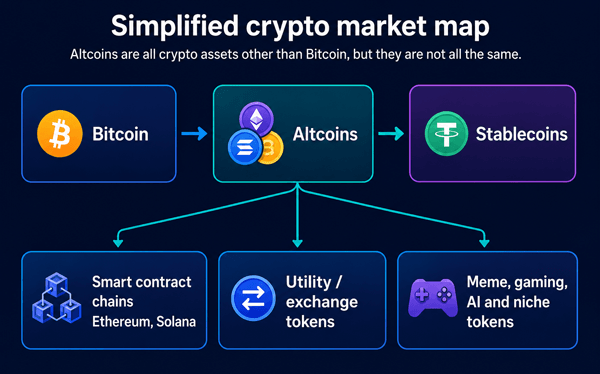
Diagram: A simplified view of where altcoins fit in the crypto market.
2. Altcoins in One Simple Table
| Term | Simple meaning | Example |
|---|---|---|
| Bitcoin | The first and largest cryptocurrency by market value; often treated as the benchmark for crypto. | BTC |
| Altcoin | Any crypto asset other than Bitcoin. | ETH, SOL, XRP, ADA, DOGE |
| Token | A crypto asset built on top of another blockchain rather than running its own chain. | ERC-20 tokens on Ethereum |
| Stablecoin | A crypto token designed to track a stable asset such as the US dollar. | USDC, USDT, DAI |
| Meme coin | A coin or token driven mostly by internet culture, community and speculation. | DOGE, SHIB and newer themed tokens |
3. How Do Altcoins Work?
Altcoins work by using blockchain or distributed ledger technology. A blockchain is a shared digital record that stores transactions across many computers. Instead of one company keeping the only copy of the database, many independent participants help verify and maintain the network.
The exact design depends on the altcoin. Some altcoins operate on their own blockchain. Others are tokens created on existing networks such as Ethereum, Solana, BNB Chain, Polygon or other smart contract platforms.
3.1 Own blockchain vs token on another blockchain
An altcoin such as Litecoin or Solana has its own blockchain. It has its own rules, validators or miners, transaction fees and native coin. A token such as many DeFi or gaming assets may not have its own blockchain. Instead, it uses another network’s security and infrastructure.
| Feature | Coin with own blockchain | Token on another blockchain |
|---|---|---|
| Network | Runs on its own blockchain | Runs on a host blockchain |
| Fees | Paid in the network’s native coin | Usually paid in the host network’s native coin |
| Security | Depends on its own validators/miners and network design | Depends partly on the host chain and smart contract security |
| Example | ETH, SOL, LTC | Many ERC-20 tokens, DeFi tokens and gaming tokens |
3.2 Consensus: how transactions are verified
Most crypto networks need a way to agree on which transactions are valid. This is called a consensus mechanism. Bitcoin uses proof of work. Many altcoin networks use proof of stake or variations of it. In proof of stake, validators lock up crypto as collateral and help verify transactions. If they act dishonestly, they can lose part of that stake. Ethereum describes proof of stake as a system where validators put ETH at risk to secure the network and validate new blocks.
3.3 Smart contracts and decentralized apps
Some altcoins are designed for smart contracts. A smart contract is a program stored on a blockchain that can run automatically when certain conditions are met. Ethereum’s documentation describes a smart contract as code and data that lives at a specific address on Ethereum. This is why altcoins are often linked with decentralized finance, NFTs, gaming, decentralized exchanges and on-chain identity tools.
3.4 Token supply and incentives
Every altcoin has tokenomics: the rules for supply, distribution and incentives. Tokenomics can affect price behavior. A project with high inflation, large insider allocations or frequent token unlocks can face selling pressure even if the technology is interesting. A project with transparent supply, real demand and balanced incentives may be easier to evaluate.
4. Main Types of Altcoins With Examples
Altcoins are easier to understand when grouped by purpose. The examples below are educational examples, not recommendations.
| Type of altcoin | What it tries to do | Common examples | Main risk to understand |
|---|---|---|---|
| Smart contract platforms | Run decentralized apps, tokens and smart contracts. | Ethereum (ETH), Solana (SOL), Cardano (ADA), Avalanche (AVAX) | Competition, outages, high fees, security bugs, changing developer activity |
| Stablecoins | Track the value of fiat currency or another asset. | USDC, USDT, DAI | Reserve quality, redemption risk, issuer risk, regulation, depegging |
| Payment coins | Move value quickly or cheaply. | Litecoin (LTC), XRP, Stellar (XLM) | Adoption risk, regulatory risk, competition from stablecoins and banks |
| Exchange tokens | Provide fee discounts, rewards or utility inside an exchange ecosystem. | BNB and other exchange-linked tokens | Exchange dependency, regulatory risk, centralized control |
| DeFi tokens | Govern or incentivize lending, borrowing, trading or yield protocols. | AAVE, UNI, COMP | Smart contract hacks, liquidity risk, governance attacks, unsustainable yields |
| Gaming and metaverse tokens | Power in-game assets, rewards or digital worlds. | AXS, SAND, GALA | Weak game demand, token inflation, trend cycles |
| Privacy coins | Try to make transactions more private. | Monero (XMR), Zcash (ZEC) | Exchange delistings, regulatory scrutiny, limited access |
| Meme coins | Driven by community, humor, culture or viral attention. | DOGE, SHIB and many newer tokens | Extreme volatility, hype cycles, low utility, scam copycats |
5. Why Do Altcoins Exist?
Altcoins exist because developers, investors and communities wanted to experiment beyond Bitcoin’s original design. Some altcoins try to improve speed or lower fees. Others add programmability, privacy, governance, stable-value payments or special-purpose apps. The key point is that altcoins are experiments in digital networks and economic incentives.
A useful comparison is the early internet. Many websites, protocols and online businesses were created, but not all survived. Some became important infrastructure, while many disappeared. Altcoins have a similar experimental character: a few may become useful long-term networks, while many may lose relevance or fail.
6. Altcoins vs Bitcoin: Key Differences
| Factor | Bitcoin | Altcoins |
|---|---|---|
| Main role | Often viewed as decentralized digital money and a store-of-value style asset. | Can serve many roles: smart contracts, apps, payments, governance, gaming, stablecoins or speculation. |
| Age and track record | Launched in 2009 and has the longest operating history. | Ranges from long-running major networks to brand-new tokens launched yesterday. |
| Supply rules | Fixed maximum supply of 21 million BTC. | Supply models vary widely: fixed, inflationary, burn-based, rebasing or controlled by governance. |
| Risk profile | Still risky and volatile, but generally more established than most crypto assets. | Often higher risk due to smaller markets, weaker liquidity, technical risk and project failure risk. |
| Innovation pace | Conservative design changes and slower upgrades. | Often faster experimentation, but faster experimentation can also mean more bugs and failures. |
7. Benefits of Altcoins
Altcoins are not automatically better than Bitcoin, but they can offer different benefits depending on the project.
- More use cases: Altcoins can support smart contracts, decentralized exchanges, lending protocols, gaming items, stablecoin payments and other applications.
- Lower transaction costs in some networks: Certain altcoins are designed for cheaper or faster transfers, although fees can change when networks are busy.
- Developer experimentation: Altcoins allow new consensus systems, scaling designs, privacy features and governance models to be tested in public.
- Access to specific ecosystems: Some tokens provide voting rights, fee discounts, staking rewards or app-specific utility.
- Potential upside from early adoption: Smaller projects can grow quickly if they find real demand, but this also comes with much higher risk.
8. Risks of Altcoins
Altcoins can be extremely risky. FINRA warns that crypto assets can be exceptionally risky and volatile, and the SEC has also warned investors that crypto asset securities can be speculative and may lack important investor protections. Beginners should take these warnings seriously.
- Volatility risk: Many altcoins can lose 50%, 80% or even 99% of their value during bear markets or after hype fades.
- Liquidity risk: A coin may look valuable on paper but be hard to sell without moving the price, especially on small exchanges.
- Project failure risk: Teams may stop building, run out of funding, miss deadlines or fail to attract users.
- Smart contract risk: Bugs, hacks or poor audits can lead to permanent loss of funds.
- Tokenomics risk: Large insider allocations, token unlocks or high inflation can create selling pressure.
- Regulatory risk: Exchanges may restrict, delist or change access to certain tokens if laws or enforcement priorities change.
- Custody risk: If you keep coins on an exchange, you rely on that platform. If you self-custody, you must protect your seed phrase and wallet security.
- Scam risk: Fake teams, copied whitepapers, pump-and-dump groups, malicious links and fake airdrops are common in altcoin markets.
9. How to Evaluate an Altcoin Before Buying
A practical evaluation process can help beginners avoid the most obvious mistakes. It cannot remove risk, but it can improve decision quality.
- Start with the problem: What real problem does the project solve? Is blockchain actually needed, or is the token just attached to a vague idea?
- Check the use case: Who uses the network or app today? Look for real users, developers, transactions, revenue or partnerships that can be verified.
- Study tokenomics: What is the total supply? How much is circulating? Who owns the rest? When do locked tokens unlock?
- Review liquidity: Is the coin traded on reputable exchanges? Is there enough daily volume? Can you exit without huge slippage?
- Look at security: Has the code been audited? Have there been hacks? Is the bridge, app or protocol complex?
- Assess decentralization: Who controls upgrades, validators, treasury funds and governance decisions?
- Read the risks, not just the marketing: Serious projects explain limitations. Weak projects only promise growth.
- Compare competitors: A good idea is not enough. Ask why this project should win against larger, better-funded alternatives.
- Decide position size before buying: The safest research still cannot guarantee success. Risk management matters more than confidence.
10. Altcoin Red Flags Beginners Should Not Ignore
- Guaranteed profit claims or “risk-free” yield.
- Anonymous team with no credible reason for anonymity.
- Pressure to buy quickly before a “listing,” “burn,” “partnership” or “secret announcement.”
- Token supply controlled by a few wallets.
- No working product, no public code and no clear roadmap.
- Fake influencer promotion, copied websites or unrealistic return screenshots.
- Locked liquidity claims that cannot be verified.
- A chart that only went up because insiders or bots created artificial demand.
- A community that attacks basic questions instead of answering them.
11. Real-World Scenarios: How Altcoins Are Used
11.1 Scenario 1: Using a stablecoin for international payment
A freelancer receives payment in a US dollar stablecoin because bank transfers are slow or expensive. The stablecoin arrives quickly, but the freelancer still must consider exchange fees, local tax rules, withdrawal options, wallet security and whether the stablecoin can maintain its peg.
11.2 Scenario 2: Using ETH to interact with a decentralized app
A user wants to use a decentralized exchange on Ethereum. They need ETH to pay gas fees. Even if they are swapping another token, the network fee is paid in ETH. This shows why some altcoins have utility beyond price speculation.
11.3 Scenario 3: Buying a meme coin after social media hype
A beginner sees a meme coin trending and buys after a large price move. The price rises for a short time, then early buyers sell. The coin has no real demand, liquidity dries up and the beginner is left holding a token that is difficult to sell. This is one of the most common altcoin mistakes.
12. Best Practices for Beginners
- Use a written plan: Decide why you are buying, how much you can risk and when you would exit before emotions take over.
- Start small: If you are learning, small amounts reduce the cost of mistakes.
- Diversify carefully: Owning many weak altcoins is not true diversification. Quality matters more than quantity.
- Avoid leverage: Borrowed money can turn normal volatility into a forced loss.
- Use reputable platforms: Check security history, withdrawal rules, fees and whether the exchange is allowed to operate in your region.
- Protect wallets: Store seed phrases offline, use hardware wallets for larger amounts and beware of fake support messages.
- Do not chase green candles: Buying after a huge move often means taking risk from earlier buyers.
- Keep records: Track purchase price, fees, sales and transfers for tax and personal performance review.
- Re-check your thesis: If the reason you bought is no longer true, do not hold only because the price is down.
13. Common Mistakes and Misconceptions
| Misconception | More accurate view |
|---|---|
| “Cheap price means cheap coin.” | A token priced at $0.01 can still be expensive if the supply is huge. Market capitalization and fully diluted valuation matter more than unit price. |
| “All altcoins are the next Bitcoin.” | Most altcoins will not match Bitcoin’s adoption, liquidity or track record. Many will fail. |
| “A strong community means low risk.” | Community can help adoption, but it cannot fix bad tokenomics, weak security or no real use case. |
| “Staking rewards are free money.” | Rewards may be offset by token inflation, price drops, lockup periods or validator risks. |
| “Audited means safe.” | Audits reduce some risks but do not guarantee safety. Hacks can still happen after audits. |
14. Should Beginners Invest in Altcoins?
Beginners should not rush into altcoins just because they see fast price moves online. Altcoins can be useful, innovative and profitable for some investors, but they are also one of the easiest areas to lose money through hype, poor research, scams or emotional trading.
A reasonable beginner approach is to learn first, avoid leverage, keep position sizes small, and understand that even strong altcoins can experience deep drawdowns. If you cannot explain what the token does, why it has value, who uses it, what could go wrong and how you will manage risk, you are probably not ready to buy it.
15. Altcoin Safety Checklist
| Question | Why it matters | Pass / fail signal |
|---|---|---|
| Can I explain the project in one minute? | If you cannot explain it simply, you may be relying on hype. | Pass: clear use case. Fail: vague buzzwords. |
| Is there real liquidity? | Low liquidity makes it hard to sell safely. | Pass: strong volume on reputable exchanges. Fail: tiny pools only. |
| Who controls the supply? | Insider control can create sudden selling pressure. | Pass: transparent distribution. Fail: few wallets hold most tokens. |
| Is there a working product? | A live product is easier to evaluate than promises. | Pass: active users or developers. Fail: only roadmap claims. |
| What are the main risks? | Every serious investment has risks. | Pass: risks are known and manageable. Fail: promoters deny risks. |
| How will I protect the asset? | Custody mistakes can be irreversible. | Pass: secure wallet plan. Fail: seed phrase stored online. |
16. FAQs About Altcoins
16.1 Are altcoins the same as tokens?
Not always. A coin usually has its own blockchain. A token is usually built on another blockchain. Both can be called altcoins if they are not Bitcoin.
16.2 Is Ethereum an altcoin?
Yes. Ethereum is an altcoin because it is not Bitcoin. It is also the largest smart contract platform by ecosystem importance and has its own native asset, ETH.
16.3 Are stablecoins altcoins?
Yes, stablecoins are generally considered altcoins because they are crypto assets other than Bitcoin. They are different from most altcoins because they try to maintain a stable value, often against the US dollar.
16.4 Can altcoins make you rich?
Some altcoins have produced large gains, but many have also collapsed. Large potential gains usually come with large risk. Beginners should avoid treating altcoins as guaranteed wealth-building tools.
16.5 What is the safest altcoin?
There is no risk-free altcoin. Larger, more liquid and more established assets may be easier to research, but they can still fall sharply. Safety depends on market risk, custody, regulation, technology and your own behavior.
16.6 How many altcoins are there?
There are thousands of crypto assets listed across market data sites. The number changes constantly because new tokens launch and old projects disappear or become inactive.
16.7 What is altcoin season?
Altcoin season is a market phrase used when many altcoins outperform Bitcoin for a period. It is not a guaranteed cycle and can end quickly.
16.8 Should I buy altcoins during a market crash?
Lower prices do not automatically mean good value. During crashes, weak projects may never recover. Use research, risk limits and a plan rather than buying only because prices are down.
16.9 Do I need a wallet for altcoins?
You can hold altcoins on an exchange or in a self-custody wallet. Exchanges are easier but involve platform risk. Self-custody gives more control but requires careful seed phrase security.
16.10 Are altcoins legal?
Legality and access depend on your country and the specific asset or platform. Regulations can change, so check local rules and use compliant services.
17. Conclusion: The Practical Way to Think About Altcoins
Altcoins are not one single thing. They are a broad category of crypto assets with different designs, use cases and risk levels. Some support major blockchain ecosystems and real applications. Some are stablecoins used for payments and trading. Some are experimental networks. Others are speculative tokens with little more than hype.
The best beginner mindset is curiosity plus caution. Learn what the coin does, how it works, who uses it, how supply is managed and what could go wrong. Avoid promises, pressure and leverage. In altcoins, protecting your downside is just as important as looking for upside.
Sources Consulted and Checked
The following sources were consulted and checked while preparing this article and supporting its accuracy.
- Investor.gov / SEC Office of Investor Education and Advocacy: Crypto Asset Custody Basics for Retail Investors, Dec. 12, 2025.
- Investor.gov: Exercise Caution with Crypto Asset Securities, Investor Alert, Mar. 23, 2023.
- FINRA: Crypto Assets investor education page.
- Ethereum.org: Proof-of-Stake and Introduction to Smart Contracts documentation.
- CoinGecko: Global Cryptocurrency Market Cap Charts, accessed June 24, 2026.
- CoinMarketCap: Bitcoin Dominance and cryptocurrency market data pages, accessed June 24, 2026.
- Reuters: Bank of England stablecoin regulatory framework update, June 22, 2026.
Reader Advice
This article is provided for educational and informational purposes only and does not constitute personalized financial, investment, legal, tax or other professional advice or a recommendation to buy, sell or hold any crypto asset. Altcoins are highly volatile and speculative, and losses, including the loss of your entire investment, are possible. Rules, policies, laws, market data and statistics can change over time and may vary by country or region, so verify current information through official regulators, tax authorities and service providers before making a decision. Consider your financial circumstances, risk tolerance, security and custody arrangements, and seek advice from a qualified professional where appropriate.