What Is the S&P 500? How It Works and Why It Matters
- The S&P 500 is an index that tracks 500 leading U.S. publicly traded companies and is widely used as a snapshot of the U.S. large-cap stock market.
- It is float-adjusted market-cap weighted, which means larger companies have a bigger effect on its movement than smaller companies.
- You cannot buy the index directly, but beginners commonly access it through low-cost S&P 500 ETFs or index mutual funds.
- It can be a strong core holding, but it is not risk-free: it is stock-heavy, U.S.-focused, and can fall sharply during bear markets.
- For most beginners, the practical question is not “Will the S&P 500 go up tomorrow?” but “Does this fit my goal, time horizon, risk tolerance, fees, and overall asset allocation?”
1. What Is the S&P 500? A Simple Definition
The S&P 500, short for the Standard & Poor’s 500, is a stock market index that follows 500 major public companies in the United States. Think of it as a large “scoreboard” for many of America’s biggest businesses. When people say “the market was up today,” they often mean the S&P 500 went up.
An index is not a company, app, bank account, or investment fund. It is a measurement. The S&P 500 tells you how a selected group of large U.S. stocks is performing. Because these companies operate across technology, finance, health care, consumer goods, industrials, energy, utilities, real estate, and other areas, the index gives a broad view of large U.S. business performance.
S&P Dow Jones Indices describes the S&P 500 as measuring the large-cap segment of the U.S. market and being composed of 500 constituent companies. Its factsheet also says the index covers about 80% of available U.S. market capitalization. That is why investors, analysts, financial advisors, retirement planners, journalists, and business owners watch it so closely.
1.1 An easy example
Imagine you want to know whether the top students in a large school are improving, but you do not have time to study every student. You create a list of 500 leading students, track their scores, and update the list when needed. The S&P 500 works in a similar way for large U.S. companies. It does not include every U.S. stock, but it includes enough large companies to be a useful market gauge.
2. How the S&P 500 Works
2.1 It is selected by rules and a committee
The S&P 500 is not simply “the 500 biggest companies.” S&P Dow Jones Indices uses eligibility rules and an index committee. Companies generally need to be U.S. companies, trade on eligible U.S. exchanges, meet size and liquidity requirements, have adequate public float, and satisfy profitability standards. As of the current S&P methodology, the eligibility market-cap threshold for new additions is USD 22.7 billion, with additional float-adjusted market-cap requirements.
The committee approach matters because it prevents the index from being a purely mechanical list that changes every time one company briefly becomes larger than another. It also means a company can be huge but still not qualify immediately if it does not meet eligibility rules.
2.2 It is market-cap weighted
The S&P 500 is weighted by float-adjusted market capitalization. Market capitalization means company size in the stock market: share price multiplied by shares outstanding. Float-adjusted means the index focuses on shares that are realistically available for public trading, not shares tightly held by insiders, governments, or controlling owners.
This is one of the most important beginner concepts. In the S&P 500, bigger companies count more. If a giant technology company rises 3%, it can move the index more than a smaller company rising 20%. This is why headlines often say that a few mega-cap stocks “led” or “dragged” the market.
2.3 It is calculated using a divisor
The simple idea is: add up the float-adjusted market value of the companies, then divide by a special number called the divisor. The divisor is adjusted for corporate actions such as stock splits, share issuances, and index changes so the index does not jump for non-economic reasons. In plain English, the divisor keeps the scoreboard consistent over time.
2.4 It changes over time
The S&P 500 is not frozen. Companies can be added or removed. Share counts and weights are updated. Sectors become more or less important. This is why the index is sometimes called a living benchmark. It evolves as the U.S. large-cap market changes.
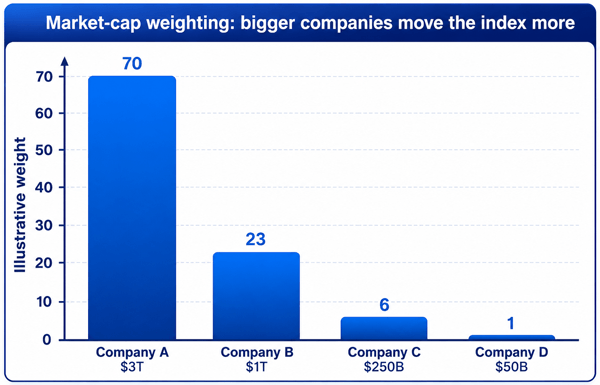
Figure 1: Market-cap weighting means the largest companies carry the most influence.
2.5 Quick comparison: price-weighted vs market-cap weighted
| Feature | S&P 500 | Dow Jones Industrial Average |
|---|---|---|
| Weighting method | Float-adjusted market-cap weighted | Price weighted |
| Number of companies | 500 constituent companies | 30 companies |
| Best used for | Broad large-cap U.S. equity benchmark | Historic blue-chip market snapshot |
| Beginner takeaway | More diversified and more representative of large U.S. stocks | Famous, but less broad and more affected by high share prices |
3. Why the S&P 500 Matters
3.1 It is a benchmark for performance
A benchmark is a measuring stick. If a U.S. large-cap mutual fund returns 7% while the S&P 500 returns 12%, investors may ask why they paid an active manager to lag a low-cost index alternative. This is one reason the S&P 500 is central to conversations about active vs passive investing.
The SPIVA U.S. Year-End 2025 report found that 79% of active large-cap U.S. equity funds underperformed the S&P 500 in 2025. This does not mean active management can never work. It does mean beginners should be very careful about paying high fees for a promise of beating the market.
3.2 It is a common core holding
Many investors use an S&P 500 index fund or S&P 500 ETF as the core stock portion of a portfolio. A “core holding” means the stable center of the plan, not a short-term trading idea. The appeal is simple: broad exposure, low cost, transparency, liquidity, and a long public history.
3.3 It influences retirement planning
The S&P 500 is often used in retirement accounts, 401(k)-style plans, IRAs, taxable brokerage accounts, and robo-advisor portfolios. It is also used in financial planning assumptions, risk questionnaires, and portfolio model comparisons. When people estimate long-term stock returns, they often look at S&P 500 history, while remembering that past performance does not guarantee future results.
3.4 It affects the news and investor psychology
When the S&P 500 hits a record, falls into a correction, or enters a bear market, it becomes a major news story. Beginners should understand that daily index headlines are not instructions. A headline can tell you what happened. It cannot tell you your personal financial plan.
4. How Beginners Can Invest in the S&P 500
You cannot buy the S&P 500 index itself. You can buy funds designed to track it. The two most common choices are S&P 500 ETFs and S&P 500 index mutual funds.
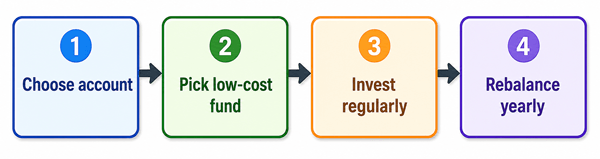
Figure 2: A simple beginner path for using an S&P 500 fund responsibly.
| Choice | What it means | Best for | Watch out for |
|---|---|---|---|
| S&P 500 ETF | A fund traded on an exchange like a stock | Brokerage accounts, flexible buying/selling, usually low expense ratios | Bid-ask spread, temptation to trade too often |
| S&P 500 index mutual fund | A mutual fund that tracks the index | Retirement plans, automatic investing, fractional investing | Minimum investment, end-of-day pricing |
| Individual S&P 500 stocks | Buying selected companies directly | Investors who want company-specific exposure | Less diversification, higher research burden, more single-stock risk |
4.1 Step-by-step beginner process
- Define the goal. Are you investing for retirement, a house deposit, education, or general long-term wealth? Money needed in the next few years usually should not be fully exposed to stocks.
- Choose the account type. A taxable brokerage account offers flexibility. A retirement account may offer tax advantages. The best account depends on your country, tax situation, and purpose.
- Compare low-cost funds. Look at expense ratio, tracking error, assets under management, trading volume for ETFs, tax efficiency, and whether the fund uses full replication or sampling.
- Decide the portfolio role. The S&P 500 can be the U.S. large-cap stock piece. It may need to be balanced with international stocks, bonds, cash, or other assets depending on your plan.
- Automate contributions. Many beginners do better with a consistent monthly contribution than with emotional buying and selling based on news.
- Rebalance periodically. If stocks rise strongly, your portfolio may become riskier than planned. Rebalancing means bringing it back to your target mix.
5. Practical Example: How an S&P 500 ETF Might Fit a Beginner Portfolio
Suppose Sara is 28, has an emergency fund, no high-interest debt, and is investing for retirement 30+ years away. She wants something simple and low maintenance. She might choose a portfolio such as 70% S&P 500 index fund, 20% international stock index fund, and 10% bond fund. This is only an example, not a recommendation. A different person may need a very different mix.
Now suppose Ali is 62 and plans to use the money in three years. A 100% S&P 500 portfolio could expose him to a major downturn right before he needs the cash. He may need more bonds, cash, or a more conservative allocation. The same index can be useful for one investor and too risky for another.
6. Important S&P 500 Facts Beginners Should Know
| Fact | Why it matters |
|---|---|
| It tracks large U.S. companies | It is not a total global stock market fund. |
| It is cap-weighted | A few very large companies can drive a lot of performance. |
| It includes multiple sectors | It provides sector diversification, but sector weights are not equal. |
| It pays dividends through funds | Index funds generally pass through dividends, but timing and tax treatment vary. |
| It can fall sharply | It is still a stock investment; bear markets are part of the experience. |
| Low fees matter | An index fund can underperform the index because of expenses, trading costs, and tracking error. |
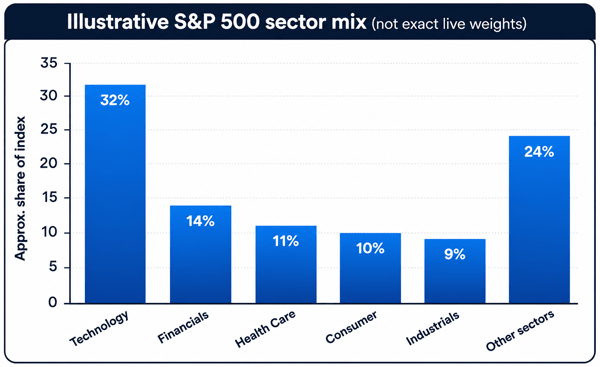
Figure 3: Original illustrative sector chart. Actual S&P 500 sector weights change over time.
7. Benefits of the S&P 500
7.1 Easy diversification
Instead of researching hundreds of companies yourself, one S&P 500 fund can give exposure to many leading U.S. companies. This does not remove risk, but it reduces dependence on a single company.
7.2 Low cost
Many S&P 500 index funds and ETFs charge very low expense ratios. Lower cost does not guarantee higher returns, but every dollar not paid in fees remains available to compound for the investor.
7.3 Transparency
You generally know what the fund is trying to do: track the S&P 500. This is simpler than evaluating an active manager’s strategy, judgment, trading style, and turnover.
7.4 Liquidity and availability
S&P 500 ETFs are widely traded, and S&P 500 index mutual funds are common in retirement plans. That makes implementation easier for beginners.
8. Risks and Limitations
8.1 It is not globally diversified
The S&P 500 is U.S.-focused. Many great companies are outside the United States. A beginner who owns only the S&P 500 is making a large bet on U.S. large-cap stocks.
8.2 It can be concentrated in mega-cap companies
Because it is cap-weighted, the largest companies can dominate returns. This can be helpful when mega-cap leaders perform well, but painful when they fall together.
8.3 It can lose money for years
Stocks do not rise in a straight line. Investors have lived through the dot-com crash, the global financial crisis, the COVID-19 crash, inflation shocks, and other painful periods. A beginner should be emotionally and financially prepared for volatility before investing.
8.4 An index fund is not exactly the index
The SEC warns that index funds may underperform their target index because of fees, expenses, trading costs, and tracking error. This is why expense ratio and tracking quality matter.
8.5 Valuation matters for future returns
The S&P 500 can be a good long-term tool and still be expensive at a particular moment. High valuations do not mean an immediate crash is certain, but they can reduce future expected returns. Beginners should avoid treating any index as guaranteed money.
9. Common Beginner Mistakes
| Beginner mistake | Why it hurts | Better practice |
|---|---|---|
| Buying because the market is at a record high | Can lead to emotional performance chasing | Use a written plan and invest regularly |
| Selling after a scary headline | Locks in losses and breaks the plan | Review time horizon and emergency fund first |
| Ignoring fees | Small fees compound over decades | Compare expense ratios and trading costs |
| Owning only S&P 500 and thinking it is “everything” | Misses international stocks, bonds, and cash needs | Build a full asset allocation |
| Trying to beat the index every month | Encourages overtrading | Judge progress against goals, not daily moves |
10. S&P 500 vs Other Popular Indexes
| Index | What it tracks | Beginner-friendly interpretation |
|---|---|---|
| S&P 500 | 500 leading U.S. large-cap companies | Core U.S. large-company benchmark |
| Nasdaq-100 | 100 large non-financial companies listed on Nasdaq | More growth/technology-heavy; less diversified by sector |
| Dow Jones Industrial Average | 30 major U.S. companies | Famous but narrow and price-weighted |
| Russell 2000 | Small-cap U.S. companies | More small-company exposure, often more volatile |
| Total U.S. Stock Market Index | Large, mid, small, and micro-cap U.S. stocks | Broader U.S. exposure than S&P 500 |
| Global stock index | Stocks across many countries | Better global diversification |
11. How to Evaluate an S&P 500 Fund Before Buying
A beginner does not need to become a Wall Street analyst, but they should know what to check before choosing a fund.
| Checklist item | What to look for |
|---|---|
| Expense ratio | Lower is usually better for the same exposure. |
| Tracking difference | How closely the fund matched the S&P 500 after fees. |
| Assets and liquidity | Larger, more liquid ETFs may trade with tighter spreads. |
| Tax efficiency | ETFs may be tax efficient in some accounts; rules vary by country. |
| Dividend handling | Understand distribution schedule and reinvestment options. |
| Account fit | Some funds are easier in retirement plans; others are better in brokerage accounts. |
| Provider reputation | Look for established fund providers with clear disclosures. |
12. Frequently Asked Questions
12.1 Is the S&P 500 safe?
It is diversified across many large companies, but it is not safe in the way a bank deposit or Treasury bill may be considered safer. It can decline significantly. It is best suited for money with a long time horizon and a tolerance for volatility.
12.2 Can beginners invest in the S&P 500?
Yes, many beginners use S&P 500 index funds or ETFs because they are simple, diversified, and often low cost. The key is to use them as part of a plan, not as a gamble.
12.3 Is the S&P 500 better than picking stocks?
For many beginners, an S&P 500 fund is more practical than picking stocks because it reduces single-company risk and research burden. Experienced investors may still buy individual stocks, but they should understand the extra risk.
12.4 What is the minimum amount needed?
It depends on the broker and fund. Many platforms now support fractional shares or low-minimum mutual funds, so beginners may be able to start with a small amount. Always check platform fees and local rules.
12.5 Should I invest all my money in the S&P 500?
Not usually. Emergency savings, short-term goals, bonds, cash, international stocks, and personal risk tolerance all matter. The S&P 500 can be a strong building block, but it is not a complete financial plan for everyone.
12.6 Does the S&P 500 include dividends?
The commonly quoted S&P 500 price index does not include reinvested dividends. Total return versions include dividends. Funds may distribute dividends or reinvest them depending on fund structure and account settings.
13. Bottom Line
The S&P 500 is one of the clearest and most useful ways to understand the U.S. large-cap stock market. It is a market-cap-weighted index of 500 leading U.S. companies, widely used as a benchmark, investment building block, and economic signal. For beginners, its real value is not that it predicts tomorrow. Its value is that it offers a simple, low-cost way to participate in the long-term growth of many major U.S. businesses.
The honest approach is to treat the S&P 500 as a tool. Learn how it works, compare fund costs, understand the risks, avoid emotional trading, and fit it into a portfolio that matches your goals. That is how a beginner can use the S&P 500 wisely.
Sources Consulted and Checked
These sources were consulted and checked while preparing this article to support its accuracy, clarity, and reliability.
- S&P U.S. Indices Methodology - S&P Dow Jones Indices
- S&P 500 Factsheet - S&P Dow Jones Indices
- Index Mathematics Methodology - S&P Dow Jones Indices
- Index Funds - SEC Investor.gov
- SPIVA U.S. Year-End 2025 - S&P Dow Jones Indices
- What is an index fund? - Vanguard
Reader Advice
This article is provided solely for educational and informational purposes and does not constitute personalized financial, investment, tax, legal, or accounting advice. The examples are illustrative only and should not be treated as recommendations or guarantees of results. Before making any financial or investment decision, readers should consider their own objectives, time horizon, financial circumstances, and tolerance for risk, and seek advice from a suitably qualified professional where appropriate. Index methodologies, eligibility thresholds, fund terms, fees, tax rules, regulations, market data, and other facts or figures may change over time and may vary by country, account type, provider, and individual circumstances.
Readers should therefore verify current information directly through official regulators, index providers, fund documents, brokers, tax authorities, and other authoritative sources. Past performance does not guarantee future results, and all investments involve risk, including the possible loss of principal.