Can the S&P 500 Make You Rich? A Realistic Look at Long-Term Wealth
1. The short answer: yes, but not quickly and not magically
The S&P 500 can help ordinary people build serious long-term wealth, but it does not make people rich overnight. The realistic path is simple: buy a low-cost S&P 500 index fund or ETF, add money consistently, reinvest dividends, keep fees low, avoid panic selling, and give compounding many years to work.
That sounds almost too plain, which is why many beginners ignore it. They look for the next hot stock, crypto trade, penny stock, or “secret” investing strategy. But the S&P 500 is powerful because it gives you ownership in many of the largest and most profitable public companies in the United States through one investment. It is not exciting every day. It is not risk-free. But for long-term investors, boring can be very effective.
A realistic expectation is this: the S&P 500 may help you become wealthy if you invest enough money, stay invested long enough, and do not need the money during a market crash. It probably will not make you rich if you invest very small amounts for only a few years, sell whenever the market drops, or expect guaranteed returns.
| Beginner question | Honest answer |
|---|---|
| Can the S&P 500 make me rich? | Potentially, yes - mainly through long-term compounding, regular contributions, and patience. |
| Is it guaranteed? | No. Stocks can lose money, sometimes badly, especially over short periods. |
| Do I need to pick stocks? | No. An S&P 500 fund owns the companies for you. |
| How long should I think? | Usually 10 years or more; 20-30 years is where compounding becomes much more powerful. |
| What matters most? | Savings rate, time in the market, low fees, diversification, and behavior during crashes. |
The S&P 500 is a stock market index that tracks 500 leading large-cap U.S. companies. S&P Dow Jones Indices describes it as a widely used gauge of large-cap U.S. equities, covering about 80% of available U.S. market capitalization.[1] In plain English, it is a scoreboard for a large part of the U.S. stock market.
When people say “the market is up today,” they often mean an index like the S&P 500 went up. You cannot buy the index directly, just like you cannot buy a scoreboard. But you can buy a fund that tries to track it.
1.1 What companies are inside it?
The companies change over time. A committee decides which companies qualify based on rules such as market size, liquidity, and profitability. The index is market-cap weighted, which means bigger companies have a bigger effect on the index than smaller companies. If a giant technology company moves sharply, it may move the index more than dozens of smaller companies combined.
This is important for beginners: owning the S&P 500 does not mean owning 500 companies equally. It means owning a broad basket where the largest companies carry the most weight. That has helped returns in some periods, especially when large technology companies performed well, but it also creates concentration risk.
| Concept | Simple meaning | Why it matters |
|---|---|---|
| Index | A list or benchmark that tracks a group of stocks | It measures performance but is not bought directly. |
| Index fund | A mutual fund or ETF that tries to copy an index | This is how most beginners invest in the S&P 500. |
| Market-cap weighted | Bigger companies receive bigger weights | Top companies can drive a large share of returns. |
| Dividend reinvestment | Using cash dividends to buy more shares | Historically, reinvested dividends have been a major part of long-term returns. |
| Expense ratio | Annual fund cost as a percentage of assets | Lower costs leave more return for the investor. |
A beginner usually invests in the S&P 500 through either an ETF or a mutual fund. Investor.gov explains that an index fund may be a mutual fund, ETF, or unit investment trust, and it follows a passive strategy designed to achieve approximately the same return as a selected index before fees.[2]
Here is what happens behind the scenes:
- You open an investment account, such as a brokerage account, IRA, Roth IRA, or workplace retirement account where available.
- You choose an S&P 500 index fund or ETF with a low expense ratio and enough trading liquidity.
- The fund provider buys the stocks in the S&P 500 or uses a sampling method to closely track the index.
- When the companies rise or fall, your fund value rises or falls with them.
- When dividends are paid, the fund distributes them or reinvests them depending on your account settings and fund structure.
The investor’s job is not to predict next week’s market. The job is to choose an appropriate fund, invest money that can stay invested, automate contributions if possible, and avoid emotional decisions when markets become scary.
2. Can the S&P 500 make you rich? The math behind the answer
The S&P 500 can make a person rich only when three things work together: amount invested, time, and return. Return gets most of the attention, but the amount you contribute and the number of years you stay invested are often more important.
Long-run U.S. stock returns have been strong, but they were never smooth. NYU Stern’s historical return dataset tracks annual returns for the S&P 500 including dividends back to 1928.[3] Many investor education sources summarize the long-run nominal return around 10% per year before inflation, but a safer planning assumption may be lower, such as 6%-8% after allowing for inflation, taxes, fees, and future uncertainty.
| Monthly investment | 30 years at 5% | 30 years at 7% | 30 years at 10% |
|---|---|---|---|
| $100 | $83,226 | $121,997 | $207,929 |
| $300 | $249,678 | $365,991 | $623,787 |
| $500 | $416,130 | $609,985 | $1,039,646 |
| $1,000 | $832,259 | $1,219,971 | $2,079,293 |
These are simplified examples using monthly contributions and constant annual returns. Real markets do not move in a straight line. The actual path could be much better or much worse depending on when you invest, market valuations, inflation, taxes, and your behavior.
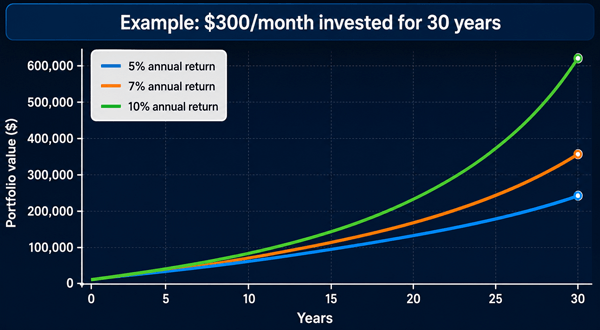
Figure 1. A simplified compounding example. This chart is not a forecast; it shows why time and regular investing matter.
3. The uncomfortable truth: the S&P 500 rewards patience, not impatience
Many real investors do not receive the returns they see quoted online because they behave differently from the index. They buy after a big rally, sell after a crash, switch funds too often, chase last year’s winner, or stop investing when headlines feel bad.
A person who invested through the 2000 dot-com crash, the 2008 financial crisis, the 2020 COVID crash, the 2022 inflation and rate-hike selloff, and other downturns had to sit through painful declines. The reward for long-term investing is not free. The price is emotional discomfort.
This is why “time in the market” usually beats trying to find the perfect entry point. A beginner does not need to be fearless. A beginner needs a plan that can survive fear.
| Investor behavior | Likely result | Better habit |
|---|---|---|
| Investing only after markets feel safe | Often buys after prices already rose | Use a fixed monthly investing plan. |
| Selling during every correction | Locks in losses and misses recoveries | Hold money needed soon outside stocks. |
| Checking the account daily | More stress and more bad decisions | Review monthly or quarterly. |
| Choosing high-fee funds | Lower net return over time | Compare expense ratios before buying. |
| Using leverage or options as a beginner | Can magnify losses quickly | Start with plain low-cost funds. |
4. Realistic returns: what beginners should expect
The S&P 500 has historically produced strong long-term returns, but no investor should assume every future decade will look like the best past decade. Returns come in cycles. Some decades are excellent. Some are disappointing. Some periods start with high valuations, recessions, wars, inflation shocks, or rate changes.
A realistic beginner framework:
- Over one year, anything can happen. A gain of 20% or a loss of 20% is both possible.
- Over five years, results are still uncertain. The market can spend years recovering from a crash.
- Over 10 years, odds historically improve, but poor decades can still happen.
- Over 20-30 years, compounding has historically had much more room to work, especially with regular contributions.
This is why the S&P 500 is usually better suited for long-term goals like retirement, financial independence, or wealth building over decades, not for rent money, emergency savings, wedding expenses next year, or a house down payment needed soon.
5. S&P 500 ETF vs S&P 500 index fund vs individual stocks
| Option | What it is | Pros | Cons | Best for |
|---|---|---|---|---|
| S&P 500 ETF | A fund traded like a stock that tracks the S&P 500 | Low cost, easy to buy, tax-efficient in many markets, tradable during the day | Can tempt beginners to trade too often | Most hands-on brokerage investors |
| S&P 500 mutual fund | A traditional fund tracking the S&P 500 | Simple, can allow automatic investing, easy inside retirement accounts | May have minimums or slightly different fees | Retirement accounts and automatic monthly investing |
| Individual stocks | Buying single companies yourself | Potential to outperform if you choose well | Higher risk, requires research, easier to make emotional mistakes | Experienced investors with a separate stock-picking budget |
| Target-date fund | A diversified fund that adjusts stock/bond mix over time | More complete retirement solution than S&P 500 alone | Usually holds more than U.S. stocks and may cost more | Beginners wanting one diversified retirement fund |
For a true beginner, the simplest comparison is this: an S&P 500 fund is a core building block, not a full financial plan. It gives strong U.S. large-company exposure, but it does not automatically include bonds, emergency savings, international stocks, insurance planning, tax planning, or estate planning.
6. What fees should beginners watch?
Fees matter because they quietly reduce compounding. Investor.gov warns that fees and expenses reduce investment returns, and if two funds have identical holdings and performance, the lower-cost fund generally produces higher returns for the investor.[4]
Many popular S&P 500 ETFs are now extremely cheap. For example, Vanguard lists VOO with a 0.03% expense ratio as of April 28, 2026, and iShares lists IVV with a 0.03% expense ratio in its current fund information.[5][6] SPY, the older and very liquid SPDR S&P 500 ETF Trust, has a 0.0945% gross expense ratio according to State Street’s current fund information.[7]
| Fund example | Structure | Expense ratio cited | Beginner note |
|---|---|---|---|
| VOO | ETF | 0.03% | Very low cost; commonly used by long-term investors. |
| IVV | ETF | 0.03% | Very low cost; another major S&P 500 ETF. |
| SPY | ETF / unit investment trust | 0.0945% | Very liquid and popular for traders, but higher cost than VOO/IVV for long-term holding. |
The difference between 0.03% and 0.095% may look tiny, and for small balances it is not life-changing. But the principle matters: when two funds track the same index, paying more usually needs a clear reason, such as trading liquidity, options availability, platform access, or account restrictions.
7. How much should a beginner invest in the S&P 500?
There is no universal number. A good amount is one you can repeat without destroying your budget or forcing yourself to sell during emergencies. For many beginners, the right sequence is more important than the exact dollar amount.
| Step | What to do first | Why it matters |
|---|---|---|
| 1 | Build a small emergency fund | Prevents selling stocks when life gets expensive. |
| 2 | Pay off toxic high-interest debt | A credit card charging 20% can beat any realistic market expectation. |
| 3 | Use employer match if available | A match can be an immediate return on contributions. |
| 4 | Automate investing monthly | Builds consistency and reduces timing mistakes. |
| 5 | Increase contributions with income | Your savings rate drives wealth more than perfect fund selection. |
A practical beginner rule is to start with an amount that feels almost boring: maybe $25, $50, $100, or $300 per month. The point is to build the habit. Once the habit is stable, increase it gradually. Wealth is built more by a repeatable system than by one dramatic purchase.
8. How to start investing in the S&P 500: step by step
- Decide your goal. Retirement in 25 years is different from saving for a car in 18 months.
- Choose the right account. Tax-advantaged retirement accounts may be useful where available; taxable brokerage accounts provide more flexibility but different tax treatment.
- Pick a low-cost S&P 500 fund. Compare expense ratio, tracking, liquidity, account availability, and whether you can automate investments.
- Set an investing schedule. Monthly investing is easier for most beginners than trying to guess market bottoms.
- Turn on dividend reinvestment if appropriate. Reinvesting dividends can help compounding, although tax rules vary by account type and country.
- Write a crash plan before the crash happens. Decide in advance what you will do if the market falls 20%, 30%, or more.
- Review once or twice a year. Rebalance if your overall portfolio becomes too aggressive or too conservative.
8.1 A simple sample plan for a beginner
Imagine Sara is 28, has no high-interest debt, has a basic emergency fund, and wants to build retirement wealth. She invests $300 per month into a low-cost S&P 500 ETF inside a retirement account. She does not expect the money to be smooth. Her written plan says: “I will keep investing monthly unless I lose my job or need to rebuild emergency savings. I will not sell because of scary headlines.”
If Sara earns a 7% annual return for 30 years, the simplified estimate is about $366,000. If she later raises contributions to $500 or $800 per month, the result can become much larger. The lesson is not that Sara is guaranteed 7%. The lesson is that contributions plus time can turn ordinary monthly amounts into meaningful wealth.
9. Is the S&P 500 enough by itself?
For some investors, an S&P 500 fund can be a strong core holding. But “core holding” does not always mean “only holding.” The S&P 500 is U.S.-focused and large-company focused. It does not fully cover small-cap stocks, international markets, bonds, cash, real estate, or other assets.
A young investor with a high risk tolerance may hold a large amount in an S&P 500 fund. A retiree who needs income soon may need more bonds and cash. Someone outside the United States may also need to consider currency risk, local taxes, access to U.S.-domiciled funds, and estate tax rules.
| Investor type | Possible role for S&P 500 | Extra considerations |
|---|---|---|
| Young long-term investor | Large growth engine | Can tolerate volatility only if job and emergency fund are stable. |
| Middle-career investor | Core stock allocation | May add international stocks, bonds, and tax planning. |
| Near retiree | Smaller or balanced role | Sequence-of-returns risk matters; cash and bonds become more important. |
| Non-U.S. investor | U.S. market exposure | Currency, tax treaties, fund domicile, and local regulations matter. |
| Very conservative saver | Limited role | Stock volatility may be too stressful without safer assets. |
10. S&P 500 investing vs active mutual funds
The S&P 500 is often compared with actively managed funds. Active managers try to beat the market by choosing stocks, sectors, or timing. Some do well, but the challenge is doing it consistently after fees.
S&P Dow Jones Indices publishes SPIVA research comparing active funds with benchmarks. In a 2026 summary of the 2025 scorecard, S&P reported that 79% of active large-cap U.S. equity funds underperformed the S&P 500 in 2025.[8] This does not prove active management can never work, but it shows why many long-term investors prefer low-cost passive funds as the default starting point.
| Approach | What you are betting on | Main advantage | Main risk |
|---|---|---|---|
| S&P 500 index fund | The broad large-cap U.S. market | Low cost, simple, transparent | Will never beat the index before fees; concentrated in U.S. large caps. |
| Active fund | Manager skill | Could outperform in some periods | Higher fees and underperformance risk. |
| Stock picking | Your own research and discipline | High upside if you choose exceptional companies | High chance of mistakes, concentration, and emotional decisions. |
11. Common beginner mistakes that reduce S&P 500 returns
11.1 Thinking average return means normal return
A 10% average does not mean the market gives you 10% every year. One year may be up 25%, another down 18%, and another flat. The average is only visible in hindsight.
11.2 Investing money needed soon
Money needed in the next few years should usually not depend on the stock market. A market crash does not care about your house deposit or tuition deadline.
11.3 Confusing simple with safe
S&P 500 investing is simple, but it is still stock investing. It can fall hard. Simplicity reduces complexity risk; it does not remove market risk.
11.4 Chasing the lowest price instead of the best plan
Waiting for the perfect market dip can keep beginners in cash for years. A dollar-cost averaging plan can be more realistic than trying to predict the best day.
11.5 Ignoring taxes and account type
Tax treatment can change results. Dividends, capital gains, retirement account rules, and international withholding taxes may matter. The best fund in one account may not be best in another.
12. Practical checklist before buying an S&P 500 fund
- I have an emergency fund or at least a plan for unexpected expenses.
- I am not using money I need within the next three to five years.
- I understand the fund can drop 30% or more in a severe bear market.
- I checked the expense ratio and compared similar funds.
- I know whether I am buying in a taxable or retirement account.
- I have decided whether dividends will be reinvested.
- I have written down what I will do during a crash.
13. How to use the S&P 500 in a complete wealth plan
The S&P 500 is a tool. A good wealth plan uses tools in the right order. For many people, the plan looks like this:
- Earn income and keep spending below income.
- Build emergency savings.
- Remove high-interest debt.
- Invest consistently in diversified, low-cost funds.
- Protect against major risks with appropriate insurance.
- Increase income and savings rate over time.
- Avoid lifestyle inflation that consumes every raise.
- Stay invested through normal market cycles.
The S&P 500 helps mostly with step four. It cannot fix overspending, job instability, excessive debt, or panic selling. This is why the best answer to “Can the S&P 500 make you rich?” is: it can help, but your financial behavior decides how much help you actually receive.
14. FAQ: beginner questions about the S&P 500
14.1 Is the S&P 500 good for beginners?
Yes, it can be a good beginner investment because it is diversified across many large U.S. companies, simple to understand, and available through low-cost funds. It is still risky in the short term.
14.2 Can I lose money in the S&P 500?
Yes. The S&P 500 can decline sharply. A long-term investor may recover if they stay invested, but recovery is not instant and is never guaranteed.
14.3 What is the minimum amount to start?
Many brokerages allow fractional shares or small recurring investments. The exact minimum depends on the platform and fund.
14.4 Should I invest all my money at once or monthly?
Mathematically, lump-sum investing often wins when markets rise, but monthly investing can be easier emotionally and reduces the regret of investing everything right before a decline.
14.5 Is VOO better than SPY?
For many long-term buy-and-hold investors, VOO’s lower expense ratio may be attractive. SPY is extremely liquid and popular among traders. The “best” choice depends on account access, costs, trading needs, and personal circumstances.
14.6 Does the S&P 500 pay dividends?
The companies inside the index may pay dividends. Funds pass dividends to investors or reinvest them depending on fund and account settings.
14.7 How long should I hold an S&P 500 fund?
A reasonable time horizon is usually at least 10 years, and preferably much longer. Shorter periods carry more risk of disappointing results.
14.8 Can the S&P 500 make me a millionaire?
It can, but usually through a combination of regular contributions, decades of time, reinvested dividends, and market growth. The smaller the monthly investment, the more time and return you need.
14.9 Is the S&P 500 better than a savings account?
They serve different purposes. A savings account is for safety and short-term needs. The S&P 500 is for long-term growth and can lose value.
14.10 Should I buy the S&P 500 when it is at an all-time high?
All-time highs are normal in growing markets. Instead of trying to predict the perfect entry point, many beginners use a monthly plan and invest according to their time horizon.
15. Final verdict: can the S&P 500 make you rich?
Yes, the S&P 500 can help make a person rich, but only under realistic conditions. It works best for people who invest consistently, hold for many years, reinvest dividends, keep costs low, and avoid emotional selling. It works poorly for people who need fast money, cannot handle volatility, or treat investing like gambling.
The most honest way to view the S&P 500 is not as a shortcut to wealth, but as a disciplined ownership plan. You are buying a slice of many leading U.S. companies and letting time, business growth, dividends, and compounding do the heavy lifting. That is not magic. It is patient capitalism.
For beginners, the action step is simple: learn the basics, choose a low-cost fund carefully, start with a sustainable amount, automate the habit, and build the rest of your financial life around risk control. The S&P 500 can be a powerful wealth-building engine, but you still have to be the driver.
Sources Consulted and Checked
These sources were consulted and checked while preparing this article to support factual accuracy and help readers verify key information.
[1] S&P Dow Jones Indices, S&P 500 index overview: describes the index as a leading gauge of large-cap U.S. equities, including 500 companies and about 80% of available U.S. market capitalization. https://www.spglobal.com/spdji/en/indices/equity/sp-500/
[2] Investor.gov, Index Fund glossary: explains that index funds may be mutual funds, ETFs, or UITs using a passive strategy designed to track an index before fees. https://www.investor.gov/introduction-investing/investing-basics/glossary/index-fund
[3] Aswath Damodaran, NYU Stern historical returns dataset: annual S&P 500 returns including dividends from 1928 onward. https://pages.stern.nyu.edu/~adamodar/New_Home_Page/datafile/histretSP.html
[4] Investor.gov, Index Funds: explains that fees and expenses reduce investment returns and lower-cost funds generally produce higher net returns when holdings are otherwise identical. https://www.investor.gov/introduction-investing/investing-basics/investment-products/mutual-funds-and-exchange-traded-4
[5] Vanguard, VOO product page: expense ratio 0.03% as of April 28, 2026. https://investor.vanguard.com/investment-products/etfs/profile/voo
[6] iShares, IVV product page/fact sheet: expense ratio 0.03%. https://www.ishares.com/us/products/239726/ishares-core-sp-500-etf
[7] State Street Global Advisors, SPDR S&P 500 ETF Trust (SPY) product page: gross expense ratio 0.0945%. https://www.ssga.com/us/en/intermediary/etfs/state-street-spdr-sp-500-etf-trust-spy
[8] S&P Dow Jones Indices, SPIVA U.S. Year-End 2025: reports that 79% of active large-cap U.S. equity funds underperformed the S&P 500 in 2025. https://www.spglobal.com/spdji/en/spiva/article/spiva-us/
Reader Advice
This article is provided solely for educational and informational purposes and does not constitute personal financial, investment, tax, legal, or accounting advice. Investing involves risk, including the possible loss of principal, and past performance does not guarantee future results. Fund fees, tax rules, account availability, regulations, market conditions, and product details can change over time and may differ by country, platform, and individual circumstances.
Before making any financial decision, readers should independently verify current facts and figures through official sources, review the applicable fund prospectus and account terms, consider their goals, time horizon, financial position, and risk tolerance, and seek advice from a suitably qualified professional where appropriate.