How to Invest in the S&P 500: A Beginner's Step-by-Step Guide
1. Introduction: the simplest way many beginners start investing
The S&P 500 is one of the easiest stock-market ideas to explain: instead of trying to pick the next winning company, you buy a fund that tracks a basket of about 500 large U.S. companies. In one investment, you can own tiny pieces of businesses across technology, health care, finance, consumer goods, industrials, energy, and more.
That does not make it risk-free. The S&P 500 can fall sharply in bad markets. It can stay flat for uncomfortable periods. It is concentrated in U.S. large-cap stocks, so it is not a complete financial plan by itself. But for many long-term investors, especially beginners, a low-cost S&P 500 index fund is a practical starting point because it is diversified, transparent, simple to manage, and inexpensive.
This guide explains the topic as if you are starting from zero. You will learn what the S&P 500 is, how S&P 500 funds work, how to choose between an ETF and a mutual fund, how to place your first order, how much to invest, what mistakes to avoid, and how to think like a long-term investor rather than a short-term gambler.
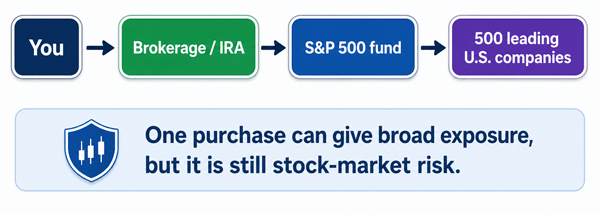
One purchase can give broad exposure, but it is still stock-market risk.
2. What is the S&P 500?
The S&P 500 is a stock market index maintained by S&P Dow Jones Indices. It is widely used as a gauge of large-cap U.S. equities. The index includes 500 leading companies and represents roughly 80% of the available U.S. equity market capitalization, according to S&P Dow Jones Indices factsheet language.
An index is not a fund and you cannot directly buy the index itself. Think of the S&P 500 as a measuring tool or recipe. Investment companies create ETFs and mutual funds that try to track that recipe by holding the same stocks, or a very close sample of them, in similar weights.
The S&P 500 is market-cap weighted. In plain English, larger companies receive bigger weights. If a giant company becomes a larger share of the U.S. market, it can become a larger share of the S&P 500. This is why the index can sometimes feel heavily influenced by a handful of very large technology or growth companies.
3. How does S&P 500 investing work?
Most beginners invest through an S&P 500 ETF or an S&P 500 index mutual fund. Both pool money from many investors and use it to hold stocks that track the index. When the underlying companies rise or fall, the fund value normally rises or falls with them, minus small costs and tracking differences.
You make money in two main ways. First, the share price of the fund may rise over time as the companies in the index become more valuable. Second, many companies pay dividends, and the fund may pass those dividends to shareholders or reinvest them depending on your account settings and fund structure.
The fund does not remove market risk. If the S&P 500 drops 20%, an S&P 500 fund will usually drop close to 20% before fees and tracking differences. The benefit is that you are not depending on one single company. You are spreading your investment across a broad group of established companies.
4. ETF vs mutual fund: which is better for a beginner?
| Feature | S&P 500 ETF | S&P 500 index mutual fund | Beginner takeaway |
|---|---|---|---|
| How it trades | Trades like a stock during market hours | Trades once per day after market close | ETF feels more flexible; mutual fund feels simpler. |
| Minimum investment | Often one share or fractional share if broker allows | Often low or no minimum at major brokers, but varies | Check your brokerage before opening the account. |
| Automatic investing | Possible at some brokers, not all | Usually very easy | Mutual funds can be smoother for monthly auto-investing. |
| Costs | Often very low, but check expense ratio and bid-ask spread | Often very low, but check expense ratio and transaction fees | The cheapest fund is not always best if your broker charges extra fees. |
| Tax behavior | ETFs are often tax-efficient in taxable accounts | Mutual funds can distribute taxable gains, though index funds are usually efficient | For taxable accounts, ETFs often have an edge. |
| Best fit | Investors comfortable placing market/limit orders | Investors who want simple automation | Both can work if they are low cost and track the index well. |
5. Step-by-step: how to invest in the S&P 500
5.1 Decide why you are investing
Before choosing any fund, write down the goal. Is this for retirement, a house down payment, a child's education, or general wealth building? Money needed in the next few years usually should not be heavily exposed to stocks. S&P 500 investing is usually better suited for long-term goals where you can tolerate market swings.
5.2 Build a basic safety base first
Many experienced investors regret investing before they had an emergency fund. A simple rule is to keep enough cash for near-term bills and unexpected expenses before putting serious money into stocks. This helps you avoid selling during a market crash just because life happens.
5.3 Choose the right account type
A taxable brokerage account is flexible. Retirement accounts such as a 401(k), traditional IRA, or Roth IRA may offer tax advantages, depending on your country, income, and eligibility. The account type can matter as much as the fund because taxes and withdrawal rules affect your real return.
5.4 Open an account with a reputable broker
Look for a regulated broker with low or no trading commissions, access to low-cost S&P 500 ETFs or mutual funds, fractional shares if you are starting small, automatic investing tools, clear tax documents, and strong security features such as two-factor authentication.
5.5 Compare S&P 500 funds
Do not choose a fund only because it is famous. Compare expense ratio, tracking error, liquidity, minimum investment, fund structure, dividend policy, tax efficiency, and whether your brokerage charges any special fee to buy it.
5.6 Fund the account
Transfer money from your bank to the investment account. Beginners often start with an amount small enough to learn the process calmly. The goal is not to impress anyone. The goal is to begin correctly and build a repeatable habit.
5.7 Place the order
For an ETF, search the ticker, choose buy, enter a dollar amount or number of shares, and consider using a limit order during market hours. For a mutual fund, enter the fund symbol and dollar amount; the trade normally executes after the market closes.
5.8 Turn on reinvestment and automation
If the investment is for long-term growth, many investors reinvest dividends and set a monthly contribution. Automation reduces the temptation to time the market and makes investing feel like paying a future bill to yourself.
5.9 Review, but not too often
A reasonable review schedule might be quarterly or twice per year. Daily checking often increases anxiety and leads beginners to make emotional decisions. Review whether your allocation still matches your goals, not whether the market moved this week.
5.10 Keep learning and avoid overcomplication
Once you understand the S&P 500, you can decide whether you also need international stocks, bonds, cash, or other assets. A simple portfolio you can stick with is usually better than a complex portfolio you abandon during the first downturn.
6. Popular S&P 500 funds beginners often compare
The examples below are not recommendations. They are common S&P 500 funds many investors research. Expense ratios shown were checked against public fund information available on July 15, 2026. Always verify the latest expense ratio, prospectus, tax details, ticker, and availability inside your own brokerage account before investing.
| Fund / ticker | Type | Provider | Expense ratio noted from current public sources | Why beginners compare it |
|---|---|---|---|---|
| VOO | ETF | Vanguard | 0.03% | Very low cost, large assets, common long-term core holding. |
| IVV | ETF | iShares / BlackRock | 0.03% | Very low cost, large assets, tight spreads, broad brokerage availability. |
| SPY | ETF | State Street SPDR | 0.0945% gross expense ratio | Very liquid and widely traded, often used by traders; cost is higher than VOO/IVV. |
| SPYM (formerly SPLG) | ETF | State Street SPDR | 0.02% gross expense ratio | Very low fee and broad S&P 500 exposure; verify the current ticker and fund details. |
| FXAIX | Mutual fund | Fidelity | 0.015% gross expense ratio | Very low-cost mutual fund option for Fidelity investors. |
| SWPPX | Mutual fund | Schwab | 0.020% total expense ratio | Very low-cost mutual fund option for Schwab investors. |
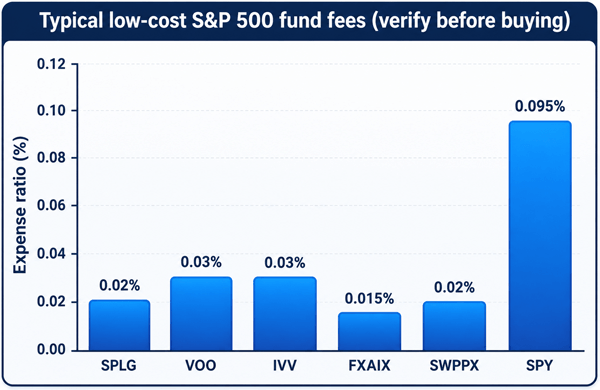
Typical low-cost S&P 500 fund fees (verify before buying)
7. What should beginners check before buying?
- Expense ratio: This is the annual fund cost expressed as a percentage. A 0.03% expense ratio means roughly $3 per year for every $10,000 invested, before other potential costs. Lower fees help, but do not ignore fund quality, tracking, liquidity, and account fees.
- Tracking difference: A fund should closely follow the S&P 500. Small differences happen because of fees, cash drag, trading, and fund operations.
- Bid-ask spread: For ETFs, the spread is the difference between the price buyers are offering and sellers are asking. Large, liquid ETFs usually have tight spreads, but it is still wise to trade during normal market hours.
- Minimums and fractional shares: A beginner with $50 or $100 may need a broker that allows fractional ETF shares or a mutual fund with low minimums.
- Tax location: Tax-advantaged accounts may be better for retirement goals. Taxable accounts are more flexible but require attention to dividends, capital gains, and recordkeeping.
- Your own risk tolerance: The best fund on paper is useless if you panic-sell during a downturn. Choose an allocation you can hold through ugly markets.
8. How much money do you need to start?
You do not need to be wealthy to start. Many brokers now allow fractional shares, which means you may be able to invest a small dollar amount instead of buying a full ETF share. Some mutual funds also allow very low minimum investments. The more important question is not the starting amount; it is whether you can contribute consistently without harming your day-to-day finances.
A practical beginner example: suppose you invest $100 per month into a low-cost S&P 500 fund. Some months the market is high and your $100 buys fewer shares. Other months the market is lower and your $100 buys more shares. This habit is called dollar-cost averaging. It does not guarantee profits or protect you from losses, but it reduces the pressure to pick the perfect day to invest.
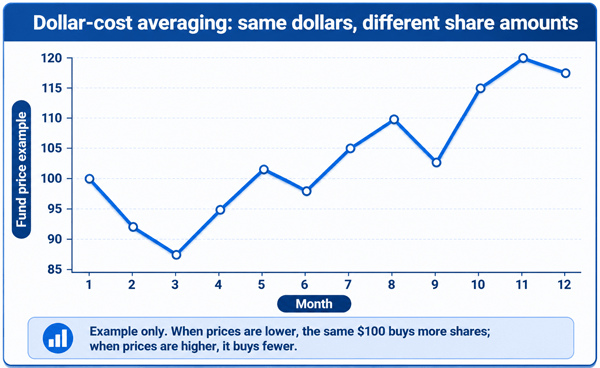
Example only. When prices are lower, the same $100 buys more shares; when prices are higher, it buys fewer.
9. Example beginner plans
| Investor situation | Possible approach | Why it may fit | Main caution |
|---|---|---|---|
| 25-year-old investing for retirement | Monthly automatic contributions to a low-cost S&P 500 fund inside a retirement account | Long time horizon can handle volatility better | Still consider international stocks and bonds as portfolio grows. |
| 40-year-old with emergency fund and stable income | Core S&P 500 fund plus bond or cash allocation based on risk tolerance | Balances growth with some stability | Do not take more stock risk than you can emotionally hold. |
| Saving for a house in 2 years | Avoid putting most of the house money in the S&P 500 | Short-term money needs stability | Stocks can fall right before you need the cash. |
| Beginner with $50 per month | Use fractional shares or a no-minimum index mutual fund | Builds the habit without waiting | Avoid brokers with fees that eat small contributions. |
10. S&P 500 vs total stock market vs Nasdaq-100
| Choice | What it owns | Main strength | Main weakness | Beginner use case |
|---|---|---|---|---|
| S&P 500 fund | Large U.S. companies in the S&P 500 | Simple, low cost, widely followed | No small-cap stocks and limited international exposure | Core U.S. stock holding. |
| Total U.S. stock market fund | Large, mid, and small U.S. companies | Broader U.S. diversification | Still U.S.-only | Core U.S. stock holding for investors who want more complete market exposure. |
| Nasdaq-100 fund | Large non-financial companies listed on Nasdaq, often tech-heavy | Higher exposure to innovative growth companies | More concentrated and potentially more volatile | Satellite holding, not usually a beginner's only investment. |
| Global stock fund | U.S. and international stocks | Broader global diversification | May trail the S&P 500 for long periods | Core holding for investors who want one global equity fund. |
11. Common beginner mistakes to avoid
- Trying to time the perfect entry point: Many beginners wait for the “right time” and never start. A better habit is to invest according to a plan, especially for long-term money.
- Panic-selling during the first drop: Seeing your account fall is emotionally difficult. Decide before investing what you will do during a 10%, 20%, or 30% decline.
- Confusing simple with safe: The S&P 500 is simple, but it is still stocks. Simple does not mean guaranteed.
- Buying leveraged S&P 500 products by accident: Leveraged and inverse ETFs are designed for short-term trading and can behave very differently from a plain S&P 500 index fund.
- Ignoring taxes: Dividends, capital gains, and account type can affect after-tax returns. Tax rules vary by country and personal situation.
- Overlapping funds without realizing it: A portfolio with an S&P 500 fund, a total market fund, and several mega-cap tech funds may be more concentrated than it appears.
12. A practical first-order walkthrough
Imagine Sara is 28, has an emergency fund, no high-interest credit-card debt, and wants to invest for retirement. She opens a Roth IRA at a reputable broker, chooses a low-cost S&P 500 ETF available with fractional shares, and sets a recurring $200 monthly contribution. She turns on dividend reinvestment and decides she will review the account twice per year.
Sara does not check the market every morning. When the market falls, her monthly contribution buys more shares. When the market rises, her existing shares benefit. She understands that some years will be negative. Her plan is built around time in the market, not perfect prediction.
This example is not a recommendation for every reader. It simply shows the logic: match the account to the goal, pick a low-cost diversified fund, automate contributions, reinvest dividends if appropriate, and avoid emotional trading.
13. FAQ: S&P 500 investing for beginners
13.1 Can I buy the S&P 500 directly?
No. You buy an ETF or mutual fund that tracks the S&P 500 index.
13.2 Is the S&P 500 good for beginners?
It can be a strong beginner-friendly option for long-term stock exposure because it is diversified, simple, and often low cost. It is not risk-free and may not be appropriate for short-term money.
13.3 What is the minimum amount to invest?
It depends on your broker and the fund. Fractional shares and no-minimum mutual funds can let some investors start with small amounts.
13.4 Should I invest all my money in the S&P 500?
Usually no. Keep emergency cash and consider whether you need bonds, international stocks, or other assets based on your goals and risk tolerance.
13.5 Is an ETF or mutual fund better?
Neither is automatically better. ETFs may be more tax-efficient and flexible; mutual funds may be easier for automatic investing. Costs and broker rules matter.
13.6 Can I lose money?
Yes. The S&P 500 can decline significantly, and an S&P 500 fund will generally decline with it.
13.7 How long should I hold?
S&P 500 investing is generally best suited for long-term goals, often measured in years or decades, not weeks or months.
13.8 Should I reinvest dividends?
For long-term growth, many investors reinvest dividends. For income needs, some investors take dividends in cash. Tax treatment can vary.
13.9 What is the best S&P 500 ETF?
The “best” depends on your broker, account type, expenses, liquidity, tax needs, and whether you want ETF trading or mutual-fund automation.
13.10 What should I do when the market crashes?
Return to your written plan. If your goal and time horizon have not changed, avoid emotional selling. If your allocation was too risky, adjust thoughtfully rather than panic-trading.
14. Conclusion: keep it simple, low cost, and long term
Investing in the S&P 500 is not about finding a secret. It is about using a simple structure that has helped many people participate in the growth of large U.S. companies without trying to pick individual winners.
A beginner does not need dozens of funds, daily market predictions, or complicated trading strategies. A strong start is often: build a cash safety net, choose the right account, pick a low-cost S&P 500 fund, automate contributions, reinvest when appropriate, and stay patient through market cycles.
The honest truth is that the S&P 500 will have bad years. That is the price of stock-market returns. The beginner who understands this before investing is far more likely to stay calm, avoid expensive mistakes, and build wealth gradually.
Reader Advice
This article is provided solely for general educational and informational purposes and does not constitute personalized financial, investment, tax, legal, or retirement advice. Investing involves risk, including the possible loss of principal. Fund fees, tickers, brokerage features, tax rules, account limits, regulations, and market conditions can change. Before making any decision, verify current facts and figures through official fund documents, regulators, and your brokerage, and consider consulting a suitably qualified professional who understands your goals, financial circumstances, risk tolerance, tax position, and local laws. Past performance does not guarantee future results.
Sources Consulted and Checked
These authoritative sources were consulted and checked while preparing this article to support accuracy, clarity, and responsible presentation of the information.
- S&P Dow Jones Indices S&P 500 factsheet / methodology: https://www.spglobal.com/spdji/en/indices/equity/sp-500/
- S&P U.S. Indices Methodology PDF: https://www.spglobal.com/spdji/en/documents/methodologies/methodology-sp-us-indices.pdf
- SEC Investor.gov Mutual Funds and ETFs guide: https://www.investor.gov/sites/investorgov/files/2019-02/mutual-funds-ETFs.pdf
- FINRA mutual fund expense ratio explanation: https://www.finra.org/investors/investing/investment-products/mutual-funds
- Vanguard VOO official fund page: https://investor.vanguard.com/investment-products/etfs/profile/voo
- iShares IVV official fund page: https://www.ishares.com/us/products/239726/ishares-core-sp-500-etf
- State Street SPY official fund page: https://www.ssga.com/us/en/intermediary/etfs/state-street-spdr-sp-500-etf-trust-spy
- Fidelity FXAIX official fund materials: https://fundresearch.fidelity.com/mutual-funds/summary/315911750
- Schwab SWPPX official fund page: https://www.schwabassetmanagement.com/products/swppx