S&P 500 vs Nasdaq: Which Index Delivers Better Returns?
1. What is the S&P 500?
The S&P 500 is a stock market index that tracks about 500 leading large-cap U.S. companies. It is widely used as a benchmark for the U.S. stock market because it covers a large share of available U.S. market capitalization. In plain English, it is a scoreboard for many of America’s biggest public companies, including technology, healthcare, financials, consumer brands, industrials, energy, utilities, and more. [1]
You cannot buy the index itself. Instead, investors usually buy an S&P 500 index fund or ETF, such as an ETF that aims to track the index. The fund owns the underlying stocks and tries to match the index’s performance before fees and tracking differences.
1.1 How the S&P 500 works
- Market-cap weighted: bigger companies get bigger weights, so a company like Nvidia, Apple, Microsoft, or Amazon can move the index more than a smaller company.
- Broad sector exposure: it includes more than technology, so weak performance in one sector may be partly balanced by another sector.
- Rebalanced over time: companies can be added or removed as the U.S. economy changes.
- Common investing use: many people use it as a core long-term holding in taxable brokerage accounts, retirement accounts, and passive investing portfolios.
2. What is the Nasdaq? Be careful: people often mean different things
When people say “Nasdaq,” they may mean the Nasdaq stock exchange, the Nasdaq Composite, or the Nasdaq-100. For investment comparisons, most articles and investors usually mean the Nasdaq-100, because popular ETFs such as Invesco QQQ track the Nasdaq-100. This article focuses mainly on the Nasdaq-100 because that is the index beginners are most likely to invest in through ETFs.
The Nasdaq-100 includes 100 of the largest non-financial companies listed on the Nasdaq exchange. It uses modified market capitalization weighting, meaning bigger companies matter more, but the methodology includes rules designed to manage weights and investability. [2]
2.1 How the Nasdaq-100 works
- Growth-oriented: the index has heavy exposure to technology and tech-adjacent businesses.
- No financial companies: banks and many traditional financial firms are excluded.
- Concentrated leadership: a small group of mega-cap companies can drive a large share of returns.
- Quarterly reviews and rebalancing: Nasdaq says regular updates help keep the index aligned with current market leaders. [3]
3. S&P 500 vs Nasdaq at a glance
| Feature | S&P 500 | Nasdaq-100 |
|---|---|---|
| Main idea | Broad U.S. large-cap market exposure | Growth-heavy exposure to large Nasdaq-listed non-financial companies |
| Typical role | Core portfolio holding | Growth satellite or aggressive core for higher-risk investors |
| Number of companies | About 500 leading U.S. companies | 100 of the largest non-financial Nasdaq-listed companies |
| Weighting | Float-adjusted market capitalization weighted | Modified market capitalization weighted |
| Sector feel | More diversified across sectors | More concentrated in technology and innovation themes |
| Return pattern | Usually steadier, but still risky | Can outperform strongly in tech bull markets, but can fall harder |
| Beginner friendliness | High | Medium: useful, but requires stronger risk tolerance |
| Common ETF examples | VOO, IVV, SPY | QQQ, QQQM |
4. Which index has delivered better returns?
Historically, the Nasdaq-100 has often beaten the S&P 500 during periods when technology, communication services, semiconductors, software, internet platforms, and growth stocks dominate. Invesco states that QQQ, an ETF tracking the Nasdaq-100, beat the S&P 500 in seven of the last ten years as of March 31, 2026. [4]
But “better returns” should never be judged from one winning period only. The Nasdaq-100 can look unbeatable after a technology-led bull market, then feel painful during a growth-stock crash. The S&P 500 can look boring during tech booms, then feel more comfortable when the market rotates into healthcare, financials, industrials, energy, consumer staples, or value stocks.
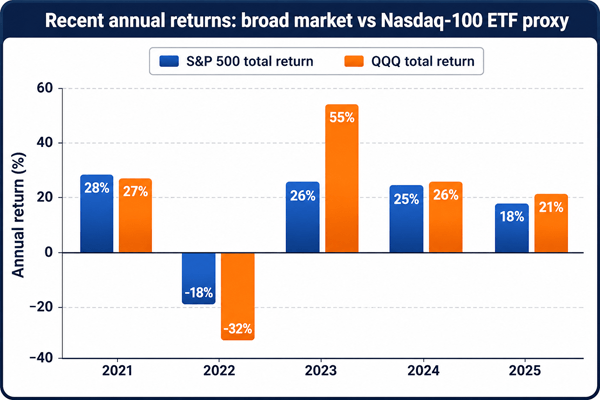
Figure 1. Recent annual return comparison using S&P 500 total return and QQQ annual total return data for 2021-2025. Sources: S&P 500 total return table and Yahoo Finance QQQ performance data. [5][6]
4.1 The practical answer
| Investor question | Likely better fit | Why |
|---|---|---|
| I want one simple long-term U.S. stock holding. | S&P 500 | It is broader, easier to understand, and less dependent on one growth theme. |
| I want higher growth potential and can handle bigger drops. | Nasdaq-100 | It gives more exposure to dominant growth and technology companies. |
| I am investing for retirement and want less concentration risk. | S&P 500 as core, Nasdaq as optional satellite | This keeps the portfolio from depending too much on one sector. |
| I already own lots of tech stocks. | S&P 500 or broader total-market fund | Adding Nasdaq may duplicate risk you already have. |
| I believe AI, cloud, semiconductors, and software will lead for decades. | Nasdaq-100, but sized carefully | The theme may be right, but valuation and timing still matter. |
5. Returns are only half the story: risk matters
A beginner mistake is asking only, “Which index made more money?” A better question is, “Which index could I actually hold through a bad year?” Many investors say they want higher returns, but sell when their account falls 25%, 35%, or 45%. The index that delivers the best real-life result is often the one you can hold without panic.
QQQ fell more than the S&P 500 in 2022, a year when rising rates hit growth stocks especially hard. That does not make QQQ bad; it shows the cost of a growth-heavy strategy. If you choose the Nasdaq-100, you must be mentally prepared for deeper drawdowns.
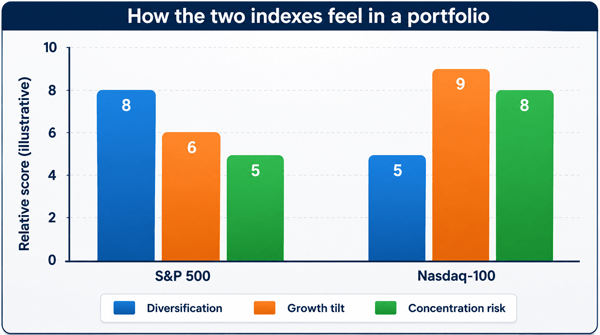
Figure 2. Illustration only: S&P 500 usually feels more diversified; Nasdaq-100 usually feels more growth-focused and more concentrated.
6. Beginner-friendly example: investing $500 per month
Imagine two beginners invest $500 every month for 20 years. One chooses an S&P 500 ETF. The other chooses a Nasdaq-100 ETF. The Nasdaq investor may end with more money if technology-led growth continues and they keep buying during crashes. But the Nasdaq investor may also face larger temporary losses along the way. The S&P 500 investor may not get the highest possible return, but may have an easier time staying consistent.
This is why dollar-cost averaging can be powerful. Instead of trying to guess the perfect buying day, the investor buys regularly. During market declines, the same $500 buys more shares. During market highs, it buys fewer shares. This does not remove risk, but it reduces the pressure to time the market perfectly.
7. How beginners can actually invest in these indexes
- Open a reputable brokerage account or use a retirement account if available in your country.
- Choose whether you want an ETF or index mutual fund. ETFs trade during the day; mutual funds usually trade once at the end of the day.
- Compare the expense ratio. Lower fees leave more of the return for you, especially over decades.
- Check tracking error and fund size. A large, liquid fund with a long history is usually easier for beginners.
- Decide your allocation before buying. Example: 80% S&P 500 and 20% Nasdaq-100, or 100% S&P 500, depending on risk tolerance.
- Automate contributions if possible. Consistency matters more than perfect timing.
- Rebalance once or twice a year if one position grows too large.
7.1 Simple allocation examples
| Profile | Possible allocation | Why it may work |
|---|---|---|
| Conservative beginner | 100% S&P 500 equity allocation, plus cash/bonds depending on age and goals | Keeps U.S. stock exposure simple and diversified. |
| Balanced growth beginner | 80% S&P 500 / 20% Nasdaq-100 | Uses S&P 500 as the core and Nasdaq as a growth tilt. |
| Aggressive long-term investor | 60% S&P 500 / 40% Nasdaq-100 | Higher growth exposure, but more volatility and concentration risk. |
| Tech employee or tech-heavy stock holder | S&P 500 or total-market index only | Avoids doubling down on the same sector that already affects income or personal holdings. |
8. Fees, taxes, and fund details beginners should check
Two funds can track similar indexes but produce slightly different investor results because of fees, trading costs, tracking error, taxes, and the price you pay when buying or selling. For long-term investors, the expense ratio is especially important. A difference that looks tiny each year can become meaningful over 20 or 30 years.
| Item to check | Why it matters | Beginner tip |
|---|---|---|
| Expense ratio | It is the annual fund cost. Lower is generally better, all else equal. | Compare similar ETFs before buying. |
| Bid-ask spread | The hidden trading cost when buying or selling an ETF. | Use liquid ETFs and avoid trading at market open/close if spreads are wide. |
| Dividend yield | S&P 500 funds often pay more dividends than Nasdaq-100 funds. | Reinvest dividends if your goal is long-term growth. |
| Tax treatment | Dividends and capital gains may be taxed differently by country/account type. | Use tax-advantaged accounts where appropriate and follow local tax rules. |
| Currency exposure | Non-U.S. investors may face U.S. dollar exchange-rate changes. | Do not ignore currency risk when investing internationally. |
9. Common mistakes people make
- Chasing last year’s winner. Buying Nasdaq only because it recently outperformed can lead to disappointment if leadership rotates.
- Ignoring overlap. Many S&P 500 ETFs already hold the same mega-cap technology names found in Nasdaq-100 ETFs.
- Thinking “index fund” means “safe.” Index funds reduce single-company risk, but they do not remove market risk.
- Going all-in before understanding drawdowns. A portfolio that looks smart in a bull market can feel unbearable in a crash.
- Using leveraged Nasdaq ETFs for long-term investing. Leveraged products are complex and can behave very differently from simple index ETFs.
- Confusing Nasdaq Composite with Nasdaq-100. They are related terms, but not the same investment exposure.
10. S&P 500 vs Nasdaq: pros and cons
| Index | Pros | Cons |
|---|---|---|
| S&P 500 | Broad exposure; strong long-term benchmark; simple for beginners; lower concentration than Nasdaq-100; many low-cost ETFs. | Still concentrated in mega-cap stocks; U.S.-only exposure; can underperform growth-heavy indexes for long periods. |
| Nasdaq-100 | Higher exposure to innovative growth companies; strong performance in many tech-led markets; popular liquid ETFs; useful growth tilt. | More volatile; sector and company concentration; excludes financials; can suffer badly when growth valuations compress. |
11. So, which one should a beginner choose?
A beginner who wants one simple index fund will usually be better served by starting with the S&P 500 or a total U.S. stock market fund. It is easier to understand, easier to hold, and less dependent on one style of investing. A beginner who already understands volatility and wants a growth tilt can add Nasdaq-100 exposure in a smaller percentage.
A practical rule is: Use the S&P 500 as the foundation and the Nasdaq-100 as seasoning. The foundation should be large enough to keep the portfolio stable. The seasoning should be small enough that a bad year does not make you abandon the plan.
11.1 Decision checklist
| Question | If yes | If no |
|---|---|---|
| Can I hold through a 30%+ drop without selling? | Nasdaq-100 may be acceptable as part of the portfolio. | Keep Nasdaq exposure small or avoid it. |
| Do I already own individual tech stocks? | Be careful adding Nasdaq-100 because of overlap. | A Nasdaq tilt may diversify your growth exposure. |
| Is this my first index fund? | Consider starting with S&P 500. | You may compare S&P 500, Nasdaq-100, and total-market funds. |
| Do I need money within 3-5 years? | Stocks may be too risky for that money. | Longer time horizons can handle more equity exposure. |
| Do I understand expense ratios and taxes? | Proceed with a written plan. | Learn the basics before investing real money. |
12. Investor experience: what people often learn the hard way
Many long-term investors say the hard part is not choosing the mathematically best index. The hard part is staying invested when the market feels scary. During a boom, Nasdaq exposure can make an investor feel smart. During a crash, the same exposure can feel reckless. The best plan is the one you can keep following when headlines are negative.
Another common experience is regret. If the Nasdaq outperforms, S&P 500 investors may regret not taking more risk. If Nasdaq crashes, Nasdaq investors may regret not choosing the broader market. This is why blended allocations are popular: they reduce the chance of emotional all-or-nothing decisions.
13. Frequently Asked Questions
13.1 Is the Nasdaq better than the S&P 500?
It can deliver higher returns in growth-led markets, but it is not automatically better. It is more concentrated and can be more volatile.
13.2 Is the S&P 500 safer than Nasdaq?
It is usually more diversified, but it is still a stock index and can lose significant value during bear markets.
13.3 Can I invest in both?
Yes. Many investors use the S&P 500 as the core and Nasdaq-100 as a smaller growth tilt.
13.4 What is the best ETF for beginners?
The best ETF depends on fees, availability, tax rules, and personal risk tolerance. Beginners often compare low-cost S&P 500 ETFs first because they are simple and widely used.
13.5 Does higher return always mean better investment?
No. Higher return often comes with higher risk, deeper drawdowns, or more concentration. The better investment is the one that fits your goals and behavior.
14. Final Verdict
The Nasdaq-100 has delivered excellent returns in many recent periods, especially when mega-cap growth and technology stocks led the market. The S&P 500 remains the stronger default choice for most beginners because it is broader, simpler, and better suited as a core holding. The most practical answer is not to treat this as a fight. Use the S&P 500 for broad exposure. Add Nasdaq-100 only if you intentionally want more growth risk and can stay invested when it becomes uncomfortable.
For a beginner, the winning strategy is usually not finding the hottest index. It is choosing a low-cost, diversified fund, investing consistently, avoiding panic selling, and giving compounding enough time to work.
Sources Consulted and Checked
The following sources were consulted and checked while preparing this article and reviewing its accuracy.
- [1] S&P Dow Jones Indices, S&P 500 official index page, including index characteristics and constituents: https://www.spglobal.com/spdji/en/indices/equity/sp-500/
- [2] Nasdaq, Nasdaq-100 Index Methodology, 2026 methodology PDF: https://indexes.nasdaq.com/docs/Methodology_NDX.pdf
- [3] Nasdaq, Nasdaq-100 official overview page, including market-cap weighting and quarterly review language: https://www.nasdaq.com/solutions/global-indexes/nasdaq-100
- [4] Invesco QQQ performance page, noting QQQ beat the S&P 500 in seven of the last ten years as of March 31, 2026, and performance risk disclosures: https://www.invesco.com/qqq-etf/en/performance.html
- [5] S&P 500 annual total return figures for recent years, compiled in public performance tables: https://en.wikipedia.org/wiki/S%26P_500
- [6] Yahoo Finance QQQ performance history annual total return figures: https://finance.yahoo.com/quote/QQQ/performance/
- [7] S&P Dow Jones Indices SPIVA research hub, passive versus active fund benchmarking context: https://www.spglobal.com/spdji/en/research-insights/spiva/
Reader Advice
This article is provided solely for educational and informational purposes. It does not constitute personalized financial, investment, tax, legal, or retirement advice, and it should not be treated as a recommendation to buy, sell, or hold any security, fund, or index-linked product.
Investments in stocks, index funds, and ETFs can lose value, including principal. Past performance does not guarantee future results, and historical comparisons may not reflect future market conditions. Returns, fees, fund holdings, index methodologies, tax treatment, regulations, and product availability can change over time and may differ by country, account type, provider, and individual circumstances.
Before making any financial decision, verify current facts, figures, fees, rules, and product details through official index providers, fund issuers, regulators, tax authorities, and other reliable primary sources. Consider your goals, time horizon, financial position, currency exposure, and ability to tolerate losses. Where appropriate, seek advice from a suitably qualified and regulated financial, tax, or legal professional.