What Are NFTs? Meaning, How It Works, Examples, Benefits and Risks
Quick answer: An NFT, or non-fungible token, is a unique digital token recorded on a blockchain. It can represent ownership, proof of authenticity, access rights, collectibles, game items, tickets, memberships, music, art, domain names, and sometimes links to physical assets. NFTs are different from normal cryptocurrencies because each token is unique rather than interchangeable.
Important beginner warning: Buying an NFT usually does not mean you automatically own the copyright, trademark, or full commercial rights to the image, music, or content connected to it. What you actually receive depends on the NFT smart contract, marketplace terms, and license set by the creator or project.
1. What Is an NFT?
NFT stands for non-fungible token. “Non-fungible” means something is unique and cannot be replaced on a one-for-one basis with something exactly the same. A $10 bill is fungible because one $10 bill can be exchanged for another $10 bill of equal value. A signed painting, a concert ticket with a specific seat number, or a rare game item is non-fungible because each one has its own identity, history, and value.
In crypto, an NFT is a token on a blockchain that has a unique token ID and ownership record. The token can be connected to a digital file, a membership, a game object, a ticket, a certificate, or another asset. The blockchain does not magically make the image or file valuable. It mainly records who controls the token and allows that token to be transferred between wallets.
A simple way to think about it: an NFT is like a digital certificate or receipt that lives on a blockchain. The value comes from what the token represents, who created it, what rights come with it, how useful it is, and whether other people actually want it.
| Term | Simple meaning | Example |
|---|---|---|
| NFT | A unique blockchain token | A one-of-one digital artwork token |
| Fungible | Interchangeable with another unit of the same type | One bitcoin can be exchanged for another bitcoin |
| Blockchain | A shared digital ledger that records transactions | Ethereum records NFT transfers |
| Wallet | An app or address used to hold and transfer crypto assets | MetaMask, Coinbase Wallet, Phantom |
| Minting | Creating an NFT on a blockchain | An artist creates 500 collectible tokens |
| Metadata | Information connected to the token | Name, description, traits, image link |
2. How Do NFTs Work?
Most NFTs work through smart contracts. A smart contract is code on a blockchain that defines how tokens are created, transferred, and tracked. When an NFT is minted, the smart contract creates a token with a unique ID. That token is assigned to a blockchain wallet address. Anyone can usually view the token history on a blockchain explorer, although knowing the wallet address does not always reveal the real-world identity of the owner.
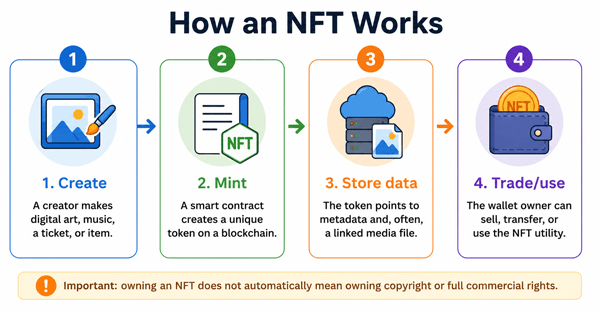
2.1 NFTs usually include three layers
- The token record: the blockchain entry showing the token ID, contract address, owner wallet, and transfer history.s
- The metadata: the name, description, attributes, and link to the asset or file.
- The media or utility: the artwork, audio, membership benefit, game item, event access, or other value connected to the NFT.
This distinction matters because the actual media file is not always stored directly on the blockchain. Many NFTs point to files stored on decentralized systems such as IPFS or Arweave, or on regular web servers controlled by a company. If storage is poorly managed, links can break or metadata can change. Strong projects explain exactly where files are stored and whether metadata is frozen or updateable.
3. NFTs vs Cryptocurrency vs Digital Files
| Feature | NFT | Cryptocurrency | Normal digital file |
|---|---|---|---|
| Interchangeability | Usually unique; one token is not the same as another | Fungible; one unit is usually equal to another unit | Copies can be identical |
| Main use | Ownership record, access, collectibles, identity, game items | Payments, transfers, staking, DeFi, store of value | Viewing, sharing, editing, storage |
| Blockchain record | Yes | Yes | No, unless linked to a blockchain asset |
| Can be copied? | The token cannot be duplicated in the same contract, but the associated image or file may be copied | Coins can be divided and exchanged | Files can usually be copied easily |
| Value source | Creator, rights, utility, rarity, demand, community, provenance | Network demand, liquidity, utility, monetary belief | Usefulness, quality, licensing, scarcity if controlled |
4. What Can NFTs Be Used For?
NFTs became famous through digital art and profile-picture collections, but the technology can represent many kinds of unique digital records. The strongest NFT use cases are usually those where proof of ownership, authenticity, transferability, or access control solves a real problem.
4.1 Digital art and collectibles
Artists can mint NFTs linked to digital artwork, animation, photography, or generative art. Collectors may buy them to support artists, display ownership, join a community, or speculate on future demand.
- Example: A digital artist releases 100 editions of an artwork, each with a unique token ID.
- Practical value: provenance and direct creator-to-collector sales.
- Main risk: copying, fake collections, weak long-term demand.
4.2 Gaming items
NFTs can represent skins, weapons, characters, land, cards, or other in-game assets. In theory, players can own and trade items outside the game company’s closed database.
- Example: A blockchain game issues character NFTs that players can trade on marketplaces.
- Practical value: player-owned assets and open marketplaces.
- Main risk: the game may fail, lose users, or change its rules.
4.3 Event tickets and memberships
An NFT can work as a digital pass for events, clubs, online communities, loyalty programs, or gated content. The token can prove that a wallet has access.
- Example: A music festival issues NFT tickets that can be verified at entry.
- Practical value: anti-counterfeit ticketing and controlled resale.
- Main risk: smart contract flaws, wallet loss, or poor user experience.
4.4 Music, media, and fan engagement
Musicians and media creators can use NFTs for limited releases, fan clubs, royalty experiments, behind-the-scenes access, or collectible editions.
- Example: A band sells NFT passes that include unreleased tracks and private livestream access.
- Practical value: direct fan relationships.
- Main risk: unclear rights and overpromised benefits.
4.5 Domain names and digital identity
Some blockchain naming systems use NFTs to represent readable wallet names or digital identities. These can make addresses easier to use.
- Example: A wallet address is connected to a readable blockchain domain.
- Practical value: simpler payments and identity signals.
- Main risk: phishing, trademark disputes, or dependence on a specific naming ecosystem.
4.6 Real-world asset certificates
NFTs can be used as certificates linked to physical goods such as luxury products, watches, sneakers, wine, event passes, or documents. This is often called a “phygital” use case.
- Example: A luxury item includes an NFT certificate that records authenticity and ownership history.
- Practical value: provenance and resale verification.
- Main risk: the token and physical item can become separated unless custody rules are clear.
5. Common NFT Examples
| NFT category | What it represents | Beginner note |
|---|---|---|
| One-of-one art | A single unique token tied to one artwork | Usually valued like collectible art; research the artist and license. |
| PFP collection | A large set of profile-picture-style collectibles | Community and brand matter, but hype can fade quickly. |
| Generative art | Art created through code and algorithmic variation | Check the artist, edition size, and on-chain/off-chain storage. |
| Gaming NFT | Playable or tradable game asset | Value depends heavily on the game’s survival and player base. |
| Membership pass | Access to a club, community, or service | Read the actual benefits and whether they are guaranteed. |
| Ticket NFT | Event access or proof of attendance | Useful when the issuer and venue support it. |
| Soulbound token | A non-transferable credential or badge | Often used for identity, reputation, or certificates rather than trading. |
6. Benefits of NFTs
NFTs are not automatically valuable, but they can be useful when the token solves a real ownership, authenticity, or access problem. Here are the main benefits in practical terms.
| Benefit | Why it matters | Example |
|---|---|---|
| Digital ownership record | Wallet ownership can be verified publicly | A collector can prove they hold an edition from a known contract. |
| Creator monetization | Creators can sell directly to fans and collectors | An artist launches a limited drop without a traditional gallery. |
| Programmable utility | Smart contracts can connect tokens to access or functions | Holding an NFT unlocks a private course or community. |
| Transferability | NFTs can often be sold or transferred between wallets | A game item can be traded on an open marketplace. |
| Provenance | Transaction history can show minting and ownership trail | Collectors can check whether a token came from the original creator. |
| Interoperability potential | Some tokens can be used across apps that support the same standard | A wallet avatar can appear in multiple Web3 platforms. |
7. Risks and Limitations of NFTs
NFTs also carry serious risks. Beginners should treat them as high-risk digital assets, not guaranteed investments. Prices can be extremely volatile, liquidity can disappear, and many projects lose attention after launch.
| Risk | What can go wrong | How to reduce the risk |
|---|---|---|
| Price volatility | The NFT may fall sharply in value or become hard to sell | Only spend money you can afford to lose; avoid buying only because of hype. |
| Low liquidity | There may be no buyer when you want to sell | Check trading volume, floor depth, and actual recent sales. |
| Scams and fake collections | Fraudsters may copy art, impersonate creators, or use phishing links | Use official links, verify contracts, and avoid unknown DMs. |
| Unclear rights | You may not receive copyright or commercial rights | Read the license and terms before buying. |
| Storage risk | The media file or metadata link may break or change | Prefer projects with permanent storage or clearly frozen metadata. |
| Smart contract risk | Bugs can cause failed mints, stolen assets, or unexpected behavior | Review audits, project history, and community security reports. |
| Wallet mistakes | Lost seed phrases or wrong transfers can be irreversible | Use hardware wallets for valuable NFTs and test with small transfers. |
| Regulatory and tax risk | NFT sales may create taxable events or legal obligations | Keep records and consult a qualified professional for tax or legal questions. |
| Project execution risk | The team may abandon the roadmap or fail to deliver utility | Judge what exists today, not only future promises. |
8. Do NFTs Give You Copyright?
Usually, no. Buying an NFT often gives you control of the token, not automatic ownership of the copyright in the artwork, song, video, or brand. Copyright is a legal right. Token ownership is a blockchain record. They can be connected, but they are not the same thing.
Some NFT projects grant commercial rights. Others grant only personal display rights. Some grant no special rights beyond owning the token. Always read the license. If the project does not clearly explain the rights, assume you have limited rights.
| What you may get | What it means |
|---|---|
| Token ownership | You control the NFT in your wallet and can usually transfer or sell it. |
| Display rights | You may be allowed to show the image in your wallet, profile, or gallery. |
| Commercial rights | You may be allowed to use the image in products or branding, subject to limits. |
| Copyright transfer | Rare; must be clearly stated in legal terms, not assumed from the NFT purchase. |
9. How to Buy an NFT Safely: Beginner Checklist
The safest approach is to slow down. Most NFT mistakes happen because people rush into a mint, click a fake link, or buy because a community is excited. Use this checklist before spending money.
- Define your reason: collecting, utility, gaming, community, supporting a creator, or speculation.
- Research the creator or team: check official website, verified social accounts, past work, and reputation.
- Verify the contract address: use links from the official project page, not random messages or ads.
- Read the license: understand whether you get personal display rights, commercial rights, or only token ownership.
- Check storage: look for IPFS, Arweave, on-chain art, or clear metadata policies.
- Review supply and rarity: know how many tokens exist and whether more can be minted.
- Check real sales, not just listing prices: a high floor price means little if no one is buying.
- Estimate total cost: include NFT price, gas fees, marketplace fees, royalties, and taxes.
- Protect your wallet: never share your seed phrase and consider a hardware wallet for valuable assets.
- Avoid pressure: “limited time,” “guaranteed profit,” and celebrity hype are common red flags.
10. How Creators Can Use NFTs Responsibly
For creators, NFTs can be a useful tool, but trust matters more than hype. A responsible NFT project should explain what buyers receive, how funds will be used, what is already built, and what is only planned.
- Use clear licensing language that buyers can understand.
- Avoid promising profits or guaranteed resale value.
- Store art and metadata in a durable way and explain the storage method.
- Be honest about royalties, fees, supply, and roadmap uncertainty.
- Protect buyers from fake links by maintaining one official link hub.
- Deliver value before expanding into more drops or tokens.
- Keep good accounting records for tax reporting.
11. NFT Costs and Fees Beginners Should Know
| Cost | What it means | Beginner tip |
|---|---|---|
| Mint price | The amount paid to create or buy a newly issued NFT | Do not mint just because everyone else is minting. |
| Gas fee | Blockchain transaction fee paid to validators or network participants | Fees can spike; check before confirming. |
| Marketplace fee | A platform fee charged on purchases or sales | Compare marketplaces and read fee details. |
| Creator royalty | A resale royalty that may go to the original creator | Royalty enforcement varies by marketplace and chain. |
| Conversion cost | Fees for buying crypto or moving it between wallets | Include exchange and withdrawal fees in your budget. |
| Tax cost | Possible income, capital gains, or other tax obligations | Keep transaction records from the beginning. |
12. NFT Pros and Cons
| Pros | Cons |
|---|---|
| Can prove token ownership and provenance on a blockchain | Does not automatically prove copyright ownership |
| Can help creators sell directly to supporters | Scams, fake projects, and phishing are common |
| Can unlock access, memberships, games, or digital experiences | Many NFTs have weak utility or no lasting demand |
| Can make digital collectibles transferable across wallets and marketplaces | Prices can collapse and resale may be difficult |
| Can support new models for fan engagement and community ownership | Technical steps are confusing for many beginners |
13. Common NFT Mistakes to Avoid
- Assuming every NFT is an investment. Many are collectibles or experiments, not reliable assets.
- Confusing the token with the file. The image may be copyable even if the token is unique.
- Ignoring copyright and licensing terms.
- Clicking links from private messages, fake airdrops, or unofficial ads.
- Buying based only on celebrity promotion, influencer posts, or “floor price” talk.
- Putting valuable NFTs in a hot wallet used for random websites.
- Forgetting that gas fees, royalties, and taxes affect real returns.
- Believing a roadmap is guaranteed. A roadmap is a promise, not a delivered product.
14. Are NFTs Still Relevant?
The NFT market has gone through major hype cycles. Some speculative collections lost most of their activity and value, while other use cases continue to develop in gaming, tickets, loyalty programs, art, memberships, brand experiences, and digital identity. For beginners, the right question is not “Are NFTs dead?” but “Does this specific NFT solve a real problem or offer real value?”
A practical NFT should have at least one clear reason to exist: genuine art value, useful access, a strong creator relationship, game utility, verifiable authenticity, or a community that continues to build. Without that, an NFT is often just a risky collectible with uncertain demand.
15. Best Practices for NFT Beginners
- Start small and learn with low-risk transactions before buying expensive NFTs.
- Use a separate wallet for minting and connecting to new websites.
- Use a hardware wallet or cold wallet for valuable NFTs.
- Bookmark official marketplaces and project pages instead of searching every time.
- Never share your seed phrase or sign transactions you do not understand.
- Check contract addresses and collection verification carefully.
- Save purchase records, sale records, transaction hashes, and fee details.
- Read licenses and terms before assuming you can use an NFT commercially.
- Treat future utility claims with caution and value what exists today.
- Ask whether you would still want the NFT if resale value dropped by 80%.
16. NFT Evaluation Framework: The 10-Point Test
| Question | Why it matters |
|---|---|
| Who created it? | Reputation and authenticity are central to NFT value. |
| Is the contract official? | Fake collections can look identical on the surface. |
| What rights are included? | The license determines what you can legally do. |
| Where is the media stored? | Weak storage can create broken links or missing files. |
| How many tokens exist? | Supply affects scarcity and market dynamics. |
| What utility exists now? | Delivered utility is more reliable than promises. |
| Is there real trading activity? | Listings do not equal demand. |
| Is the community healthy? | Long-term value often depends on trust and participation. |
| What are the fees? | Gas, royalties, and marketplace fees reduce returns. |
| What is the worst-case outcome? | You should be comfortable with the possibility of major loss. |
17. FAQs About NFTs
17.1 What does NFT mean in simple words?
NFT means non-fungible token. It is a unique digital token recorded on a blockchain. It can represent ownership, authenticity, access, or a collectible item.
17.2 Can I copy an NFT image?
You may be able to copy or screenshot the image, but that does not give you ownership of the token. The NFT itself is the unique blockchain token, not merely the image displayed on a website.
17.3 Does owning an NFT mean I own the artwork?
Not automatically. You usually own the token, while copyright and commercial rights depend on the project’s license or separate legal agreement.
17.4 Are NFTs a good investment?
NFTs are high-risk. Some have gained value, many have lost value, and many are hard to resell. Beginners should not treat NFTs as guaranteed investments.
17.5 What is minting an NFT?
Minting is the process of creating a new NFT on a blockchain through a smart contract. After minting, the NFT appears in a wallet and can often be transferred or sold.
17.6 What is gas in NFTs?
Gas is the blockchain transaction fee paid to process actions such as minting, buying, selling, or transferring NFTs. Gas fees vary by network and demand.
17.7 Can NFTs be stolen?
Yes. NFTs can be stolen through phishing, malicious approvals, fake websites, compromised seed phrases, or wallet security mistakes.
17.8 What happens if the NFT marketplace disappears?
If the NFT exists on a public blockchain, the token may still exist, but the marketplace interface, hosted images, descriptions, and trading activity may be affected.
17.9 Are NFTs only for art?
No. NFTs can be used for game items, tickets, memberships, certificates, identity, loyalty programs, music, and other unique digital or real-world-linked assets.
17.10 What should beginners check before buying an NFT?
Check the creator, official contract, license, storage, supply, recent sales, fees, security risks, and whether the NFT has value beyond hype.
18. Conclusion: What NFTs Really Mean
NFTs are best understood as unique blockchain tokens that can represent ownership, authenticity, access, or digital collectibles. They are not magic money, and they do not automatically make digital files scarce in the ordinary sense. Their usefulness depends on the rights, utility, creator, storage, community, and real demand behind each token.
For beginners, the smartest approach is simple: learn the basics, protect your wallet, read the license, verify official sources, avoid hype, and only buy NFTs when you understand what you are getting and what could go wrong.
Sources Consulted and Checked
These sources were consulted and checked while preparing this document to support accuracy and reliability:
- IRS Digital Assets guidance: digital asset transactions, including NFTs, may need to be reported and income from digital assets is taxable.
- SEC investor alerts on crypto asset scams and fraud risks.
- CFTC digital asset fraud warnings about guaranteed returns and low-risk claims.
- General blockchain and NFT reference material on non-fungible token structure, metadata, and common use cases.
Reader Advice
This article is provided for educational and informational purposes only and is not personalized financial, investment, tax, or legal advice or a recommendation to buy, sell, mint, or use any NFT. NFT markets, platforms, smart contracts, and digital assets can involve substantial risks, including price loss, fraud, phishing, wallet compromise, technical failure, unclear ownership or licensing rights, limited liquidity, and possible tax or regulatory obligations. Rules, policies, laws, fees, and statistics may change over time and vary by country or region, so verify important information through current official sources and seek advice from a suitably qualified professional before making decisions or committing funds.