NFT Use Cases Beyond Art: Complete Guide, Examples, Risks and Best Practices
1. Quick Answer: What Are NFT Use Cases Beyond Art?
NFTs, or non-fungible tokens, are unique blockchain-based tokens that can represent ownership, access, identity, membership, rewards, credentials, game items, event tickets, or rights connected to a digital or physical asset. Art is only one use case. The broader idea is to use a unique token as a verifiable record that can be checked by wallets, apps, marketplaces, games, ticket scanners, or business systems.
The best NFT use cases beyond art usually solve one of four problems: proving authenticity, controlling access, making digital assets portable, or creating transparent transfer and resale records. The weakest NFT projects are those that add a token without solving a real user problem.
| Use case | What the NFT represents | Beginner example | Main value | Main risk |
|---|---|---|---|---|
| Event tickets | A unique ticket or access pass | A concert ticket that can be scanned and verified on-chain | Less counterfeiting and programmable resale rules | Bad user experience, wallet loss, regulatory or refund issues |
| Gaming | In-game asset or character | A sword, skin, card, land plot, or character owned by the player | Player ownership and secondary markets | Speculation can damage game design |
| Memberships | Access rights or community pass | A token that unlocks a private club, discount, course, or event | Portable, resellable access | Promises may disappear if the team stops supporting it |
| Credentials | Certificate, license, or badge | A course completion badge that employers can verify | Harder to fake qualifications | Privacy and identity-linking concerns |
| Supply chain | Proof of origin or product history | A luxury item with a linked digital certificate | Authenticity and traceability | The physical item and digital record can become separated |
| Real estate and RWAs | Ownership claim, title record, or fractional interest | A tokenized property share or digital title record | Faster transfer and transparent records | Legal enforceability varies by jurisdiction |
2. NFTs Explained Simply
An NFT is a unique token recorded on a blockchain. Unlike regular cryptocurrencies, where one unit is generally interchangeable with another unit, each NFT has its own token ID and metadata. On Ethereum, the ERC-721 standard is one widely used NFT standard for unique tokens, while ERC-1155 can support both unique and semi-fungible items. Standards matter because they allow wallets, marketplaces, games and apps to recognize and interact with tokens in a predictable way.
For beginners, it helps to think of an NFT as a digital record, not necessarily the thing itself. A concert NFT is not the concert. A real estate NFT is not automatically a legal deed. A certificate NFT is not the education itself. The NFT is the record that points to a right, asset, file, membership, or proof. The real value depends on whether that record is legally, technically, and practically recognized by the people or systems that matter.
3. How NFT Utility Works
A useful NFT normally has three layers: the token, the rules, and the real-world or digital benefit. The token proves which wallet owns it. The smart contract may define transfer rules, supply, royalties, expiration, or special permissions. The app, company, game, school, event organizer, or marketplace then checks the wallet and delivers the benefit.
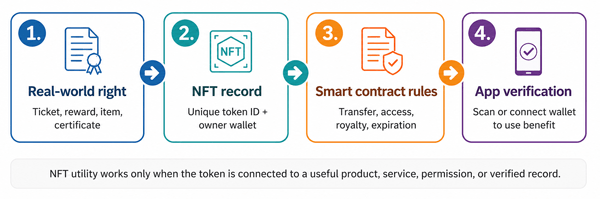
Diagram: How an NFT can connect a real-world right to blockchain ownership and app verification.
4. Why People Use NFTs Beyond Art
- Verifiable ownership: Anyone can check whether a wallet owns a specific token.
- Programmable rules: Smart contracts can define transfers, royalties, limits, or access permissions.
- Portability: A token can sometimes be used across marketplaces, wallets, communities, or apps.
- Scarcity and uniqueness: NFTs can represent limited tickets, seats, items, identities, or editions.
- Transparent history: Ownership and transfer history can be visible on public blockchains.
- Composability: Developers can build apps that read NFT ownership and unlock features automatically.
However, these benefits are not automatic. A badly designed NFT can be less convenient than a normal account, QR code, database entry, or PDF certificate. The NFT only helps when the blockchain record creates trust, portability, automation, or market access that a traditional system cannot easily provide.
5. Gaming and In-Game Items
Gaming is one of the most discussed NFT use cases because games already have scarce digital items: skins, weapons, cards, avatars, land, vehicles, badges and characters. In a traditional game, the publisher controls the database. You may spend money on an item, but you usually cannot freely sell it outside the game or move it to another game. NFT gaming tries to give players more control over certain digital assets.
5.1 Practical example
A strategy game might issue NFT cards. Players can earn, buy, sell, trade or rent those cards through approved marketplaces. The game app checks the player’s wallet and loads the cards they own. If the game supports crafting, two lower-level NFT cards might be burned or combined to create a rarer one.
5.2 Benefits
- Players can trade assets without relying entirely on a closed game store.
- Developers can create player-driven economies.
- Rare items can have transparent supply and history.
- Communities can build tools, marketplaces, and analytics around game assets.
5.3 Risks and limitations
- Speculation can turn the game into a financial product instead of entertainment.
- Expensive entry costs can discourage new players.
- Interoperability is often exaggerated; a sword from one game rarely works in another without custom development.
- If the game shuts down, the NFT may remain on-chain but lose most practical use.
6. Event Tickets and Access Passes
NFT ticketing uses tokens as event tickets. The ticket can be stored in a wallet, scanned at the venue, and transferred under rules set by the organizer. This can help reduce fake tickets, improve resale transparency, and create post-event collectibles or benefits.
6.1 Practical example
A music festival could issue NFT tickets that unlock entry, camping access, merchandise discounts, and a post-event video. The organizer can limit resale price, block transfers close to showtime, or collect a small resale fee. Fans can verify whether a ticket is real before buying it on a supported marketplace.
6.2 Where it works best
- High-demand concerts, festivals, sports events, conferences and fan experiences.
- Events with a resale problem or counterfeit ticket risk.
- Communities where the ticket also unlocks future benefits, recordings, loyalty points, or merchandise.
6.3 Where it can fail
- Users may not want to manage crypto wallets just to attend an event.
- Refunds, chargebacks, consumer protection and accessibility must be handled clearly.
- If the venue scanner or ticketing app fails, the blockchain record alone does not get people through the gate.
7. Memberships, Communities and Subscriptions
NFT memberships are tokens that unlock access to a group, service, event, discount, content library or recurring benefit. The token acts like a membership card that can sometimes be sold, transferred, gifted, or upgraded.
7.1 Practical example
A professional learning community could sell 1,000 membership NFTs. Token holders get access to private webinars, templates, networking events and job boards. If a member no longer needs access, they may sell the token to another person, depending on the rules.
7.2 Best uses
- Communities where membership scarcity matters.
- Clubs with ongoing events or perks.
- Educational programs with alumni benefits.
- Brands that want transferable VIP access without managing every transfer manually.
7.3 Important caution
A membership NFT is only as good as the organization behind it. If the team stops delivering benefits, the token may become useless. Buyers should read the terms carefully and avoid assuming that a token guarantees lifetime value unless that promise is legally and operationally clear.
8. Loyalty Programs and Brand Rewards
NFTs can be used as digital loyalty badges, collectible rewards, unlockable coupons, VIP passes, or proof of customer history. In theory, this can make rewards more engaging and portable than traditional points. In practice, many consumers prefer simple rewards that do not require wallet setup or crypto knowledge.
8.1 Practical example
A sneaker brand might issue NFTs to customers who buy limited-edition shoes. Holding the NFT could unlock early access to future drops, repair services, event invitations or authentication support. The NFT could also act as a digital collectible tied to the physical product.
8.2 Lessons from real-world experiments
Brand loyalty NFTs should not force users into complicated Web3 behavior. Starbucks Odyssey, a widely discussed NFT-based loyalty experiment, was shut down in 2024, which shows that even major brands can struggle if the experience is not simple, scalable, or strategically useful enough. The lesson is not that all NFT loyalty fails; it is that utility, ease of use, and customer value matter more than hype.
9. Digital Identity and Access Control
NFTs can represent a digital identity credential, access badge, role, or permission. For example, an NFT might prove that a wallet belongs to a verified community member, a conference attendee, a course graduate, or an approved contributor.
9.1 Practical example
A decentralized community could issue non-transferable NFTs, often called soulbound tokens, to verified contributors. The token could grant voting access, private forum permissions, or eligibility for grants. Because the token is non-transferable, it is harder to buy someone else’s reputation.
9.2 Benefits
- Portable proof of status across apps.
- Reduced need for repeated account creation.
- Automated access control based on wallet ownership.
- Potentially useful for DAOs, education, professional communities and online platforms.
9.3 Risks
- Privacy loss if a public wallet links many activities to one person.
- Permanent or hard-to-remove records can create reputational harm.
- Identity systems need recovery methods if a wallet is lost or compromised.
10. Education, Certificates and Professional Credentials
NFTs can be used for diplomas, course certificates, professional licenses, attendance badges or skill credentials. The main benefit is verification: an employer, school, or platform can check whether a credential is authentic without relying only on screenshots or PDFs.
10.1 Practical example
An online course provider issues a certificate NFT when a learner passes a final assessment. The NFT metadata includes the course title, issuer, date and credential ID. A hiring manager can verify the issuing wallet and the credential record instead of trusting an uploaded image.
10.2 Best practices for credential NFTs
- Use a trusted issuing wallet or institution name that is easy to verify.
- Avoid putting sensitive personal data directly on a public blockchain.
- Provide a revocation or correction process for mistakes.
- Make the credential useful even for people who do not understand crypto wallets.
11. Supply Chain, Product Authenticity and Physical Goods
NFTs can act as digital certificates linked to physical products. This is useful for luxury goods, collectibles, sneakers, watches, wine, pharmaceuticals, art objects, electronics, and high-value replacement parts. The NFT can record origin, ownership history, warranty status, repair records, or authenticity checks.
11.1 Practical example
A luxury watch brand issues an NFT certificate when a watch is sold. The owner can use the certificate to prove authenticity, transfer ownership, access warranty service, and view repair history. A buyer in the secondary market can check whether the NFT certificate matches the watch serial number.
11.2 Key limitation: the oracle problem
Blockchains can verify token history, but they cannot automatically know whether a physical item is genuine. Someone must connect the real-world item to the digital record. This is often called the oracle problem. Brands need secure packaging, serial numbers, NFC chips, tamper-resistant tags, inspections, or trusted custodians to reduce fraud.
12. Real Estate and Tokenized Real-World Assets
NFTs can represent property-related records, such as title documents, access rights, lease rights, property data, or fractional interests. This area is promising but legally complex. A token alone does not automatically replace land registries, courts, tax authorities, notaries or local property law.
12.1 Practical example
A property investment platform might tokenize shares in a rental property. Each token could represent a contractual claim to a portion of rental income. Another system might use NFTs to store title-related documents or transfer rights after legal checks are complete.
12.2 What beginners should understand
- A real estate NFT must be backed by enforceable legal agreements.
- Fractional ownership can trigger securities, tax and investment rules.
- Custody, compliance, valuation, and dispute resolution matter more than the token itself.
- Do not buy a property-related NFT without legal and financial advice.
13. Music, Media and Intellectual Property Rights
NFTs can be used for music access, fan clubs, limited media editions, royalty-sharing experiments, licensing records, or proof of ownership for digital rights. For creators, NFTs may create direct relationships with fans. For buyers, they can unlock content, events, community access or collectible status.
13.1 Practical example
A musician releases 500 NFT passes. Holders get early listening access, backstage livestreams, merchandise discounts and voting on setlist options. A separate licensing NFT might represent permission to use a sample in a limited commercial project, but that requires clear legal terms outside the token metadata.
13.2 Common misconception
Buying an NFT usually does not mean buying the copyright. Unless the terms clearly transfer copyright or a license, the buyer may only own the token and whatever limited benefits the issuer promises.
14. Healthcare Records and Patient Data Access
Healthcare NFTs are often discussed as a way to manage data access, consent, research participation, or medical record pointers. This is a sensitive area. Personal medical information should not be placed directly on public blockchains. A safer model is to store private data off-chain and use tokens or smart contracts to manage permissions, audit trails, or consent records.
14.1 Practical example
A patient could control a tokenized access permission that allows a research institution to view a specific anonymized dataset for a limited time. The actual medical file stays in a compliant database, while the blockchain records the permission event.
14.2 Risks
- Privacy violations if sensitive data is exposed.
- Compliance challenges under healthcare privacy laws.
- Wallet loss or poor recovery design can block access.
- Patients may not understand what they are consenting to.
15. Domain Names, Digital Land and Metaverse Assets
NFTs can represent blockchain domain names, virtual land, avatars, wearables, buildings, usernames, or digital spaces. These assets are useful when a platform or ecosystem recognizes them. For example, a blockchain domain may simplify wallet addresses, while digital land may provide a place to build games, events, shops or communities.
15.1 Practical example
A user buys a blockchain domain that points to their wallet address and profile. Instead of sharing a long wallet address, they share the domain name. In a virtual world, a brand might own digital land where customers can attend product launches or interactive events.
15.2 Risk
Digital land and metaverse assets can be highly speculative. Their value depends heavily on platform adoption, user activity, developer support and broader market sentiment.
16. NFTs vs Traditional Digital Records
| Feature | Traditional database or account | NFT-based system |
|---|---|---|
| Ownership record | Controlled by company or platform | Recorded in a wallet and blockchain smart contract |
| Transferability | Usually limited or prohibited | Can be programmable and marketplace-enabled |
| User experience | Usually simpler for mainstream users | Can be harder unless wallet is hidden or simplified |
| Transparency | Private unless company exposes data | Often publicly verifiable |
| Recovery | Password reset or customer support | Wallet recovery may be difficult without good design |
| Best fit | Simple accounts, points, internal records | Scarce assets, verifiable ownership, open marketplaces, cross-platform access |
17. Benefits of NFT Use Cases Beyond Art
- They can reduce fake tickets, fake certificates and counterfeit goods when paired with good verification systems.
- They can give users more control over digital items and memberships.
- They can create new resale and secondary market models.
- They can automate access to events, content, communities, games or software.
- They can help creators and brands build direct relationships with audiences.
- They can make ownership history more transparent.
18. Major Risks and Problems
18.1 Scams and phishing
NFT users are often targeted by fake mint pages, hacked social accounts, fake airdrops, malicious wallet approvals and impersonation scams. If a user signs a malicious transaction, assets can be stolen quickly. Beginners should use hardware wallets for valuable assets, verify URLs, avoid surprise links, and never share seed phrases.
18.2 Legal uncertainty
Some NFTs may be treated as collectibles, access products, licenses, securities, or something else depending on how they are sold and what they promise. Projects that promote profit expectations, revenue sharing, fractional ownership or investment-like returns may face additional legal obligations. Laws vary by country and can change.
18.3 Weak connection to real-world rights
The NFT must be connected to enforceable rights. If the terms say nothing about refunds, access, ownership, or transfer rules, the buyer may have little protection.
18.4 Platform dependency
Many NFTs depend on a website, game, API, marketplace, storage provider or issuer. If that system disappears, the token may still exist but lose its function.
18.5 Privacy
Public blockchains can reveal wallet activity. If a wallet is linked to a person, others may see purchases, memberships, transactions or credentials.
18.6 Environmental and cost concerns
Blockchain fees, network congestion and energy use vary by chain. Many newer chains and proof-of-stake systems are more efficient than older proof-of-work models, but users should still consider costs and sustainability claims carefully.
19. Beginner Checklist Before Buying or Using a Utility NFT
- Identify the actual utility. What does the NFT unlock today, not someday?
- Read the terms. Does the token transfer copyright, access, membership, revenue rights or only a collectible?
- Check the issuer. Is the brand, school, venue, game studio or platform real and verifiable?
- Check fees. Include mint price, gas, marketplace fees, royalties, transfer fees and withdrawal costs.
- Understand custody. Know how you will store the NFT and recover access if you lose a device.
- Avoid pressure. High urgency, guaranteed returns and secret links are warning signs.
- Verify smart contract and marketplace links from official sources only.
- Consider whether a normal account, QR code or certificate would work better. If yes, the NFT may be unnecessary.
- Use a separate wallet for risky mints and a hardware wallet for valuable assets.
- Do not spend money you cannot afford to lose. Utility NFTs can fail even when the idea is good.
20. Best Practices for Businesses Building NFT Utility
- Start with a real user problem, not a token. Ticket fraud, credential verification, limited access or product authenticity are stronger use cases than vague “community.”
- Hide complexity where possible. Users should not need to understand gas, seed phrases or block explorers to get basic value.
- Write clear terms. Explain what buyers own, what they do not own, refund rules, transfer rules, expiration and support policies.
- Plan for wallet recovery and customer service. Mainstream users expect help when something goes wrong.
- Protect privacy. Avoid putting personal information, health data or sensitive identity details on public chains.
- Use reliable storage. Important metadata and files should not disappear if one website goes offline.
- Design against speculation. Utility should be useful even if resale prices fall.
- Audit smart contracts and security processes before launch.
- Follow local laws on consumer protection, securities, taxes, data privacy, ticketing and advertising.
- Measure real engagement, not just mint volume or floor price.
21. When NFTs Are a Good Fit and When They Are Not
| NFTs may be useful when... | NFTs may be unnecessary when... |
|---|---|
| The asset is scarce, unique, or transferable | The record is only used inside one company database |
| Users need public verification | Private verification is enough |
| Secondary markets are expected and controlled | Resale would create legal or customer support problems |
| Ownership history matters | A simple receipt is enough |
| Multiple apps or communities need to recognize the asset | Only one platform will ever use it |
| The issuer can support the utility long term | The benefit depends on hype or future promises |
22. Common Mistakes Beginners Make
- Confusing the NFT with the underlying legal right.
- Assuming an NFT automatically includes copyright or commercial rights.
- Buying because of celebrity promotion instead of real utility.
- Ignoring gas fees and marketplace fees.
- Using the same wallet for risky experiments and valuable assets.
- Trusting screenshots instead of verifying the contract and issuer.
- Assuming “on-chain” means the project cannot fail.
- Forgetting that the issuer may stop providing access, perks or support.
23. Future of NFT Use Cases Beyond Art
The future of NFTs is likely to be less about expensive profile pictures and more about invisible infrastructure. The most practical NFT systems may not even use the word NFT in front of users. A fan may simply receive a secure digital ticket. A graduate may receive a verifiable credential. A gamer may trade an item. A customer may unlock VIP access. Under the hood, a token may handle ownership and verification.
The strongest long-term use cases are likely to be those where NFTs make something simpler, safer or more valuable: fraud-resistant tickets, portable game assets, trusted certificates, product authenticity, membership access, and regulated tokenization of real-world assets. The weakest use cases will continue to be projects that rely mainly on hype, artificial scarcity, or unclear future promises.
24. FAQs About NFT Use Cases Beyond Art
24.1 Are NFTs only for digital art?
No. NFTs can represent many unique digital records, including tickets, game items, memberships, certificates, loyalty rewards, product authenticity records, domain names, identity badges and property-related rights.
24.2 Can an NFT prove ownership of a physical item?
It can help, but only if the physical item is securely linked to the digital token. Brands often need serial numbers, NFC chips, tamper-proof tags, inspections or trusted custody to prevent fraud.
24.3 Do NFTs give copyright ownership?
Usually no. Buying an NFT normally gives ownership of the token, not automatic copyright. Copyright or commercial-use rights must be clearly granted in separate terms or license documents.
24.4 Are utility NFTs safe?
They can be useful, but they are not risk-free. Main risks include scams, wallet loss, smart contract bugs, project failure, unclear legal rights, privacy exposure and market volatility.
24.5 What is the best NFT use case for beginners to understand?
Event tickets are one of the easiest examples. Each ticket is unique, can be verified, may be transferred under rules, and can unlock entry or extra benefits.
24.6 Can NFTs be used without cryptocurrency knowledge?
Yes, if the app hides wallet complexity. Some systems let users sign in with email, pay by card, and hold tokens behind the scenes. This is often better for mainstream users.
24.7 Are NFT games the same as play-to-earn games?
Not always. NFT games may use tokens for items or ownership without promising income. Play-to-earn is a specific model that rewards players with tradable assets or tokens, and it can create sustainability problems if rewards depend mainly on new buyers.
24.8 Can NFTs be deleted?
The blockchain token record may be hard to remove, but the linked file, website, metadata, or app utility can disappear if storage and project support are weak.
24.9 Are NFTs legally recognized?
It depends on the country, asset type and legal structure. A token may be recognized as evidence of a right, but real estate, securities, tickets, identity, health data and intellectual property all have their own laws.
24.10 What should I check before buying a utility NFT?
Check the issuer, actual current utility, terms, smart contract, fees, wallet security, resale rules, refund policy, privacy risks and whether the benefit depends on future promises.
25. Conclusion
NFT use cases beyond art are real, but they are not magic. A token can make ownership, access, verification and transfer more transparent, but it cannot replace good product design, legal clarity, security, customer support or real demand. For beginners, the safest approach is to judge every NFT by its practical utility: What does it do now? Who recognizes it? What rights does it include? What happens if the platform fails?
The best NFT projects will feel useful even when market hype is low. They will make tickets harder to fake, credentials easier to verify, products easier to authenticate, memberships easier to manage, and digital items easier to own. The worst projects will sell vague promises. Learn the difference before you buy, build or recommend one.
Sources Consulted and Checked
These sources were consulted and checked while preparing this article to support accuracy and provide reliable background information.
- Ethereum.org, “ERC-721 Non-Fungible Token Standard,” updated June 18, 2026.
- EIP-721, “ERC-721: Non-Fungible Token Standard,” January 24, 2018.
- NIST Interagency Report 8472, “Non-Fungible Token Security,” 2024.
- FBI Internet Crime Complaint Center, “Cryptocurrency.”.
- SEC Commissioners Hester M. Peirce and Mark T. Uyeda, “Statement on Impact Theory, LLC,” August 28, 2023.
- Chainlink Education Hub, “What Are NFT Games?” updated August 12, 2025.
- Econsultancy, “Starbucks Odyssey: What the short-lived NFT beta tells us about loyalty schemes,” March 28, 2024.
Reader Advice
This article is provided for educational and informational purposes only and is not personalized legal, financial, investment, tax, cybersecurity, privacy, or other professional advice or a recommendation to buy, sell, build, or use any NFT. NFT projects, smart contracts, wallets, marketplaces, and tokenized rights can involve scams, technical failures, loss of access, market volatility, privacy concerns, and uncertain or changing legal treatment. Rules, policies, laws, fees, standards, and statistics may change over time and vary by country or region, so verify important details through current official sources and consult an appropriately qualified professional before making a significant decision. Never share a seed phrase, and do not commit money or assets you cannot afford to lose.