How NFTs Work: Complete Guide, Examples, Risks and Best Practices
NFTs became famous because of digital art sales, profile-picture collections, and blockchain games. But the real idea is broader: an NFT is a unique digital token recorded on a blockchain. It can represent ownership, access, membership, or proof of authenticity for something digital or physical.
This guide explains how NFTs work from the ground up. You will learn what is actually stored on the blockchain, what buyers really own, how minting and trading work, why prices can move so much, and how to avoid common mistakes.
1. Quick Answer: How Do NFTs Work?
An NFT works by creating a unique token on a blockchain through a smart contract. The blockchain records the token ID, owner wallet address, transfer history, and contract rules. The NFT usually points to metadata, such as a name, description, image, video, or game item details. When someone buys or transfers the NFT, their crypto wallet signs a transaction and the blockchain updates the ownership record.
2. Simple NFT Flow Diagram
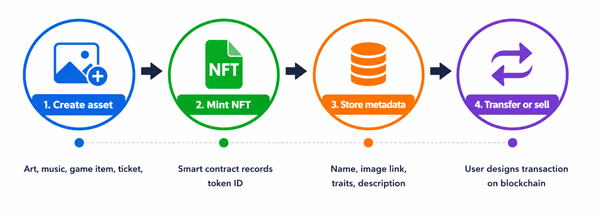
Diagram: A typical NFT starts as an asset, is minted by a smart contract, connects to metadata, and is transferred by wallet-signed blockchain transactions.
3. What Is an NFT?
NFT stands for non-fungible token. “Non-fungible” means unique or not directly interchangeable. One bitcoin can be swapped for another bitcoin, but one NFT may be different from another because it has a different token ID, artwork, traits, rights, or history.
An NFT is not simply “a JPEG.” The image, video, or file is usually the media connected to the token. The NFT itself is the blockchain record that identifies a specific token and its owner.
4. NFTs vs Cryptocurrency: What Is the Difference?
| Feature | NFT | Cryptocurrency Coin or Token |
|---|---|---|
| Interchangeability | Unique; each token can have different traits or meaning | Fungible; each unit is usually equal to another unit |
| Common use | Collectibles, art, game items, memberships, tickets, identity proofs | Payments, trading, staking, governance, network fees |
| Example | A specific digital collectible with token ID #1024 | 1 ETH, 1 BTC, 1 USDC |
| Value basis | Rarity, utility, community, creator, demand, rights, history | Market demand, network use, supply, liquidity, macro conditions |
5. The Main Parts of an NFT
| Part | What it means | Why it matters |
|---|---|---|
| Blockchain | The public ledger where the token exists. | Shows ownership and transfer history. |
| Smart contract | Code that creates and manages NFTs. | Defines minting, transfers, royalties, supply, and rules. |
| Token ID | A unique number inside the contract. | Distinguishes one NFT from another. |
| Wallet address | The owner’s blockchain account. | Controls the NFT if the private key is safe. |
| Metadata | Data such as name, description, image link, and traits. | Explains what the NFT represents. |
| Media file | The artwork, video, audio, 3D item, or other linked asset. | Often the visible thing people associate with the NFT. |
6. How NFTs Work Step by Step
6.1 A creator prepares the asset
The asset may be digital art, a song, an animation, a game item, a ticket design, a domain name, or a membership pass. The creator also decides the supply: one-of-one, limited edition, or a larger collection.
6.2 Metadata is created
Metadata describes the NFT. It can include the title, description, image URL, animation URL, collection attributes, rarity traits, and other information. Some metadata is stored directly on-chain, but many NFTs store metadata off-chain using services such as IPFS, Arweave, or centralized servers.
6.3 The NFT is minted
Minting means creating the token on a blockchain. A smart contract assigns a token ID and records the first owner. Minting usually requires a blockchain transaction and may require a network fee called gas.
6.4 The NFT appears in a wallet or marketplace
Once minted, the NFT can be viewed through a compatible wallet or marketplace. The marketplace reads blockchain data and metadata to display the image, traits, and ownership information.
6.5 The NFT can be transferred, sold, or used
The owner can transfer the NFT to another wallet, list it for sale, use it in an app, unlock a community, access an event, or hold it as a collectible. The exact use depends on the project and smart contract design.
6.6 The blockchain records the new owner
When the NFT is sold or transferred, the blockchain updates the owner address. The transaction history is usually public, which makes provenance easier to inspect, but it also means wallet activity is not fully private.
7. Common NFT Standards
NFT standards are shared rules that wallets, marketplaces, and apps use to recognize and transfer NFTs. On Ethereum and compatible chains, ERC-721 is commonly used for unique NFTs, while ERC-1155 can support multiple token types, including semi-fungible editions and game items. Other blockchains have their own standards and tooling.
8. What Do You Actually Own When You Buy an NFT?
This is one of the most important beginner questions. Buying an NFT usually gives you control of the token in your wallet, not automatic copyright ownership of the artwork. The rights depend on the project’s license, terms, and applicable law.
Some NFTs only give personal display rights. Others grant limited commercial rights. A few may include broader intellectual property permissions. Always read the official license before buying or using NFT artwork in a business.
| You may receive | You may not automatically receive |
|---|---|
| Control of the blockchain token | Copyright to the artwork or media |
| Ability to transfer or sell the NFT | Right to stop others from copying the image |
| Access to project utilities, if promised and delivered | Guaranteed profit or future value |
| Public ownership history linked to your wallet | Legal ownership of the underlying physical or digital asset unless clearly stated |
9. Practical Examples of NFTs
NFTs can be used in many ways. Some uses are speculative, while others focus on access, identity, ticketing, or in-game ownership.
| Use case | Example | How it works in practice |
|---|---|---|
| Digital art | A one-of-one illustration | The NFT identifies the edition and owner; the image may be stored on decentralized or centralized storage. |
| Collectibles | A 10,000-piece avatar collection | Each token has traits such as background, clothing, or rarity level. |
| Gaming | A sword, skin, character, or land parcel | A game can check wallet ownership and unlock the item in gameplay. |
| Music | Limited edition song NFT | Owners may get collectible access, bonus content, or community perks. |
| Tickets | Concert or sports ticket NFT | The token can verify entry and reduce some forms of ticket fraud if implemented well. |
| Membership | Private community pass | Holding the NFT can unlock Discord channels, events, discounts, or content. |
| Domain names | Blockchain-based name such as a wallet-readable domain | The NFT can represent control of a human-readable address. |
10. Benefits of NFTs
NFTs are not useful for every situation, but they can solve specific problems around digital ownership, portability, and verifiable provenance.
- Verifiable ownership: Anyone can usually check which wallet owns a token.
- Provenance: Transfer history can help track the origin and previous owners.
- Creator monetization: Creators can sell directly to collectors and may set royalty logic, although marketplace enforcement varies.
- Programmable access: NFTs can unlock content, games, memberships, or event entry.
- Interoperability potential: A token can sometimes be used across apps if standards and partnerships support it.
- Digital scarcity: A collection can have a known supply, though scarcity alone does not create value.
11. Risks and Limitations of NFTs
| Risk | What can go wrong | How to reduce the risk |
|---|---|---|
| Price volatility | NFT values can fall sharply or become illiquid. | Spend only what you can afford to lose; avoid buying based on hype. |
| Scams and phishing | Fake mint sites, malicious wallet approvals, and impersonators can steal assets. | Use official links, hardware wallets, and approval checkers. |
| Copyright confusion | A seller may not own the art or may grant limited rights only. | Check creator identity and license terms. |
| Metadata failure | If files are on weak centralized hosting, images or metadata may disappear. | Prefer projects using durable storage and clear metadata policies. |
| Wash trading | Fake volume can make a project look more popular than it is. | Look at unique buyers, holder distribution, and suspicious repeated trades. |
| Smart contract bugs | Code flaws can affect minting, transfers, or project funds. | Review audits, contract history, and team transparency. |
| Regulatory uncertainty | Some NFT offerings may raise securities, tax, consumer protection, or IP issues. | Avoid projects marketed mainly as investment contracts; seek professional advice for business use. |
| Liquidity risk | You may not find a buyer when you want to sell. | Check real bid depth, not just floor price. |
12. How to Evaluate an NFT Before Buying
A good NFT decision starts with research, not FOMO. Use this practical checklist before connecting your wallet or placing a bid.
- Confirm the official website and marketplace link from multiple trusted sources.
- Check the creator’s history, identity, previous projects, and community reputation.
- Read the license: personal use, commercial rights, royalty terms, and restrictions.
- Inspect supply, holder count, royalty settings, mint price, and distribution.
- Look for real engagement instead of bot-like social activity.
- Review trading history for wash-trading patterns or sudden unnatural volume.
- Understand utility claims and whether they are already working or only promised.
- Check where metadata and media are stored and whether they can be changed.
- Consider tax implications in your country before trading frequently.
- Never treat an NFT as guaranteed income.
13. How to Buy an NFT Safely: Beginner Process
13.1 Set up a wallet
Choose a reputable wallet that supports the NFT’s blockchain. Write down the recovery phrase offline and never share it.
13.2 Fund the wallet carefully
Buy only the cryptocurrency needed for the purchase and network fees. Start with a small amount while learning.
13.3 Use official links
Go to the marketplace or mint page from the project’s official website or verified social profile. Avoid links from DMs, ads, and random comments.
13.4 Review the transaction
Read wallet prompts carefully. Be cautious with “set approval for all” permissions because they may allow a contract to move assets from your wallet.
13.5 Store valuable NFTs more securely
Consider a hardware wallet or separate vault wallet for high-value NFTs. Keep a separate burner wallet for risky mints or experimental sites.
13.6 Keep records
Save transaction hashes, purchase prices, fees, project terms, and sale proceeds for accounting and tax reporting.
14. Common NFT Mistakes Beginners Make
- Buying because a celebrity promoted it without checking incentives.
- Assuming high floor price means there is real demand.
- Thinking the NFT automatically includes copyright ownership.
- Connecting a main wallet to unknown mint websites.
- Ignoring gas fees and marketplace fees.
- Buying copied art or fake collections.
- Not checking whether metadata can be changed after mint.
- Using the same wallet for everything.
15. Best Practices for NFT Buyers and Collectors
- Use a separate wallet for browsing and experimental mints.
- Bookmark official marketplaces and project websites.
- Verify contracts instead of relying only on collection names or images.
- Use a hardware wallet for valuable assets.
- Regularly revoke unnecessary token approvals.
- Avoid signing messages you do not understand.
- Research the team, license, roadmap, and past delivery.
- Focus on enjoyment, utility, or learning rather than guaranteed profit.
- Be skeptical of “risk-free,” “guaranteed floor,” or “passive income” promises.
- Keep screenshots and documents for purchases, taxes, and disputes.
16. NFT Pros and Cons
| Pros | Cons |
|---|---|
| Can prove token ownership on a public blockchain | Ownership does not always equal copyright or legal rights |
| Can support creator-to-collector sales | Markets can be highly speculative and illiquid |
| Can unlock digital access and membership | Scams, phishing, and wallet-draining attacks are common |
| Can make digital items portable across compatible apps | Many projects never deliver promised utility |
| Can show provenance and limited supply | Metadata and media storage can fail if poorly designed |
17. NFT Best Practices for Creators and Brands
- Be clear about what buyers receive and what they do not receive.
- Publish plain-English license terms before minting.
- Avoid marketing NFTs primarily as investments or guaranteed profit opportunities.
- Use reliable smart contracts and consider independent security review for high-value drops.
- Make metadata and storage choices transparent.
- Protect buyers from fake links by maintaining one official link hub.
- Plan customer support, refunds, community management, and legal compliance before launch.
- Avoid overpromising roadmaps that depend on uncertain future funding or hype.
18. Are NFTs Bad for the Environment?
The environmental impact depends on the blockchain. Older proof-of-work systems used far more energy. Many NFT ecosystems now run on proof-of-stake or lower-energy chains. Ethereum, one of the largest NFT platforms, moved from proof of work to proof of stake in 2022, which greatly reduced its energy use. Still, users should consider the network, storage, and broader project impact rather than assuming every NFT has the same footprint.
19. The Future of NFTs
The early NFT boom focused heavily on collectibles and speculation. The more durable uses may be less flashy: gaming assets, brand memberships, loyalty programs, ticketing, digital identity, certificates, licenses, and tokenized real-world assets. The technology is useful when a transferable, verifiable, programmable record adds value. It is not useful when a normal database, receipt, or account login would solve the problem more simply.
20. Key Takeaways
- An NFT is a unique blockchain token, not just the image attached to it.
- Minting creates the token and records it in a smart contract.
- Most NFTs store ownership on-chain but store media and metadata through linked storage.
- Buying an NFT usually gives token control, not automatic copyright ownership.
- NFTs can be useful for collectibles, games, tickets, memberships, domains, and access passes.
- The main risks are scams, volatility, copyright confusion, liquidity, metadata failure, and regulatory uncertainty.
- The safest approach is to research carefully, use secure wallets, verify official links, and avoid investment hype.
21. FAQs About How NFTs Work
21.1 What does NFT stand for?
NFT stands for non-fungible token. It is a unique digital token recorded on a blockchain.
21.2 Is an NFT the same as a JPEG?
No. The JPEG or media file may be connected to the NFT, but the NFT itself is the blockchain token and ownership record.
21.3 Can I copy an NFT image?
You may be able to copy an image visually, but that does not give you ownership of the token or legal rights to use the artwork commercially.
21.4 Do NFTs automatically include copyright?
Usually no. Copyright depends on the creator’s license and sale terms. Always read the license before using NFT media publicly or commercially.
21.5 Can NFTs lose value?
Yes. NFT prices can drop sharply, and some NFTs may become impossible to sell.
21.6 What is gas in NFTs?
Gas is the network fee paid to process blockchain transactions such as minting, buying, selling, or transferring NFTs.
21.7 What is minting an NFT?
Minting is the process of creating the NFT token on a blockchain through a smart contract.
21.8 Where is the NFT image stored?
It depends. Some projects use decentralized storage such as IPFS or Arweave, while others use centralized servers. Some store data directly on-chain, but that is usually more expensive.
21.9 Can an NFT be deleted?
The blockchain token may remain, but linked metadata or media can disappear if storage is poorly managed. Some contracts may also allow metadata changes.
21.10 Are NFTs legal?
NFTs are not automatically illegal, but legal issues can arise around copyright, securities law, taxes, consumer protection, gambling, and fraud. Rules vary by country and use case.
21.11 Should beginners buy NFTs?
Beginners should only buy after understanding wallets, fees, scams, rights, liquidity, and the possibility of total loss. Start small and treat the purchase as high risk.
21.12 What is the safest way to store NFTs?
Use a reputable wallet, protect your recovery phrase offline, consider a hardware wallet for valuable NFTs, and avoid connecting your main wallet to unknown websites.
Reader Advice
This article is provided for educational and informational purposes only. It is not personalized legal, financial, tax, investment, or cybersecurity advice, and it does not recommend any NFT, marketplace, wallet, project, or transaction. NFT prices can be highly volatile, liquidity may disappear, and scams, technical failures, loss of wallet access, and total financial loss are possible. Laws, regulations, tax rules, platform policies, technical standards, and market statistics can change over time and vary by country or region. Before acting, verify current information through official sources, review the applicable terms and licenses, assess the risks carefully, and seek advice from a qualified professional when appropriate.
Sources Consulted and Checked
The following sources were consulted and checked while preparing this document and reviewing its accuracy:
- Ethereum.org NFT and smart contract documentation
- OpenSea marketplace and user safety resources
- Chainalysis resources on crypto market manipulation and wash trading
- U.S. SEC materials and public actions related to digital assets and NFTs