Blockchain Gaming Explained: Meaning, How It Works, Examples, Benefits and Risks
Blockchain gaming is a type of video game that uses blockchain technology to record ownership of digital items, manage in-game economies, or let players trade assets outside a traditional game account. Instead of every item existing only inside a company-owned database, some items may be represented as tokens on a blockchain.
For beginners, the easiest way to understand blockchain gaming is this: a normal game lets you use items inside the game, while a blockchain game may let you own, transfer, sell, rent, or use some assets through a crypto wallet. These assets can include characters, skins, cards, land, weapons, badges, currencies, or collectibles.
The idea sounds simple, but the reality is mixed. Blockchain games can give players stronger digital ownership and new ways to participate in game economies. They can also expose players to crypto volatility, scams, poor game design, high fees, regulatory uncertainty, and projects that fail. This guide explains blockchain gaming in plain English so you can understand the opportunity without ignoring the risks.
| Quick Answer | Explanation |
|---|---|
| What is blockchain gaming? | Blockchain gaming means using blockchain, NFTs, crypto tokens, or smart contracts inside a video game so selected assets or transactions can be owned and verified on-chain. Not every game feature needs to be on a blockchain, and not every blockchain game is play-to-earn. |
1. What Is Blockchain Gaming?
Blockchain gaming, also called Web3 gaming, crypto gaming, NFT gaming, GameFi, or play-and-earn gaming, is gaming that uses blockchain infrastructure for at least part of the game experience. The blockchain may track ownership of in-game items, manage marketplace trades, distribute rewards, verify scarcity, or support community governance.
A blockchain is a shared digital ledger. In gaming, it can act like a public record that says which wallet owns a specific token or item. A smart contract is a program on the blockchain that can automatically enforce rules, such as minting an item, transferring it to a buyer, or paying a royalty fee.
| Term | Beginner-friendly meaning | Gaming example |
|---|---|---|
| Blockchain | A shared record of transactions that many computers verify. | Records that a wallet owns a sword, card, skin, or land item. |
| NFT | A unique digital token that can represent an item or collectible. | A rare character, trading card, avatar skin, or virtual land plot. |
| Fungible token | A token where each unit is interchangeable, like in-game currency. | A reward token used for crafting, upgrades, staking, or marketplace fees. |
| Wallet | A digital account used to hold crypto tokens and blockchain assets. | The place where a player keeps tradable game items. |
| Smart contract | Code that runs on a blockchain and follows preset rules. | A marketplace contract transfers an NFT from seller to buyer after payment. |
| Gas fee | A network fee paid for some blockchain transactions. | A fee paid when minting, trading, or moving an asset on certain chains. |
2. Blockchain Games vs Traditional Games
| Feature | Traditional game | Blockchain game |
|---|---|---|
| Asset ownership | Items usually exist inside the publisher’s servers and account system. | Some items may be tokens held in a player wallet. |
| Trading | Trading may be limited, banned, or controlled by the publisher. | Trading may happen through open or semi-open marketplaces. |
| Interoperability | Items usually work only in one game. | Some assets may work across apps, but this is still limited in practice. |
| Economy | Mostly designed as a closed in-game economy. | May include crypto tokens, NFTs, marketplace fees, and external speculation. |
| Player risk | Main risks are account bans, scams, and spending too much. | Adds wallet security, token volatility, smart contract risk, and regulatory uncertainty. |
| Developer control | Developer can change, remove, or rebalance most items easily. | On-chain assets may be harder to change once issued, depending on design. |
3. How Blockchain Gaming Works Step by Step
Not all blockchain games work the same way. Some are normal games with optional NFT cosmetics. Others are full crypto economies where players earn, trade, craft, stake, lend, or vote through tokens. A typical flow looks like this:
- The player creates an account. Some games require a crypto wallet immediately; others let beginners start with an email or social login and create a wallet later.
- The player receives, buys, earns, or crafts a digital asset. The asset may be a regular database item, an NFT, or a token that can be moved to a wallet.
- A smart contract handles important blockchain actions. This may include minting an NFT, transferring ownership, distributing rewards, or confirming a marketplace sale.
- The game reads the blockchain record. When the player logs in, the game can check the wallet and show the items the wallet owns.
- The player may use, trade, sell, or upgrade the asset. Depending on the game, items may be listed on a marketplace, rented to another player, burned for crafting, or used in gameplay.
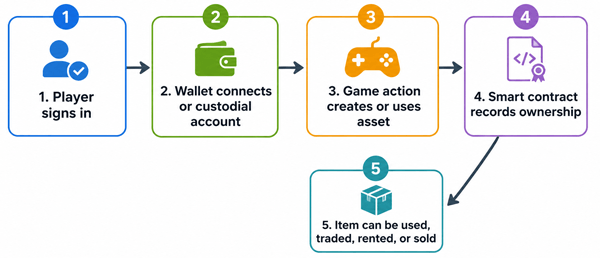
Diagram: A simplified blockchain gaming asset flow.
4. The Main Parts of a Blockchain Game
4.1 Game Client
This is the actual game you play on a browser, PC, console, or mobile device. Ideally, the game should be fun even before you think about tokens. If a game only feels interesting because of rewards or speculation, its economy may struggle when rewards fall.
4.2 Wallet and Account System
A wallet stores blockchain assets. Beginner-friendly games may hide this complexity using embedded or custodial wallets. Advanced players may use self-custody wallets where they control the private keys. Self-custody gives more control but also more responsibility: if you lose the seed phrase or sign a malicious transaction, recovery may be impossible.
4.3 NFTs for Unique Assets
NFTs can represent unique or limited game assets such as cards, characters, skins, weapons, land, pets, or membership passes. For example, Axie Infinity describes Axies as collectable and battle-ready creatures, while Gods Unchained presents a large collectible card game with digital cards and game modes. Sources: Axie Infinity official site and Gods Unchained official site.
4.4 Fungible Tokens for In-Game Economies
Some blockchain games use fungible tokens for rewards, crafting, governance, upgrades, marketplace fees, or staking. These tokens can behave like in-game currencies, but if they are traded openly on crypto markets, their prices can rise or fall sharply.
4.5 Smart Contracts
Smart contracts run the rules for on-chain actions. They can make ownership transparent, but they can also contain bugs. A smart contract audit can reduce risk, but it cannot guarantee safety.
4.6 Marketplace
Many blockchain games have official or third-party marketplaces where players can buy and sell assets. Marketplaces may charge fees. Some assets may become illiquid, meaning there are few or no buyers even if a listed price looks high.
5. Common Types of Blockchain Games
| Type | How it works | Common examples of assets | Main risk |
|---|---|---|---|
| Play-to-earn / play-and-earn | Players may earn tokens or assets through gameplay. | Reward tokens, NFTs, crafting materials. | Economies can collapse if rewards depend on constant new demand. |
| NFT collectible games | Players collect, upgrade, trade, or battle with tokenized items. | Cards, creatures, heroes, skins. | Speculative buying can overtake actual gameplay. |
| Metaverse / virtual world games | Players build, own, or trade virtual spaces and digital goods. | Land, avatars, wearables, buildings. | Land values can be highly volatile and utility may be unclear. |
| Strategy and card games | Blockchain is used for collectible cards, heroes, or tournament assets. | Cards, champions, decks, cosmetics. | Pay-to-win concerns and balance issues. |
| Move-to-earn / activity games | Real-world activity may generate token rewards. | Sneakers, badges, reward tokens. | Token inflation and sustainability problems. |
| On-chain games | Game logic is partly or mostly on-chain. | Units, maps, game state. | Technical limits, higher costs, and slower gameplay. |
6. Real-World Examples of Blockchain Gaming
The examples below are not recommendations to buy tokens or NFTs. They are useful because they show different ways blockchain can be used in games.
| Game / project | What it is | Blockchain gaming angle | Beginner takeaway |
|---|---|---|---|
| Axie Infinity | A creature-collecting and battling game built around Axies. | Uses NFTs and tokens in a player-owned economy. The official site describes Axies as creatures that can be battled, collected, and used in gameplay. | Shows the potential and risks of play-to-earn economies. |
| Gods Unchained | A digital trading card game. | Uses blockchain-backed cards and marketplaces, with many cards and competitive modes. | A practical example of NFT cards in a familiar game format. |
| The Sandbox | A virtual world and creator platform. | Uses virtual land and creator-made digital assets. | Shows how blockchain can support user-generated virtual economies. |
| Splinterlands | A collectible card battler. | Uses tradable cards and game-related tokens. | Highlights NFT cards, rentals, and community-driven game economies. |
| Alien Worlds | A blockchain game with mining, planets, NFTs, and missions. | Uses NFTs and tokens across a space-themed game economy. | Shows how activity-based token rewards can drive on-chain transactions. |
| Ubisoft Champions Tactics | A tactical PC game from a major traditional publisher. | Uses NFT champions and marketplace mechanics, according to press coverage. | Shows that major studios are experimenting, but player reception can be mixed. |
7. How Popular Is Blockchain Gaming?
Blockchain gaming activity changes quickly and should not be judged only by hype. DappRadar reported that blockchain gaming reached about 5.8 million daily unique active wallets in Q1 2025, dropped to 4.8 million in April 2025, was around 4.9 million in May 2025, and recorded about 4.66 million daily unique active wallets in Q3 2025. These figures measure wallet activity, not necessarily unique human players, because one person can use multiple wallets and bots may exist.
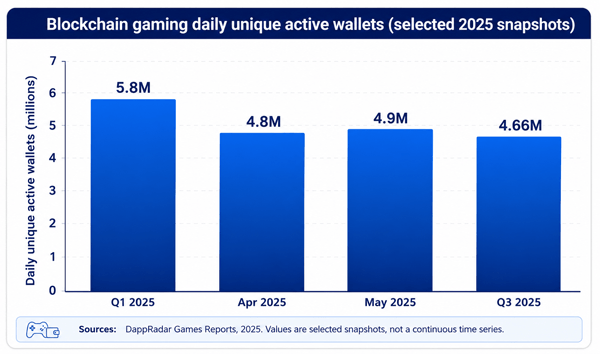
Chart: Selected 2025 DappRadar snapshots show that blockchain gaming activity was significant but uneven.
CoinGecko also tracks a GameFi category and defines GameFi as a combination of blockchain technology, gaming, and decentralized finance where players may earn crypto or NFT rewards. The category market value changes daily, so readers should check live market data before making any financial decision.
8. Benefits of Blockchain Gaming
8.1 For Players
- Stronger digital ownership: Some assets can be held in a wallet instead of only inside a company account.
- Open trading: Players may be able to sell or trade assets in approved marketplaces.
- Portability potential: In limited cases, assets may be used across connected apps or communities.
- Transparent scarcity: Players can sometimes verify how many copies of an item exist.
- New reward models: Some games reward players, creators, tournament winners, or community contributors.
8.2 For Developers and Publishers
- New monetization models through marketplace fees, primary sales, season passes, or creator economies.
- Community-driven growth when players become collectors, creators, guild members, or token holders.
- Programmable economies where assets can be crafted, burned, upgraded, rented, or governed by smart contracts.
- Stronger secondary markets, although these also bring speculation and regulatory concerns.
8.3 For Creators and Communities
- Creators may sell digital items directly to players.
- Communities may build guilds, marketplaces, tools, tournaments, or content around a game.
- Royalties can sometimes be programmed into marketplace systems, though enforcement depends on marketplace design and chain standards.
9. Risks and Limitations of Blockchain Gaming
Blockchain gaming is not automatically better than traditional gaming. It adds new possibilities, but it also adds financial and technical risks. Beginners should understand these risks before connecting a wallet or spending money.
| Risk | What can happen | How to reduce the risk |
|---|---|---|
| Token volatility | In-game tokens can lose value quickly, reducing rewards or asset prices. | Treat game tokens as risky crypto assets, not guaranteed income. |
| Scams and phishing | Fake sites, fake airdrops, fake support accounts, and malicious wallet approvals can steal assets. | Use official links, bookmark sites, never share seed phrases, and review transactions carefully. |
| Weak game economy | Reward systems can fail if token supply grows faster than real demand. | Look for sustainable sinks, good gameplay, active players, and transparent economic design. |
| Pay-to-win pressure | Players who spend more may gain unfair advantages. | Check whether paid assets affect competition or are mostly cosmetic. |
| Smart contract bugs | A contract exploit can drain funds or break marketplace logic. | Prefer audited projects, but remember audits do not remove all risk. |
| Illiquid assets | A rare item may have no real buyers when you want to sell. | Do not assume listed prices equal real market value. Check actual sales history. |
| Account and wallet loss | Lost seed phrases or hacked wallets may mean permanent loss. | Use hardware wallets for valuable assets and keep a separate gaming wallet. |
| Regulatory uncertainty | Tokens, rewards, gambling-like mechanics, or securities issues may draw regulatory attention. | Know your local rules and avoid games that promise investment returns. |
| Project failure | Games can shut down, lose users, or stop development. | Evaluate the team, roadmap, funding, game quality, and community health. |
| Environmental concerns | Some blockchains consume more energy than others. | Check whether the game uses a proof-of-stake or energy-efficient network. |
Regulatory and consumer-protection concerns are not theoretical. Reuters reported in 2024 that the U.S. Treasury encouraged regulators to consider guidance for NFTs because they can be vulnerable to fraud and money laundering. That does not mean every NFT game is unsafe, but it does mean beginners should be cautious and avoid treating NFT assets as risk-free collectibles.
10. Play-to-Earn, Play-and-Earn, and Play-and-Own: What Is the Difference?
| Model | Meaning | Best-case scenario | Common problem |
|---|---|---|---|
| Play-to-earn | Players focus on earning tokens or assets through gameplay. | Useful rewards for skilled or active players. | Can become unsustainable if earnings rely on new buyers. |
| Play-and-earn | The game is meant to be fun first, with optional rewards. | Rewards support engagement without becoming the whole reason to play. | Still depends on good economy design and real demand. |
| Play-and-own | Players own selected digital items, but income is not the main promise. | Better fit for cosmetics, collectibles, trading cards, and creator assets. | Ownership may be overstated if servers, licenses, or marketplaces can still disappear. |
A healthier blockchain game usually emphasizes gameplay first and financial rewards second. When marketing focuses mainly on income, token price, or future resale value, that is a red flag.
11. When Blockchain Makes Sense in Gaming
Blockchain is most useful when it solves a real problem that a normal game database does not solve well. It may make sense when players need verifiable ownership, open trading, community-created assets, transparent item supply, cross-platform identity, or programmable digital economies.
| Good use case | Why blockchain may help | Watch out for |
|---|---|---|
| Tradable collectibles | Players can verify scarcity and ownership. | Speculation, fake rarity, and unclear utility. |
| Digital card games | Cards can be owned and traded like physical cards. | Balance problems and high cost of competitive decks. |
| Creator economies | Artists and builders can sell assets directly. | Copyright issues and marketplace quality control. |
| Virtual land | Ownership records can be public and tradable. | Land bubbles and low real utility. |
| Tournament rewards | Prizes can be distributed transparently. | Legal issues around prizes, gambling, and eligibility. |
12. Common Misconceptions About Blockchain Gaming
| Misconception | Reality |
|---|---|
| “Blockchain games always let you earn money.” | Some games offer rewards, but earnings are never guaranteed and can fall to zero. |
| “NFT ownership means the item works forever.” | You may own the token, but the game server, art files, license terms, or utility can change or disappear. |
| “Rare means valuable.” | Value depends on demand, utility, community, liquidity, and trust, not rarity alone. |
| “A game is safe because it is on-chain.” | On-chain code can still have bugs, scams, bad economics, and poor user experience. |
| “All blockchain games are gambling.” | Not all are gambling, but some mechanics can resemble speculation, loot boxes, or betting. Legal classification depends on design and jurisdiction. |
| “No one can change anything on blockchain.” | Some contracts are upgradeable, marketplaces can change policies, and game servers can still control gameplay rules. |
13. How to Evaluate a Blockchain Game Before Playing
Use this practical review process before connecting your wallet or spending money:
- Play or watch the game first. Ask whether it looks fun without token rewards.
- Check whether the game is live, in beta, or only a promise. A trailer is not a playable product.
- Read the official documentation. Look for clear explanations of assets, tokens, fees, and risks.
- Review the team and investors, but do not rely on reputation alone.
- Check the economy. Are there real reasons to use tokens, or only reasons to sell them to new players?
- Look at actual marketplace sales, not just listing prices.
- Check wallet permissions before signing. Avoid unlimited approvals unless necessary and revoke unused approvals.
- Use a separate wallet with limited funds for gaming.
- Avoid games promising fixed returns, passive income, or guaranteed profit.
- Start free or with a small amount you can afford to lose.
14. Beginner Safety Checklist for Blockchain Gaming
- Use official websites only. Do not click random links from Discord, Telegram, X, YouTube comments, or direct messages.
- Never share your seed phrase or private key. Real support teams will not ask for it.
- Use a separate gaming wallet instead of your main crypto wallet.
- Start with free-to-play options where possible.
- Check gas fees before confirming transactions.
- Read what each wallet transaction says before signing.
- Be careful with “claim,” “airdrop,” “mint,” and “urgent whitelist” messages.
- Verify the contract address from official sources.
- Keep your device secure and avoid browser extensions you do not trust.
- Do not borrow money or use essential savings to buy game assets.
15. Practical Example: Buying an NFT Game Item Safely
Imagine you want to buy a blockchain trading card for a game. A careful process would look like this:
- You start at the official game website and follow the official marketplace link.
- You confirm the collection name and contract address from the game documentation.
- You check recent completed sales to see what buyers actually paid.
- You decide your maximum budget and include possible gas or marketplace fees.
- You connect a separate wallet that holds only the amount needed for the purchase.
- You read the wallet prompt and confirm that it is a purchase transaction, not a broad approval you do not understand.
- After buying, you disconnect from the site and consider revoking unused approvals.
- You treat the item as entertainment spending, not an investment guarantee.
16. Best Practices for Developers Building Blockchain Games
- Make the game fun before adding tokens. A weak game cannot usually be saved by NFTs.
- Use blockchain only where it creates real player value, such as ownership, trading, provenance, or creator economies.
- Avoid misleading earnings claims. Explain risks clearly.
- Design sustainable token sinks and avoid uncontrolled reward inflation.
- Keep onboarding simple. Beginners should not need deep crypto knowledge to play safely.
- Provide clear wallet safety education inside the product.
- Audit smart contracts and publish plain-English summaries of what they do.
- Protect competitive balance so spending does not ruin gameplay.
- Use energy-efficient networks and be transparent about environmental impact.
- Plan for asset utility if servers shut down, migrate, or change.
17. The Future of Blockchain Gaming
The future of blockchain gaming will likely depend less on hype and more on games that ordinary players actually enjoy. Early blockchain games often focused heavily on earning and speculation. Newer projects are increasingly trying to hide crypto complexity, improve gameplay, reduce fees, and use blockchain for ownership or marketplace features rather than making every action financial.
A realistic future may include optional NFT cosmetics, player-owned trading cards, creator marketplaces, cross-game identities, loyalty passes, esports rewards, and tokenized community economies. However, widespread adoption will require better security, clearer regulation, better user experience, lower costs, and stronger games.
18. Blockchain Gaming Pros and Cons Summary
| Pros | Cons |
|---|---|
| Potential for player-owned digital assets. | Crypto volatility can make game economies unstable. |
| Open or semi-open marketplaces for trading. | Scams, phishing, malicious links, and wallet-draining approvals. |
| Transparent scarcity and asset history. | NFT ownership does not guarantee game support forever. |
| New creator and community monetization models. | Speculation can overshadow gameplay. |
| Programmable rewards and tournament payments. | Regulatory uncertainty around tokens, rewards, and marketplaces. |
| Potential for interoperable identities or assets. | Interoperability is still limited and often overstated. |
19. FAQs About Blockchain Gaming
19.1 What is blockchain gaming in simple words?
Blockchain gaming is gaming that uses blockchain technology to record ownership, trade digital items, distribute rewards, or manage parts of a game economy. Some items may be NFTs or tokens held in a crypto wallet.
19.2 Is blockchain gaming the same as NFT gaming?
Not exactly. NFT gaming is a type of blockchain gaming that uses NFTs for items such as cards, characters, skins, land, or collectibles. Blockchain gaming can also use fungible tokens, smart contracts, or on-chain game logic without focusing only on NFTs.
19.3 Do I need crypto to play blockchain games?
Sometimes. Some games require a wallet and crypto from the start. Others offer free-to-play modes, custodial wallets, or credit card payments. Always check the game’s official onboarding process.
19.4 Can you really make money from blockchain games?
Some players have earned money, but it is not guaranteed. Rewards depend on token prices, demand, game rules, fees, time spent, and marketplace liquidity. Treat earnings claims with caution.
19.5 Are blockchain games safe?
They can be safe to play if designed well, but they carry extra risks such as wallet scams, token volatility, smart contract bugs, and malicious links. Use a separate wallet and never share your seed phrase.
19.6 What is play-to-earn?
Play-to-earn is a model where players may earn tokens or tradable assets through gameplay. The model can be exciting but risky if rewards rely on constant new users or rising token prices.
19.7 What is the difference between GameFi and blockchain gaming?
GameFi usually refers to games that combine gaming with crypto finance features such as earning, staking, lending, or token rewards. Blockchain gaming is broader and can include games that only use NFTs or ownership features.
19.8 Can NFT game items be used in different games?
Sometimes, but it is much less common than marketing suggests. Even if a token is portable, another game must choose to support its design, art, balance, and utility.
19.9 What happens if a blockchain game shuts down?
You may still hold the token or NFT, but its usefulness can disappear if the game servers, marketplace, art hosting, or community support vanish. Ownership of a token is not the same as guaranteed ongoing gameplay.
19.10 Should beginners buy blockchain game assets?
Beginners should start free or with very small amounts. Buy only if you understand the game, wallet risks, fees, asset utility, and the possibility that the item may lose most or all of its value.
20. Final Thoughts: Is Blockchain Gaming Worth It?
Blockchain gaming is worth understanding because it introduces a new way to think about digital ownership, in-game economies, and player participation. The best version of blockchain gaming gives players useful ownership, transparent markets, and fun games that stand on their own.
The worst version turns games into speculative markets where players are mainly encouraged to buy assets, chase rewards, and recruit new users. For beginners, the safest approach is simple: play for fun first, spend cautiously, use a separate wallet, verify every link, and never treat blockchain game assets as guaranteed investments.
Sources Consulted and Checked
The following sources were consulted and checked while preparing this article and reviewing its accuracy:
- DappRadar, State of Blockchain Gaming Q3 2025 - reported 4.66 million daily unique active wallets and other sector activity data.
- DappRadar, Gaming Hits 4.8M dUAW - Lowest of 2025 So Far - reported 4.8 million daily unique active wallets in April 2025 and category dominance context.
- DappRadar, Games Report May 2025 - reported around 4.9 million daily unique active wallets and market commentary.
- DappRadar Reports page - summarized 2024 overview and Q1 2025 context including 5.8 million daily unique active wallets.
- CoinGecko Gaming/GameFi category - live market category and definition of GameFi.
- Axie Infinity official website - description of Axies and gameplay concepts.
- Gods Unchained official website - description of the trading card game and game modes.
- Reuters, U.S. Treasury says regulators should consider NFT guidance given fraud risks, May 29, 2024.
- The Verge, Ubisoft Champions Tactics coverage, October 30, 2024.
Reader Advice
This article is provided for educational and informational purposes only and is not personalized financial, legal, investment, tax, or professional advice. Blockchain games, crypto tokens, NFTs, wallets, and related marketplaces can involve price volatility, scams, security failures, loss of access, project shutdowns, and the possible loss of some or all money spent. Rules, policies, laws, platform terms, and statistics can change over time and may vary by country or region, so please verify important information through current official sources and seek qualified professional guidance where appropriate before making a decision. Use only money you can afford to lose, protect your wallet credentials, and carefully review every transaction and platform before proceeding.