How to Buy and Sell NFTs: Step-by-Step Guide, Tips, Fees, Risks and Best Practices
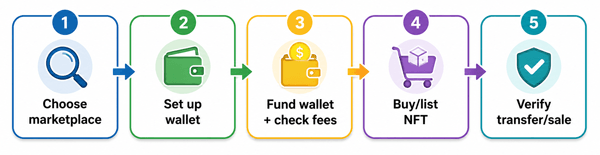
NFT buying and selling workflow: research first, transact carefully, then verify ownership or payout.
Buying and selling NFTs can feel confusing at first because it combines digital art, crypto wallets, blockchain transactions, marketplace fees, and online safety. The basic idea is simple: an NFT is a blockchain token that represents ownership or access to a unique digital item, such as artwork, music, a game asset, a membership pass, or a collectible. To buy or sell one, you usually need a compatible wallet, cryptocurrency for payment and fees, and a marketplace where the NFT is listed.
This guide explains the complete process in beginner-friendly language. It covers how to choose a marketplace, set up a wallet, buy your first NFT, list an NFT for sale, understand fees, avoid scams, price your item, and follow best practices.
1. Quick answer: how do you buy and sell NFTs?
- To buy an NFT, choose a reputable marketplace, connect a compatible wallet, fund it with the correct cryptocurrency, research the collection, review all fees, and confirm the purchase in your wallet.
- To sell an NFT, connect the wallet that owns the NFT, choose a sale method, set your price and duration, review platform fees, creator royalties, and network fees, then approve the listing or sale transaction.
- The most important beginner rule is to slow down. Verify the collection, website URL, wallet prompts, total cost, and resale restrictions before signing anything.
2. NFT basics beginners should understand first
2.1 What is an NFT?
NFT stands for non-fungible token. “Non-fungible” means it is not interchangeable in the same way one dollar is interchangeable with another dollar. Each NFT has a unique token ID or record on a blockchain. That record can point to, represent, or unlock a digital or physical asset.
Important: Owning an NFT does not automatically mean you own the copyright to the artwork, music, video, or brand behind it. In many cases, you own the token and the rights specifically granted by the creator or project terms. Always read the license or project rules before assuming you can commercially use the art.
2.2 How NFT ownership works
When you buy an NFT, the blockchain records that your wallet address owns that token. The marketplace helps you find and purchase it, but the ownership record lives on the blockchain. Your wallet is the tool that proves ownership and lets you approve transactions. If you lose wallet access or sign a malicious transaction, you may lose the NFT permanently.
2.3 Common types of NFTs
| NFT type | Example | Beginner note |
|---|---|---|
| Digital art | A 1-of-1 illustration or generative profile picture | Value often depends on artist reputation, rarity, community, and demand. |
| Collectibles | Trading-card style digital items | Scarcity matters, but hype can fade quickly. |
| Gaming assets | Skins, characters, weapons, land, or items | Check whether the game is live and whether the asset is usable. |
| Music and media | A limited music release or video collectible | Rights vary widely; buying the NFT may not include commercial rights. |
| Membership or access passes | A token that unlocks a community, event, or discount | The NFT is only useful if the promised access remains active. |
| Real-world linked NFTs | Tickets, certificates, or physical item redemption | Understand who handles delivery, redemption, and disputes. |
3. What you need before buying or selling NFTs
3.1 A marketplace
An NFT marketplace is a website or app where NFTs are listed, discovered, bought, and sold. Popular marketplaces differ by supported blockchains, categories, fees, wallet support, and safety tools. Examples include OpenSea, Magic Eden, Rarible, Foundation, Blur, Tensor, and blockchain-specific or game-specific marketplaces. Marketplace features and fees change, so always check the official fee page before you transact.
| Marketplace factor | What to check | Why it matters |
|---|---|---|
| Supported blockchain | Ethereum, Polygon, Solana, Bitcoin Ordinals, Base, Arbitrum, etc. | Your wallet and funds must match the chain. |
| Fees | Marketplace fee, gas/network fee, creator royalties, payment processing fee | Fees reduce profit and increase purchase cost. |
| Verification tools | Verified collection badge, contract address, reporting tools | Helps avoid fake collections and impersonators. |
| Liquidity | Recent sales, number of active buyers, floor price history | An NFT may be hard to resell if there are few buyers. |
| Wallet support | MetaMask, Phantom, Coinbase Wallet, Ledger, etc. | The marketplace must work with your wallet. |
| Asset category | Art, gaming, Ordinals, collectibles, membership NFTs | Some marketplaces are stronger in specific niches. |
3.2 A crypto wallet
A crypto wallet stores your private keys and lets you sign blockchain transactions. It does not hold NFTs like a normal file folder; instead, it controls the blockchain address that owns the NFTs. Common wallet choices include MetaMask for Ethereum-compatible networks and Phantom for Solana. Hardware wallets such as Ledger or Trezor can add extra protection for higher-value assets.
Never share your seed phrase or private key. A legitimate marketplace, support agent, artist, or buyer will never need it.
3.3 Cryptocurrency for payment and fees
Most NFT purchases use cryptocurrency such as ETH, SOL, MATIC, or another chain-specific token. You may also need extra funds for network gas fees. Some marketplaces support card payments or fiat on-ramps, but fees and availability vary by country and provider.
3.4 Basic security habits
- Use official marketplace URLs and bookmark them.
- Create a separate wallet for NFT trading instead of keeping all assets in one wallet.
- Use a hardware wallet for valuable NFTs.
- Read wallet prompts before signing; do not blindly approve permissions.
- Be suspicious of free mints, airdrops, urgent private messages, and “support” accounts.
4. How to buy NFTs step by step
4.1 Step 1: Choose the NFT and marketplace
Start with the marketplace that actually supports the collection you want. For example, Ethereum profile-picture collections may trade on OpenSea or Blur, Solana collectibles may trade on Magic Eden or Tensor, and game assets may trade on a game-specific marketplace. Search from the official project website or verified social channel rather than random links in messages.
4.2 Step 2: Set up a compatible wallet
Install a trusted wallet from the official website or app store. Write down the recovery phrase offline and store it safely. Do not save it in email, screenshots, cloud notes, or messaging apps. Add the correct blockchain network if needed.
4.3 Step 3: Fund your wallet
Buy the cryptocurrency needed for the NFT and network fees. Beginners often underestimate fees, so leave a buffer. For example, if an NFT costs 0.05 ETH, you may need additional ETH for gas and possibly marketplace charges depending on how the sale is structured.
4.4 Step 4: Research the NFT before buying
Check the collection contract, creator, ownership history, recent sales, rarity, metadata, utility claims, and community activity. Do not buy only because a celebrity, influencer, or anonymous account says the price will rise.
4.5 Step 5: Review the listing details
Confirm the NFT name, collection, token ID, chain, price, currency, creator royalty, and total cost. Watch for fake collections with similar images or names.
4.6 Step 6: Connect your wallet carefully
Click connect wallet only on the official marketplace. Your wallet will show the site requesting access. Connecting a wallet is not the same as giving full spending permission, but malicious sites may ask for dangerous approvals.
4.7 Step 7: Complete the purchase
Click Buy Now, place a bid, or make an offer depending on the marketplace. Your wallet will ask you to review and sign the transaction. Confirm only after checking the price, gas fee, and transaction type.
4.8 Step 8: Verify ownership
After confirmation, check your marketplace profile or wallet NFT tab. You can also verify the transaction on the relevant blockchain explorer. If it does not appear immediately, wait for the transaction to settle and confirm you are viewing the correct wallet and chain.
4.9 Buying methods: fixed price, auction, bid, and mint
| Method | How it works | Best for | Main risk |
|---|---|---|---|
| Fixed-price buy | You pay the listed price immediately. | Beginners who want simple purchases. | You may overpay if you do not compare recent sales. |
| Offer or bid | You propose a price and the owner may accept. | Trying to buy below the listed price. | Your offer may expire or be accepted when market conditions change. |
| Auction | Bidders compete until the auction ends. | Rare NFTs with active demand. | Emotion can push you above your budget. |
| Mint | You create/buy a new NFT directly from a project drop. | New launches and primary sales. | Higher scam risk if the mint site is fake or project is weak. |
5. How to sell NFTs step by step
5.1 Step 1: Confirm you own the NFT in your wallet
Open your wallet or marketplace profile and confirm the NFT is in the wallet you plan to use. If the NFT is on a different chain or wallet, you may need to switch networks or transfer it first.
5.2 Step 2: Choose where to list it
List where buyers for that collection actually shop. Check active listings, recent sale volume, floor price, and whether the marketplace supports your NFT standard. Some marketplaces aggregate listings from multiple platforms, but not all listings appear everywhere.
5.3 Step 3: Decide your selling method
You can list at a fixed price, run an auction, accept offers, or bundle multiple NFTs. Fixed-price listings are simplest. Auctions work best when there is enough buyer demand. Bundles can help sell related items but may limit buyer interest.
5.4 Step 4: Set a realistic price
Compare recent sales, not only current listings. The “floor price” is the lowest listed price, but it does not guarantee buyers are willing to pay that amount. For rare traits, compare NFTs with similar traits and actual sold prices.
5.5 Step 5: Review fees and royalties
Before listing, estimate marketplace fees, creator royalties, network gas fees, and possible tax impact. Some platforms charge no fee to list but charge when the NFT sells. Others may require gas to approve or cancel listings.
5.6 Step 6: Approve and list
Your wallet may ask you to approve the marketplace contract and sign the listing. Read the prompt carefully. Avoid unlimited approvals when a safer limited approval is available.
5.7 Step 7: Manage offers and buyer messages
Real offers usually appear inside the marketplace interface, not through private messages asking you to click a separate link. Be careful with “buyer” messages that pressure you to verify your wallet or use another site.
5.8 Step 8: Confirm the sale and payout
After the NFT sells, confirm the transaction and payment in your wallet or marketplace activity. Depending on the chain and marketplace, proceeds may arrive as ETH, WETH, SOL, USDC, or another token.
6. NFT fees explained
NFT costs are not limited to the sticker price. Fees can come from the blockchain, marketplace, creator royalty rules, payment providers, and currency conversion. Fee structures change often, so treat the numbers below as examples and verify current official fee pages before buying or selling.
| Fee type | Who usually pays? | What it means | Practical example |
|---|---|---|---|
| NFT price | Buyer | The listed or accepted sale price. | You buy an NFT for 0.08 ETH. |
| Network/gas fee | Buyer or seller, depending on action | Blockchain cost to process a transaction. | Buying, accepting an offer, cancelling a listing, or transferring an NFT may require gas. |
| Marketplace fee | Often seller, sometimes buyer or both | Platform commission for facilitating the sale. | OpenSea says it typically charges a 1% seller fee; Magic Eden says it takes 2% on transactions; Rarible describes protocol fees that may apply to buyers and sellers. |
| Creator royalty/earnings | Varies by platform and chain | Payment intended for the original creator on secondary sales. | Some marketplaces make royalties optional or collection-specific. |
| Payment/on-ramp fee | Buyer | Fee for card, bank, or third-party crypto purchase. | Buying crypto with a card may cost more than a bank transfer. |
| Currency conversion/spread | Buyer or seller | Difference between quoted and actual exchange price. | Converting fiat to crypto or crypto to fiat may include a spread. |
| Withdrawal fee | Seller | Cost to move crypto from wallet or exchange. | Withdrawing ETH or SOL to another platform may have network or exchange fees. |
Practical fee example: Suppose you buy an NFT for $100 equivalent. If the marketplace fee, royalties, gas, and crypto purchase fees add another $10 to $25, your true break-even resale price may be much higher than $100. Sellers should calculate net proceeds, not just listing price.
6.1 Marketplace fee examples to verify before trading
| Marketplace | Public fee example found during review | Beginner takeaway |
|---|---|---|
| OpenSea | OpenSea’s selling guide states it typically charges a 1% seller fee and notes gas, marketplace fees, and possible creator earnings. | Check the exact collection and transaction details before confirming. |
| Magic Eden | Magic Eden’s help page states listing fees are 0% and it takes 2% on transactions, with buyer options around creator royalties. | Good reminder that listing can be free while selling is not. |
| Rarible | Rarible’s help/protocol documentation describes service/protocol fees and notes that fee structures can vary by marketplace type. | Do not assume one universal fee across all Rarible-powered markets. |
7. How to price an NFT for sale
Pricing is one of the hardest parts of selling NFTs because most NFTs are illiquid. That means there may not be many active buyers at any given time. A listed price is only an asking price; recent accepted sales are usually more useful.
7.1 Useful pricing signals
- Recent sales of the same collection, especially within the last 24 hours, 7 days, and 30 days.
- Floor price, but only as a rough reference.
- Trait rarity and demand for similar traits.
- Creator reputation and long-term activity.
- Collection volume and number of unique buyers.
- Utility, game usage, membership access, or redemption rights.
- Overall crypto market conditions and NFT category trends.
7.2 Simple pricing formula for beginners
Estimated minimum sale price = your purchase price + buying fees + selling fees + desired profit margin + tax buffer. This formula does not guarantee a sale, but it helps you avoid accidentally listing below your real cost.
Example: You bought an NFT for $120 equivalent, paid $12 in combined fees, expect $5 in selling fees, and want a $20 profit. Your rough target sale price would be $157 before considering taxes and price volatility.
8. Risks of buying and selling NFTs
| Risk | What can go wrong | How to reduce it |
|---|---|---|
| Price volatility | NFT values can fall sharply or become unsellable. | Only spend money you can afford to lose; avoid hype-driven buys. |
| Low liquidity | There may be no buyer when you want to sell. | Check recent sales and buyer activity before buying. |
| Fake collections | Scammers copy art, names, and profiles. | Use verified links, contract addresses, and official project channels. |
| Phishing | Fake websites or messages trick you into signing approvals. | Bookmark official sites and read wallet prompts. |
| Malicious approvals | A bad approval can let attackers move assets. | Use a separate trading wallet and revoke old approvals periodically. |
| Copyright confusion | You may not own commercial rights to the artwork. | Read the project license before using the art publicly or commercially. |
| Broken utility promises | Promised games, perks, or memberships may never arrive. | Value existing delivery more than future promises. |
| Metadata/storage problems | Media links can break if files are poorly hosted. | Prefer projects with transparent storage such as IPFS/Arweave or robust hosting plans. |
| Tax complexity | Buying, selling, swapping, and earning NFTs can have tax consequences. | Keep records and consult a qualified tax professional in your jurisdiction. |
| Regulatory uncertainty | Some NFTs may be treated differently depending on structure and jurisdiction. | Avoid projects marketed mainly as profit promises or guaranteed returns. |
9. Common NFT scams and red flags
- Guaranteed returns or “risk-free” profit claims.
- Private messages from “support” asking you to verify, sync, or validate your wallet.
- Mint links shared in replies, Discord DMs, Telegram groups, or fake ads.
- Collections that copy popular artwork with slightly different names.
- A buyer who offers more than asking price but asks you to use a strange marketplace.
- Requests for your seed phrase, private key, QR code, or screen share.
- Airdropped NFTs that tell you to visit a website to claim a reward.
- Urgent countdowns designed to make you skip research.
- Founders, artists, or partners who cannot be verified outside the project’s own channels.
Investor education resources from financial regulators warn that digital asset scams often use social media, promises of guaranteed returns, and claims of little or no risk. Treat those promises as major red flags.
10. Best practices for buyers
- Start small and use your first transaction as a learning exercise.
- Research the collection contract, creator, official links, and recent sales.
- Compare total cost, not just listing price.
- Use a dedicated wallet for NFT trading and a hardware wallet for long-term storage.
- Avoid buying under pressure from influencers, friends, or community hype.
- Check whether the NFT gives any rights, access, or utility and whether those rights are written clearly.
- Take screenshots or export records of purchases, fees, and wallet activity for tax/accounting records.
11. Best practices for sellers and creators
- Price based on actual sales data, not only floor listings.
- Write clear descriptions and disclose what the buyer receives and does not receive.
- Use high-quality previews and accurate metadata.
- Avoid promising future profits or unrealistic utility.
- Understand platform fees, royalties, and gas before listing.
- Keep communication inside trusted marketplace or official channels.
- Maintain records of sale price, fees, royalties, dates, and wallet addresses.
- If you are minting your own NFTs, make sure you own or have permission to use the underlying media.
12. Beginner checklist before buying an NFT
| Check | Question to ask |
|---|---|
| Official source | Did I reach the listing from the official project website or verified profile? |
| Collection authenticity | Does the contract address match the official collection? |
| Total price | Do I understand the NFT price, gas, marketplace fee, royalties, and payment fees? |
| Liquidity | Are there recent real sales, not just many listings? |
| Rights and utility | What exactly do I receive by owning this NFT? |
| Wallet safety | Am I using the right wallet and reading the signing prompt? |
| Risk limit | Can I afford to lose this money if the NFT becomes worthless? |
13. Beginner checklist before selling an NFT
| Check | Question to ask |
|---|---|
| Ownership | Is the NFT in the wallet connected to the marketplace? |
| Marketplace fit | Is this where buyers for the collection are active? |
| Net proceeds | What will I receive after fees, royalties, and gas? |
| Pricing | Have I checked recent sales and similar traits? |
| Listing terms | Is this a fixed price, auction, bundle, or offer acceptance? |
| Approval safety | Does the wallet prompt match the action I intended? |
| Records | Have I saved transaction details for taxes and accounting? |
14. Pros and cons of buying and selling NFTs
| Potential benefits | Potential drawbacks |
|---|---|
| Easy access to digital art, collectibles, and blockchain-based assets. | Prices can be extremely volatile and speculative. |
| Creators can sell directly to global audiences. | Scams, phishing, fake collections, and malicious approvals are common. |
| Ownership and transaction history can be publicly verifiable. | Ownership of a token may not equal copyright ownership. |
| Some NFTs unlock communities, games, events, or memberships. | Utility may depend on a project continuing to operate. |
| Secondary sales can be fast when demand is strong. | Many NFTs have little or no resale liquidity. |
15. Practical example: buying an NFT safely
Imagine you want to buy a digital collectible listed for 0.10 ETH. Instead of clicking the first link you see on social media, you go to the project’s official website, follow its marketplace link, confirm the verified collection badge, compare recent sales, and check the token ID. You then make sure your wallet has enough ETH for both the NFT price and gas. Before signing, you read the wallet prompt and confirm it is a purchase transaction on the correct marketplace. After purchase, you verify the NFT appears in your wallet and save the transaction record.
16. Practical example: selling an NFT without mispricing it
Suppose you bought an NFT for $200 equivalent and paid $18 in fees. The current floor price is $250, but the last five actual sales were between $190 and $230. Listing at $250 may not sell quickly. You decide whether you want a fast sale near recent sales or a higher listing that may take longer. Before listing, you estimate marketplace fees, royalties, and gas so you know your likely net proceeds.
17. Mistakes beginners should avoid
- Buying because of hype without checking recent sales.
- Confusing floor price with guaranteed resale value.
- Using one wallet for everything.
- Signing wallet approvals without reading them.
- Assuming NFT ownership includes copyright or commercial rights.
- Ignoring gas fees and marketplace fees.
- Buying from lookalike collections.
- Trusting private messages from fake support accounts.
- Spending more than you can afford to lose.
18. FAQs about buying and selling NFTs
18.1 Do I need cryptocurrency to buy NFTs?
Usually yes, but some marketplaces support card payments or fiat on-ramps. Even then, the NFT is still usually settled on a blockchain, and fees may apply.
18.2 What is gas in NFT trading?
Gas is the network fee paid to process blockchain transactions. Gas can change based on network congestion and the chain you use.
18.3 Can I sell an NFT immediately after buying it?
Usually yes, if the marketplace and smart contract allow it. But you may lose money after fees, price changes, and low buyer demand.
18.4 Why did my NFT not sell?
Common reasons include high price, weak demand, low collection volume, poor visibility, or a market downturn.
18.5 Is minting the same as buying?
Minting creates or issues a new NFT from a project or creator. Buying usually means purchasing an NFT that already exists from another owner or marketplace listing.
18.6 Can NFTs be copied?
The image or media can often be copied, but the blockchain token ownership record cannot be duplicated in the same way. Still, copied artwork and fake collections are common problems.
18.7 Can I lose my NFT?
Yes. You can lose it by losing your wallet recovery phrase, sending it to the wrong address, signing a malicious transaction, or approving a scam contract.
18.8 Are NFTs a good investment?
NFTs are highly speculative. Some gain value, many lose value, and some become impossible to resell. Buy primarily because you understand and value the asset, not because profit is guaranteed.
18.9 Do NFT sellers pay taxes?
Tax rules vary by country. Sales, swaps, royalties, and crypto conversions may have tax consequences. Keep detailed records and consult a qualified professional.
18.10 What is the safest way to start?
Use a reputable marketplace, start with a small amount, use a dedicated wallet, avoid private links, and practice checking fees and transaction prompts before buying expensive NFTs.
19. Conclusion
Buying and selling NFTs is not difficult once you understand the workflow: choose a trustworthy marketplace, use a compatible wallet, fund it with the right token, research the asset, review fees, sign carefully, and verify the result. The hard part is judging value and staying safe. NFTs can be useful for art, collectibles, gaming, access, and creator communities, but they also carry serious risks including scams, low liquidity, broken promises, and price volatility.
For beginners, the best approach is slow and practical. Start small, learn how wallet transactions work, verify every link, calculate total costs, and never risk money you cannot afford to lose.
Sources Consulted and Checked
These sources were consulted and checked while preparing this document to support accuracy and reliability.
- OpenSea Learn: “How to Sell NFTs” - marketplace and gas fee explanation, including OpenSea seller-fee language.
- Magic Eden Help Center: “What Fees Will I Pay to List or Sell NFTs on Magic Eden?” - listing fee and transaction fee information.
- Rarible Help Center: “What are royalties and service fees on Rarible?”.
- Rarible Protocol Docs: “Fees structure” - protocol fee and origin fee definitions.
- CFTC Investor Advisory: “Watch Out for Fraudulent Digital Asset and Forex Websites” - fraud red flags including guaranteed returns and low/no-risk claims.
- SEC Investor.gov investor alerts page and SEC social media fraud alert - general investor fraud awareness.
Reader Advice
This article is provided for educational and informational purposes only and is not personalized financial, investment, legal, tax, or professional advice or a recommendation to buy, sell, mint, or hold any NFT or digital asset. NFT transactions can involve significant risks, including price volatility, scams, phishing, malicious wallet approvals, loss of access, limited resale demand, fees, tax consequences, and possible total loss of funds or assets. Rules, marketplace policies, laws, fees, and statistics can change over time and may vary by country, region, blockchain, platform, and transaction, so readers should verify current information through official sources and seek advice from appropriately qualified professionals before making decisions. Never risk money you cannot afford to lose, and carefully confirm websites, wallet prompts, contract addresses, ownership rights, total costs, and transaction details.